Metal extraction
Key Definitions
Metal ore – Rock containing enough of a metal to make extraction profitable.
Metal extraction – Removal of a metal from a rock using physical and/or chemical processes.
Alloy – Mixture of a metal with one or more other elements (metal or non-metal).
Mineral – Naturally occurring compound or mixture of compounds, or the native metal.
Rock – Mass of minerals found in the Earth’s crust.
Ore – Rock with a high enough concentration of minerals (metal compounds or rarely metals) to extract economically.
Extraction of Metals
Haematite (iron ore) contains iron(III) oxide, Fe₂O₃
Bauxite (aluminium ore) contains aluminium oxide, Al₂O₃
Steps to extract a metal from its ore:
Mining and collecting the ore from the ground
Mining is removing ores from the Earth’s crust
Environmental problems: habitat destruction, soil erosion, water pollution, dust and noise
Extraction of the metal from the ore
Extracting a metal usually involves chemical or thermal decomposition to release the metal
Environmental problems: high energy use, greenhouse gas emissions, chemical waste
Advantages of mining and mineral extraction:
Provides raw materials for industry and construction
Creates jobs and economic growth
Allows production of metals for technology and infrastructure
Disadvantages of mining and mineral extraction:
Causes environmental damage (land and water pollution)
Can displace communities and wildlife
High energy consumption and CO₂ emissions
Extracting Metals from the Ores
Most metals naturally occur in rocks as compounds of oxygen or sulfur.
The more reactive the metal, the more tightly it is bonded to other elements in the ore and the harder it is to separate.
Extraction usually involves reduction of metal oxides.
Unreactive metals are found as native elements and do not require chemical separation (e.g., gold).
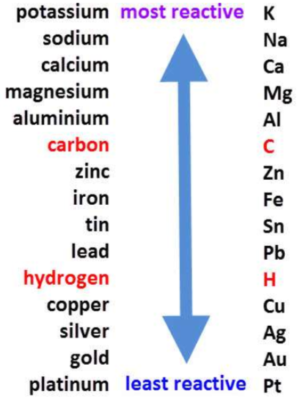
The method used to extract a metal depends on its position in the reactivity series.
Questions:
Could carbon be used to extract iron from haematite?
Yes, carbon can reduce iron(III) oxide.
Reaction: Fe₂O₃ + 3C → 2Fe + 3CO
Could carbon be used to extract aluminium from bauxite?
No, aluminium is too reactive to be reduced by carbon.
Alternative: electrolysis of molten aluminium oxide using cryolite.
Linking Reactivity of the Metal with Method of Extraction
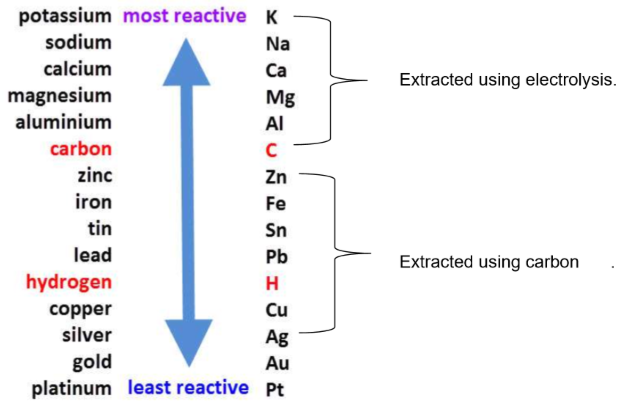
Metals above carbon in the reactivity series are extracted using electrolysis.
Metals below carbon are extracted by heating with carbon.
Advantages and Disadvantages:
Electrolysis
Energy requirements: Very high, requires a lot of electricity
Purity of product: High, produces very pure metal
Impact on environment: High energy use → CO₂ emissions if electricity is from fossil fuels
Heating with Carbon
Energy requirements: Lower than electrolysis
Purity of product: Lower, may contain impurities
Impact on environment: Produces CO/CO₂ → contributes to air pollution and greenhouse gases
Extraction of Metals and Recycling
Metals higher than carbon in the reactivity series (e.g., Groups 1 & 2 and aluminium) are extracted by electrolysis. This requires a lot of energy and is expensive.
Less reactive metals such as copper, lead, iron, and zinc occur as oxides or sulfides. Since these metals are less reactive than carbon, their ores are heated with charcoal. Carbon reduces the metal oxide to carbon dioxide and leaves the pure metal:
Metal oxide + carbon → metal + carbon dioxide
These metals have been known for thousands of years.
The cost of a metal depends on the abundance of the ore and the cost of extraction (including purification if needed).
Copper is costly due to purification by electrolysis.
Gold is expensive because it is rare, though it requires little processing as it occurs natively.
Recycling of Metals – Benefits:
Saves raw materials and reduces mining.
Reduces energy consumption compared with extracting from ores.
Minimizes environmental impact (less habitat destruction and pollution).
Reduces waste in landfills.
Problems with Recycling:
Metals can be mixed or contaminated, requiring separation.
Collection and transport can be expensive and energy-consuming.
Not all metals can be recycled indefinitely without losing quality.
Some metals are difficult to recover from complex products.
Displacement of Metals from Their Oxides
1. Displacement of metals from hot oxides by a more reactive metal
Heating zinc powder with metal oxides.
Safety: Wear goggles and lab coat, tie hair back. Follow teacher’s instructions.
Metals can be extracted by reacting the compound with a more reactive metal; less used industrially due to demand for reactive metals.
Method:
Place half a spatula of zinc powder on scrap paper.
Add half a spatula of metal oxide and mix.
Transfer mixture to a metal cap.
Heat strongly with a roaring flame until changes occur.
Let cool.
Tip mixture onto scrap paper to look for iron, lead, and copper. Use a magnet for iron detection.
Results:
Mixture | Observations |
|---|---|
Zn + Fe₂O₃ (grey + rust-brown) | Fe forms, Zn remains |
Zn + PbO (grey + orange) | Pb forms, Zn remains |
Zn + CuO (grey + black) | Cu forms, Zn remains |
Conclusion:
The metals compete for oxygen.
The more reactive metal removes the less reactive metal from its oxide.
This is a displacement reaction and also a redox reaction.
Balanced Chemical Equations and Redox:
Zn + Fe₂O₃ → 3ZnO + 2Fe
Zn is oxidised, Fe³⁺ is reduced
Zn + PbO → ZnO + Pb
Zn is oxidised, Pb²⁺ is reduced
Zn + CuO → ZnO + Cu
Zn is oxidised, Cu²⁺ is reduced
More reactive metal is oxidised.
Cation of least reactive metal is reduced.
Word Equations:
Magnesium + zinc oxide → magnesium oxide + zinc
Copper + iron(III) oxide → no reaction (copper less reactive than iron)
Lithium + copper(II) oxide → lithium oxide + copper
Thermit(e) Reaction
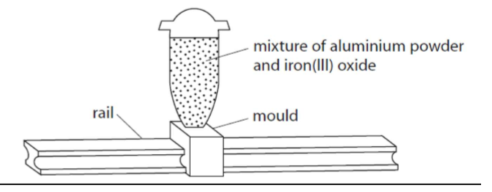
The reaction between aluminium and iron(III) oxide is a metal displacement reaction: more reactive aluminium displaces less reactive iron from its oxide.
Equation: Fe₂O₃ + 2Al → 2Fe + Al₂O₃
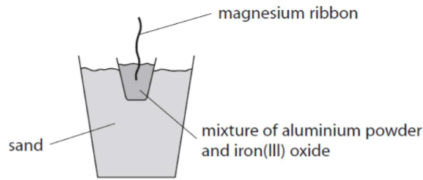
The reaction is ignited using magnesium ribbon.
The diagram below shoes how this thermit reaction can be carried out.
This reaction is extremely exothermic.
Temperature exceeds the melting point of iron, and the iron produced is molten.
Use: Joining railway tracks – molten iron flows into the gap between rails and solidifies, welding them together.
Advantage: Can be done in remote areas without electricity.
The reaction mixture is ignited and molten iron pours into the mould. The mould is removed and molten iron solidifies to create a join between the two rails.
Displacement of Metals from Hot Oxides by Carbon
Safety: Wear goggles and lab coat, tie hair back, follow teacher’s instructions.
Method:
Mix 1 spatula of carbon powder with 1 spatula of copper(II) oxide on scrap paper, transfer to a test-tube.
Heat in a roaring Bunsen flame for 5 minutes using a test-tube holder.
Let cool, tip mixture onto scrap paper, check for copper.
Repeat with lead(II) oxide and iron(III) oxide.
Results:
Metal oxide | Colour before heating | Appearance after heating with carbon |
|---|---|---|
Iron(III) oxide | Reddish-brown | Grey / metallic iron formed |
Lead(II) oxide | Orange | Grey / metallic lead formed |
Copper(II) oxide | Black | Reddish-brown / metallic copper formed |
Removing oxygen from a substance is called reduction.
Carbon acts as a reducing agent.
Metals obtained this way: zinc, iron, lead, copper.
Metals whose oxides are easily reduced by carbon are less reactive than metals whose oxides do not react.
Equations and Redox:
Fe₂O₃ + 3C → 2Fe + 3CO
C is oxidised, Fe³⁺ is reduced
PbO + C → Pb + CO
C is oxidised, Pb²⁺ is reduced
CuO + C → Cu + CO
C is oxidised, Cu²⁺ is reduced
Extraction of Aluminium
Aluminium makes up 7.5% of the Earth’s crust.
Ore: bauxite
Mineral in bauxite: aluminium oxide, Al₂O₃. Oxygen must be removed to release aluminium.
Aluminium is more reactive than carbon, so it cannot be extracted by carbon reduction.
Aluminium is extracted by electrolysis.
Aluminium oxide is a poor conductor with a high melting point (2015°C).
Cryolite (Na₃AlF₆) is added to dissolve Al₂O₃ and lower melting point to ~1000°C.
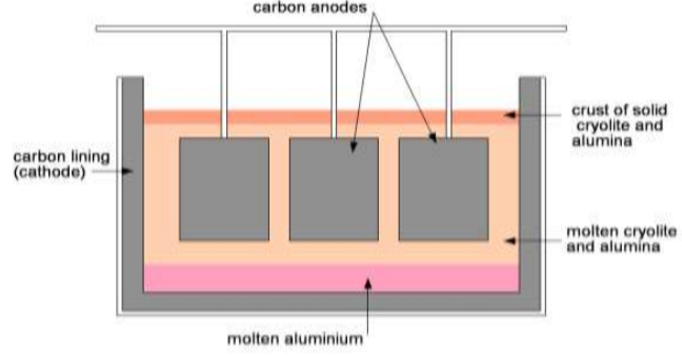
Electrolyte: molten mixture of aluminium oxide and cryolite at 1000°C.
Electrodes: carbon/graphite
Cathode (-): aluminium forms
Anode (+): oxygen forms
Oxygen reacts with carbon anodes → carbon dioxide, so anodes must be replaced regularly
Major costs: electricity and anode replacement
Uses of Metals – Alloys
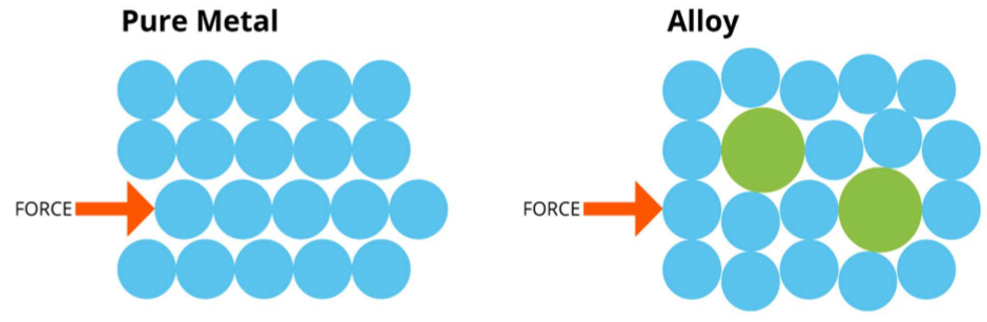
Pure metals (e.g., iron) are soft because layers of atoms slide easily.
Alloy: mixture of two or more elements, at least one metal.
Atoms of different sizes distort layers → harder and stronger than pure metal.
Examples:
Brass: 70% copper, 30% zinc → harder, used in electrical fittings
18 carat gold: 75% gold, 25% copper/other metals → harder, cheaper, used in jewellery
Duralumin: 96% aluminium, 4% copper/other metals → low density, stronger, used in aircraft manufacture
Uses of Metals and Alloys
Metal / Alloy | Uses | Properties that make it suitable |
|---|---|---|
Aluminium | Overhead electricity cables | Low density, good conductor of electricity |
Manufacture of aeroplanes | Lightweight and strong | |
Saucepans, cooking foil | Resistant to corrosion, lightweight | |
Copper | Electrical wiring | Excellent conductor of electricity, malleable |
Domestic hot water pipes | Corrosion-resistant, ductile | |
Iron | Construction of bridges | Strong and durable |
Low carbon steel (0.25% C) | Car body panels | Malleable, can be shaped easily |
High carbon steel (2.5% C) | Hard cutting tools | Very hard and strong |
Stainless steel (with Ni and Cr) | Cutlery and sinks |