The Yellow Wallpaper Quote Notation
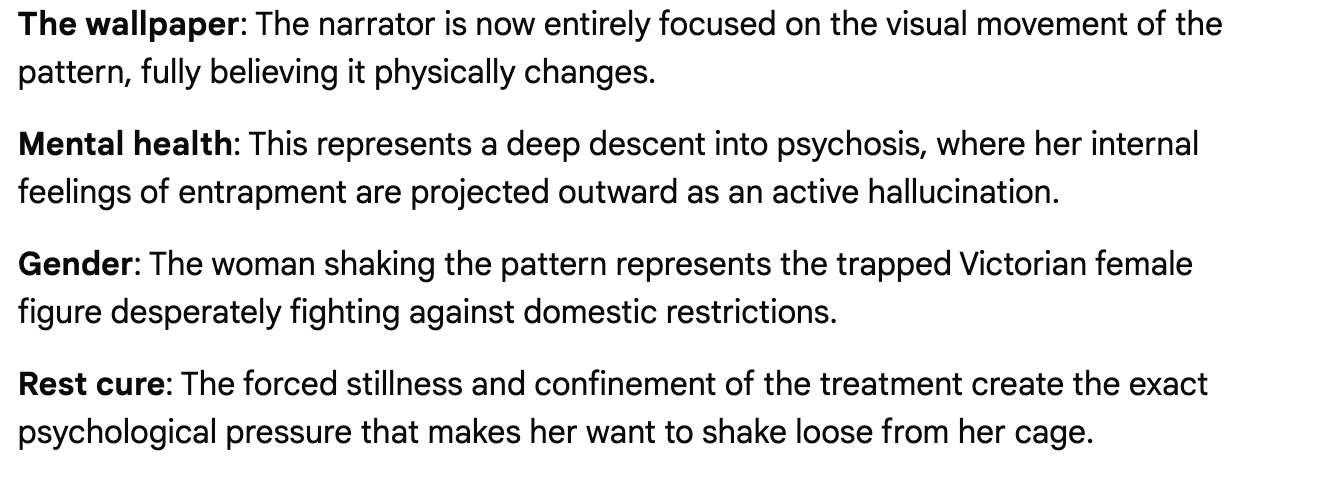
“I’ve got out at last… in spite of you and Jane. And I’ve pulled off most of the paper, so you can’t put me back!”
Context of production and reception: Controversial in 1892 (seen as too horrifying); now celebrated as triumphant feminist resistance or tragic defeat.
Genre Expectations: Gothic/psychological horror climax — ambiguous resolution (madness as liberation?).
Style/Stylistic Choices: Short, triumphant, fragmented sentences; shocking final image of creeping over the fainted husband.
Characterisation and Setting: Narrator fully identifies with the wallpaper woman; John reduced to fainting patriarch.
Narrative POV: Complete loss of reliable narration — her “victory” is also her total breakdown.
Language patterns: Repetition and exclamation for defiance; circular creeping motif completes the pattern.
Readings: Feminist (madness as rebellion against patriarchy), Ambiguous (is it liberation or destruction?), Psychoanalytic (return of the repressed).
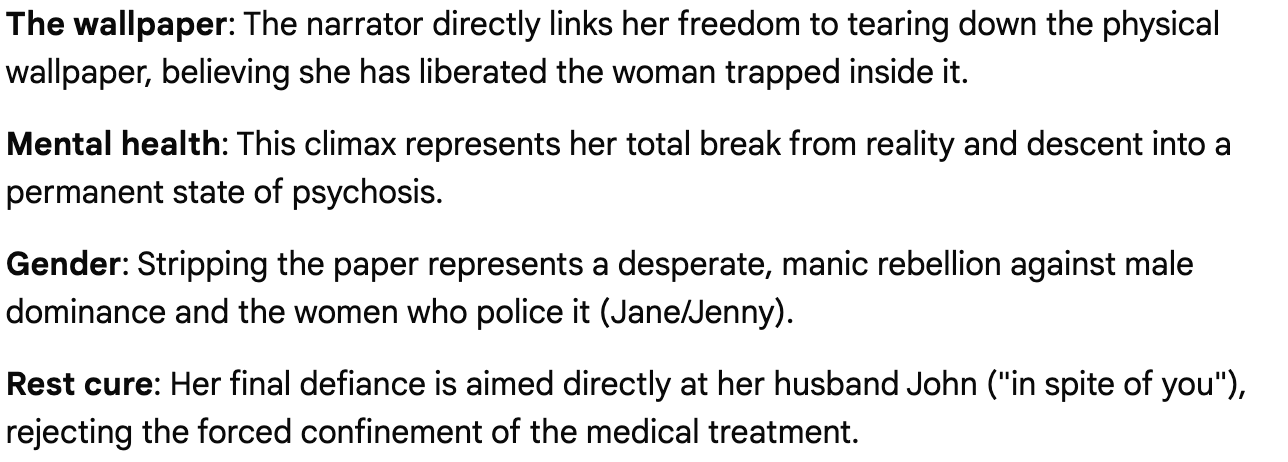
“If a physician of high standing, and one’s own husband, assures friends and relatives that there is really nothing the matter with one but temporary nervous depression—a slight hysterical tendency—what is one to do?”
Context of production and reception: Written in 1892 after Gilman herself suffered the “rest cure” prescribed by Dr Silas Weir Mitchell; published amid growing debates on women’s mental health and the women’s suffrage movement. Initially shocking; later hailed as a feminist classic.
Genre Expectations (form and subject matter): Gothic short story / psychological horror — domestic setting becomes a site of terror; critiques medical “cure” for women.
Style/Stylistic Choices: Conversational, diary-like tone creates intimacy and growing unease; highlights irony and powerlessness.
Characterisation and Setting: Establishes the narrator as intelligent but dismissed; John as rational patriarchal authority; isolated ancestral mansion as prison.
Narrative POV: First-person unreliable narrator — we see her gradual loss of agency through her own words.
Language patterns: Rhetorical question, long formal sentence contrasting with her helplessness; repetition of male authority (“physician… husband”).
Readings: Feminist (patriarchal control of women’s bodies/minds), Marxist (class and gender oppression), Psychoanalytic (repression leading to breakdown).
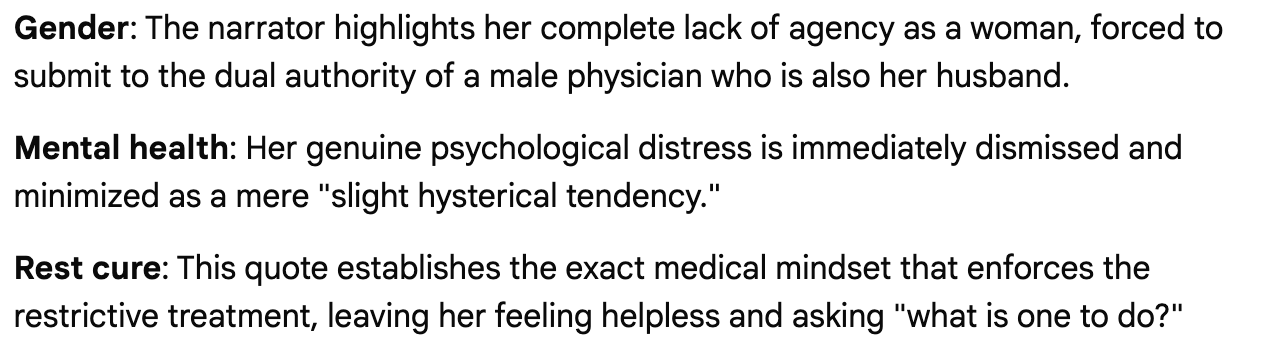
“It becomes bars! The outside pattern, I mean, and the woman behind it as plain as can be.”
Context of production and reception: Written 1892 during the women’s rights movement; Gilman criticises the rest cure that trapped women in domestic roles.
Genre Expectations (form and subject matter): Gothic short story – ordinary domestic object turns into a symbol of imprisonment and horror.
Style/Stylistic Choices: Sudden realisation creates growing horror and claustrophobia; draws reader into the narrator’s obsession.
Characterisation and Setting: The barred nursery room symbolises women’s confinement; the woman behind the pattern represents the narrator’s trapped self.
Narrative POV: First-person diary shows her mind deteriorating as she projects herself onto the wallpaper.
Language patterns: Metaphor (“becomes bars”), sudden exclamation, clear visual imagery of prison bars and the trapped woman.
Readings: Feminist (symbol of patriarchal imprisonment), Psychoanalytic (the repressed self breaking through), Gothic (domestic space as prison).
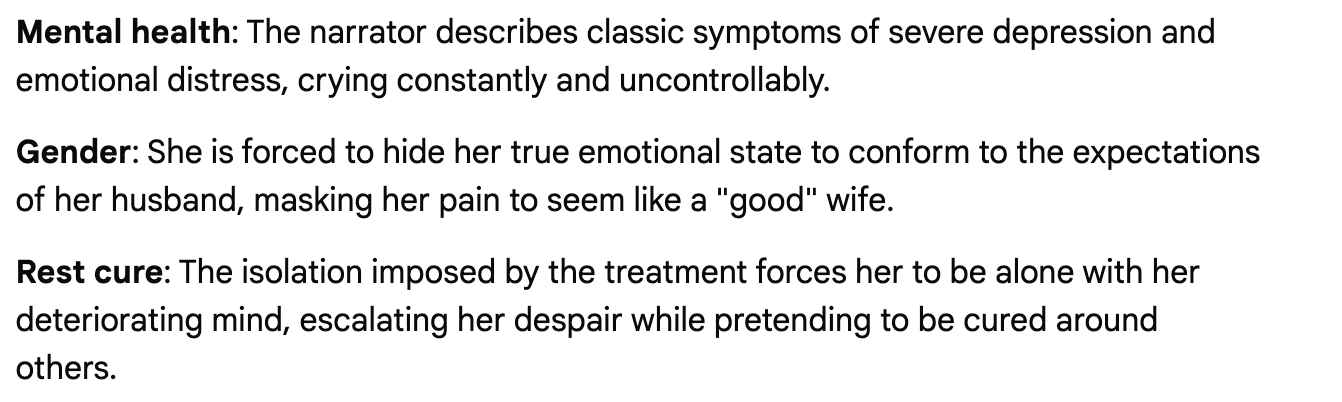
“I cry at nothing and cry most of the time. Of course I don't when John is here, or anybody else, but when I am alone.”
Context of production and reception: Reflects 19th-century dismissal of women’s emotions as “hysteria” and the isolation caused by the rest cure.
Genre Expectations: Psychological descent – reveals emotional suppression and loneliness.
Style/Stylistic Choices: Honest, confessional tone creates sympathy and highlights the gap between public and private self.
Characterisation and Setting: Narrator as emotionally fragile and isolated; John’s presence forces her to perform “normality”.
Narrative POV: First-person unreliability – we see her true feelings only when alone.
Language patterns: Repetition of “cry”, contrast between public restraint and private breakdown, simple and fragmented sentences.
Readings: Feminist (emotional repression under patriarchy), Psychoanalytic (repressed feelings returning), Reader-response (builds pity and frustration).
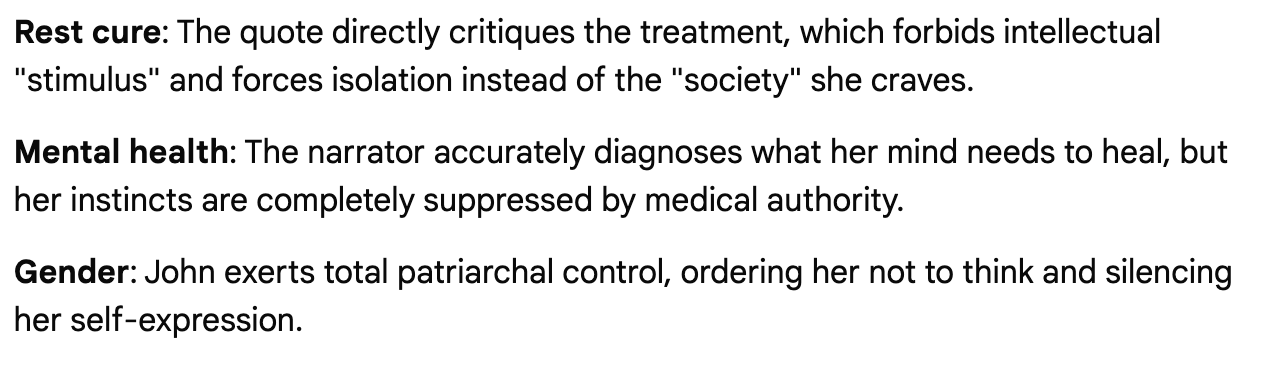
“I sometimes fancy that in my condition if I had less opposition and more society and stimulus - but John says the very worst thing I can do is to think about my condition.”
Context of production and reception: Direct attack on the rest cure (no intellectual activity allowed), which Gilman experienced and later called “nearly ruined my life”.
Genre Expectations: Critique of medical patriarchy within a Gothic framework.
Style/Stylistic Choices: Interrupted thought shows mental conflict and growing frustration.
Characterisation and Setting: John as controlling husband/doctor who infantilises her; narrator’s intelligence is suppressed.
Narrative POV: Diary form reveals her insight while showing how it is immediately dismissed.
Language patterns: Dash creates broken, hesitant flow; contrast between her “fancy” and John’s authority; ironic repetition of “my condition”.
Readings: Feminist (male control of female thought), Marxist (oppression through “care”), Autobiographical.
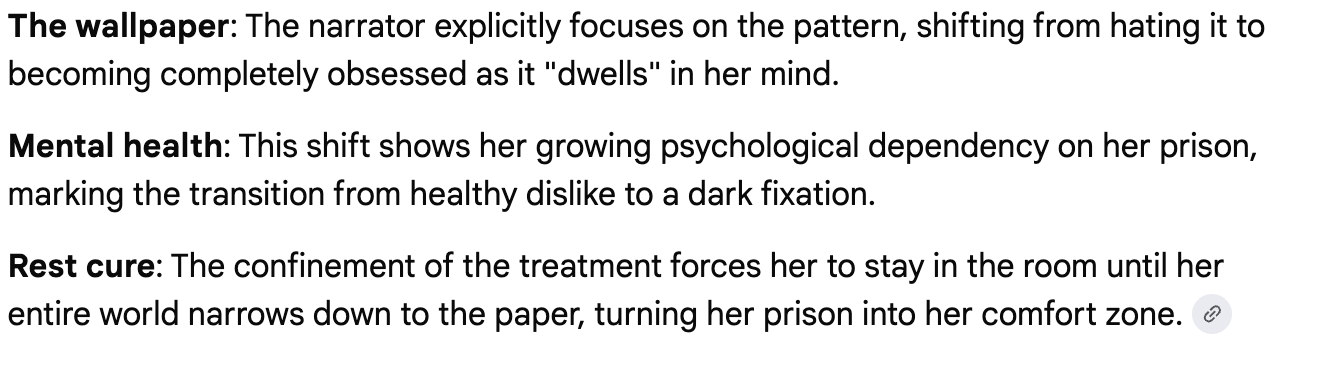
“I'm getting really fond of the room in spite of the wallpaper. Perhaps because of the wallpaper, it dwells in my mind so.”
Context of production and reception: 1890s interest in psychology and the dangers of isolation; Gilman shows how oppression creates obsession.
Genre Expectations: Gothic transformation – hated space becomes strangely attractive through fixation.
Style/Stylistic Choices: Paradox creates unease; shows the narrator’s mind being consumed.
Characterisation and Setting: The room shifts from prison to obsession; wallpaper dominates her entire world.
Narrative POV: First-person shows her gradual identification with the wallpaper.
Language patterns: Paradox (“in spite of… because of”), repetition of “wallpaper”, personification (“dwells in my mind”).
Readings: Psychoanalytic (obsession as escape from reality), Feminist (trapped woman internalising her cage), Gothic (the uncanny in the everyday).
“John laughs at me of course, but one expects that in marriage.”
Context of production and reception: Written when marriage was seen as a woman’s natural role, but Gilman critiques its power imbalance.
Genre Expectations: Domestic Gothic – highlights everyday sexism within “normal” marriage.
Style/Stylistic Choices: Ironic, resigned tone makes the reader angry on her behalf.
Characterisation and Setting: John as patronising husband; narrator as childlike wife in a supposedly loving marriage.
Narrative POV: First-person reveals her acceptance of belittlement as “normal”.
Language patterns: Casual “of course”, ironic understatement, short resigned sentence.
Readings: Feminist (normalisation of patriarchal condescension), Marxist (power dynamics in marriage), Reader-response (provokes anger at casual misogyny).

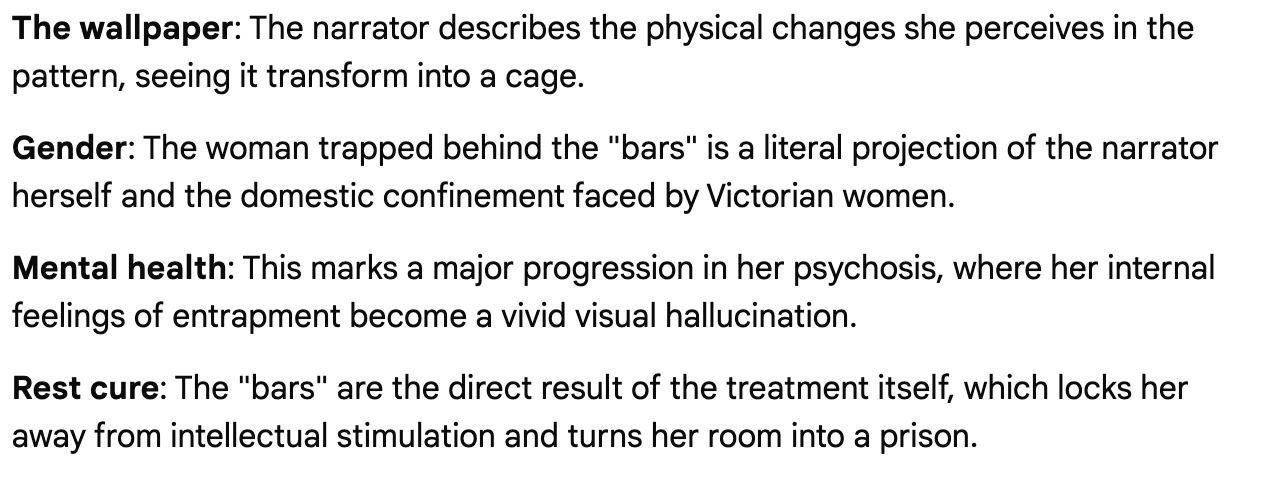
“The front pattern does move — and no wonder! The woman behind shakes it!”
Context of production and reception: 1892, during debates on women’s “nervous” conditions and the New Woman movement; Gilman uses it to show repressed women beginning to resist.
Genre Expectations (form and subject matter): Gothic horror – the wallpaper shifts from static horror to something alive and rebellious.
Style/Stylistic Choices: Builds suspense and horror through revelation; creates a chilling sense of the uncanny and reader unease.
Characterisation and Setting: The narrator fully projects herself onto the wallpaper woman; the nursery room becomes a site of both imprisonment and secret rebellion.
Narrative POV: First-person diary lets us witness her complete psychological merging with the trapped figure in real time.
Language patterns: Exclamation for sudden realisation, personification (“the woman… shakes it”), repetition of movement (“move”, “shakes”, “creeps”), contrast between “front pattern” (visible oppression) and what lies behind.
Readings: Feminist (repressed women shaking the bars of patriarchy), Psychoanalytic (return of the repressed self), Gothic (doubling and the monstrous feminine), Ambiguous (is this liberation or final descent into madness?).