Baylor PSC 1387 - Unit 2 - Bridge
Professor Bridge
Judicial Review
Judicial Review is the courts’ ability to strike down laws or actions as unconstitutional. It’s not in the constitution, instead, it was declared by the Supreme Court during Marbury vs Madison. The supreme court has original and appellate jurisdiction.
Original Jurisdiction: Cases that originate at the supreme court; they have not been heard before.
Appellate Jurisdiction: A lower court has heard this case, but the litigants appealed the decision and the supreme court decided to see it.
Judicial Review is a balance between minority rights and public accountability, as the judges are not publicly accountable but those who are publicly accountable follow the majority and may ignore minority rights.
Marbury vs Madison
Facts: John Adams appoints lots of like-minded, last minute “midnight” judges. James Madison refuses to deliver Marbury’s commission. Marbury sues.
Issue: Has Marbury’s commission been illegally withheld? Does the court have the power to deliver Marbury’s commission?
Verdict: Marbury’s commission was illegally withheld and should be delivered via Writ of Mandamus, which was given to the courts via the Judiciary Act. However, the Judiciary Act was declared unconstitutional (Judicial Review!) as only the Constitution can establish original jurisdiction, which the Act attempted to do, so the court had no power to order Marbury get his commission.
Spatial Model
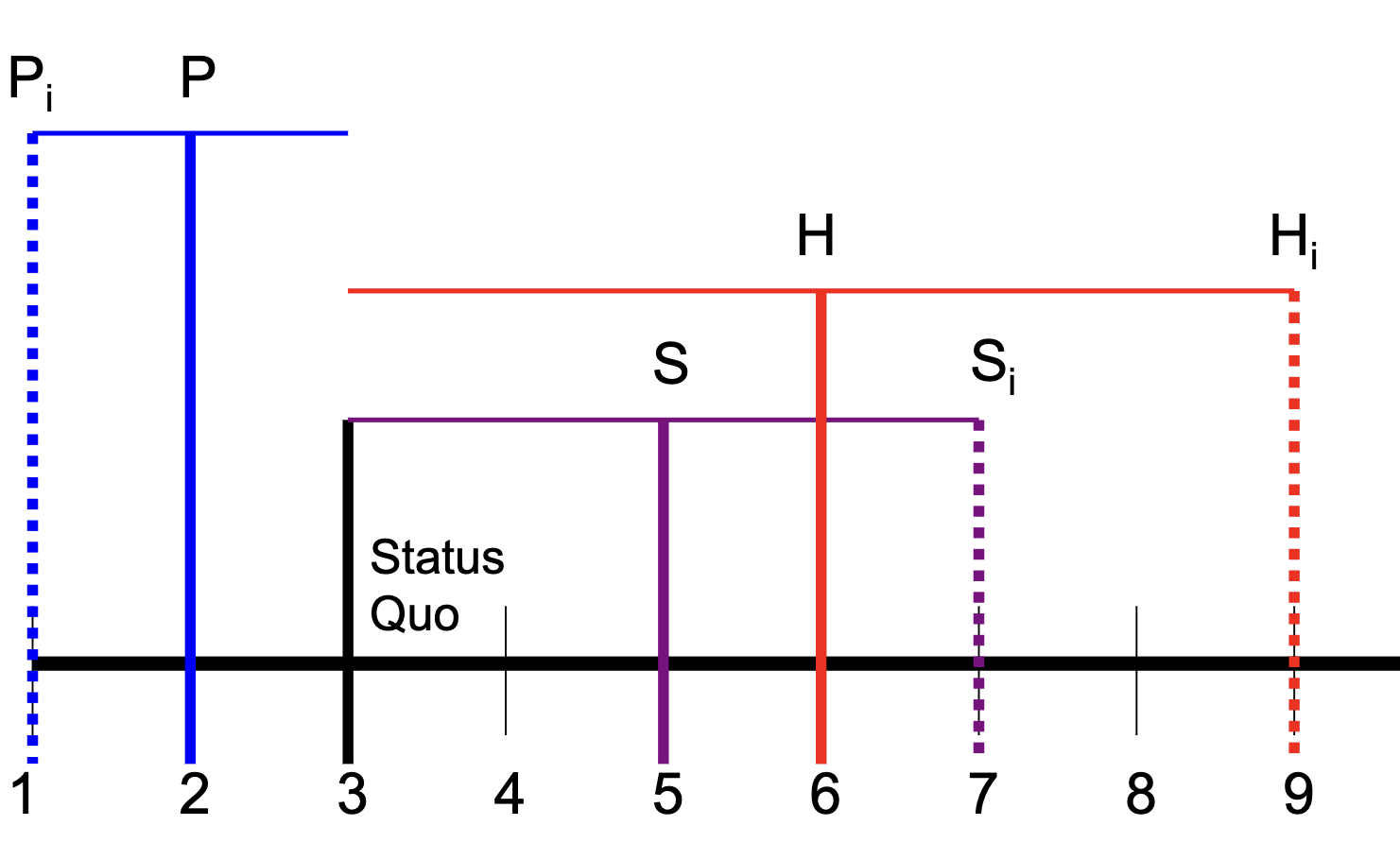
P - president
H - House
S - Senate
1 = Most liberal, 10 = most conservative
Each Body wants to move the status quo (current public policy) closer to their ideological point.
Indifferent Term (Pi/Hi/Si) - The point where the group doesnt care if the status quo is moved to it vs its original point because it is equally far away from them as the original point is.
Ideal point - Where the status quo is equal to the group’s point
Winset - The point where a group “wins,” anyplace between the original point and the indifference point.
In order to move the Status Quo, the proposed value has to be within the winset of all three groups, or the courts can reset the status quo with judicial review regardless of what the other three groups think.
The Spatial Model of all 3 groups have perfect ideological agreement:
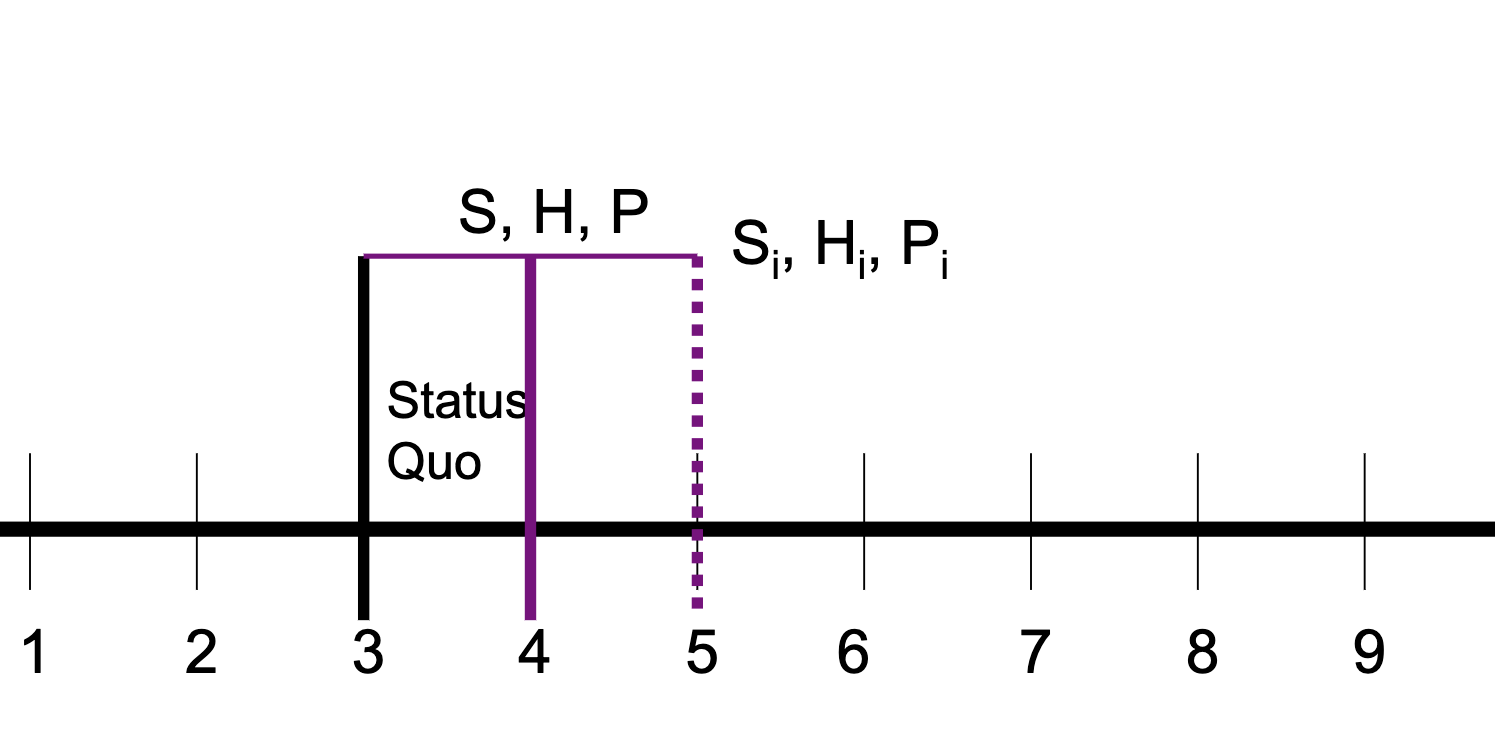
They would immediately move the Status Quo to four, and no matter where the court moves it, the unified government would move it back to four.
Supreme Court Nominations
The President appoints nominations, and the senate confirms (votes on) these nominations.
Things the president considers
Divided Government (Does the senate have the same beliefs and who will they approve?)
Ideology
Outgoing Justice’s beliefs
Ex: Scalia and Bork were very similar nominees, appointed by the same president, both educated, both conservative, etc. However, Scalia was approved 90-9, but Bork was rejected 42-58. This was because Scalia was replacing a conservative, but Bork was replacing a swing-voter/moderate.
Demographics
Personal Story
Age/Health
Legal Training/Experience
Recent Nominations
Trump
Scalia (R) → Gorsuch (R); republicans delayed for the next president
Kennedy (M) → Kavanaugh (M/R); Median Justice replacement (but more conservative)
Ginsburg (R)→ Barrett (R); Republican act quickly before the next president (huge hypocrite)
Biden
Breyer (D) → Jackson (D); normal
Pushback 11-19
Counter-majority Difficulty: the issue that judicial review allows unelected judges to overturn the will of the majority
Coined by Bicket
Antifederalists and Jeffersonians were skeptical of judicial review
Argue judicial review removes power from the people
Constitution Day
Each branch of the US government is elected or appointed.
The US is one of only 25 countries in the world that is structured for federalism (division of gov.)
The two party system can exacerbate fragmentation in an divided government and it can help things move quickly in a unified government.
17th Amendment - direct election of senators
The US Government is designed for conflict.
Congress
Substantive - Only caring about the end result, not how it got there
Procedural - Caring about the process
Amending the constitution requires 2/3 of the congress & house and ¾ of the state
Congress is bicameral, split into the house and senate.
House Purpose
Link people to the government, more accountable
Formal rule
Reactive, election every 2 years
Senate Purpose
Link states to the government
Informal/less rules
Deliberative, 6 year terms, national decisions, bigger districts
Constitutional Powers of Congress - “Broad powers”
Collect Tax
Regulate commerce
Coin money
Create post offices and roads
Create lower courts
Declare war
Create army/navy
Call the militia
Elastic Clause
Limits on power
Cannot suspend the writ if Habeas Corpus (be told your charge)
Cannot make ex post facto laws, making something illegal and punishing those who did it before its illegal
Cannot impose on first amendment establishment clause, speech, etc
Paradoxically, congress can do constitutionally more than the other branches, but politically, they cannot do anything for four reasons.
Things that make it hard for Congress to function
1) Committees
Investigate legislation, write bills, think about alternatives
More specialized
Contain sub-committees
Bills must pass all committees
Easily vetoed
2) Senate Filibuster
When someone wont shut up (yield the floor) so a bill cant be passed
3/5 votes required to cloture (end) a filibuster (60 votes), compared to the 51 needed to pass anything
“The “Nuclear Option:” A procedure allowing the senate to override a rule by a simple majority of 51 votes, rather than the normal supermajority (3/5) normally required to amend the rules. Ex: ending a filibuster with only 51/49 vote.
Longest Filibuster: 24 hours against the civil rights act
Pros
Required supermajorities to end and therefore pass laws
Gives the minority party a veto
Cons
Mostly for partisan politics and position-taking
Gives minority party a veto
Both parties like the filibuster when they are the minority, but not when they are the majority
History of pettiness and tit-for-tat fights
3) Electoral Connection
Members of Congress want to get re-elected, so instead of focusing on policies, they focus on what can get them reelected, such as…
Take positions
Pork-barrel spending (spending just for their constituents, not for the general good)
Claiming credit
Return home
Raising money
4) Polarization
Those on the left and right are drifting further apart to more extremes with less moderates
Polarization
Causes
People move to areas where their believes are more tolerated/expected
Less diverse views = people become more extreme
Redistricting
More moral issues
People are more willing to negotiate and find compromises on tax issues/etc, but not on moral issues
Effects
There is less NE republicans and southern democrats, areas are more unified
The vast majority of senators/reps/etc vote along party-line votes
NOMINATE score (+=liberal, -=conservative) are in more extremes
less bipartisan collaboration
Arguments that we are not polarizing
We are closely, not deeply divided— the elections are very close
Political activists are not normal people, they are much more extreme/polarized
The media is incentivized to make us think we are polarizing
Fear and anger are the most profitable emotions
We confuse positions with choices
Just because someone chooses to vote a certain way, that doesnt mean they have the same position as who they vote for. If you’re slightly left leaning, when you have a choice between extreme liberal and conservative, you choose the extreme liberal. That doesn’t mean you are an extreme liberal. You might be more similar to a slightly right leaning person (who voted for the conservative extreme) then who you voted for, even though the two extremes are super far apart
Presidential Powers
Institutional Roles (President Roles guaranteed by the constitution)
Extra-constitutional powers (Enumerated Powers) via the Vesting Clause in Rdd
Chief Executive
Executes Laws (Ex: state of the union address)
Prosecutorial Discretion (deciding whether or not to prosecute)
Nominate political appointees
Removals
Chief Diplomat
Negotiate treaties (not pass)
Executive Agreements (“no its not a treaty I swear its just between the executive and another executive)
Commander-in-Chief
Direct and control the military
Undeclared wars (“no its not a war i swear,” ex: Vietnam)
Chief Legislature
suggest laws to congress
Executive orders
pass/veto laws
Singing Statements
Presidential Powers in Action
John Tyler
Veto: Tariffs & 2nd National Bank
Appointments: Patronage
Execution of Laws (he didn’t execute the law, but he made/had the choice not to): Rhode Island rebels
Treaty-Making: Maine border disputes → Treaty-Making
Legislative Recommendations: Recommends Congress make laws to offer annexation to the Lone Star Republic/Texas
Military: Texas Dorr
Trump’s Isolated Presidency (2nd term)
Veto: Abortion
Legislative recommendations: Border money
Appointments: Loyalists
Execution of laws: Saying he would put illegal immigrants in Guantanamo Bay
Military: Somalia ISIS strike
Treaty-making: Gaza
Trump & Extraconstitutional Powers
Signing statment: Sanctions on Russia (2017)
Executive Order: a lot… like a lot (ex: tariffs)
Removals: lots
Prosecutorial discretion: NYC Major (did bribery and fraud, gets caught and is being prosecuted, starts supporting Trump & the prosecution stops)
Undeclared Wars: Alien & Sedition Act of 1798 + national emergency
Executive agreements: Paris (pulling out)
+pardons are a constitutional power as well
Isolated Presidency - A president who is unelected (vice president promoted after assassination/lost popular vote), there is interparty division, and intraparty division (their own party doesn’t like them). These presidents are the least likely to get stuff done.