Intro to Critical Care
Knowledge Acquisition
competencies:
competent in clinical judgment, teamwork and collaboration, clinical skills, and communication.
advocacy, diversity, and client education.
Association of Critical Care Nurses (AACN) → progressive care units
Emergency Nurses Association (ENA)
Level of Competence
critically ill have multiple health issues
Benner’s Novice to Expert Model:
novice: uses policies to guide
advanced beginner
competent
proficient
expert: intuitive due high knowledge and experience + self-actualization
imposter syndrome vs self-assessment
Critical Care Nurse Foundational Competencies
care for all ages and acute, chronic, rehabilitative and palliative care
manage data and clinical judgement
nurse actions to address situations, reduce risk and complications
aware of diverse family needs
advocate for end of life
support safe and respectable enviroment
self-care, adhere to professional values
communicate and work as team
strong medical knowledge, skills such as ventilation,
professional development
critical care nursing process
assess: gather info/data regarding changes
analyze to prioritze
plan w/ collaborating with interprofessional and family + pt’s preferences → record plan = handoff
implement proper procedures when prioritizing problems, education, monitor response, and document properly
evaluate response, if it was desired outcomes and modify
care of pt who has chest pain
assess:
CV: heart, VS, bilateral BP, peripheral/apical HR
hx of illness.
chest pain
intrepret cardiac enzyme: BMP, troponin, CK-MB
evaluate rhythms + ECG + cardiac monitoring
check if STEMI, or non STEMI
triage, interprofesional, labs, IV assess, O2
prepare for transfer in case of cardiac catheterication or CPR
inc skills/experience = inc autonomy
provider relies on nurses ability to perform their role + vice versa
→ collaborative decision w/ interprofessional team
→ leadership must support nurse autonomy
→ comprehensive orientation and continuous support from experienced nurses
CCE =
american Association of Critical Care Nurses (AACN) → Critical Care Nurse (CCRN)
Emergency Nuses Association (ENA) = emergency + trauma CCE
Trauma Nursing Core Course (TNCC) = renew q4y
1yr of critical care unit
, Society for Critical Care Medicine (SCCM) = offers Fundamental Critial Care Support (FCCS)
AHA advanced Cardiac Life Support (ACLS) = renew q2yr
strategies for growth:
review physical assessment
expected heart sounds, VS, and identify reasons for alterations
cardiac enzymes
telemetry unit with rhythm strips, ECG
chest pain protocol
journal articles
review certifications, seek learning opportunities, feedback
critical care certification, CPR certification
time w/ preceptor, lab tech, IV team to practice advanced skills
accompany pt to catheterization lab
interprofessional teams:
intensivist = HCP specializes in critical care medicine
critical care nurses, pharmacists, respiratory therapists, rehabilitation specialists, dietitians, social workers, case managers, spiritual care providers, critical care intensivist providers, and non-intensivist providers
mobilizing a ventilated pt
HCP = Rx
pharmacist = coordinate with Rx
dietitian = maximize nutrition
respiratory therapist
pt + family
PT → mobilization
nurse coordinates care + monitors response with mobilization and Rx
interpersonal daily rounds + input from pt
HCP asks for input from team = makes daily goal
nurses discusses changes over 24hrs = physical and mental functioning, CV/ resp/ GI, nutrition
pharmacist reports spontaneous awakening trials (SAT)and evaluation to pt response to Rx for pain, agitation, delirium
occupational and physical therapists
respiratory therapist in SAT and SBT
nutritionist
Social worker and case manager after discharge
family helps with previous medical records and social hx
Assessment:
critical care → ABCDEF + VS, head-to-toe, lab reports
emergency department index (ESI)
mass casualty → Sort, Assess, Life-saving interventions, Treatment, Transportation (SALT)
ABCDEF
A: Assess, prevent, and manage pain
→ 1-10 scale, behavioral pain scale (BPS), critical-Care Pain Observation Tool (CPOT)
some interventions can cause pain (ventilation, suction)
B: Breathing, spontaneous awakening trails (SAT), and spontaneous breathing trials (SBT)
mechanical ventilation: goal is to remove them from ventilation
causes pain, fear, and anxiety → opioids(morphine), and BZ (midazolam)
→ prevents pt from pulling on tubing
acute lung injury/ acute respiratory distress syndrome → require paralytic agents (rocuronium) → ventilation required
require extreme vigilance to make sure ventilation is running properly
propofol is common for sedation
Spontaneous awakening trials (SAT) → daily stop of sedatives and narcotics
Spontaneous breathing trials (SBT) → stopping ventilation for spontaneous breathing
if they exhibit: agitation, inc 35/min, O2 <89%, cardiac dysrhythmia = failed (SBT)
SAT + SBT check if pt can breath w/o assistance
Choice of analgesia and sedation:
assess pt 6 or more times per day
to wean off ventilation = pt should be awake, no distress, able to cooperate (1qd)
Scales: from unarousable to dangerously agitated
Richmond Agitation-Sedation Scale (RASS)
+4 | Combative, violent, danger to staff |
+3 | Pulls or removes tubes or catheters, aggressive |
+2 | Frequent non-purposeful movement, fights ventilator |
+1 | Anxious, apprehensive, but not aggressive |
0 | Alert and calm |
–1 | Awakens to voice (eye opening/contact) for more than 10 seconds |
–2 | Light sedation, briefly awakens to voice (eye opening/contact) for |
–3 | Any movement (but no eye contact) to voice |
–4 | Deep sedation, no response to voice, but movement or eye opening to physical stimulation |
–5 | Unarousable, no response to voice or physical stimulation |
Sedation-Agitation Scale (SAS)
Ramsay Sedation Scale
Delirium: Assess, prevent, and manage
→ longer stay, discharge to post acute, inc death, lasting decline in cognitive function
→ s/s:
hyperactive → agitation and restless
hypoactive → apathy and withdrawn
vs. dementia = delirium can be reversed
vs depression = preceded by several weeks of low interest/mood
→ risk factors:
pain or mood RX
stroke, heart attack, fall injury, progressive lung/liver, dementia, PD/ chronic terminal illness
fluid E/I
internal toxins shock or sepsis
O2 low, pain, hx of delirium
sensory impairment or deprivation or overload
tools: assess at least x2/day
Confusion Assessment MEthod for ICU (CAM-ICU)
Intensive Care Delirium Screening Checklist (ICDSC)
strategies to prevent delirium:
wean off ventilation
refrain from restraints
removed urinary catheters when not required
minimize noise from alarms
turn off lights at night, opens blinds during the day
ambulate pt ASAP
Assist w eyewear and hearing aids
Early mobility:
sever muscle weakness which impact long-term
evaluated daily for mobility → if not able → appropriate interventions for readiness and LOC → provide ROM, sitting on the side of bed, or chair
if not at all → electrical neuromuscular stimulation
at most lightly sedated
Family engagement
family and pt centered care → encourage participation and encouraged to be present
code blue
not yet cardiac arrest + can require skill/expirence to be recognized → rapid response teams (RRTs)
→ critical care nurse, a pharmacist, a respiratory therapist, and a provider
developing sepsis and respiratory failure → acute inpatient deterioration
clinical triggers for RRT
Resp alteration:
distress, inc HR, or low RR
CV alteration:
inc/dec HR, or dysrhythmia
severe hypotension/ hypertension SBP = 60/160
AMS = confusion or restlessness
O2 less than 90%
→ code blue
staff roles:
nurse that finds pt + calls code, → CPR
other staff bring code cart + attach cardiac monitor
AED is attached
Code Blue Team takes over → leader becomes stationed next to code cart
pt’s nurses manages environment and communicates w/ family
one nurse becomes recorder
rotate compressions
One nurse ensures IV access
resp therapist or anesthesia will ventilate pt
others act as runners
→ transfer to critical care unit
debrief
Code Cart Content ← document after each use, documented/checked q24hrs
defib + defribillation/cardioversion/pacing pads
battery charged defibrillator → maintain charge during power outage
+ non-battery powered code cart
bag valve / facemasks
O2 tube/ tank
CPR backboard
Meds:
epinephrine
amiodarone
sodium bicarbonate, calcium
glucose
IV access start, angiocatheters, needles, syringes, spinal needles (pericardiocentensis), scalpels, sutures, arterial line catheters nasal packs, balloon for severe nose bleed, magnet to reset malfunction pacemakers
Resp equipment = batteries, light bulb, laryngoscope, tape, CO2 detector, xylocaine spray
central venous catheter, chest tube, thoracostomy kit, suture set, trauma tourniquet, sterile stapler, burr hole manual drill kit
IV fluids/ tubing, blood administration sets
family presence during resuscitation:
if present → family recognize the efforts made to save pt’s life
give chance of say goodbye in case cannot be saved
care for pt end of life → aid in dying, withdraw from life saving equipment, stop tx, + palliative care
→ aid in dying: depends on each state
→ withdrawing lifesaving equipment: ventilator/ NG
advanced derivative
stopping resuscitation efforts → continue to deteriorate during resuscitation → HCP determines when death is imminent
Compassionate Care:
P: Prepare to discuss the issue in advance if there is time.
R: Relate to the client and family.
E: Elicit client and caregiver wishes.
P: Provide education specific to the needs of the client and their family.
A: Acknowledge emotions and concerns.
R: (foster) Realistic hope (such as the wish for a peaceful death, support).
E: Encourage questions and continue to be available for ongoing communication.
D: Document.
→ manifestation control, physical cleanliness, and removal of an endotracheal tube or other tubing
(SAGE and THYME model, and SPIKES mode)'
resilience
→ risk for burnout ← heavy workload, insufficient staffing, emotional exhaustion related to a feeling of a lack of personal accomplishment, perceived or real lack of support or recognition from administration,, influence burnout
to minimize stress:
Practice mindfulness, compassion for self and others.
Incorporate diaphragmatic breathing.
Participate in recreational activities.
Relaxation exercises.
Decrease use of social media.
Participate in peer support sessions.
Address needs for food, drink, rest, and sleep.
Build positive and nurturing relationships in the workplace.
Balance work and life.
Develop emotional intelligence.
Emergency department
Triage nurse → assess VS + pt interview (cc), hx of present illness + focused assessment
emergent: life-threatening
urgent: not immediately life threatening
delayed: minor injuries or can be delayed
5- tier Emergency Severity Index (ESI)
1–Resuscitation: life saving intervention
2–High risk:
chest pain, suicide ideation
AMS (confused, lethargic)
severe pain 7<
severe distress = sexual assault, partner violence, acute grief
immediately provide tx w/ → IV access, O2, cardiac monitoring, (ECG)
3–Two resources needed:
lab test, XR, IV fluids, simple procedure
4–One resource needed
5–No resources needed.
Resuscitation requirement:
open airway, breathing? O2
pulse? quality, rhythm, HR of pulse
hx of intubated
immediate medication/ IV blood transfusion or fluid volume
apneic, pulseless, severe resp distress
acute AMS, unresponsive?
assess in disaster:
primary triage: tx at scene and priotize pt for evacuation or trauma unit
secondary: ED triage (w/ 3 / 5 tools)
tertiary: exits the ED and moves to OR or ICU
assess in trauma
SALT
→ primary survey (ABCDE)
since airway obstruction, respiratory arrest, shock due to hemorrhage, and head injuries cause most deaths
Airway: Assess mouth, larynx, pharynx, trachea, bronchi, and bronchioles
obstruction/ aspiration
laryngotracheal trauma
allergic reaction / edema
Breathing: Assess respiratory distress (sweating, central cyanosis, use of accessory muscles), respiratory rate <12 or >20, oxygen saturation < 90%, stridor, wheezing, asymmetrical rise and fall of chest
asthma, secretions, COPD
partial airway obstruction,
Circulation: cardiac arrest, hemorrhage, MI
Disability: assess neuro using → AVPU ( Alert, Responds to voice, Responds to Pain, Unresponsive)
metabolic abnormalities such as hypo/hyperglycemia
hypoxia
head injury
Exposure: preserve evidence ( cloth, impaled objected, weapons, drugs, bullet)
child, elder, partner abuse,
sexual assault, homicide, suicide, drug overdose
→ secondary/ tertriary survey
2nd: head-to-toe assessment for injuries not addressed in primary
pts can improve one system and decline in another
3rd: uncover injuries that may have been missed (ex. brain injury or w/ emergency surgery) by disharge
Hand off
SBAR,
ED nurse is faced w/ multiple interruptions
identify information to communicate
use checklist, forms, protocols, and SBAR
receiver asking questions, better when face to face
coordinate all data and communicate all in one time
communicator name/ contact → background pt → lab results/ VS → events leading to injury → assessment/ plan of care → interventions provided → Rx, allergies, code status
deliver where minimal interruptions, include team members or family
electrical health records
Legal issues
abide for external and internal regulations
state laws except if Federal entities including the Department of Veterans Affairs, the Department of Defense, and the Indian Health Service
Emergency Medical Tx and Active Labor Act (EMTALA) → 1986
prevent refusing care from uninsured pt
any pt who has medical or psych condition reports to the ED must have throughout evaluation before discharge or transferred + documentation
pt can sue the hospital for personal injuries in civil court,
if violated EMTALA → risk of losing Medicare
COVID 19 → send pt to alternative location for medical screening and to permit transfer for those who are not that stable
For sexually assaulted
under reported → fear of stigma, keep secret, unable to prove it happen, minimizing what happen, concern for retribution, fear of police response, protecting someone, unsure if it was criminal
Sexual Assault Nurse Examiner (SANE)
→ emotional support, evaluate injuries, forensic exams, collects evidence for sexual assault
not require certification but better outcomes = from Association of Forensic Nurses (IAFN): minimum of 45 CE hrs for q3y
Law enforcement: available right after evidence, foreignsic photography to properly document injuries
Time is important for collection of forensic evidence, vital to conviction of perpetrator,
Private room + emotional support, obtain consent before all steps, do not change clothes or void prior to the exam
Assess possible exposure to HIV → tx w/ postexposure prophylaxis (PEP) ~ 72hrs
evaluated for STIs and emergency contraception (ulipristal acetate/ 30mg once up to 120hrs after unprotected intercourse)
discharging sexual assault
bathing, food/drink, grooming supplies, phone, replacement clothing (since those are for forensic exam)
determine safety issure prior to home
verbal/ written instructions + follow-up appt
information of medications, law enforcement agencies, support services
Role of nurses
if experiencing circulatory or cardiac problems:
→ hx:
cehst pain, SOB, HR/rhythm, BP, pain in legs, syncope, meds, family CV hx, smoking or recreational drug, diet and exercise
→ physical assessment:
perfusion in hands/feet
BP = both arms + laying
carotid + JVP
color of mucous membranes
listen to heart and palpate all pulses
interprofessional communication:
must deal with accomplish care in a short time, working with rotating members of the care team, weak interpersonal relationships due to members not being familiar with each other’s experience, and personal factors such as lack of confidence
other communication that streghts interpersonal:
asking for help,
providing updates on lab or radiology results,
checking to see how other members are doing
giving positive feedback.
communicating w/ family:
due to low communication of ED (since life-saving) family has lot of anxiety
giving written information that describe ED experience, informational TV screen
breaking bad news: nurse (empathy/support) + HCP (technical)
first say what happen first, then say how they were transported or treated
never given false hope
media in ED:
staff nurses are not expected to have responsibility w/ info sharing in news media
communication policies are in Disaster Plan and describe process on how to communicate w/ authorities, public, equipment, vendors, and other health care facilities
challenge of misinformation: refrain from sharing info in ED → remember HIPAA
violence in the ED
more than 50% of nurses face verbal or physical assault
stress and anxiety leads pt and family to lash out at staff
or those w/ pain, drug/alcohol, mental illness, long wait times, fear of dx
risk reduction → redesign more space, private rooms, security officers, caregivers to see each other, safety glass partition, video and audio monitoring, duress alarms
human trafficking
multiple illnesses: fractures, bruises, headaches, weight loss, infections, sexually transmitted diseases, and depression
chemical emergency
PPE: hair net, face shield, googles, N95 mask, Isolation gown, gloves, shoe cover
nurse should be aware of what types of chemicals in community and locate them in material safety data sheet (MSDS)
Decontamination process:
“Hot zone” contaminated pts
pts are triaged and placed in a holding area
pt remove discard contaminated clothing → shower dry → provided w/ clean clothes
→ “Cold zone”
evaluated for discharged
During disasters
mass casualties: natural disasters, terror attacks, mass shootings, and bombings
pre-disaster → planning, / actual disaster → response to disaster → recovery + evaluation period
pre disaster: risk assessment:
→ disaster drills, other activities
response phase → activation of plan, command post, lines of communication
triage, identify areas for shelter
recovery: continued provision of pt affected by disaster, continue w/ triaging, assist w/ transport + transfer of pts
monitoring mental health of those in the disaster and helping reuniting w/ family members
smoking inhalation:
evidence of burns in mouth, face, nose
stridor or wheezing
expectorant containing charcoal-like material
continuous coughing
O2 less than 95%
severe burns → shock due to fluid shift → High BP/ low BP
if higher TBSA of 15% → IV fluid resuscitation = LR + pain manage
mechanical ventilation, GI intubation, indwelling catheter
Assess:
considerations
Where did the disaster occur? What kind of disaster is it?
How many individuals might there be?
How many facilities can help clients who experienced the disaster?
Competencies
Knowledge of and role in the clinical facility disaster plan
Immediate action to disaster alert when not working at the facility
Performing rapid physical and psychological assessments using ABCDE tool
Performing triage during a disaster
Analysis:
Considerations
How many staff members will be needed?
How many beds are available?
Where can clients be transferred?
Competencies
Registering clients and documenting during a disaster
Managing clients who require specialized care, such as those who have burn injuries, traumatic injuries, or chemical injuries
Managing clients of different ages
Planning:
Considerations
What protocols, procedures and policies will be needed?
What are the manifestations of the potential diseases the nurse may encounter, such as biologic agents, smallpox, and anthrax, and how do they manage them?
Competencies
Identifying resources needed for client care such as need for PPE and wound dressing
Identifying appropriate disposition of clients (those who have died, those who can be discharged, those who need further care)
Identifying how communications will be handled with family members, the media, and the community
Implementation:
Considerations
The nurse implements the facility’s disaster plans.
The nurse organizes and assigns staff appropriately, following established protocols for triaging and treating clients.
Competencies
Providing care for various populations:
Older adults, infants, children, young adults, clients who are pregnant, individuals who have disabilities
Addressing legal aspects of care such as caring for a minor when their guardian is not present
Reporting using SBAR
Communicating with agencies outside of the facility
Evaluate Outcomes:
Considerations
The nurse evaluates the effectiveness of the implemented plan to determine if the established outcomes were met.
Competencies
Following the initial disaster, the nurse participates in debriefing.
Disaster preparation
hazard vulnerability analysis
requires every hospital to have an Emergency Operations Plan (EOP)
→ importance of preparation and training, resource planning, and the need for experienced staff members who can coordinate the incident command center
→ high level of interdisciplinary communication, possess excellent triage skills, and provide seamless transitions of care’
triage: Simple Triage Algorithm and Rapid Assessment (START) and Sort, Assess, Life-saving Interventions, Treatment, and Transportation (SALT) algorithm.
SALT:
sort → pt unresponsive first, then those who can wave but not walk are next → those who can walk and be alert
assess →
green: lacerations, contusions, sprain, strains
yellow: fracture, open wound, deep laceration
red: neuro injury, shock, major burns, CPR is applied and hemorrhage is controlled
black: those who died or not expected to live
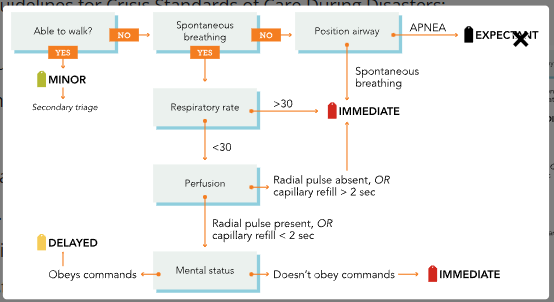
resources for those who will be nbenifited the most
max care for max pt
communicate public health messages on how to take care of themselves
determine level of care based on facility
base triage on legal framework
gain community trust by transparency, honesty, and inclusitivity
/
State of emergency:
emergency when Stanfford Act and National emergency act
or state emergency → state gains the ability to empower government officials to activate authorities and resource
→ Federal financial, personnel, logistical, and technical resources will be mobilized.
→ Emergency portions of the Social Security Act and statutory immunity or liability protection will be activated under the Public Readiness and Emergency Preparedness Act (PREP Act).
→ Regulatory demands for individuals, organizations, and state and local governments will be relaxed.
Resource allocation
Prepare: stockpile.
Substitute:.
Adapt: not equivalent but sufficient, such as using an anesthesia machine in place of a ventilator.
Conserve: Use less of a resource by decreasing dose or changing method of use →discontinuing elective surgical procedures.
Reuse: ex reusing N95 face masks by sanitizing them after use rather than discarding them.
Reallocate: Restrict or prioritize resources to those clients with a greater chance of survival or greater need.
Bystander Assistance Program:
→ CPR programs
STOP the BLEED: direct pressure, bandages, tourniquet