Accounting 211 Terms
Unknown
Accounting 211
W1 Class 1
Word of the day: Haphazard
“Marked by lack of a plan or order”
Lacking any obvious principle of organization (Aimless, arbitrary, disorganized, helter skelter)
What is accounting?
Record keeping
Communicating (tells the story)
Financial statements tell stories
“Fundamental language of business”
Accounting is storytelling (really controlled, rigid form of communication)
Accounting is called the “language of business” because all organizations set up an accounting information system to communicate data to help people make better decisions.
External users:
Shareholders own part of the company
Lenders
Eternal auditors
Boards of directors
Regulations
Regulations
Vendors
Internal users:
Leadership
Purchasing managers
Human resource managers
Production managers
Research and development managers
Marketing managers
Why do people use accounting?
Managers - to figure out which stores/division to close because they are underperforming.
Investors - to figure out which company to invest in.
Competitors - to better understand company strategy and opportunities to take market share.
Banks - to decide whether to loan money to your business.
Unions - to help in upcoming contract negotiation.
Ethics are critical
When things go bad there's the Employee Retention Credit(ERC)
Trust: firm belief in the reliability, truth, ability, or strength of someone or something
Ethics: moral principles that govern a person's behavior of the conducting of an activity
Accounting-Putting the Pieces Together
Record-keeping
Communication the “story” of the company
Users of the “language of business” are internal and external to the company
Trust in the information requires strong ethics
Rules of accounting are called GAAP
Accounting applies to business entities
GAAP-Generally Accepted Accounting Principles*
Overseers of GAAP
Financial Accounting Standards Board (FASB)
Securities and Exchange Commission (SEC)
International accounting standard board (IASB) (different from those 2 above)
Basic characteristics:
Relevance
Reliable
Comparable
4 key Accounting Principles
Management Process Principle (Cost Principle)
Accounting information is based on actual cost
Actual cost is considered objective
Revenue Recognition Principle
Recognize revenue when goods and services are provided to customers
At an amount expected to be received from the customer
Revenue must be earned*
Expense Recognition Principle (Matching Principle)*
A company record its expenses incurred to generate the revenue reported
Rev - expenses = net income (needs to match)
Full Disclosure Principle
A company reports the details behind financial statements that would impact users decisions in the notes to the financial statements
Anything that the lender needs, financial statements needed
4 key Accounting Assumptions
Going Concern Assumption
The business is presumed to continue operation instead of being closed or sold
Molistery Unit Assumption
Transactions and events are expressed in monetary, or money, units
Time Period Assumption
The life of a company can be divided into time periods, such as months and years
Business Entity Assumption
A business is accounted for separately from other business entities, including its owner
4 Business Entity Types
Sole proprietorship
Partnership
Corporation
Limited liability company
Accounting equation*
Assets = liabilities + owners equity
Assets = liabilities + common stock + retained earnings
Assets = liabilities + common stock + net income(rev - expenses) - dividends *
Equity and Liabilities are how we get the money and Assets are how we use it
Assets
Assets are resources owned or controlled by the company
Cash - actual cash and bank accounts
Investments - stocks and bonds
Accounts Receivable - amounts due from customers
Inventory - items held for selling to customers
Prepaid Expenses - amounts paid in advance for items used by the business
Supplies - items used in the business
Properties & Equipment - land, building, chachines, computers and more
When you use up an asset, it is an expense
Liabilities
Liabilities are claims on assets that require repayment(not ownership)
Accounts Payable - amounts owed to suppliers and vendors (short term)
Wages Payable - amounts owed to employees
Taxes Payable - taxes owed to governments (sales, income)
Unearned (deferred) revenue - services or goods owed to customers
Notes Payable - loans (long term)
Mortgage - loans for buildings/land
Equity
Equity residual claims on assets that do not require repayment(ownership)
Common Stock - investment in the company by owners
Retained Earnings - cumulative earning(net income) of the company not paid out as dividends to shareholders. Earnings that have been retained.
Service Revenue - amounts changed to customers for services provided
Sales Revenue - amounts changed to customers for products provided
Cost of Good Sold - cost of products sold to customers
Retained Earnings - dividends, revenues, expenses
Operating Expenses - cost of services and product used by the business
Wages and benefits paid, facility rents, utilities and maintenance, costs like supplies, insurance and marketing
Other Items - interest revenue, interest expense, gains, loses on sale of property
Dividend is not an expense*
Dividend is not an expense*
10 basic transactions
Investment by owner
Purchase supplies for cash
Purchase equipment for cash
Purchase supplies on credit
Provide services for cash
Payment of expenses in cash
Provide services for credit ‘
Receipt of cash from accounts receivable
Payment of accounts payable
Payment of cash dividend
W1 Class 2
Word of the day: Maelstrom - noun
“He was caught in a maelstrom of emotions after reading chapter one in his accounting text”
A maelstrom is a powerful, often violent whirlpool that sucks in objects within a given radius.
Maelstrom is also often used figuratively to refer to a situation resembling the turbulence of maelstrom.
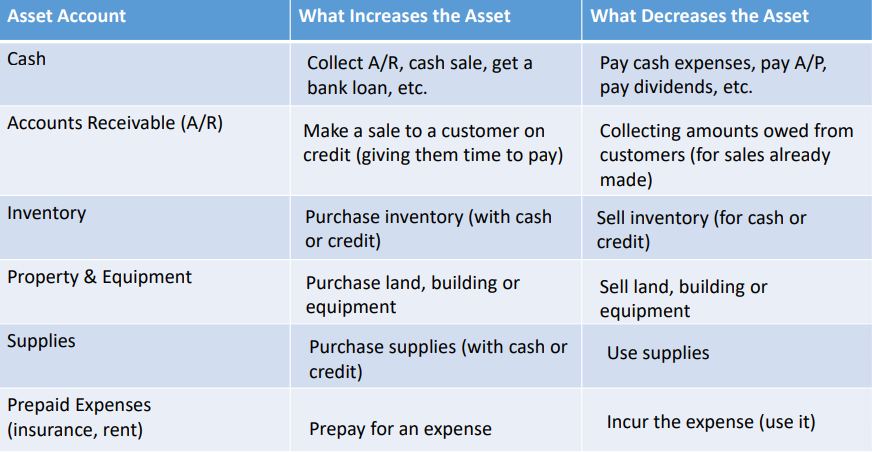
Examples of assets:
cash
accounts receivable inventory
supplies
prepaid expenses
Investments
plant, property and equipment
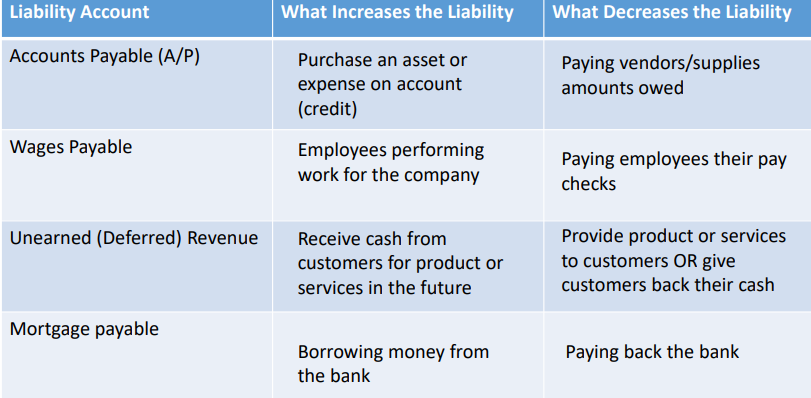
Examples of liabilities:
accounts payable
wages payable
taxes payable
uneared (deferred) revenue
notes payable
mortgage payable
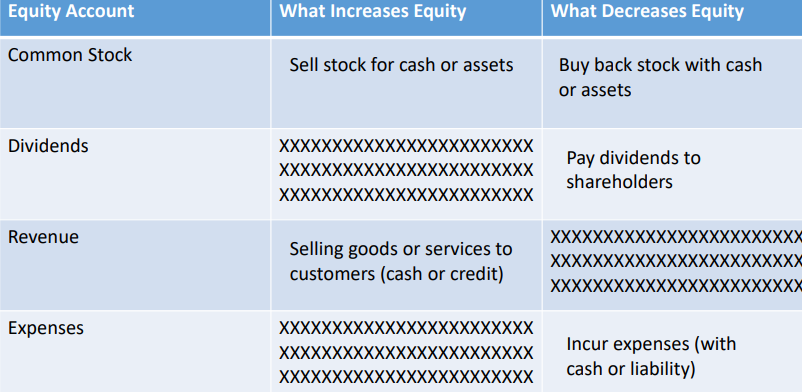
Examples of equity:*
common stock (investment in company),
retained earnings (rev = exp - div)
Transactions
A transaction generally includes an exchange or interaction.
Transactions always affect at least 2 items (not sides) from the acc equation.
Events of a company occur through transactions
Companies transact with:
Employees (payroll)
suppliers (venders)
Shareholders (owners)
Banks (lending)
Customers (revenue)
Other companies
When payments are on “credit” or on “account”
When the company buys something:
Supplier (vendor) has given out company time to pay them (typically 30 days)
Use the accounts payable (liabilities) account to track amounts owed to others
When the company sells something:
Company has given a customer time to pay us (typically 30 days)
Use the accounts receivable (asset) account to track amounts owed to us
Transaction practice:
Investment by owner increases an asset and increases equity
Purchase of supplies for cash increases an asset and decreases an asset
Purchase equipment for cash increases an asset and decreases an asset
Purchase supplies on credit increases an asset and increase a liability
Provide services for cash increase an asset and increase equity
Payment of expenses in cash decreases an asset and decreases equity
Provide services for credit increases an asset and increases equity
Payments of accounts payable decreases an asset and decreases a liability
Payment of cash dividend decreases an asset and decreases equity
Pay for next month’s rent early with cash increases an asset and decreases an asset
Receipt of cash from customers against accounts receivable increase an asset and decreases an asset
Financial statements - 4 Parts
Account records result in financial statements
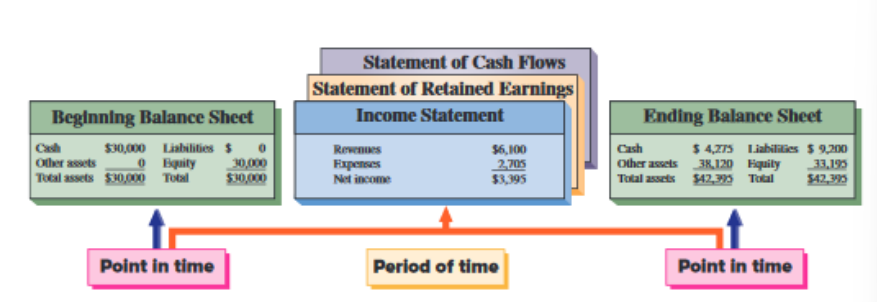
Balance Sheet
Describes a company's financial position (types and amounts of assets, liabilities, equity) at a point of time (snap shot)
Income Statement
Describes a company's revenues and expenses and computes net income or loss over a period of time (movie)
Statement of Retained Earnings
Explains changes in retained earnings from net income or loss and from nay dividends over a period of time
Statement of Cash Flows
Identifies cash inflows (receipts) and cash outflows (payments) over a period of time
Asset accounts:
Liability accounts:
Equity accounts:
Classification of Cash Flows:*
The statement of cash flows includes the following 3:
Operating activities
From income statement plus notes (use + (inflows)-(outflows))
inverting activities
Cash paid for purchase of long-term assets (PPE)
financing activities
Cash component of transactions with owners (investments by them and payment of dividends to them)
What is the change in the bal of account
Current assets/current liabilities + net income is in the cash flow*
Statements of Cash Flow
1. Net increase or decrease in cash
2. Net cash from or used by operating activities
3. Net cash from or used by investing activities
4. Net cash from or used by financing activities
5. Add up the cash from all sources, and then prove it by adding it to the
beginning cash balance to get ending cash balance.
What is a ratio and why do we use them?
A ratio is a way of expressing the relationship between one accounting data point to another
A ratio must show an economically important relationship
Useful: Cost of good sold to sales
Not useful: Freight costs to patients
Under conditions trends difficult to detect by looking at individual accounts
Types of rations:
Liquidity and Efficiency
Availability of resources to pay short-term cash requirements
How productive a company is in using its assets
Solvency
Ability to meet long-term obligations and generate future revenues
Profitability
Ability to earn an adequate return
Market Prospects
Analyzing corporations with publicly traded stock
Return on Assets (ROA)
Return on assets equation measures the assets that are making you earn things.
Stated in ratio form as a net income divided by the average total assets invested
ROA = Net Income/Average Total Assets
4 Steps (sort of) to Record Transactions:
Step 1 - identify the transaction and any source documents
Step 2 - analyze the transaction sing the accounting equation
Step 3 - record the transaction in journal entry from applying double-entry accounting
Step 4 - post the entry (for simplicity, we use T-accounts to represent ledger accounts)
Very quickly you should be comfortable enough going directly to step 3 and/or 4
T-accounts and debits and credits:*
T-accounts are a representation of increases and decrease in individual accounts
Debit (DR) is on the left
Credit (CR) is on the right 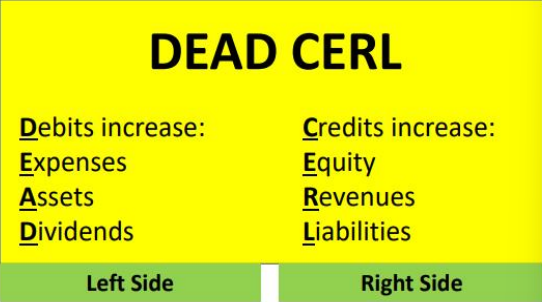
Double-entry accounting*
Accounting equation
Assets = Liabilities + Equity
Debits = Credits
Double entry accounting also requires for each translation:
Total Debits = Total Credits
Exs:
Purchase equipment on account = debit (increase) asset and credit (increase) liability
Issue common stock for cash = debit (increase) asset and credit (increase) equity
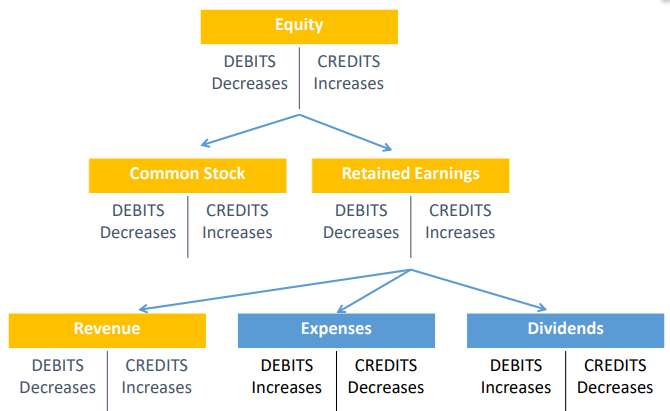
Debits and credits for equity:*
W2 Class 1
Accounts
An account is a consolidated record of increases in a specific asset, liability, equity, revenue or expense item.
Asset Accounts
Cash, accounts receivable (A/R), inventory, prepaid expenses, supplies, equipment, building, land
Liability Accounts
Accounts payable, note payable, uneared (deferred) revenue, mortgage payable, wages payable
Equity Accounts
Common stock (or contributed capital), retained earnings, dividends
Revenue ( sales to customers)
Expenses (cost of good sold, advertising, rent, salaries, utilities, insurance)
Transactions
Always affect at least 2 items from the accounting equation
Financial statement has 4 parts
Ratio - return on assets
Classification of Cash Flows
Operation activities - What is being measured here?
Day to day activities: Net income + non-cash + (Current assets minus current liabilities)
Are you generating cash from the everyday activities
Investing activities - What is being measured here?
Long term investing in assets
Investing for revenue in the future
Financing activities - What is being measured here?
Where are they getting the finance
Debt and equity
Transactions
Transactions represent exchange of assets, goods or services between parties
Transactions are recorded in the accounting books, which are a set of journals and ledgers and can be paper (but today are almost always electronic)
Source documents - paper or electronic form
Invoices, purchases orders, checks, receipts bank statements
Typically define when a transaction has taken place
Debit and Credit Balances Normal Balance Increases*
Accounts with Debit Bal:
Assets
Expenses
Dividends
Accounts with Credit Bal:
Liabilities
Stock/investment
Revenue
Normal Balances
Each account has an expected debit or credit balance, called the normal balance
That normal balance is usually whatever increases the account
For assets, we expect a debit balance
For liabilities, we expect a credit balance
For equity, we expect a credit balance
Journals and Ledgers*
Journals provide the detail to each transaction or accounting entry
A journal is a listing of journal entries: This everything
A ledger is the collection of all the accounts: this is specific accounts
We use t-accounts to represent ledgers
Posting reference column often called PR, is a column in the general journal that is used to indicate when entries have been posted to the ledger accounts
Trial balance lists all ledger accounts and their balances at a point in time.
If the books are in balance, the total debits will equal the total credits
Journal entries are t-accounts are 2 ways to represent transactions Posting from the journal to the ledger isn't that tangible of a step
W2 class 2
Preparation Order of Statements:
Income statement records activity over a period of time
Retained earnings as the income flows to retained earnings
Balance sheet records the business at a moment in time
Cash flow statement analyzes where the cash was used
Types of Rations:
Liquidity and efficiency
Availability of resources to pay short-term cash requirements
How productive a company is in using its assets
Solvency
Ability to meet long-term obligations and generate future revenue
Profitability
Ability to earn an adequate return
Debt Ratio Equation:
Evaluates the level of debt risk.
Debt ratio = total liabilities/total assets
Financial leverage = debt ratio
A higher ratio indicates that there is a greater probability that a company will not be able to pay its debt in the future
The Accounting Period *
What time period are you working with, monthly, yearly, quarterly?
Cash and Accrual Accounting
Accrual Accounting*
Adjustments to financial statements to “properly” state balance sheet elements, and to match operating activities to period during which they occurred
More accurately reflects economic profit (net income)
Improves compatibility, across time and across firms
Accrual basis = total
Cash Accounting (cash accounting is for another school term)
The inflows and outflows of cash reflects revenue and expenses
No Accounts Receivable or Accounts Payable
No adjustments are made for assets purchased and used up
W3 Class 1
Key Accrual Principles:
Revenue recognition principle:
Recorded when the company has provided the goods or services to the customer (has the company “earned” it?)
At the amount the company expects to receive from customers
Matching principles (expense recognition):
Expenses are recorded in the same period as the revenues are recorded as a result of those expenses
We generally record expenses in the period in which the cost was used, consumed, incurred
Adjusting Entry Steps*
Analyze transactions and accounts for adjustments
Determine if an adjustment is needed (what should the balance be)
Make adjusting journal entry (amount necessary to get the account to the right balance
Adjust the ledger account
Make an adjusted trial balance
4 types of adjustments
Deferrals (cash paid” early”)
When we record the amount on the income statement. Cash is being paid, but the revenue or expense is deferred.
Prepaid expense
Unearned revenue
Accruals (cash paid “late” )
Menas “to come into existence as a legally enforceable claim”. Expenses and revenue need to be recorded but have not received the cash.
Accrued expense
Accrued revenue
Deferred Revenue:
When cash is received in advance of providing products or services.
It's in the liability account since it creates an obligation.
Deposit
Retainer
Use of Plant & Equipment: Depreciation
“the allocation of cost for long-lived assets over the expected useful life”
Long-lived assets (anything with expected useful life over a year)
Building
MRI scanner in a hospital
Computer systems
Allocation: spread the expense over a long period of time to match expenses to revenues
Depreciation *
Instead of expending the cost of a plant asset (equipment, building, cars, and more) in the year it is purchased we allocate, or spread out, the cost over their expected useful lives.
Contra Accounts
An account linked to another account that records adjustments or decreases to the account separately
Has an opposite normal balance and is reported as a subtraction from the other accounts balance
Contra accounts will show up again in later chapters
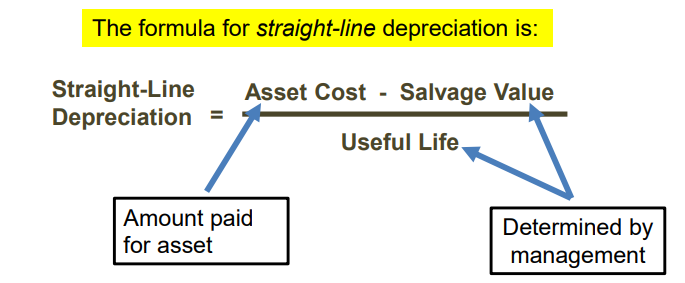
Straight-line Depreciation
Net cost (amount to depreciate)
Original cost - salvage value = net cost (this is what we depreciate)
Adjusting for Depreciation*
Non-cash expense
Accumulated Depreciation Contra Asset Account*
Is linked to the asset that is being depreciated. It will lower the book value of the asset. It's fixed in place, permanent. Contra means the opposite.
Depreciation Expense - Adjusting Entry
An adjusting journal entry is needed at the end of each period to reflect the use of buildings and equipment and equipment for the period.
Total is the “Net Book Value”
Term used at the individual asset level category asset level or for all fixed assets
Incurred = Expense
Accrued = Unearned
Deferred = Prepaid
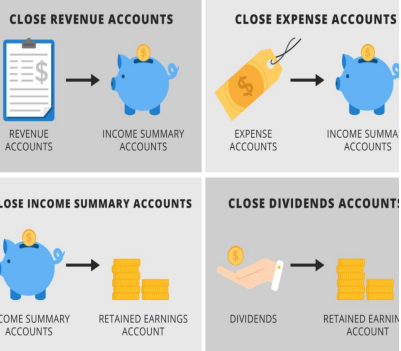
Closing Process*
It identifies accounts for closing, records and post closing entries, and prepares post-closing trial balance.
Resets revenue, expenses , and dividends (temporary) accounts balances to zero at the end of the period
Helps summarize a periods revenues in the income summary account
Balance sheet accounts: are permanent.
They retain their balances from one period to the next
Revenue, expenses, gains, and loss accounts: are temporary.
Their balances accumulate but start with a zero balance at the beginning of the next period (fiscal year)
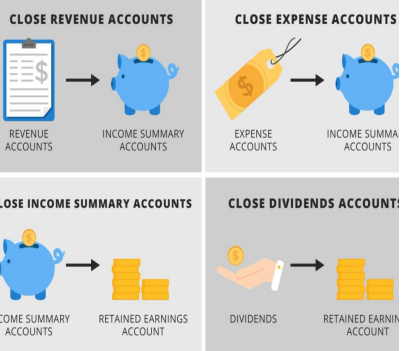
Closing Temporary Accounts
At the end of the period, revenue, expenses, and dividends are in separate accounts. Closing entries just moves those to retained earnings.
First close each revenue and expense account balance to zero
Then offsetting account is “income summary”
After that close “income summary” to retained earnings
Finally close “dividends” to retained earnings
Post-closing Trial Balance
List of permanent accounts and their balances after posting closing entries
Total debits and credits must be equal
Temporary accounts are closed to retained earrings
Income Statement Accounts - close out yearly
Since income statements cover a period of tie, we need to close these accounts at least annually.
We want to start each year with a fresh start = zero balance
Balance sheet carries over each account balance
Classified Balance Sheet
Assets: Current assets, long term investments, plant assets or property plant and equipment, and tangible assets
Current assets
Cash
Accounts receivable
Inventory
Supplies
Prepaids
Less than one year
Long-term assets
Property (land)
Buildings
Equipment
Notes receivable
More than one year
Liabilities
Current or short-term liabilities, and long-term liabilities
Current liabilities
Accounts payable
Wages payable
Taxes payable
Interest payable
Unearned revenue
Less than one year
Long-term liabilities
Notes payable
Mortgages
Long-term lease
More than one year
Equity
Contributed capital
Common stock
Retained earnings
Net income (+ -)
Dividends (-)
Profit Margin
Profit margin ratio measures the company's net income to net sales
Profit margin = net income/net sales
Current Ratio
Current ratio helps assess the companies ability to pay its debts in the near future
Current ratio is the ability to meet
Current ratio = current assets/current liabilities
Financial Statement Ratio Equations
Return on Assets = Net Income/Average Total Assets
Debt Ratio = total liabilities/total assets
Current Ratio = current assets/current liabilities
Profit Margin = net income/net sales
Benefits of a Worksheet
Reduces risk of errors
Links accounts and their adjustments
Helps in preparing financial statements
Shows the effects of proposed transactions
Use of a Worksheet
Enter unadjusted trial balance
Enter adjustments
Prepare adjusted trial balance
Sort adjusted trial balance accounts to financial statements
Total statement columns, compute income or loss, and balance column
W3 class 2
Framework for adjustments
Step 1 - determine hat the current account balance equals
Step 2 - determine what the current account balance should equal
Step 3 - record on AJE to get from step 1 to step 2
We wanna close account to start the timeline fresh
We wanna come back to 0
Depreciation
Instead of expending the cost of a plant asset (equipment, building, cars and more) in the year it is purchased we allocate, or spread out, the cost over their expected useful lives.
Midterm study 4/20
Chapter 1:
Permanent accounts are in the balance sheet
There are beginning and end balances in the balance sheet
Temporary accounts are in the income statement
Dividends in a debit account on a normal balance
Chapter 2:
Double entry accounting is debits = credits
T-accounts are post account ledgers that go to trial balance that go to the financial statements
Cash received before revenue recognition is unearned (deferred( revenue (liability)
Cash paid after expense recognition is accrued expenses, cash incurred during fiscal period, unpaid and unrecorded, payables, salaries, (liability)
Cash paid after revenue recognition accounts receivable, internet receivable
Cash re
When talking about interest rent charge percentage you have to divided by 12 months
Income summary is a temporary account ( have to make it 0 to close the account)