Nucleic Acids
Nucleic Acids
Another major group of biological molecules is nucleic acids, which include deoxyribonucleic acid (DNA) and ribonucleic acid (RNA). While there is only one major form of DNA, there are three different kinds of RNA, all with different functions.
All the genetic information that you inherited from your parents is stored and transmitted by nucleic acids in the form of DNA. DNA has segments, called genes, that carry the information for the production of every protein found in your body. Basically, genes in DNA are sets of master instructions for how to build proteins, and RNA works to ensure that the information can get to the areas of the cell where the proteins are needed. In fact, the proteins that we discussed above could not even be formed without the instructions provided by genes in DNA and the distribution of that information through RNA.
Composition of Nucleic Acids
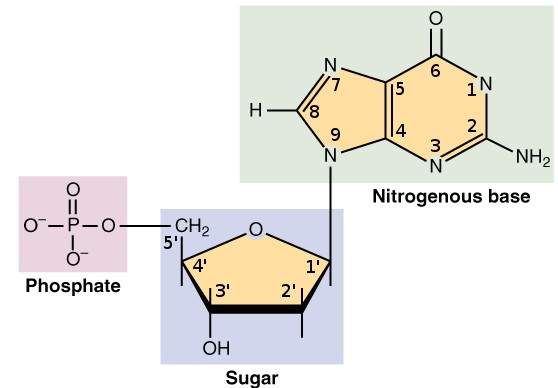
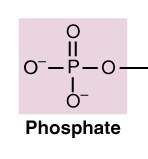
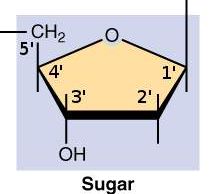
Nucleic acids are polymers; they are made up of monomers (or building blocks) called nucleotides that link together in long, unbranched chains. There are 5 different nucleotides that make up a chain of nucleic acid. The structure of a nucleotide can be broken down into 3 parts: a phosphate group, a 5-carbon sugar called a pentose (pent- meaning five, and -ose meaning sugar), and a nitrogen-containing base.
Phosphate group
–
Phosphate is composed of one phosphorous atom bound to four oxygen atoms. In a free nucleotide (one not incorporated into a nucleotide chain), the phosphate group carries a negative charge of two (-2). To form a nucleic acid chain, the phosphate group of one nucleotide binds to the pentose of another, forming a phosphodiester bond. This reduces the charge on the phosphate group to -1. Still, the phosphate group in nucleotides imparts an overall negative charge to chains of DNA and RNA. The overall negative charge of nucleic acids aids important interactions with certain proteins, which are somewhat positively charged.
Pentose
–
Pentoses are sugars containing only 5 carbon atoms. The sugars in DNA and RNA nucleotides are very similar, but not identical. The pentose in RNA is a sugar called ribose, while the pentose in DNA is deoxyribose. Deoxyribose contains one less oxygen atom than ribose, hence the "deoxy" prefix (de- meaning off, and -oxy- meaning oxygen). This difference allows DNA to be more stable (oxygens can lend more reactivity to a molecule), which protects DNA from breaking down. RNA does not need to be stable, because copies of RNA can be made from the DNA whenever the cell needs.
When nucleotides link to form a nucleic acid chain, the phosphate group of one nucleotide binds to the pentose in another; for this reason, the phosphate and pentose groups together are called the "backbone" of nucleic acids.
Nitrogenous base
–
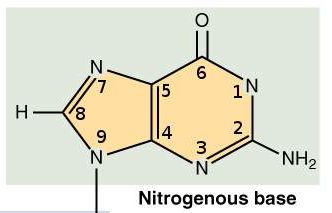
There are five different bases with different ring-like structures. The bases are what distinguish the different nucleotides from each other. These bases are adenine (A), thymine (T), guanine (G), cytosine (C), and uracil (U). DNA and RNA share three of the five nitrogenous bases, A, G, and C. Interestingly, the base T is only found in DNA, and the base U is only found in RNA.
Basing pairing
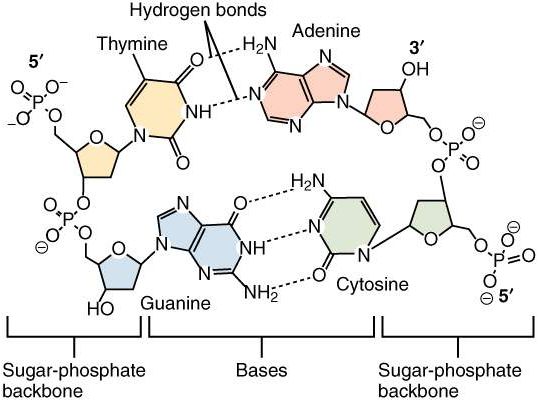
In each nitrogenous base, certain nitrogen atoms are bonded to hydrogen, which allows for the formation of hydrogen bonding to occur between bases. The formation of hydrogen bonds between bases is called base pairing. Due to the unique ring configuration of each nitrogen-containing base, base pairing can only occur between specific bases. In DNA, A can only pair with T, and G can only pair with C; in RNA, A only pairs with U, and G only pairs with C. Note that in both DNA and RNA, G pairs with C.
The image below depicts how the bases in DNA form hydrogen bonds between base pairs.
DNA
As stated above, the nucleic acid DNA houses your unique genetic code, which contains the instructions needed to make every protein in your body. In eukaryotic organisms (like humans), DNA is protected inside a membranous sac near the center of every cell called the nucleus. DNA provides the instructions for all the proteins in a cell and is critical for directing cellular function. Because of this, protecting the information contained in DNA is not only vital for the survival of each cell, but also for the survival of the organism as a whole.
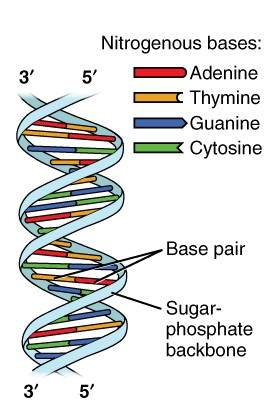
DNA nucleotides contain a backbone made of deoxyribose, a pentose sugar, which helps stabilize the molecular structure. Additionally, DNA is always found in two complementing strands. This means that the bases in each stand exactly line up with their pair on the other strand. So, hydrogen bonds hold the two strands together, and they form a slight spiral that looks much like a twisted ladder. This structure is called a double helix and further adds to the stability of DNA. The phosphate group and the 5-carbon sugar form the sides of the ladder, and the nitrogenous bases from each strand pair together to form the rungs of the ladder.
DNA
As a review, the four bases found in DNA are adenine (A), thymine (T), guanine (G), and cytosine (C). It is the order of the nitrogenous bases along a DNA strand that determines the "instructions" encoded in the DNA.
Remember that in DNA, A only pairs with T, and G only pairs with C.
RNA
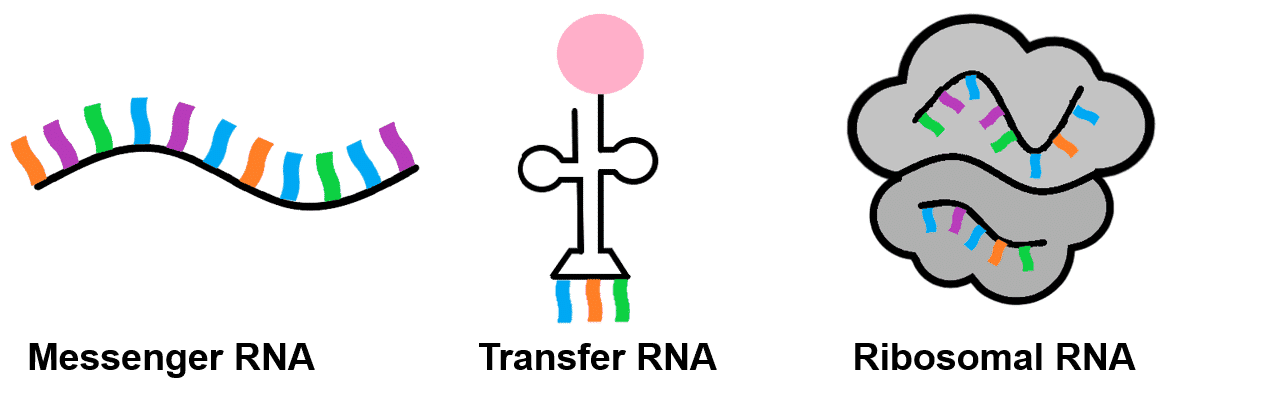
As DNA stores the information for making proteins, RNA makes those instructions available to the cell and carries them out. As said above, there are three different types of RNA that are important for this work. Since DNA is protected in the nucleus of eukaryotic cells, the instructions, or genes, from DNA need to be made available to other regions of the cell in some way. Messenger RNA (mRNA) basically copies the information from a gene inside the nucleus and then carries that information to the rest of the cell. Using the copied instructions from mRNA, transfer RNA (tRNA) and ribosomal RNA (rRNA) build the proteins. tRNA identifies and brings the appropriate amino acids to build the protein, and rRNA forms the peptide bonds between the amino acids to form the primary structure of the protein chain.
Types of RNA
Later in this course, DNA and RNA will be covered in more detail. However, for now, there are a few properties of RNA that differ from DNA that are important to note:
1
1
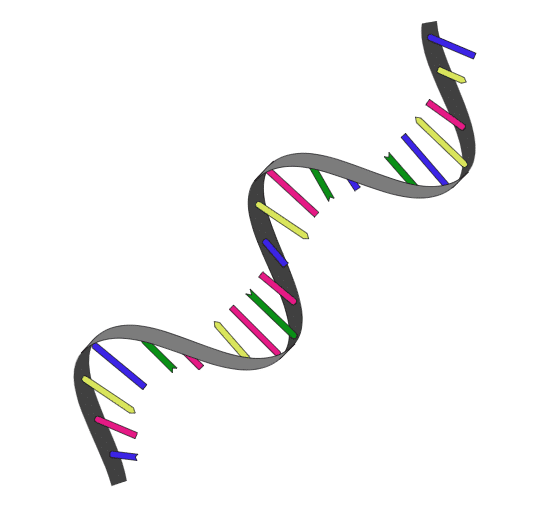
RNA is single-stranded rather than double-stranded. It does not produce a double-helix shape. It looks more like half of a twisted ladder.
2
2
Additionally, the nucleotides of RNA contain different bases: adenine (A), uracil (U), guanine (G), and cytosine (C). Note that thymine is not included in this list as it is with DNA.
3
3
And, in RNA, A always pairs with U. However, G always pairs with C, just as it does in DNA
RNA