week 1:
economic methodology: answers “why” questions about economy
economic procedure answers the “how” questions about economy
descriptive economic methodology describes different economic research practice and results
prescriptive/normative economic methodology distinguishes between good and bad explanations and assess how good statements should be formulated
RECEIVED VIEW OF SCIENCE:
standard image of science, presumed to be correct just because it is visible. Used to refer to logical positivism or logical empiricism.
only accepts what can be observed and thus rejects statements that are not empirical such as theology
development of logical positivism credited to Vienna Circle (1929), a manifesto of the Ernst Mach Society
where logic refers to all scientific language, including maths
where positivism refers to empiricism: idea that knowledge comes from experiencing
ANALYTIC AND SYNTHETIC A POSTERIORI PROPOSITIONS
Vienna Circle wanted to delineate (demarcate) (set boundaries) scientific, tangible knowledge more clearly from imaginary, metaphysical. intangible knowledge.
programme used a delineation rule that only accepted analytical and synthetic a posteriori claims as scientific knowledge.
analytical claims are tautological; true by definition
synthetic claims: non analytical, not true by definition
synthetic a posteriori assertions: proven through empirical research
synthetic a priori assertions: truth not dependent on empirical research
universally valid
not recognised in science by logical positivists due to demarcations
under logical positivism, empiricism consists of:
all evidence of synthetic claims comes from sensory perceptions as opposed to analytical claims true by defintions
predicates (honorary titles) must be empirically verifiable so based on experience or findings
non analytical assertion only useful if it is empirically verifiable.
vienna circle argued that scientific theories is both precise and transparent. scientific statements should be distinguished between syntax and semantics.
scientific theories: systems of ideas that help us understand observations about the world through principles and explanations
syntactic pov: focuses of structure. suggests proper scientifc theory expressed through formal language involving axioms. which are basic statements that are accepted as true without proof and used as basis for further understanding
language of theory:
observation statements: descriptions of what can be observed. water boiling when heated
theoretical explanations: deeper interpretations of why things happen, often unobservable mechanisms. eg) molecular kinetic energy explanations for why water boils
operationalisation and correspondence rules:
operationalisation: defining theortical terms or concepts in ways that can be measured in observation terms. eg. defining temp from readings from a thermometer
correspondence rules: guidelines on how theories should be applied to real world phenonma through experiments. ensure theoritcal terms have practical counterparts. making theory useful.
deductive-nomological explanatory model: scientfic statment should show any event or reguality as an example of a fundamental law =.
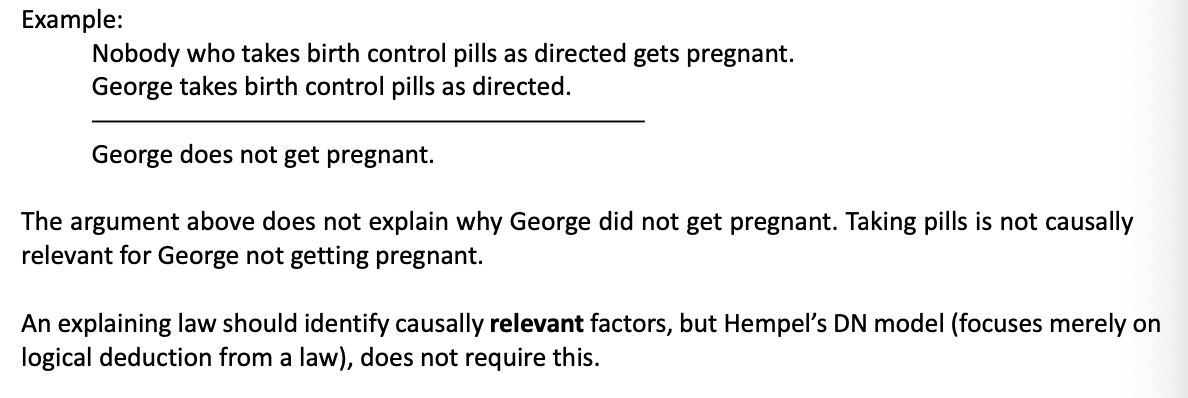

symmetry thesis: explanation and predicition are two sides of the same coin, both which can be demonstrated with the DN model.
induction: process of inferring general laws from particular events or individual observations.
problem of induction: observation can only justify singular statements and never general statements. implies that there are no universal laws that can be based on basic data
dilemma of no universal laws:
instrumentalism (schlick): view that laws are useful instruments whose value is not measured by their truth, but by how effectively they explain and predict phenomena. therefore laws should be judged in their usefulness in explainining things
confirmationism (carnap): view that laws do not express certain knowledge about the world but instead express probabilistic knowledge. the more they are confirmed, the more likely it is that they are true. nothing is certain but we can confirm things based on patterns
some theory cannot be operationalised:
logical positivists attempt to demarcate science from non science fails
restricition of scientific statments to analytic and synthetic a posteriori fails because theories such as newtons laws are neither of them
even when a theortical term can be opertionalised, there is often more than one procedure or operation
CHAPTER 2: METHODOLOGIES OF POSITIVE ECONOMICS
econometricians shared scientific ideas logical positivists. main econometricians were jan tinbergen, trygve haavelmo, tjalling koopmans. main debates were:
keynes - tinbergens debate about the new method of econometrics
measurment without theory debate, comparing the method employed by the national bureau of economic research with the econometric approach of the cowles commission.
friednmans essay about a positive methodolgu for empirical rsearch as an alternative to the cowles comission approach
samelsons descriptivism, which was proposed as an alternative to friednmans method
main goal of econometrics:
model must be specified in explicit functional forms
determine correct data definitions and compile relevant data sets for the variables inducluded in the model
build a bridge between theory and data by using statistical methods. bridge consists of several group stats to help determine validity of theoretical model
econometric society had a numbetr of spearheads
science should not engage in ideology, because that leads to radicilism and infulences science
without bias anyone can independitely check truth of statement
unification of the theorical quantititative and empricial quatitative appraoch to economic pronlems
keynes-tinbergens debate:
technique of multiple correlation analysis was only a measurment method → contributed nothing to discovery and criticism.
supposed linearity of the relationships between these factors.
problem of invariance: would the relo found also apply to the future
keynes conflucded that econometrics was not yet a scientific appraoch
some significant factors in an economy not capbale of measurment or may be interdependent
assume the linearity of the relation between these factors. the determination of time lags and trends were often trial and error
measuring is fine but one can only measure properly if all the causalities are known. that bias at keynes/tinbergen is called OVB. if one omits explanatory variables, test correlations that are too high
in epistemology, laws are crucial in terms of both explanation and predicition. however the specific problem in the case of economics and social sciences is that these cases, laws must be found outside of an experimental enrivonment.
trygve haavelmo indtoruced the probabilty approach or the diagnosis confirmation. discovered the problem of passive observation. if a certain variable does not change signficantly, one doesnt know if they should take it with them
measurement without theory debate:
measurment without theory debate debate between cowles committee and NBER.
NBER: theory is the result of observation
cowles comitee: economists unable to conduct experiments on an economic system as a whole therefore impossible for many economic affairs to separate causes from consequences
koopmans critique based on Haavelmo’s “Probability Approach”
koopmans put out 3 arguments to explain limitations of the NBER’s empiricist approach
to effectively study complex phenomena like the business cycle, it's essential to use theoretical preconceptions. These frameworks help systematically observe and analyze the intricate patterns of economic expansions and contractions. Without them, the analysis may overlook crucial details, leading to a less comprehensive understanding.
provided no evidence for the assumption that empirical relationships found would be eternal over time
statistical analysis of the data requires additional assumptions about their probabilistic characteristics that cannot be subject to statistical testing from the same data
econometric modelling always runs risk of being incomplete. some variables excluded for empirical reasons may later prove to plan important role. cowles comittee recognised the need for a complete system of descriptive comparisons. these comparisons shall include all relevant observable variables be of known form and have measurable coefficients.
problems with econometrics:
no labs so no certainties
one will need to use more vairables
more variables leads to more complex model
nber and tinbergens said: start with large model
koops and haavlemo: start small based on thoery and expand if necessary. reducing complexity
conclusion is that complexity almost inevitable
cowles comission and friedmans methodolgy of postive economics
friedman found that simple models predict much better than difficult models of tinbergen. he stole the way of simplifying from marshall. assumptions need not be realistic as long as they provide good predictions. the more significant the model, the more unrealistic the assumptions are
according the alan musgrave, an instrumentalist positions stems from the indistinguishability of 3 kinds of assumptions”
negligibility assumption means that a factor that can be expected to influence the phenomenon under investigation has no discernible effect
domain assumption means that an expected factor is absent, and is therefore used to specify domain applicability of the theory concerned
heuristic assumption is made if a factor is considered negligible, to simplify the “logical” development of the theory
dealing with problem of specification:
use more comprehensive theory: cowles commission approach
to select phenomena for which the theory works. so indicate the domain for which the formula works.
summarising friedmans strategy for finding explanations a hypothesis or theory should consist of 3 parts:
model containing only those forces that are assumed to be important - each model implies negligibility assumptions
set of rules defining the class of phenonomena for which model can be an adequate rep
specifications of the correspondence between the varibales or entities in the model and observable phenomena
samuelson and the descriptivism debate:
samuelson called friedmans position the f twist. according to samuelson, in the field of theory, unrealism is a failure. he criticised f twist by outlining his own methodological vision, descriptivism: a valid theory equals the complete set of empirically valid consequences
according to sam, theories = complete set of their consequences, the validity should be empirically tested. theories cannot give an explanation but only descriptions.
For deriving explanations according to the DN model, we need laws
this is the problem of induction and means that empirically valid theories can never contain laws. a difficulty with the notion of descriptivism is that most scientists even SAM use theoretical idealisations and simplifications that contain many false empirical implications.
descriptivism:
A: assumptions
B: theory
C: consequences
friedman: as long as the route abc walked in one direction, we are working scienftically. if a and b not right but c is correct, then it is fine.
sameulson: must be possible to walk the route back.
samuelson’s views that theories are equivalent to the full set of their consequences whose validity should be tested empirically
