Foreign Policy decisions in China
Centralized yet complex system
Overview of China’s FP
China is too big to be too centralized
party, state, regions, institutions
CCP (Politburo Standing Committee) is a primary policy makers
Aims for cohesive international strategies, but not always successful (challenges because of the fragmented bureaucratic landscape)
CCP (Chinese Communist Party)
Core principles guiding decisions
Leadership ensures alignment with national objectives
Strict control over foreign affairs
Politburo Standing Committee (PBSC)
7 members – ultimate authority
deciding on the strategic decisions
Decides on critical foreign policy matters concerning national sovereignty and territorial integrity
Xi Jinping – has been centralizing decision making
National Security Council made by him – attempt of centralization around him
His positions as President and General Secretary enable him to influence global initiatives remarkably
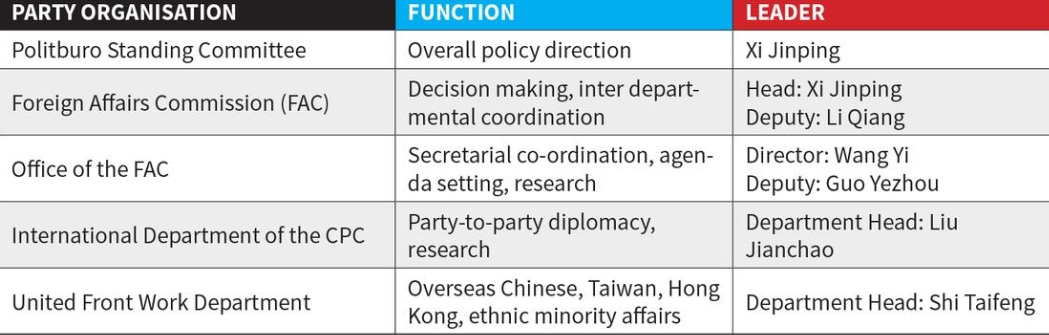
Central Foreign Affairs Commission
under Xi’s leadership, part of CCP
CCP’s dominance while sidelining the Ministry of Foreign Affairs
leader: Wang Yi even though Xi is the official leader
complex bureaucratic system
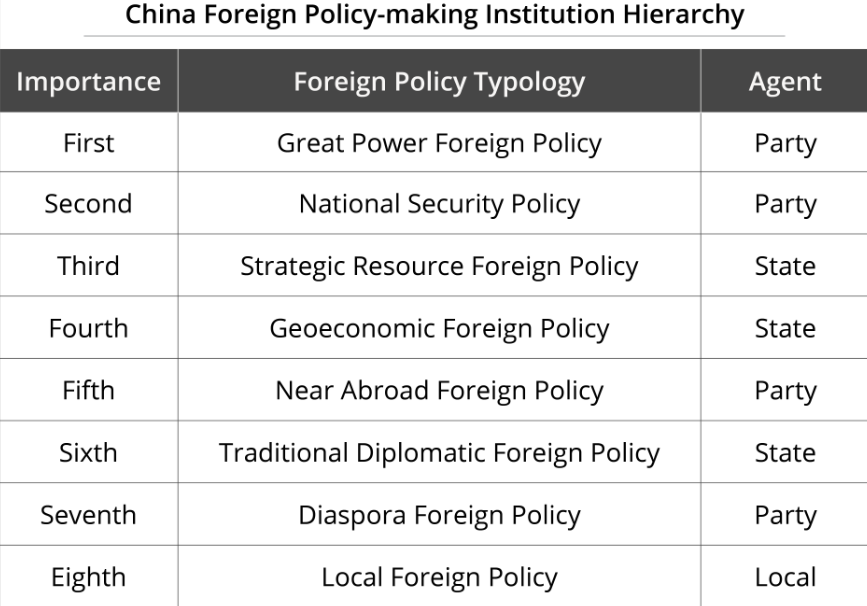
· 1. great power foreign policy – by Xi – elevating China to the same level of the US
· International Liaisons – de facto decision maker of the party (not the gov.)
· Belt and Road Leading Group
· 2. National Security Foreign Policy
o Nat. Sec. Commission (leader XI)
o Defense, PLAGF, PLAN, PLAAF, Rocket Force
o PLA most active in China’s neighborhood – impact on foreign policy there
· 3. State Foreign Policy – Strategic Resource Foreign Policy
o natural resources – maritime, island, mineral, transport, coast guard, agriculture
· 4. Geoeconomic Foreign Policy
o belt and road, stb
o Minister of Collars??
· 5. Near-Abroad Foreign Policy
o Politics and Legal Affairs Commission – secretary, armed police, public and state security
o border control, terrorist groups, minority groups (state security)
· 6. Traditional Diplomatic Foreign Policy
o what the Minister of Foreign Affairs does – Wang Yi
o part of this is the Ministry of Foreign Affairs – much smaller significance than in other countries
o Central Europe is actually covered by both the European and Eurasian department (bcz of Soviet background)
· 7. Diaspora Affairs (incl. Hongkong and Macau)
o Overseas Chinese Affairs, Ethnic Affairs Commission
o 30-60 million Chinese living abroad – 2nd biggest
· 8. Local Foreign Policy
o food resources, investment
o departments of border provinces
Major Country Diplomacy Doctrine
China’s ambition for global leadership and norm shaping
promotes an assertive diplomatic stance aimed at redefining international norms
High profile initiatives
Serve to solidify China’s influence globally
shift towards nationalistic foreign policy
Under Xi’s leadership
emphasizes assertiveness in diplomatic engagements and global stances
even though communism is supposed to be internationalistic
US as the external threat
Key institutions:
Ministry of Foreign Affairs
Implement policy, but don’t have the authority to make major decisions
Often sidelined from initial strategy formulation - dominance of CCP
People’s Liberation Army (PLA)
key player - shaping FP, particularly national security and territorial integrity
largest part in the budget
Its involvement emphasizes military considerations (especially Taiwan and South China Sea)
Ministry of State Security (MSS)
internal and external intelligence agency
significantly influence security-oriented foreign policy decisions
very secretive, very influential
Ministry of Commerce (MOFCOM)
sometimes more influential than even the Min. of Foreign Affairs
leads trade negotiations, oversees foreign investments
navigates the intersection of economic interests and diplomatic relations
Propaganda Department and United Front Work Department
shape China’s international image and narrative control
influence public opinion abroad
soft power efforts
Regional Government Engagement
very powerful regional governments
Chinese provinces – limited autonomy, but they can use this to interact with foreign governments (reflects a bottom-up approach)
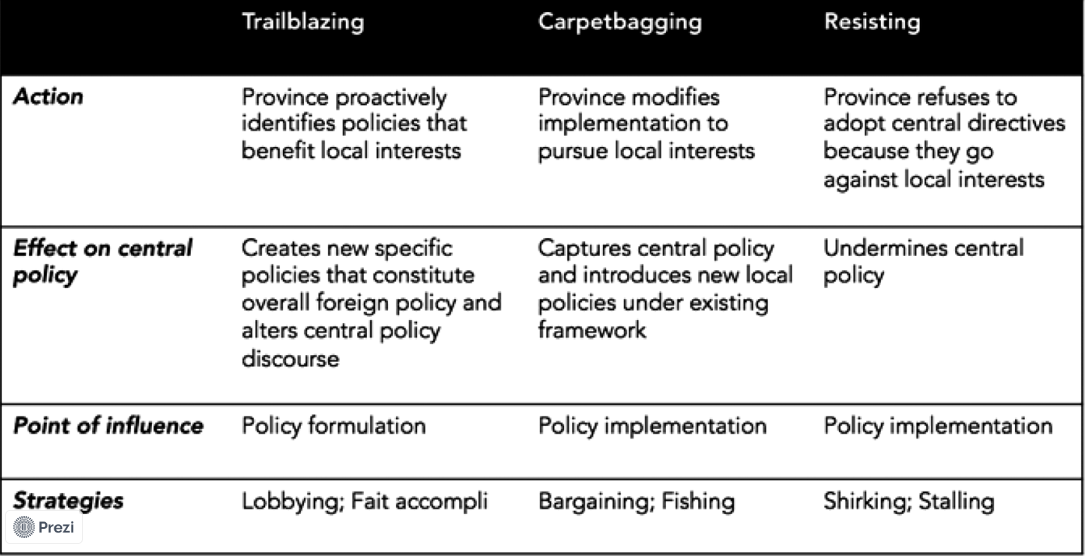
3 types of strategies: trailblazing, carpetbagging, resisting
1. convincing central gov. to start a new foreign policy
2. province modifies implementation to pursue local interests, bargaining
3. province refuses to adopt central directives cuz they go against their interests – so China is not as centralized as people think
EU is somewhat more unified as China
State owned enterprises (SOEs)
bigger say in economy than before Xi
act on behalf of the state but often prioritize commercial interests (leading up to complex relationship with the central authority)
Their autonomy allows them to engage independently in international markets
CEOs elected by the party – they outrank ministers, their rank is the same as provincial governors
relationships with central authority – corporate and governmental functions – hybrid structure
the reason China still couldn’t decrease CO2 emissions even though the central government wants to, is cuz these enterprises don’t want to
Xi Jinping’s Personal Role
Centralization of decision-making
unified direction aligned closely with Xi’s strategic vision
Belt and Road Initiative (designed to create infrastructure between China and Eurasia) – not that important anymore though
Major initiatives linked to Xi’s Vision
Major initiatives exemplify his vision for China as a global leader
Promoting an alternative model compared to the Western ones
Impact of foreign policy direction
centralized approach → assertive and nationalistic policy
‘Wolf Warrior’ diplomacy – significant departure from previous paradigms emphasizing sovereignty and national interests over diplomacy and compromise
strategic patience nowadays – don’t engage with the US – no provocation reaction – China thinks time is on their side (like thinking the trade war will hurt the US more and faster than China)
expressing they are not in a hurry to engage with the US
Coordination and Challenges
Bureaucratic Turf Battles
FP landscape is characterized by intense rivalries in China – agencies compete for resources and influence
Lead to fragmented policy-making
→ diminishing overall coherence in foreign policy direction
authoritarian bureaucracies tend to turn chaotic
Asymmetric information flow
Lower level receive filtered info from their superiors leading to gaps in understanding the strategic intentions of top leaders, hindering effective implementation of policies
Institutional reforms for better coordination
Recent reform: establishment of the National Security Commission
Never effective
Even more complicated
Domestic and International Drivers
o nationalism
o CHINESE SOCIAL CONTRACT – stay out of politics, in turn we will make the economy and living standards better and better for you
§ but today it doesn’t grow as much anymore, but now China is a global power
· regime survival and legitimacy – 1 constant: the party thinks that this is the priority, most important (party survival)
· nationalism and sovereignty – playing pivotal role in shaping China’s foreign policy decisions, especially surrounding Hongkong and Taiwan – asserting sovereignty over these territories is of great importance – double edged sword (what if they can’t keep the promise? – could lead to war or facing their on people’s dissatisfaction)