Polling In Input-Output Systems For Operating Systems
Polling in Input-Output Systems for Operating Systems
Polling is a technique used in operating systems to manage input-output (I/O) devices efficiently.
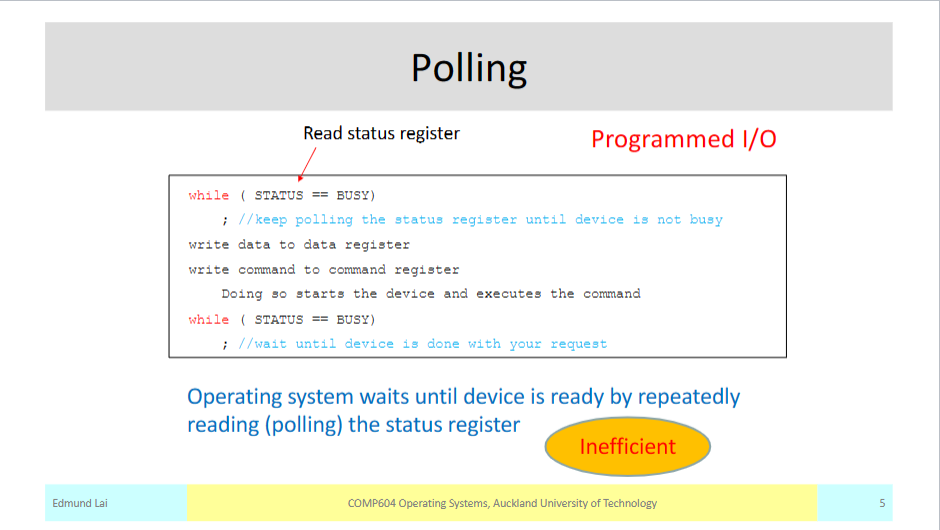
It involves the operating system continuously checking the status of I/O devices to determine if they are ready for data transfer.
The process of polling typically follows these steps:
The operating system sends a request to the I/O device to check its status.
The device responds with its status, indicating whether it is ready for data transfer or not.
If the device is ready, the operating system initiates the data transfer process.
If the device is not ready, the operating system continues to poll the device until it becomes ready.
Polling can be implemented using different techniques:
Busy Waiting: The operating system continuously checks the device status in a loop, wasting CPU cycles.
Interrupt-Driven: The operating system sets up an interrupt handler that is triggered when the device becomes ready, allowing the CPU to perform other tasks until the interrupt occurs.
Programmed I/O: The operating system uses programmed I/O instructions to check the device status periodically.
Polling has advantages and disadvantages:
Advantages:
Simplicity: Polling is relatively easy to implement and understand.
Control: The operating system has direct control over the I/O devices.
Disadvantages:
Wasted CPU cycles: Busy waiting can consume CPU resources while waiting for I/O devices.
Inefficiency: Polling can lead to delays in data transfer if the operating system does not poll frequently enough.
Limited scalability: As the number of devices increases, the overhead of polling can become significant.
To overcome the limitations of polling, alternative techniques like interrupt-driven I/O and DMA (Direct Memory Access) are commonly used in modern operating systems.
→Detailed notes below:
Polling in Input-Output Systems for Operating Systems
Polling is a fundamental technique used in operating systems to efficiently manage input-output (I/O) devices. It involves the continuous checking of the status of I/O devices by the operating system to determine if they are ready for data transfer.
The process of polling typically follows a series of steps. First, the operating system sends a request to the I/O device to check its status. The device then responds with its status, indicating whether it is ready for data transfer or not. If the device is ready, the operating system initiates the data transfer process. However, if the device is not ready, the operating system continues to poll the device until it becomes ready.
Polling can be implemented using various techniques, each with its own advantages and disadvantages. One such technique is Busy Waiting, where the operating system continuously checks the device status in a loop. While this approach is relatively simple to implement and understand, it can lead to wasted CPU cycles as the CPU is occupied while waiting for I/O devices.
Another technique is Interrupt-Driven polling, where the operating system sets up an interrupt handler that is triggered when the device becomes ready. This allows the CPU to perform other tasks until the interrupt occurs, reducing wasted CPU cycles.
Additionally, Programmed I/O can be used, where the operating system periodically checks the device status using programmed I/O instructions. This technique strikes a balance between simplicity and efficiency.
Despite its advantages, polling also has its limitations. One major drawback is the potential for wasted CPU cycles in busy waiting, which can consume valuable CPU resources. Moreover, polling can lead to delays in data transfer if the operating system does not poll frequently enough. As the number of devices increases, the overhead of polling can become significant, limiting its scalability.
To overcome the limitations of polling, modern operating systems employ alternative techniques such as interrupt-driven I/O and DMA (Direct Memory Access). These techniques allow for more efficient and scalable data transfer, reducing the reliance on continuous polling. Interrupt-driven I/O utilizes interrupts to signal the operating system when an I/O device is ready, allowing the CPU to perform other tasks in the meantime. DMA, on the other hand, enables I/O devices to directly access system memory, bypassing the CPU and further enhancing efficiency.
In conclusion, polling is a crucial technique in operating systems for managing I/O devices. While it offers simplicity and control, it also presents challenges such as wasted CPU
Key Information:
Polling is a method used in input-output systems for operating systems.
It involves the CPU repeatedly checking the status of devices to determine if they need attention.
Polling can be done in a synchronous or asynchronous manner.
Synchronous polling involves the CPU waiting for a response from a device before moving on to the next one.
Asynchronous polling involves the CPU checking the status of multiple devices simultaneously.
Polling can be inefficient as it requires constant CPU involvement.
It can lead to high CPU utilization and increased response time.
Interrupt-driven I/O is an alternative to polling that reduces CPU involvement.
Interrupt-driven I/O allows devices to interrupt the CPU when they need attention.
This allows the CPU to perform other tasks while waiting for device responses.