Wk 6: Colour perception, colour mixing and types of colour vision
6a: Colour perception
how colour info is encoded
colour mixing
metamers
models of colour processing
retinal based colour ‘blindness’
tests of colour abnormalities
colour blind visual processing
ways to define diff colours
colour - perceived colour
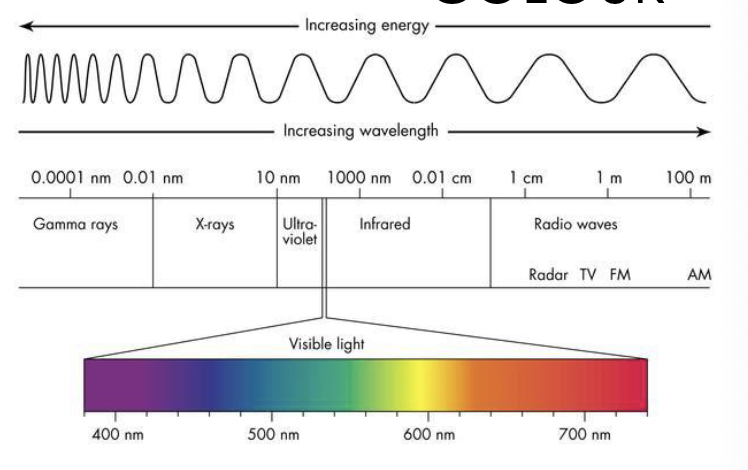
defined by wavelength \lambda lambda
EMR: electromagnetic radiation
energy that travels in waves and includes a broad spectrum
visible 400-700 nm (10^-9m)
wavelength order: ROY G BIV
red, orange, yellow, green, blue, indigo, violet
definitions
hue:
the actual colour
e.g. red, green
saturation:
amount of colour relative to white
great saturation = great vividness
less sat = washed out colour
brightness
light intensity
narrow or broadband
cells that mediate (bring about) colour perception can either be broadband or narrow band
narrowband:
sensitive to a narrow stimulus dimension
cell responds strongly to a narrow range of wavelengths
typically tuned to a specific colour
broadband:
sensitive to a broad range of stimulus dimension
cells respond to a wide range of wavelengths
often spanning multiple colour channels
drawback of a narrowband system
need lots of cells to encode the entire stimulus dimension
low sampling density
with more cell types spread out across the retina, each type becomes less densely packed
hence low spatial resolution
fine details not detected well
poor spatial acuity
because each cone type is spaced further apart, the system struggles to resolve small or closely spaced visual features
this is especially problemati in tasks requiring sharp vision
e.g. reading or detecting edges
tuning of individual cones
individual cones are tuned/selective to colour
specific cones need to feed into specific colour-sensitive retinal-ganglion cells to give them their specific colour sensitivity
these specific RG cells feed into specific colour sensitive v1 cells
individual cones are not tuned to orientation or motion
v1 simple cells are tuned to orientation so that means a given cone can feed into many simple cells that are tuned to different orienations
same for complex cells that are tuned to motion
reasons why the brain can have narrow-band tuning for orientation and motion and not impair spatial acuity for those stimulus dimensions
### 🟥 1. What cones are tuned for: Colour
- Cones = colour detectors in your retina (red, green, blue types).
- Each cone connects to a specific retinal ganglion cell that’s sensitive to colour.
- These ganglion cells then pass colour information to V1 cells (in the brain’s visual cortex) that are also tuned to colour.
- 🔑 Key idea: Colour sensitivity is preserved all the way from cone → ganglion cell → V1 cell.
---
### 🟦 2. What cones are not tuned for: Orientation or Motion
- Cones themselves don’t care about which direction a line is tilted (orientation) or whether something is moving.
- But V1 cells do care about those things:
- Simple cells in V1 are tuned to orientation.
- Complex cells in V1 are tuned to motion.
- A single cone can send signals to many different V1 cells, each tuned to different orientations or motion directions.
- 🔑 Key idea: This setup allows the brain to be very precise about orientation and motion without losing detail (spatial acuity).
---
### 🧠 Summary
- Colour tuning starts early (at the cone level) and stays specific.
- Orientation and motion tuning happen later (in the brain), using flexible input from cones.
- This division helps the brain process different visual features efficiently without overlap or loss of detail.
---
Let me know if you’d like a diagram or analogy to go with this—like a “cone-to-brain” signal pathway or a metaphor for how tuning works!
broadband and narrowband: effect on mixing
mix stimuli that are processed by a broadband system
e.g. add red and green together, you’ll perceive a new colour - yellow
broadband systems blend input into one unified perception
mix two stimuli that are processed by a narrowband system
e.g. combine vertical and horizontal linesm you’ll perceive both line separately
these systems don’t blend
they keep distinct features apart
pooling of broadband and narrow cells
how the outputs of those cells are pooled
applies to cells that are looking at the same region of visual space
broadband tuning
e.g. colour
total population average
relative activation of the three cone types
narrowband tuning
e.g. orientation and motion
local populaiton average of cells tuned to similar orientations
but not cells tuned to markedly different orientations/direction
only pool output from cells that are processing that stimulus and so depends upon the tuning bandwidth of the cells
population response
definition: how a group of neurons responds to a stimulus. The shape of the response (unimodal vs bimodal) depends on how neurons are tuned (broadly or narrowly)
broadband tuning
neurons respond to a wide range of stimulus types
e.g. colours
when you mix colours, the brain looks at the relative activation of these cones
create a unimodal response
one clear peak of activity
you perceive a single colour as a result
narrowband tuning
responds to very specific stimuli
e.g. line andle or motion direction
bimodal response
two separate peaks of activity
result: perceive both stimuli distinctly
when is a stystem narrow or broadband?
spectrum: energy at each wavelength for a given light
monochromatic light: light of a single wavelength, spectrum is a spike at that wavelength
composition of white light
can create white light with 2 complimentary colours
3 correctly chosen colours can generate all colours
major colour in the spectrum
red, orange, yellow, green, blue, indigo, violet
ordered in terms of decreasing wavelength.
6b: Colour Mixing
what do we perceive when we add diff colour together
how does the brain process colour iinfo
metamers: physically diff stimuli but perceived the same
colour mixing studies tell us: people determined how the colour system worked
behavioural studies tell us: a function map of the system
metamers
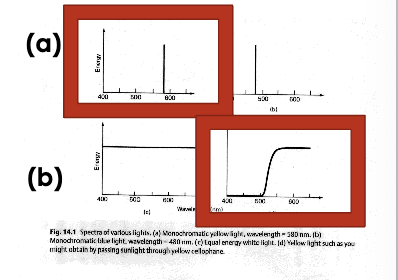
e.g. yellow
spectral yellow
a single wavelength of light (a)
mixed yellow
combine multiple long-wavelength light (red+green) (b)
why this happens
our visual system uses three types of cones (red, green, blue)
diff light combinations activate these cones in the same way
hence we perceive the same colour
types of colour mixing
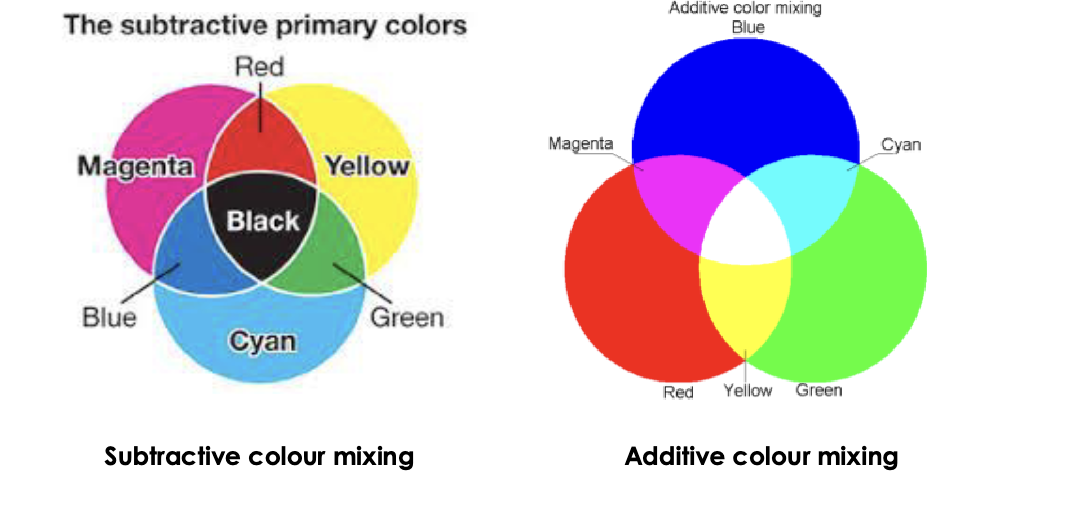
mixing type | additive | subtractive |
medium | light sources | pigments/filters |
primary colours | red green blue | cyan magenta yellow |
result of full mix | white | black/dark |
perception mechanism | combined cone activation | reflected wavelength after absorption |
additive mixing
primary colours: RGB
combining light sources of different colours
resultant spectrum is the sum of the component spectrums
more light in the mixture than in the components
brain interprets the combined cone activation as a new colour
methods
projection
project different colour onto the same region
spatial summation
project to points in close proximity
e.g. red, green, blue points of light that are so close together the brain can’t spatially resolve them, so the brain averages them
like a TV/phone scren
temporal summation
temporally interleave different colours faster than the brain can resolve them
faster than our temporal acuity limit
the brain adds up signals that arrive close together in time
if brief flashes of light occur rapidly enough, they’re perceived as continuous or brighter
if diff colours are flashed quickly in sequence, the brain can average them over time
subtractive mixing
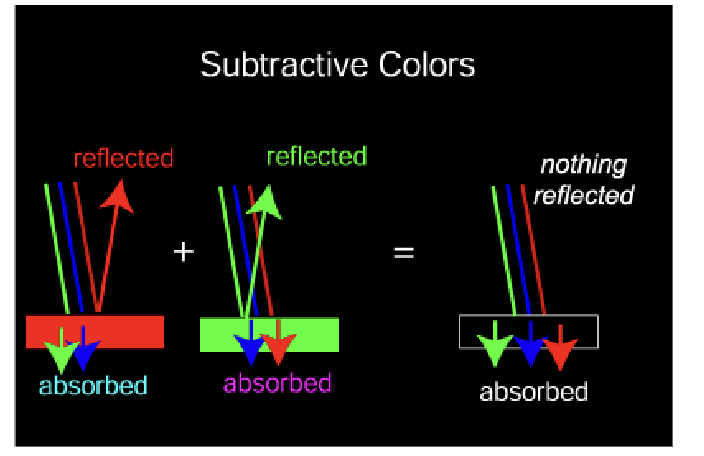
primary colours: CMY cyan magenta yellow
light is removed, so there is less light in the mixture than in the components
only the light that is common to both components remain
combining materials that absorb certain wavelengths
perceives wavelengths that are left over after absorption
methods
add colours to remove light
less light in the mixture than in either component
e.g. adding paints together, stacking lenses together
mixing the spectral colours
what if we mix all ROYGBIV colours
colour matching
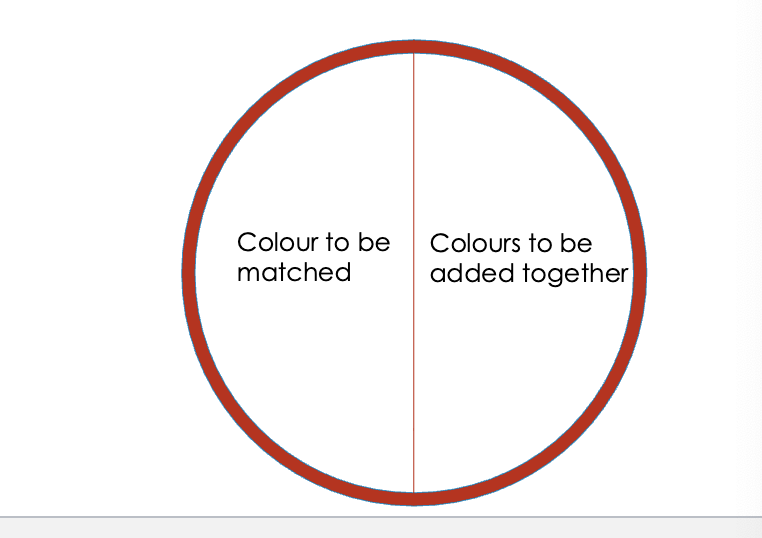
process of recreating a target colour by combining other colours
minimum no. of primary colours
3 to maky any colour
2 to make white
implications for colour mechanisms
for people with standard colour vision, any colour can be matched by three appropriately chosen primaries
related to having three cones types
long, medium, and short LMS lambda sensitive
also called RGB
6c: Types of Colour Vision
consider the type of vision a person would have if they had one, two or three diff cone types
monochromatic vision
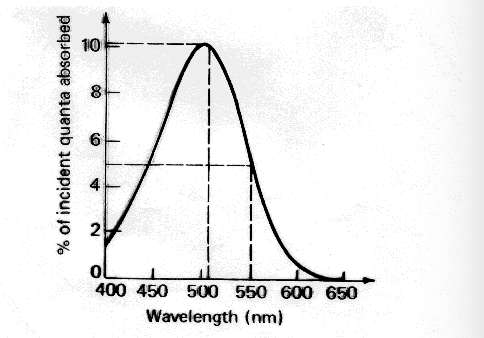
only one type of cone
this system cannot discriminate colours, only light intensity
the response of the receptor to diff wavelengths can be matched by varying the relative intensities of the lights
e.g. it might abosorb more light at 500nm than 550nm
a dim light at one wavelength can produce the same response as a brighter light at another wavelength
e.g. 500nm has same response as 550nm with twice the intensity
can only encode intensity: black and white vision
shades of grey
similar to how the rod system works
monochromatic light at neutral point will drive them both equally
ratio of response 1:1
monochromatic light at neutral point is perceived as white
white light also drives both types of detectors equally and so is signalled b relative activity of 1:1
dichromatic vision
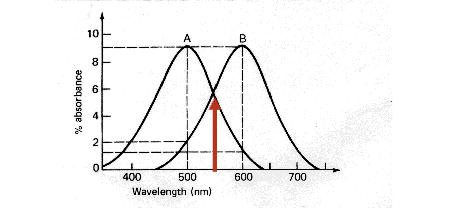
two types of cones
can encode colour
limited range of distinct colours that can be perceived
only two distinct colours
need only two primaries to match any colour
presence of a neutral point
wavelength at which the two curves cross over
excites both receptors equally
trichromatic
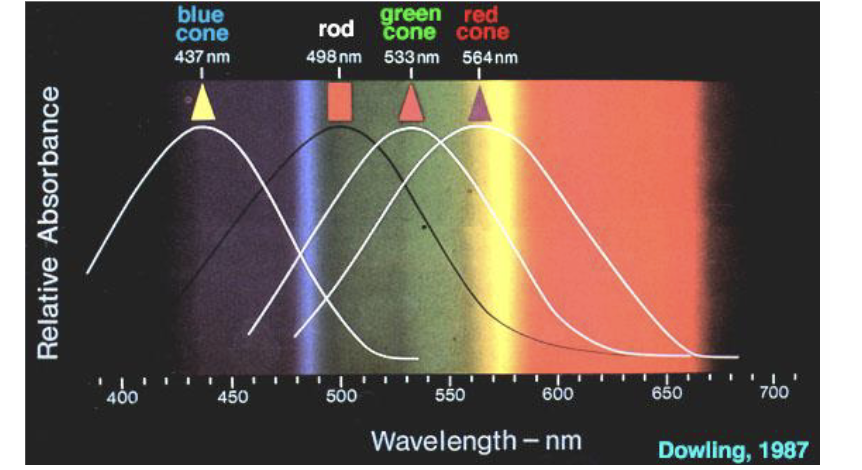
colour perception based the relative activity of three receptor types
need three primaries to match all colours
no neutral point
no wavelength excites all receptors equally
tetrachromatic
four types of cones
affects on human colour perception
subdivide the spectrum into more bands (10 vs 7)
trichromatic theory
three types of ‘fibres’ in the eye
perceived colour is based on the ratio of LMS activity
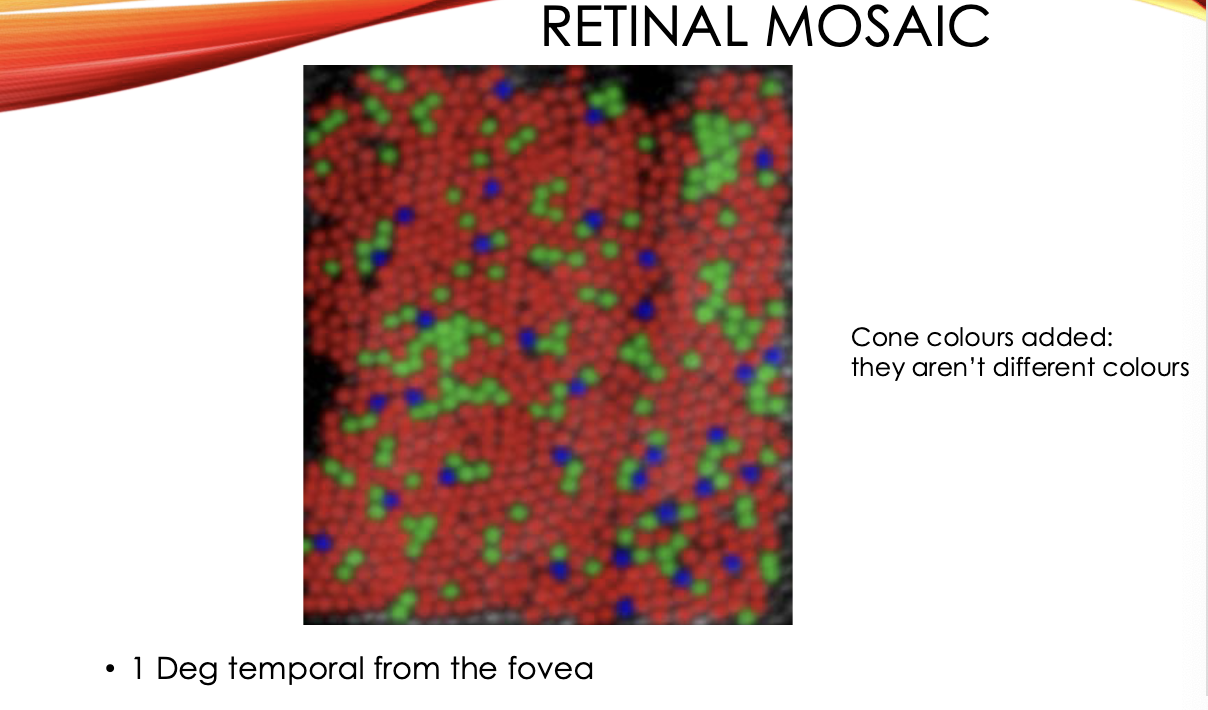
physical ratio of LMS cones are about 32:16:1
results that can’t be accounted for by trichromatic theory
colour afterimages
e.g. view red, green afterimage
colour naming
asked to assign a name to monochromatic lights
can’t describe all colours using RGB
need to add Y
can’t get certain combinations
e.g.can’t get RG but can get RB
opponency model
colour vision is mediated by three opponent mechanisms
opponent channels:
red, green
blue, yellow
white, black
trichromacy vs opponency
pairing
opponent | cone |
red, green | LM |
BY | S, ML |
white, black | LM, LM |
our colour perception is based up
having three cone types and their relative activation
opponent mechanisms is how the brain encodes their relative activity
note RGB the same as LMS
LMS often used to make it clear that they are not only sensitive to RGB
colour bliind processing
Magnocellular and parvocellular distinction
M: only luminance sensitive (colour blind), no colour info
P: colour and luminance sensitive