prechewed politics socialism notes (from videos)
what are the origins of socialism?
utopian origins of socialism
Robert Owen (1771-1858): welsh social reformer + utopian socialist
tested socialist ideas in increasingly grand experiments
labelled ‘utopian’ socialist by Marx, who argued earliest socialists had goals + methods that, while appealing, were naive + lacking scientific/historical basis
became factory manager in early 20s + horrified by working/living conditions of employees, extent their lives plagued by alcoholism, theft + violence
Robert Owen: New View of Society (1813)
‘‘each individual man forms his own character…therefore he is accountable for all his sentiments and habits, and consequently merits reward for some + punishment for others”
Owen proposed alternative theory…
“the character of man is, without exception, always formed for him”
those grown up in poverty w/out access to education + opportunity inevitably shaped into v/ diff people, w/ diff characters to those grown up in supportive, wealthy families.
1799, Owen purchased large cotton mill in New Lanark, Scotland - gave opportunity for him to test out ideas
employed 2000+ people, lived in isolated village far from neighbouring towns + cities
when O. became manager - “found the population…similar to that of other manufacturing districts” was “with some exceptions, existing in poverty, crime and misery”
upgraded the existing housing, built new homes that were vastly superior to those that most mill workers would have enjoyed
environmental improvements were also made, w/ better sanitation + water supplies, new gardens, allotments + public walkways
found children young as 5, working 13hrs/day - banned employment of children under 10, reduced working hours for older children to max. 10hrs/day
started world’s first nursery, required all children to attend newly established school - offered comprehensive curriculum. children not just reading + writing but lessons in geography, history, playing music, dance + sing
cut adult working hours, asked workers to contribute 1/60 wages to cover medical insurance, pensions, sick pay
founded Institute for Formation of Character for adult education, social activities….
New Lanark had company-owned village store - workers paid in labour tokens, not cash - could be redeemed only at the store. instead of exploiting, Owen used buying power to purchase quality goods at low price - profits used to fund education
O. invented ‘silent monitor’, painted wood block hanging beside each worker - indicating how hard-working. scores marked down in log-book w/ similar ratings for character + behaviour outside work
Curfews + random searches prevent theft - patrols made through village at night + drunk fined. Inspectors checked homes kept clean, O. recquired all children be educated by community not families
Classical liberals likely raise concerns about impact on NEGATIVE FREEDOM - mill’s workers were not entirely happy with Owen’s more controversial reforms
O. would have considered reforms to have promoted POSITIVE FREEDOM - won many over when paid wages even when production forced to stop
didn’t just make changes at N.Lanark bc he thought morally right… also thought happier, healthier workers would produce more even if worked shorter hours
mill’s financial success led curious visitors globally to come + see experiment
1813-1816, focused on achieving his ends by legislative means
Lobbied in parliament to:
raise taxes + increase spending on the poor
ban employment of children under 10
limit working hours for children under 18
introduce new national system of public education
Parliament + other factory owners reluctant to support reforms
Report to County of Lanark (1820)
called for creation of new self-sufficient villages of cooperation, 800-1200 people work + live tgt in farming/manufacturing
families have apartments in large buildings, communal sitting rooms, kitchens, schools + libraries open to all
children over 3 board at village school, where taught curriculum O. hoped promoted good character
wages replaced by system of labour notes - treated all work equally - could be exchanged for goods community produced.
O. failed to raise funds needed for new communities - decided to fund one himself.
travelled to America, purchased town called Harmony, Indiana from religious group that founded it 10 years earlier
renamed New Harmony - invited anyone interested to join experiment, attracted wide variety of people, from working-class farmers + labourers to scientists, philosophers, teachers, journalists excited by vision
those who moved in allowed to live free in buildings Owen purchased. Food + commodities produced sent to village store operated as a non-profit. Work rewarded w/ labour notes - exchanged for goods handed to village store
O. only lived there for few months - spent most of his time travelling world, promoting ideas. town couldn’t agree how to put ideas into practice - had 7 constitutions in just 2 years. lower + upper-class residents often clashed, coming from diff backgrounds/cultures.
attracted range of religions + cultures that often clashed - “members were too various in their feelings and too dissimilar in their habits to govern themselves harmoniously as one community” (Owen’s SON)
committees supposed to democratically decide things like what to plant, what to make - often disagreed on simple matters (would have been easier decided by individuals managing own land/factories)
town failed to attract sufficient no. skilled labourers, who could seek ↑ individual wealth elsewhere. BUT did attract no. people more interested in offer of free accommodation + goods
After NH failure, Owen moved back to Britain, tried to achieve socialist ends by 3 other means:
cooperative stores
labour exchanges
trade unions
Cooperative Stores
Inspired by NL village shop, co-operative stores began establishment mid 1800s - owned collectively by ordinary members not few rich shareholders, prioritised selling local goods at fair price
profits reinvested/distributed back out to store’s members in dividends
Labour Exchanges
1832, helped found National Equitable Labour Exchange, aim to reward all work equally
like NH, workers bring produced goods + issues notes factoring in cost of materials + hours worked
labour notes used to purchase other goods + valued in terms of working hours + materials
Trade Unions
helped form Grand National Consolidated Trade Union (1834), soon had 1.5mn+ members
organisation only lasted months - businesses + gov responded fiercly + O. had v/ diff views to many union members
O. firmly against strikes + violent protest - his utopia only possible if all classes worked tgt
what did Marx and Engels contribute to socialism?
Karl Marx (1818-1883) german philosopher, historian, economist + social theorist - one of most influential theorists in history
Friederich Engels (1820-1895) german philosopher, journalist + businessman - worked closely w/ Marx + edited/translated much of his work
theory of alienation:
Under capitalism, we work in ways that separate us from humanity
Workers alienated under capitalism, separates them from ‘species-essence’ - from own humanity
“free conscious activity is man’s species-character”
Capitalism alienates workers from…
products of their labour
process of labour
species-essence (humanity)
other people
Products of labour
workers spend time making things not useful. to them, bc don’t belong to them. products taken away + sold to others, possibly in shops w prices too high for them to afford
Process of labour
pre-industrial revolution, skilled craftspersons would make items step-by-step/start to finish…factory production line efficient but less fulfilling - workers repeat simpler, alien tasks w/ little meaning
Species-essence (human nature)
“conscious life activity directly distinguishes man from animal life activity” - human labour can be conscious + creative. under capitalism, work is basic + animal-like - means to an end, rather than expression of humanity
Other people
humans all part of global cooperation system - rely on labour + contribution of others. capitalism: fail to see + appreciate these connections, see others as competitors/rivals
Like Owen, M+E believed human character, beliefs + ideas influenced by environment BUT M. criticised O. for treating people as machines that could be improved w/ right rules, lessons + conditions
“social existence determines their consciousness”
type of society we live in, social class we belong to, daily activities + relationships w./ others that fundamentally shape us
to build better society, isn’t enough to try to convince wealthy to raise wages, build schools + improve conditions…change requires revolution (fundamentally transforms society by changing way humans work together to produce material goods)
historical materialism
human history is story of increasing productive capacity - way goods are produced impacts all aspects of society
until Marx history of making seen largely as series unconnected events, driven forward by accidents, key historical figures + influential ideas
M. said humans clearly progressed through series of stages…each shaped by way it produced material goods
primitive communism → slavery → feu
dalism → capitalism → ?
all human societies have had to produce material goods to survive so societies must work out how to best produce essentials of life before can devote time to laws, culture etc.
each stage of history shaped by distinct
means of production
methods society uses to produce material goods
determined by the tools, technology, human knowledge + skills available at that time
e.g. agricultural production
relations of production
social relations that form as result of this production
class divisions develop based on ownership of means of production
e.g. feudal lords and peasants
“the history of all hitherto existing societies is history of class struggle”
primitive communism: hunter gatherers cooperate with hunter gatherers
slave societies: slave owners exploit slaves
feudalism: aristocracy explot peasants
capitalism: bourgeousie exploit proletariat
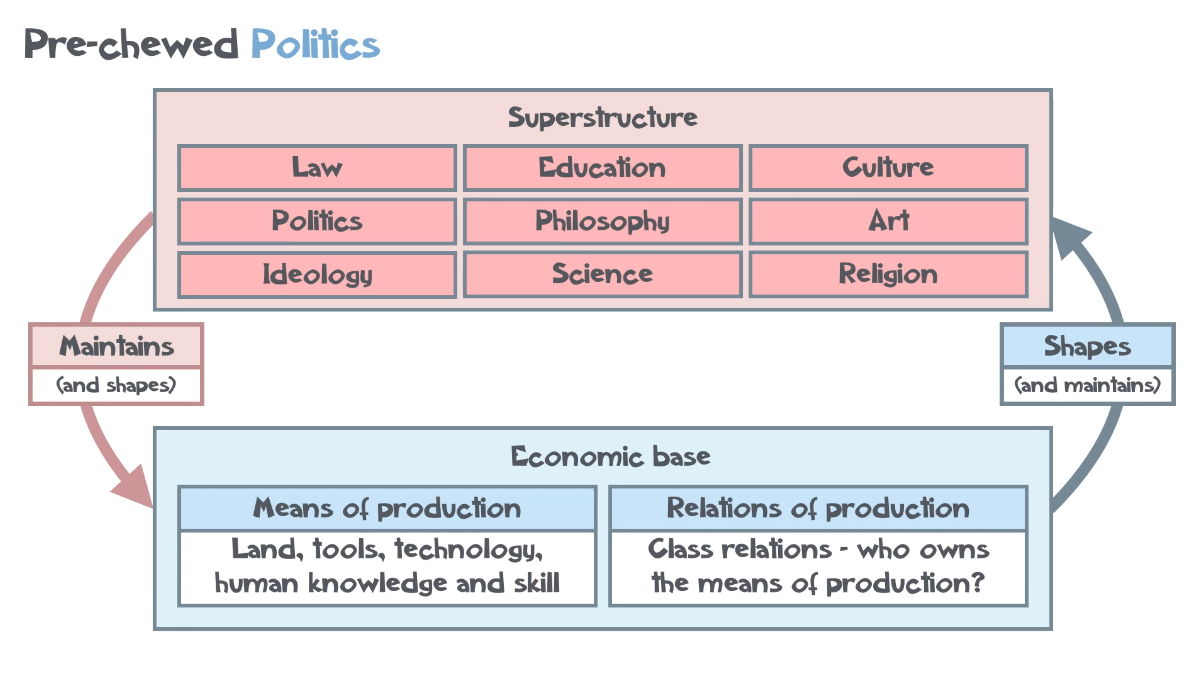
capitalist-dominated superstructure promotes ideology that instills
false consciousness: proletariat (working classes) unable to see they are being exploited
“ideas of the ruling class are in every epoch the ruling ideas”
feudal superstructure | capitalist superstructure |
religion stressed kings divine right to rule + own land + importance of feudal hierarchy | parliament passed Enclosure Acts allowing landowners to fence off + privatise common land |
culture encouraged in peasants, sense of duty + obligation, rather than individualism + self-interest | culture stressed new virtues of individual self-interest, negative freedom + equality of opportunity |
laws bound peasants to land, gave nobles secure labour supply | feudal hierarchy said to have been replaced by fair meritocracy |
historical materialism holds that it is the production of material goods that had most fundamental impact on history development, outweighing ideas, religion, politics etc.
dialectal materialism
all change results from opposing forces - it is class conflict + economic contradictions this creates, that drives history forward
dialectics: method of reasoning made famous by German philosopher Hegel
M. took idea of incompatible forces driving change but believed it was economic forces, not ideas that drove human progress - applied it to material world
dialectal materialism: dialectal conflict in economic base (way societies produce material goods) that ultimately drives history forward
each stage of history built upon conflict - rival classes wanting incompatible things
e.g. hunter gatherers v rival tribes, slave owners v slaves, aristocracy v peasants
M. said eventually…
existing ‘relations of production’ → fetter → new ‘means of production’
feudal relations, feudal land laws etc. → fettered → growth of new industrial technology
when this happens, society enters “era of revolution” where old ruling class is replaced by new rising class
part two: in summary…
Theory of Labour Value: commodities have use-value and exchange value. which is determined by amount of labour necessary to produce them
Theory of Surplus Value: workers are exploited bc they are forced to sell their labor power for less than full value of commodities they produce
Dialectal materialism: capitalism is rife with dialectic conflict, workers want higher wages and lower working hours, while capitalists must increase efficiency + cut costs to remain competitive, all while relying on others to pay workers enough to buy their products - such tensions can leas to crises caused by overproduction
Class consciousness: Marx said with wages tending to drop to subsistence levels + economic crises becoming ever more severe, it was only matter of time before increasingly large urban proletariat developed class consciousness
Revolution: necessary if workers are to completely abolish capitalist, bc ruling class dominates superstructure + will resist gradual efforts at reform
Socialism + Communism: transitionary socialist stage follows capitalism in which dictatorship of proletariat paves the way for final, communist stage of history - “From each according to his ability, to each according to his needs”
core ideas of socialism: in summary…
Equality - foundational + formal equality greatly undermines + real equality of opportunity is not possible w/out greater equality of outcome
Social Class - class is most important division in society, divisions need to be either reduced through taxation + redistribution, or abolished all together
Common Humanity - all humans have common interests - we should look at others as ‘brothers’ and cooperate w/ + support each other
Collectivism - superior to individualism both morally (good to put collective interest above self-interest) + economically (cooperating towards common goals can produce more than wasteful, crisis-prone, free market competition)
Common Ownership - private property creates divisions between ‘haves’ and ‘have notes’ + encourages materialism - common ownership (nationalisation, redistribution etc.) is means through which socialist goals can be achieved
Workers Control: workers alienated under capitalism, should have more influence over work - as is fundamental part of life
what is revolutionary socialism?
what is the end goal of socialism?
fundamental socialists: believe socialism requires overthrow of capitalism + end of private property, class divisions
revisionist socialists: believe that fairer, more equal socialist society can be achieved w/out abolishing capitalism
what is the best path to socialism?
revolutionary socialists: believe socialism requires revolution that completely sweeps away existing system
evolutionary socialists: believe socialism can be achieved gradually, peacefully + lawfully through existing political system
in summary…
improved economic conditions + victories by trade unions + elected representatives led evolutionary, revisionist socialists like Bernstein to argue that capitalism could be peacefully reformed - no need for revolution
Luxemburg disagreed, argued Bernstein wasn’t suggesting diff path to socialism but entirely diff goal - capitalism can’t be improved, is inherently exploitative - state isn’t neutral + must be overthrown
Dialectic of spontaneity + organisation - mass direct action is essential to revolution - workers must develop class consciousness + can only be done by directly participating, it cannot. be decreed by party leaders
The Vanguard Party - Luxemburg criticised Lenin’s belief that revolutionary elite was needed to lead + defend revolution + ensure workers developed class consciousness, rather than trade union consciousness
Socialist democracy - Luxemburg believed that local democracy of workers’ and soldiers’ councils was essential to socialism - she feared that in Russia, dictatorship of proletariat was fast becoming dictatorship of party elite.
what is evolutionary socialism? in summary…
Evolutionary/democratic socialism - socialist reforms can + must be brought about gradually, peacefully + constitutionally through parliament
Webbs’ socialism: inspired far more by Owen - thought Marx’s theories were flawed + belief in revolution was utopian
Inevitability of gradualism - people already taking collective steps towards socialism by forming co-operatives + unions, extension of franchise would allow socialist MP’s to use neutral state to accomplish socialist goals
Cooperatives - cooperative federalism is superior to cooperative individualism bc factors in needs of community rather than partic. workers
Trade Unions - still essential to represent producers, who might otherwise go overlooked by consumer co-operatives + local/state governments
Municipalisation and Nationalisation - to ensure ‘National Minimum’ some services must be available to all - should be run by elected officials + expert civil servants in public interest, paid for by taxes on wealthy
what is social democracy? in summary…
Social democracy - emerged after WWII as revisionists began to argue that socialism should reform, not abolish, capitalism - characterised by Keynesian economics, a mixed economy + welfare state to redistribute wealth
End of 19th century capitalism - Grosland argued that new era of managed capitalism was fundamentally diff to system Marx had critiqued
Limits of nationalisation - Grosland argued soviet russia + Britain’s experience of nationalisation, showed that collectivism did not necessarily result in more free, democratic, equal, classless, prosperous, worker-led society
Equality as core of socialism - Grosland argued socialist aim with most relevance was equality - nationalisation was only method, not key aim
Education - Grosland felt that class divisions were created not only by unequal incomes, but ‘interacting triad’ of education, style of life + occupational status - wanted well funded comprehensive to give pupils equal opportunities
Redistribution + state-managed capitalism - Grosland wanted new wealth taxes to redistribute inherited property/wealth + fund public services - also wanted state to manage economy + promote investment/growth
What is the Third Way? in summary…
neither the old left not New Right have answers to major revolutions of time - globalisation, transformation in personal life = environment
Triangulation - Third Way sought to find new solutions by combining social justice of social democracy w/ economic efficiency of Thatcherism
Economy - ‘new mixed economy’ seeks synergy between public + private sectors - competition state must ensure UK competes globally
Equality - excessive redistribution discouraes the investment + effort that produces economic growth that funds efforts to expand opportunity
Social investment state - Better to focus on social inclusion by ending poverty traps with positive welfare + expanding education to invest in human capital
Communitarianism - people are unique individuals but identity is fundamentally shaped by our community relationships - we have rights AND responsibilities
Social policy - Gov must play regulative role in both economic + social matters - “"tough on crime, tough on the causes of crime” - cannot ignore consequences of decline of tradition + changes in family life
How do socialists view human nature, society, the state and the economy?
human nature
generally share positive view of human nature - naturally capable of being sociable + fraternal + seek strong community bonds/comradeship
HOWEVER socialists believe that human behaviour is socially determined - right conditions needed for humans to express natural preference for cooperation + collective interest
fundamentalist socialism
revolutionary socialism
we have abundance to once again live in classless society
freed from capitalism, moral + ethical incentives will replace material incentives
capitalism is alienating - work should make us feel our most human
evolutionary socialism
people showing preference for collective action by establishing new co-operatives + unions
economic + moral case for socialism can rationally persuade even existing parties to support socialist aims
revisionist socialism
social democracy
collectivism does not necessarily result in free, equal, democratic worker-led society
salaried manaers not as exploitative + profit driven as C19th capitalist owners
co-operation has become fashinoable
the third way
new individualism - traditional is increasingly challenged by new lifestyles + identities
communitarianism - individuals shaped by their communities
welfare state can influence human nature just as much as capitalism
society
generally believe individuals shaped by their society, as result all socialists share concern about societal impact of capitalism + class divisions that arise from it
all socialists hope to promote greater equality + social justice in society - however various branches tend to understand these terms v/ diff
fundamentalist socialism
revolutionary socialism
class is key division in society - relationship to means of production
historical materialism - means + relations of production shape each stage’s superstructure
dialectal materialism - historical change is driven by class conflict
evolutionary socialism
inspired by owen not marx - brotherhood rather than class war
balance interests of consumers (co-ops), producers (unions) + citizens (gov)
national minimum - poverty is a “disease of society itself”
revisionist socialism
social democracy
equality is core of socialism - social class is still too entrenched
improving education is key to establishing real equality of opportunity
narrow, but don’t abolish class divisions - material incentives can still benefit society
the third way
class is less relevant in increasingly individualistic = post-materialist society
focus on social inclusion + exclusion over egalitarianism
rights + responsibilities - welfare can be as harmful as markets
the state
compared to liberals, socialists generally see much greater role for state, engineering more equal society + managing harmful effects of capitalism
however, diff branches vary wildly in what exactly they want state to do + how state should go about doing it
fundamentalist socialism
revolutionary socialism
revolution - state must be overthrown bc exists. to support ruling class
dictatorship of proletariat - workers seize state apparatus to pass socialist reforms
state will ‘wither away’ under communism
evolutionary socialism
‘inevitability of gradualism’ - universal suffrage makes peaceful change possible
state is neutral - elected + appointed experts + appointed experts can run it in interest of workers
nationalisation and muncipalisation are key
revisionist socialism
social democracy
not all industries benefit from public ownership
state can reform capitalism w/ mixed economy, Kaynesian economics + welfare
state should run public services of such high quality that there’s no diff. w/ private
the third way
market state - should act as facilitator of growth - keep UK competitive.
social investment state - provide positive welfare that invests in human capital + creates jobs
state should play regulative role in both economy + society
the economy
socialists generally agree capitalism has flaws + if left unaddressed social divisions that arise from it will have detrimental impact on society
socialists generally support some form of economic collectivism + degree of state intervention/planning to address flaws of free market capitalism
fundamentalist socialism
revolutionary socialism
exploitation - workers forced to sell labour power for less than value of their labour
private property is divisive, unjust + morally corrupting
“"from each according to his ability, to each according to his needs”
evolutionary socialism
collective ownership through nationalistion, municipalisation, co-operatives and unions
clause IV - “…common ownership of means of production…”
redistribute w/ income taxes + heavy wealth + land taxes
revisionist socialism
social democracy
capitalism provides economic growth that ultimately raises living standards the most
C19th capitalism Marx critiqued no longer exists in Britain
Nationalisation is only single method - equality is core of socialism
the third way
globalisation makes it difficult to rely upon old interventionist methods
knowledge economy - must invest in human resources + devolop an entrepreneurial culture
‘New mixed economy’ - utilise markets in public interest