module 1
What is Marketing?
Definition: Marketing involves activities undertaken by a company to promote the buying or selling of a product/service. It involves advertising.
Marketing professionals aim to capture the attention of potential audiences through advertising.
Targeted Promotions: Promotions are directed towards specific audiences using tactics such as:
Celebrity endorsements
Catchy slogans
Engaging in packaging and design
Increased media exposure
Networking Importance: Engaging with clients through emails, meetings, and social events enhances relationships.
At its core, marketing aims to align a company’s products/services with customer demands, ensuring profitability.
Marketing Communication: Refers to the means companies use to convey messages about their products/brands, either directly or indirectly, to persuade customers.
Used to create brand awareness, influencing purchase decisions.
Marketing Communication Mix/Tools
Why, How, Who, Where, When (can the product be used)?
Includes various approaches such as:
Advertising
Sales Promotion
Events and Experiences
Public Relations
Publicity
Direct Marketing
Interactive Marketing
Word-of-Mouth Marketing
Personal Marketing
These collectively constitute Integrated Marketing Communication (IMC) Tools.
Advertising Overview
Advertising: A paid, indirect method for informing customers about products/services via various media (TV, radio, print, online). Most widely used method → complete information → communicated easily with the huge target audience coverage.
Sales Promotion: Short-term incentives to encourage purchase initiation. Helps in retaining existing customers but also attracts new ones. (Sales promotion tools → rebates, discounts, paybacks, Buy- one –get- one free scheme, coupons)
Events and Experiences: Brands sponsor events to enhance brand visibility (reinforce their brand in the minds of the customers and create a long-term association with them) and customer loyalty.
Public Relations: Engaging in social initiatives to generate a positive brand image.
Publicity: Publicity is to publicize a product, service or company to provide information. It is what others say about a product.
Direct Marketing: Direct communication with customers, often through digital means.
Interactive Marketing: Gaining feedback from customers via online engagements.
Word-of-Mouth: Most widely practised method → image of the brand depends on what the customer feels about the brand and what message he conveys to others.
Personal Selling: Direct interaction between sales personnel and customers to inform and persuade. (done directly either orally, i.e., face to face or in writing via emails or text messages.)
Advertising
According to the American Marketing Association (AMA):
“Advertising is any paid form of non-personal presentation and promotion of ideas, goods and services by an identified sponsor”
According to John.S.Wright:
“Advertising refers to controlled, identifiable information and persuasion through mass-communication media”
Objectives:
Build brand image and goodwill.
Stimulate buying impulse.
Introduce new products.
Support sales efforts and target new customer segments.
Tap the memory of existing customers.
Counter competition effectively.
Reinforce customer loyalty and brand recall.
Characteristics:
A commercial activity.
It is a sponsored communication.
Lacks personal elements.
Carried out to target and attract a large group of consumers.
Encompasses research, planning, coordination & execution of activities.
A key component of the promotion element of the marketing mix.
Highly persuasive.
Functions:
Preparing the ground for new products.
Creation of demand.
Facing competition.
Act as a competitive weapon.
Informing the changes to customers.
Build a brand image.
To lower prices.
Jagdish N Seth 4 primary sequential functions of advertising:
Precipitation, Persuasion, Reinforcement, Reminder.
Classification of Advertising
It can be classified on the basis of:
Function:
Informative Adv: informs the customers about a product.
Persuasive Adv: persuades the consumers to buy products.
Reminder Adv: existing customers about the presence of the product in the market.
Region
Global
National
Regional Local
Target Market:
Consumer products
Industrial products
Trade Advertising (designed for whole-sellers and distributors)
Professional Advertising (particular trade or business stream like Doctors, Engineers, teachers etc….)
Financial Advertising (for banks, financial institutions, etc…)
Company demand: ????
Desired response:
Direct action advertising → season sale, purchase coupon (with a time limit), etc…
In-direct action advertising → is carried out to make a positive effect on the mind of the reader or viewer.
Surrogate advertising → in this type of promotional effort, the marketer promotes a different product.
Media:
Audio
Visual
Audio
Written Ad’s
Internet / Social Media
Verbal
Types of Advertising – 1954, Procter and Gamble
Above-The-Line Advertising (ATL): ATL activations are widespread advertising → undertaken at a general level, without any specific audience targeting. Undertaken as a brand-building exercise, and to establish a clear brand image among a massive audience. ex: a huge brand’s national/international advertising campaign that’s untargeted and broad-reaching in nature ( makes definite ROI, not an aim).
General ATL Advertising Activities: Television Advertising, Print Media, Radio.
Below-The-Line Advertising (BTL): In stark contrast to ATL, BTL activities are more focused in nature and are directed towards a specific group of individuals that the company identifies as potential customers → highly targeted and advertisements are created considering all the necessary parameters of the audience’s interest → a primary focus on gaining tangible results through conversions, a quantifiable ROI and definitive audience interaction → easily trackable results and quantifiable parameters for judging the success of an advertising campaign
Popular BTL Activation Activities: Outdoor Advertisements, Direct Marketing, Sponsorship, Public Relations, In-Store Promotions.
Many companies and well-established brands make use of BTL advertising through events that are quickly taking over the corporate space → giving customers a memorable event experience. These are interactive technology solutions deployed through Experiential Marketing Technology agencies, that scoop out and analyze your audience’s demographics to create a personalized event experience for them to enjoy.
Some of these Experiential Marketing Solutions that brands use at their events to give their guests a personalized experience: Magic Mirror Photo-booth, Instagram Hashtag Printer, Social 360, AR selfie and Social Mosaic.
Through-The-Line Advertising (TTL): An advertising approach that integrates both ATL and BTL advertising activities, through-the-line activations or TTL advertising to secure your brand greater visibility, better brand recall value & increased sales through measurable, quantifiable parameters.
Audience Touchpoints
Audience touchpoints refer to the various ways in which a brand or advertiser can connect with their target audience. These touchpoints can be physical, digital, or emotional interactions between the audience and the brand, and they play a critical role in shaping the overall customer experience.
Television
Radio
Print
Digital
Out-of-Home (OOH)
Events and Sponsorships
Influencer Marketing
Moment of Truth ( MOT )
In advertising, the moment of truth often refers to the point at which a consumer sees an ad and decides whether to take action, such as visiting a website, making a purchase, or sharing the ad with others. In media, the moment of truth can refer to the point at which a viewer or reader forms an opinion about a particular story or news item. Overall, the moment of truth is a critical point in the marketing and communication process, and understanding how consumers react and make decisions in these moments is essential for businesses and media organizations to be successful.
Types / Classification of Moments of Truth ( MOTs)
Classified based on the context in which they occur:
First Moment of Truth (FMOT) → This refers to the moment when a consumer sees a product on a shelf or in an advertisement and decides whether to purchase it.
Second Moment of Truth (SMOT) → This refers to the moment when a consumer uses a product and forms an opinion about it.
Zero Moment of Truth (ZMOT) → This refers to the moment when a consumer researches a product online before making a purchase decision.
Ultimate Moment of Truth (UMOT) → This refers to the moment when a consumer shares their experience with a product or brand with others, either through word-of-mouth or social media.
Cognitive Dissonance in Marketing
Cognitive dissonance is the state of mind that holds opposing, and even irreconcilable (in-compactable ) ideas, at the same time. It's a state of mind that most people find sufficiently uncomfortable to motivate them to find some way of reconciling the two views.
Marketing strategies that employ cognitive dissonance can be effective, although only within certain limits. People are hardwired to seek consistency in their views and behaviours. Cognitive dissonance occurs when information comes along that runs counter to your beliefs.
Cognitive dissonance strategies can be effective in marketing, especially if the reconciliation of opposing views protects or enhances the consumer's self-image.
Theories of Advertising
1. Stimulus-Response/Black Box Model
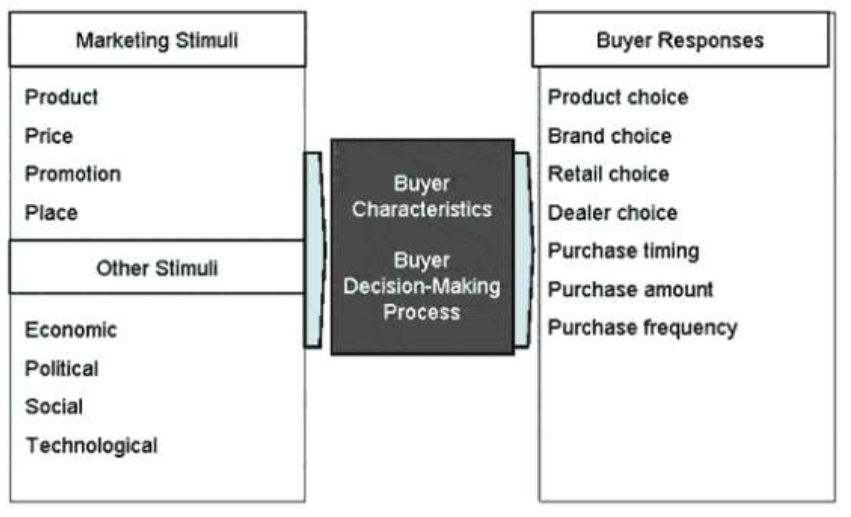
Highlights the process where marketing & other stimuli influence consumer behaviour through internal buyer characteristics. The black box is an invisible process i.e. figuring out what goes inside the mind of buyers.
A consumer is confronted with a stimulus in the environment. One is presented by the 4 P’s of marketing and the other is presented by the environment i.e. PESTAL.
The buyer’s black box comprises two sub-components i.e. buyer’s characteristics and buyer’s decision process.
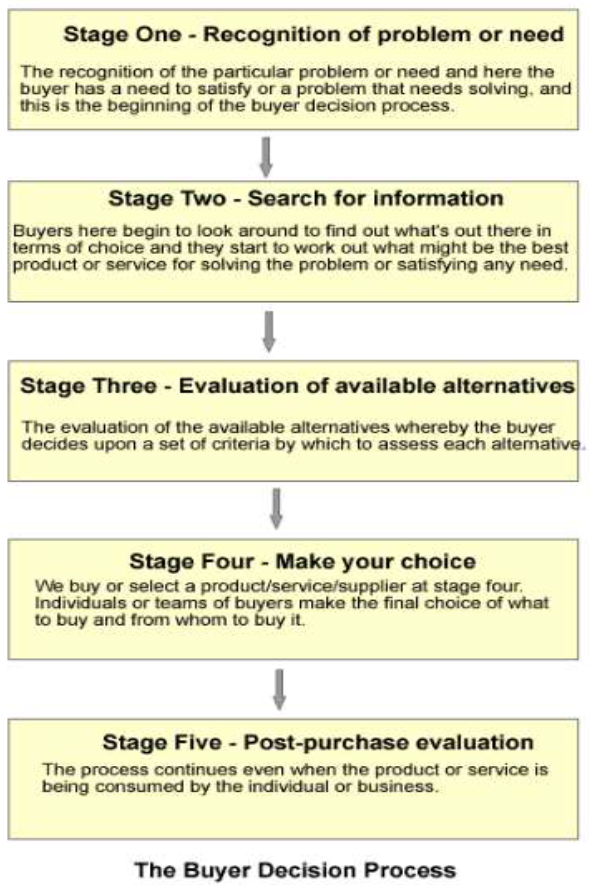
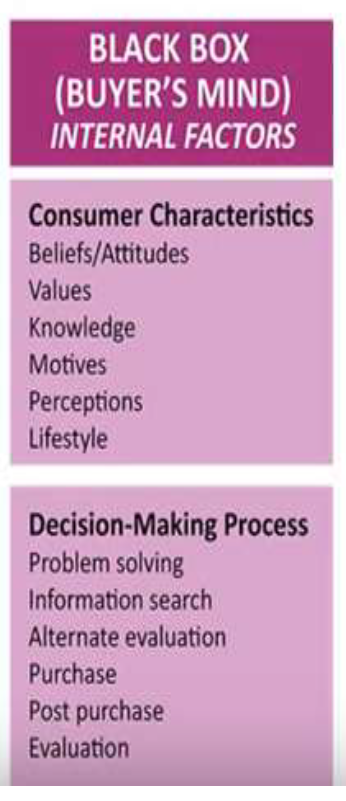
Buyer’s responses are the outcome of the thinking that takes place in the black box. What does the consumer buy, where, when, and in what quantity? Lastly, it comes to purchase or NO purchase.
2. Hierarchy of Effects Model
created by Robert J Lavidge and Gary A Steiner in 1961
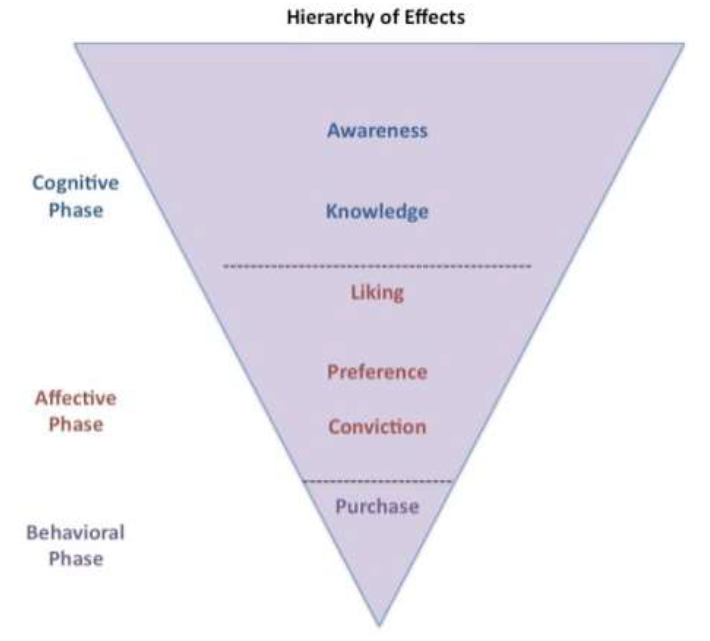
Awareness → Brands must make sure that the consumer is aware of the presence of your brand in a particular product segment.
Knowledge → This is where your product will be evaluated against other brands by the consumer. Enough knowledge should be available for the customers to evaluate.
Liking → This is where the consumer builds a liking to your product. This is where your product is being considered for its emotional benefits; be sure to make them prominent.
Preferences → Points of differentiation or unique selling points need to be highlighted to make sure that the consumer likes your brand more than the others in consideration/competition.
Conviction → This is the stage where the doubt in consumers’ minds about buying the product of your brand needs to be converted into action. Marketers can aid in this step by giving out free samples, test drives etc.
Purchase → Make sure that the purchase experience is easy and perhaps even enjoyable for the consumer. The main aim of this tool is to encourage consumers to go through the six steps that end in the purchase of the product. It is not necessary that consumers always go through all the six steps but the aim is to land a purchase.
Lavidge and Steiner further grouped these six stages into three main stages of consumer behaviour:
1. Cognitive: Also called the “thinking” stage, this is where the consumer gathers knowledge about the product and becomes aware of it. This can be said to be a rational step where the pros and cons, product specifications etc. of a product are evaluated.
2. Affective: Also called the “feeling” stage is when the consumer starts developing a liking for the product, and may even develop strong positive (or negative) feelings toward it.
3. Behavioral: This is the “behaviour” stage of the process. This is when the consumer, after weighing the pros and cons, and deciding his/her preference actually buys the product.
3. AIDA Model
Outlines phases: Attention, Interest, Desire, and Action, essential for guiding purchasing decisions.
The AIDA model was developed by the American businessman, E. St. Elmo Lewis, in 1898 (19th Century), It has been modified many times since.
The original main purpose was to optimize sales calls, specifically the interaction between seller and buyer concerning the product.
Attract Attention
The product must attract the consumer's attention. This is done via the advertising materials. It is a type of “eye-catcher.” Examples: a sensational YouTube clip.
Maintain Interest
In the first phase, the attention of the potential customer is caught; their interest in the product or service should be aroused. • Example: detailed information on the product is presented.
Create desire
If interest in the product is aroused, it is the seller’s task to persuade the customer that they want to own this product. In the best-case scenario, the advertisement or the product itself creates the desire to purchase. Example: the seller provides clear examples of the advantages of the product or service, taking into account the daily lives of the target group.
Take action
As soon as the desire to buy is aroused, this must be transferred into an action, that is, the purchase. Example: In the case of online shops, this would ultimately be the shopping cart process, in which a customer leads to a conversion. The customer can be encouraged to buy the product with a call-to-action.
Nowadays, the AIDA formula is frequently supplemented with an “S” for "satisfaction", because the product has to ultimately satisfy the consumer. With the insertion of the “confidence” (trust) factor, a sixth element can also be added. Many marketers also work with the AIDCAS model to optimize sales processes and advertising.
4. DAGMAR Model
Focuses on defining advertising goals to measure results, emphasizing communication effectiveness. Introduced by Russell Colley in 1961. ( expanded in 1995)
DAGMAR is an abbreviation for “Defining Advertising Goals to Measure Advertising Results”. Russell Colley observed that although people were investing in advertising, they had to invest a lot of time in other marketing activities to get the ROI of advertising.
The Two core concepts that the DAGMAR Model stands for are:
Creation of communication tasks to achieve goals
Creating a communication task, that involves communications between the company and the consumer, is solely the responsibility of the Advertising department.
The goal of communication task in DAGMAR is as follows:
Awareness
Comprehension
Conviction
Action
The ACCA model is used to understand the effectiveness of advertising and the communication task that advertising carries out.
Defining the objective of the communication tasks in a manner that results can be measured.
Concrete and measurable tasks
Define the target audience
Degree of change sought
Time period
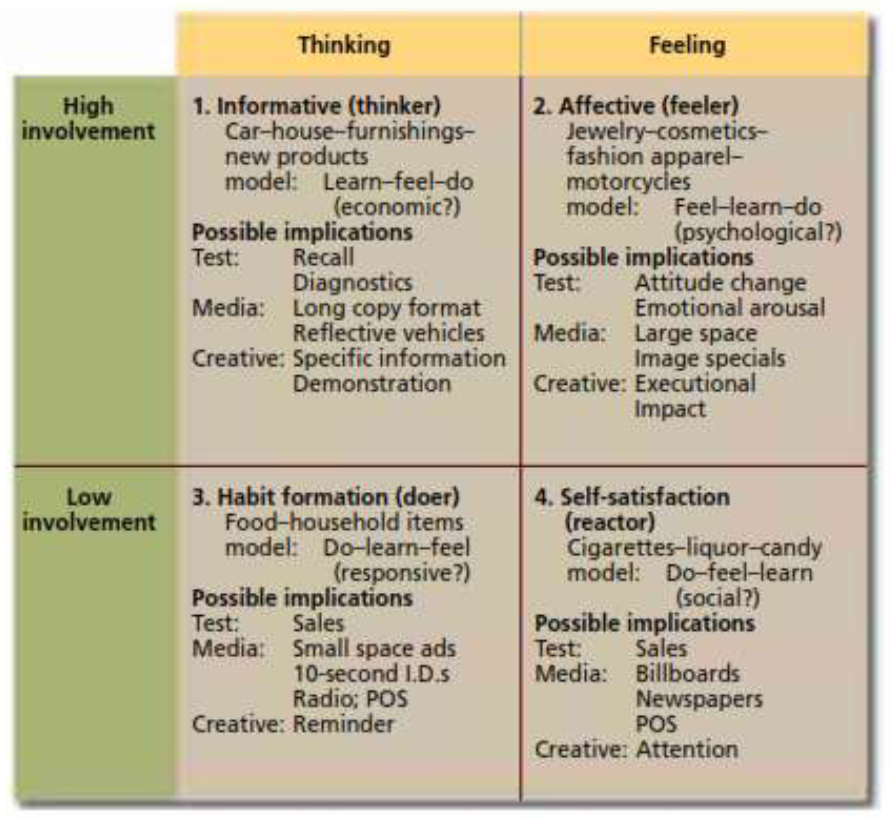
5. FCB Grid
Framework for assessing consumer involvement in decision-making, guiding advertising strategy. Developed by Richard Vaughn.
6. Innovation Adoption Model
Illustrates phases from awareness to adoption of new products.
The customer has to cross these 5 stages to adapt an innovative product:
Awareness
Interest
Evaluation
Trial
Adopt
7. Information Process Model of Advertising ( IP Model )
William McGuire developed the IP model which assumes that the advertising audiences act like information processors and problem solvers. They observe, understand, digest, compare and contrast the advertisement, they decide whether it solves their problems or not, and decide on whether to buy or not buy.
Process:
Presentation
Attention
Comprehension
Yield
Retention
Behavior
Role of Advertising in Marketing Process
Marketing Strategy & Analysis:
A market analysis forces the Company to become familiar with all aspects of the market so that the target market can be defined and the company can be positioned to garner its share of sales. A market analysis also enables the Company to establish pricing, distribution, and promotional strategies that will allow the company to become profitable within a competitive environment.
Marketing Mix Strategy:
The marketing mix refers to the set of actions, or tactics, that a company uses to promote its brand or product in the market. The 4 P’s make up a typical marketing mix:
Product → At this stage you must decide on all aspects of your marketable product or products, whether it is style, quality, packaging or whether you intend to provide warranties, along with a clear description of the product and what the customers get out of buying it.
Price → It has a very important role in the image that your product will have and the branding it will create. • This can be quite difficult and needs to take into consideration a lot of factors. You need to have a strategy on pricing and whether you are in a position to offer discounts to ensure customer loyalty.
Place → The distribution of the product is determined by how you plan to distribute your product. These decisions affect the need for warehousing and can affect your marketing mix, costs get added on, because of this decision. When to re-stock inventory, process orders and the avenues you will use to ensure that your product is available in the regions that have a market for it.
Promotion → Promotion of a product has to be undertaken, so that prospective customers learn about the availability of the item from your business. This may require many strategies and the use of various media. It may be necessary to constantly review the success of each strategy, and find new ones to constantly boost sales.
Target Market Selection & Identification
Marketing tailors a marketing mix for one or more segments identified by market segmentation. Target marketing contrasts with mass marketing, which offers a single product to the entire market.
Two important factors to consider when selecting a target market segment are
a) The attractiveness of the segment (the fit between the segment)
b) the firm's objectives, resources, and capabilities
NOTE: larger segments are not necessarily the most profitable to target since they likely will have more competition. It may be more profitable to serve one or more smaller segments that have little competition.
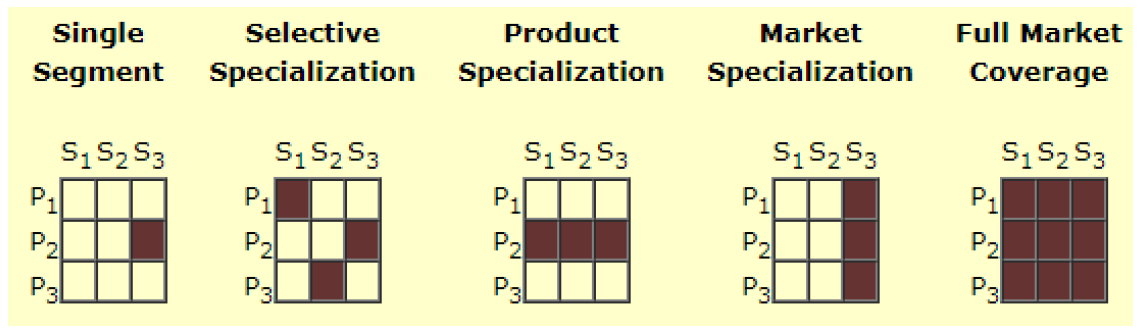
Target Market Strategies
Single-segment strategy (concentrated strategy) → One market segment (not the entire market) is served with one marketing mix (mostly choice for smaller companies with limited resources).
Selective specialization (multiple-segment strategy/differentiated strategy) → Different marketing mixes are offered to different segments (the product itself may or may not be different but the promotional message or distribution channels could vary).
Product specialization → The firm specializes in a particular product and tailors it to different market segments.
Market specialization → The firm specializes in serving a particular market segment and offers that segment an array of different products.
Full market coverage → The firm attempts to serve the entire market. This coverage can be achieved using either a mass market strategy in which a single undifferentiated marketing mix is offered to the entire market, or by a differentiated strategy in which a separate marketing mix is offered to each segment.
Market Segmentation
The process of defining and sub-dividing a large homogenous market into clearly identifiable segments having similar needs, wants, or demand characteristics. Its objective is to design a marketing mix that precisely matches the expectations of customers in the targeted segments.
The 6 basic factors (Attributes) that affect Market Segmentation are:
Clear identification of the segment.
Measurability of its effective size – should justify the resources required to target the segments.
It’s accessibility through communication, distribution & promotional efforts.
It’s appropriateness to the policies and resources of the company.
The market’s Unique needs – responding differently to different markets.
Market responsiveness
Need for Market Segmentation
Mass Marketing refers to the treatment of the market as a homogenous group & offers the same marketing mix to all its consumers. The drawback is that consumers’ needs, tastes and preferences will differ and ignoring the same will lead to a Competitor taking its benefits.
Target marketing, on the other hand, recognizes the diversity of consumers and does not try to please all of them with the same product/service. The first step is to target the markets based on their individual needs, tastes, and preferences in terms of economic, cultural, political, social, technological and other related aspects.
Bases for Segmentation in Consumer Markets
Geographical Segmentation → Region, Size of metropolitan area, Population density, Climate.
Demographic Segmentation → Age, Gender, Family size, Religion, Social class.
Psychological Segmentation → Lifestyle as per Activities, Interest, Opinions (AIO). some include attitudes and values as well alongside AIO.
Behavioural Segmentation → Benefit sought, Usage rate, Brand loyalty, User status, Occasions.
Market Positioning
Market Positioning refers to the ability to influence consumer perception regarding a brand or product relative to competitors. Objective → to establish the image so that consumers perceive it in a certain way.
Types of Positioning Strategies
Product attributes and benefits → with certain beneficial value
Product price → competitive pricing
Product quality → high quality
Product use and application → with a specific use
Competitors → is better than your competitors
How to create an effective Market Positioning Strategy?
Determine Company uniqueness by comparing competitors (SWOT).
Identify the current market position.
Competitor positioning analysis.
Develop a positioning strategy.
Market Repositioning
Adjusting a brand’s market status due to changes in the environment or declining performance. Example: Maruti Suzuki Baleno's previous discontinuation and relaunch.