Pre-Main-Sequence (Part 1)
The Role of Gravity in Stellar Evolution
Gravity is a crucial force that influences stellar lifecycles.
It compresses stars, generating heat and initiating nuclear fusion.
Stars emit vast amounts of radiation as a result of fusion processes.
As stars age, their chemical compositions, masses, and brightness change.
Phases in the life of a star can span a diverse range of timescales, from days to hundreds of billions of years,
Total lifespans of stars typically range from millions to hundreds of billions of years.
Formation of Stars and Interstellar Matter
The solar system's formation is theorized to have originated from a collapsing, rotating fragment of a gas and dust cloud approximately 4.6 billion years ago.
Current understanding posits that interstellar matter exists and is integral to continued star formation.
Observations of Interstellar Matter
Interstellar medium comprises gas and dust, accounting for at least 10% of the galaxy's observed mass.
Composition Analysis (Table 13-1):
Hydrogen: 90% (by particle number), 74% (by mass)
Helium: 9% (by particle number), 25% (by mass)
Metals (all elements excluding hydrogen and helium): 1% (by particle number), 1% (by mass)
Over 190 types of molecules identified, including:
Molecular Hydrogen (H₂)
Carbon Monoxide (CO)
Water (H₂O)
Ammonia (NH₃)
Formaldehyde (H₂CO)
Glycoaldehyde (C₂H₄O₂)
Buckminsterfullerene (C₆₀, "buckyballs").
Spectral emissions help identify these molecules, akin to atomic spectrum analysis.
Interstellar Dust Structures:
Dust particles exhibit various structures and compositions.
Small carbon-based (organic) particles:
Typically 0.005 microns across (10,000 times smaller than the diameter of a typical human hair).
Among these are polycyclic aromatic hydrocarbons (PAHs), composed of only carbon and hydrogen atoms, similar to molecules found in engine exhaust and burnt meat.
Much larger pieces of space dust:
Have cores of carbon or silicon compounds surrounded with mantles of ice and other materials.
These grow to more 0.30 mm in diameter (still nearly 200 times smaller than the diameter of a human hair).
Nebulae Types and Formation
Nebula: Dense regions of interstellar gas and dust.
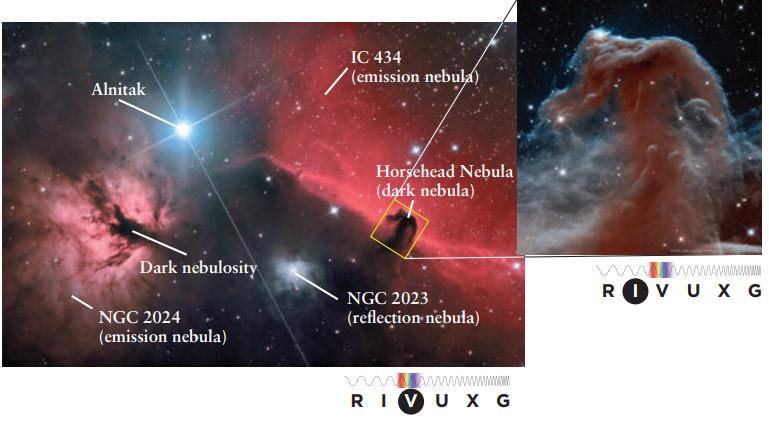
Often embedded in much larger bodies of gas and dust, called molecular clouds.
The largest molecular clouds, called giant molecular clouds, contain upward of a million solar masses of matter and extend up to about 600 light-years across.
Classified into distinct types:
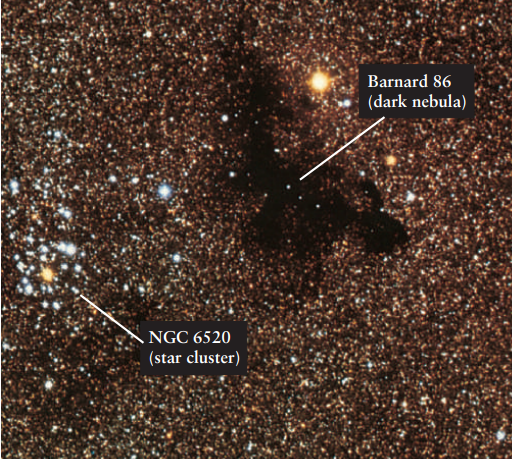
Dark Nebulae: Dense enough to block visible light (e.g., the Coalsack Nebula or Barnard 86).
Emission Nebulae: Glow from energy they receive from nearby stars or events like supernovae.
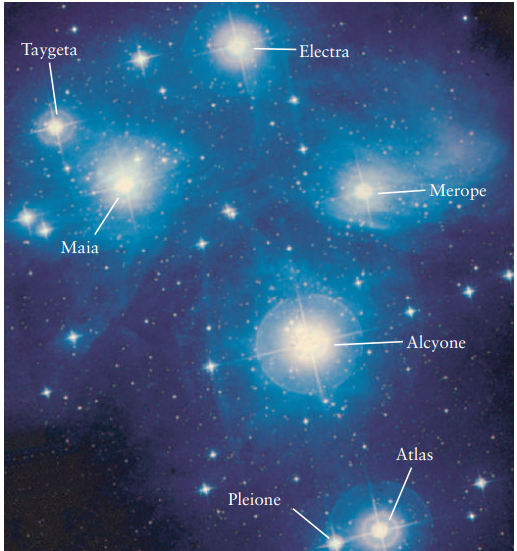
Reflection Nebulae: The blueish haze, starlight scattered by the interstellar gas and dust (e.g. the blue glow surrounding the stars of the Pleiades star cluster).
Interstellar Medium Characteristics:
Interstellar Extinction: Dimming of light from objects behind interstellar clouds due to their density. Dark nebulae are extreme examples of interstellar extinction.
Interstellar Reddening: A phenomenon where the color of starlight appears redder because shorter wavelengths are scattered more than longer wavelengths as it passes through interstellar mediums (violet is scattered the most). Unlike reddening caused by the Doppler shift, which lengthens all wavelengths equally, interstellar reddening only alters the intensity of the received starlight, not its actual wavelengths, due to the preferential scattering of shorter wavelengths.
Jeans Instability and Star Formation
Stars originate from regions of interstellar gas being Jeans unstable.
Primarily hydrogen gas in molecular form, which is challenging to detect in space.
Radio astronomers track emissions from carbon monoxide (CO) as a proxy for locating dense clouds of molecular hydrogen.
Calculations based on the known abundances of interstellar elements reveal that there are about 10,000 hydrogen molecules for every molecule in the interstellar medium.
Giant Molecular Clouds:
Contain masses from to solar masses and can extend up to 600 light-years.
Estimated 6000 such clouds exist in the Milky Way, with densities ranging from to hydrogen molecules/cm³.
Supernovae and Star Formation
Supernova Events and Remnants:
Star death triggers new star formation.
Interact with nearby interstellar clouds, compressing them into Jeans unstable conditions.
Supernova remnants (e.g., Cygnus Loop):
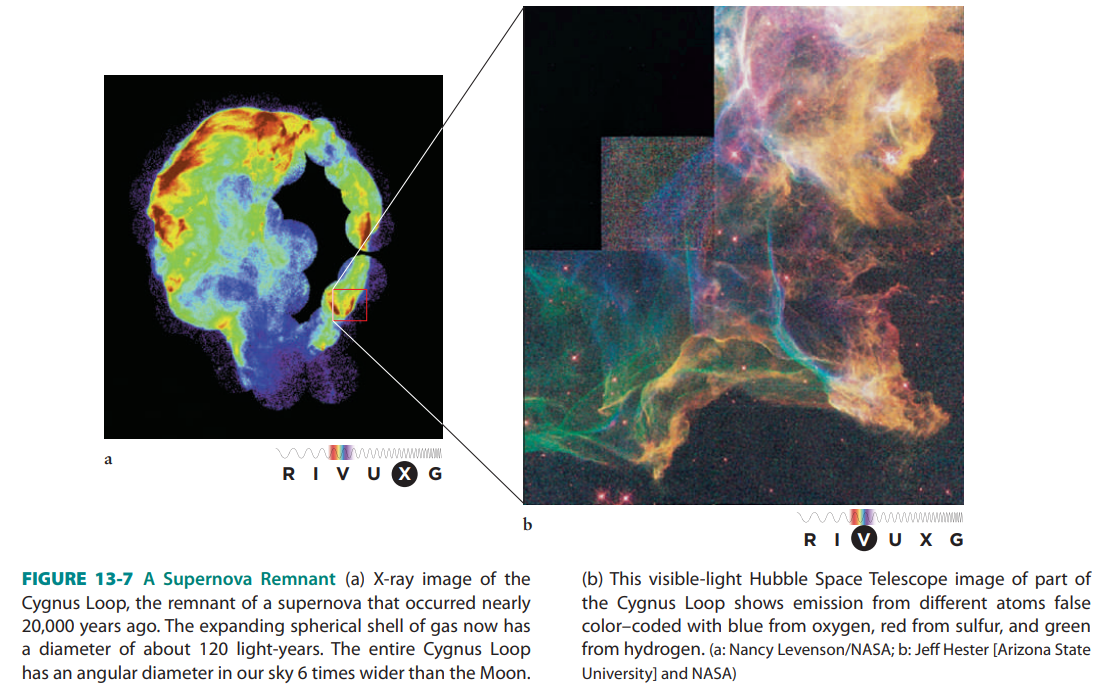
A type of nebula.
Gaseous and dusty "ashes" of dead stars.
Exhibit an arched appearance as expected of an expanding shell of gas and dust.
Collide with surrounding interstellar medium, exciting electrons and causing gases to glow.
Impact giant molecular clouds (if sufficient speed) to compress, making parts Jeans unstable, stimulating new star birth.
Radiation from O and B Stars:
Ionizes surrounding gas.
Causes gas to expand and compress the nearby interstellar medium.
Facilitates new star birth.
Bok Globules and Dense Cores:
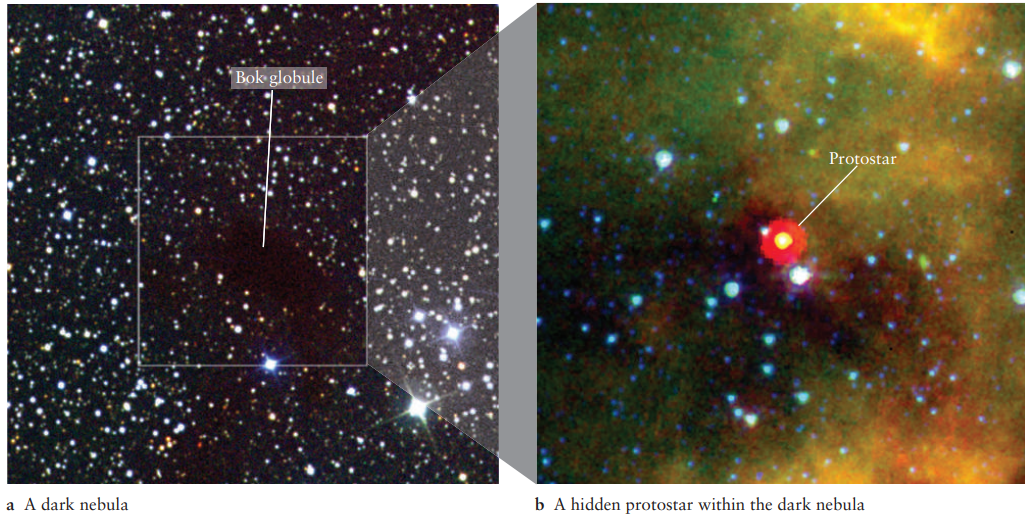
As small regions of a giant molecular cloud become Jeans unstable and collapse, they become denser, preventing light from behind and inside them from escaping.
These darker regions are called Bok globules.
Contain compact regions of gas and dust called dense cores.
Dense cores are destined to become stars as gravity pulls matter inward.
Often, hundreds to thousands of these cores form together, leading to open clusters of stars, such as Pleiades.
Open clusters: Gravitationally unbound systems, meaning that the stars in them eventually drift apart.
Protostars:
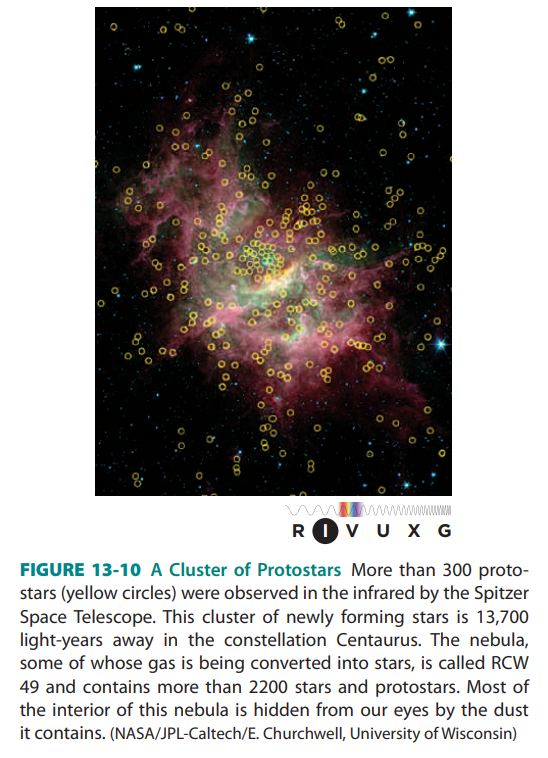
Formed as a dense core collapses from the inside out.
Central region rapidly increases mass through accretion.
These are early forms of stars, enveloped in gas and dust.
Emit energy primarily from compression and infalling gases colliding with their surface.
Have not yet begun nuclear fusion.
Collapse depending on spin:
Non-spinning dense core: Collapses into a sphere, forming an isolated star.
Spinning core: Collapses into a disk, potentially forming multiple stars or a single star with orbiting protoplanets.
When a protostar ceases to accumulate mass, it becomes a pre–main-sequence star
Protostars:
Are physically larger than main-sequence stars (e.g., a 1 solar mass protostar () is ~5 times the Sun's diameter).
Due to their large size, emit great quantities of radiation and gas (analogous to solar wind).
Observable as sources of infrared radiation.
Cannot be seen in visible light due to being enshrouded by outer layers of gas and dust.
Continuously accumulate mass through the infall of gas and dust from the dense core's outer shell.
Infall eventually halts when outward force from radiation and particles equals inward gravitational pull.
Once this happens, the protostar becomes a pre-main-sequence star.
Pre-Main-Sequence Stars:
Formed when mass accretion stops for a protostar.
Contract slowly, unlike the rapid collapse of a protostar.
Hydrogen fusion begins when the core temperature reaches .
Energy from hydrogen fusion creates enough pressure to stop contraction.
In the final stages of pre-main-sequence evolution, the outer shell of gas and dust dissipates, making the star visible in light.
The evolutionary track of a pre– main-sequence star depends on its mass
Influence of Mass on Fusion Onset:
More massive pre-main-sequence stars initiate hydrogen fusion more rapidly.
Example: A star begins fusion in less than a million years, while a star takes tens of millions of years.
Brown Dwarfs:
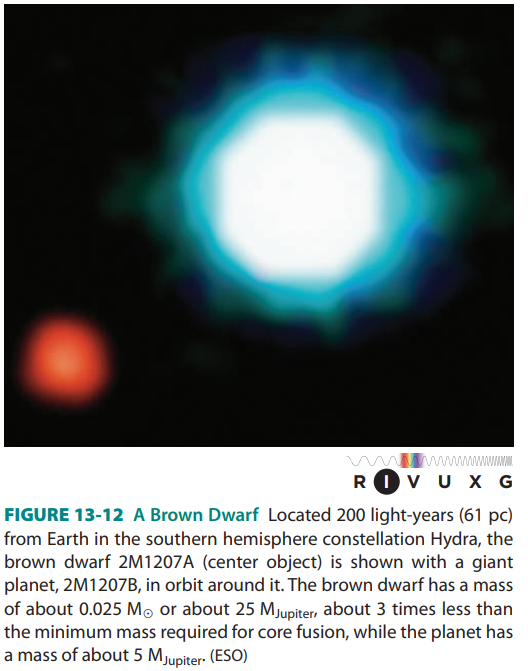
Usually, the minimum core temperature required for normal hydrogen fusion is 10 million .
However, pre-main-sequence stars less massive than do not have enough gravitational force compressing and heating their cores to ever get this hot.
As a result, these bodies contract into planet-like orbs of hydrogen and helium, known as brown dwarfs.
The lowest observed mass star is , approximately 95 times more massive and 16% larger than Jupiter.
Modeling Stellar Evolution:
Astrophysicists employ computer models and stellar structure equations to simulate pre-main-sequence star evolution.
These simulations track changes in energy emission, plotting evolutionary tracks on a Hertzsprung–Russell (H-R) diagram, representing changes in a star’s temperature and luminosity.
Birth Line and Protostar Transformation:
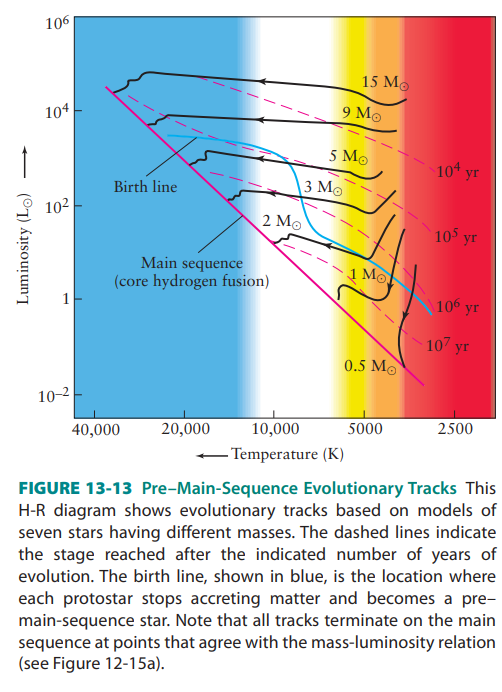
Protostars transition into pre-main-sequence stars upon crossing the birth line on the H-R diagram.
A star's position on this line is primarily determined by its mass and, to a lesser extent, its metal content (elements other than hydrogen and helium).
T Tauri Stars and Gas Ejection:
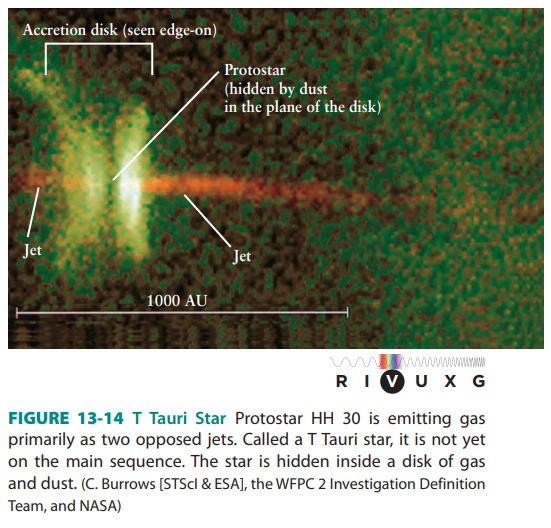
Many pre-main-sequence stars, particularly those in spectral classes G, K, and M, vigorously eject gas in oppositely directed jets just before reaching the main sequence; these are called T Tauri stars.
This stage is characterized by intense chromospheric activity (spicules, flares) and can lead to a mass loss of up to as the star sheds its cocoon.
T Tauri stars exhibit variability in brightness.
Evolutionary Paths of More Massive Stars:
Pre-main-sequence stars with masses greater than become hotter with minimal change in overall luminosity, moving nearly horizontally from right to left on the H-R diagram.
Stars more massive than approximately bypass the pre-main-sequence phase, initiating hydrogen fusion during their protostellar phase due to intense gravitational compression.
Revisiting the Upper Limit of Stellar Mass:
Historically, the upper limit for main-sequence stellar mass was thought to be around , beyond which protostars were believed to expel their outer layers due to extreme fusion rates and surface temperatures.
Pistol Star is an example, possibly starting at and expected to stabilize at less than after shedding mass.
Recent observations challenge this limit:
2004: A main-sequence star observed with 130-150 .
2006: Remnants of a star found to have been at least 150 .
2010: R136a1 observed at 265 (estimated original mass 320 , potentially a merger of smaller stars).
The understanding of star formation, particularly for very massive stars, remains an active area of research.