Biochem
%%Block 8 - Receptors- Chan%%
- Explain receptor types & functions
- Major types:
- Cell surface: TM proteins formed by hydrophobic aa arranged in helical structure
- Major types:
hormone binds receptor → change shape → hormone-receptor complex → response * Function: utilize secondary messenger system/signaling cascade * GPCR * Receptor tyrosine kinases (*intrinsic enzymatic activity) * Amino acid derived hormone receptor (ex. bind epinephrine via GPCR) * Peptide/protein hormone receptor (ex. bind insulin via RTK) * Intracellular: cross PM w/o help; receptor-hormone complex → bind hormone response element on DNA → influence transcription of specific genes * Function: bind to HRE & directly influence transcription of specific genes * Lipid derived/steroid (intracellular)
- Described receptor types: transmembrane localization, subunit structure and function; enzymatic activity, intracellular receptors
- @@GPCR:@@ 7 TM protein made from a single polypeptide chain (NH3 outside of cell, carboxyl end is cytoplasmic), 700+ genes in human genome
- Ligands: photons to proteins
- Subunits: heterotrimeric, alpha, beta, gamma subunits
- Function: same signaling molecule can interact w/ different receptors & trigger distinct responses
- Enzymatic activity:
- alpha s → + AC → increase cAMP ==> stimulatory
- alpha i --| AC → decrease cAMP ==> inhibitory (phospholipase, phoshodiesterases)
- alpha q → PLC: PIP2 → DAG & IP3 → SR release of Ca++ → + PKC ==> stimulatory
- Classes
- A: Rhodopsin-like (makes up 85%): largest group & most studied
- B: Secretin receptor family
- C: Metabotropic glutamate/pheromone
- ==RTK==: single TM protein, 58 genes; ligand activated enzymatic activity = autophosphorylation → signaling cascade
- @@GPCR:@@ 7 TM protein made from a single polypeptide chain (NH3 outside of cell, carboxyl end is cytoplasmic), 700+ genes in human genome
- Properly use terms related to ligand-receptor interactions, agonists/antagonists
- Agonist: molecule that activates a receptor to create a biological response (some agonists elicit stronger responses than the endogenous ligand)
- Antagonist: blocks the action of the agonist
- Inhibitor: blocks the receptor-ligand interaction
- Understand post receptor signaling pathways
- GPCR: AC → increase cAMP → PKA→ CREB
- RTK: bind protein ligands w/ high affinity → autophosphorylation → + activate/recruit of effectors to generate signaling cascade → change cellular processes
- PIP3: important lipid second messenger which regulates many cellular processes
- Class 1 PI3 Kinase: phosphorylates inositol ring of PIP2 @ 3rd position → PIP3
- Reaction reversed by PTEN (tumor suppressor)
- Apply knowledge of receptors to drugs and drug design
- Humira (adalimumab) = biologic monoclonal antibody; used to treat RA, psoriatic arthritis, ankylosing spondylitis, Crohn’s, UC [has been a top selling drug for the past 7 years]
- Diabetes mellitus: insulin
- insulin → + insulin R → IR kinase enzymes → cascade (bovine → human insulin 1980s)
- Chronic myelogenous leukemia/CML: too many myeloblasts in the blood & bone marrow
- Philadelphia chromosome (translocation between 9 & 22)
- progressive disease
- Sx: fever, fatigue, easy bleeding, anemia, infection, splenomegaly, arthralgia
- Tx: Gleevec 2001, first kinase inhibitor drug (inhibits BCR - ABL)
- Steps in drug discovery chemical drugs
1. Basic research
2. Drug discovery: screening chemical drug libraries using several assays (testing drug & target, repeat and validate)
3. Preclinical research
4. Clinical research
5. FDA approval of drug
- Applying drugs to new diseases, ex. COVID-19
1. Basic research: viral mechanism, viral entry infection, immune response
2. Drug discovery: providing therapeutic options (vaccines, anti-virals, antibody, anti-toxin, enhance immunity)
Questions: Slide 20
Is she trying to say that PIP3 or PI3K is an oncogene?
Block 9: Metabolism & bioenergetics - Potter
- Describe anaerobic reactions: Immediate energy sources, stored ATP and fast energy source of glycolysis ending in lactate
- Anaerobic reactions: Glycolysis & TCA
- Immediate energy sources: glycolysis is anaerobic → 2 ATP, 2 NADH
- Stored ATP: high concentrations of ATP signifies cells are at high energy state
- Describe aerobic reactions
- Pyruvate oxidation, TCA and ETC are all aerobic
- Inner mitochondrial membrane: ATP synthase converts ADP + Pi → ATP → oxidative phosphorylation
- Described sustained energy sources: glycolysis ending in pyruvate and beta oxidation of fats
- Oxidation-reduction reactions indirectly provide much of the energy needed to make ATP
- Describe cellular metabolic programs: growth and burning of energy
- Cells can either be burning energy via aerobic respiration or growing (can’t do both at the same time)
- When cells are in rapid growth → rely on glucose & are depleted of mitochondria
- Describe nutrient-sensing enzymes that control metabolic programs
- AMPK (master regulator)→ tells mitochondria to burn energy from glucose; stimulated by metformin [anti-cancer, anti-aging, --| FA synthesis → also weight loss drug]
- AMPK very sensitive to levels of AMP (high AMP → cell low energy → need more mitochondria to function)
- Fructose/glucose → methylglyoxal (MGO) → bind active site of AMPK & inactivate it
- PI3K → determines whether the cell opens up the glucose flood gates and allows 400x more glucose to enter
- mTOR → determines whether cells will live or die
- AMPK (master regulator)→ tells mitochondria to burn energy from glucose; stimulated by metformin [anti-cancer, anti-aging, --| FA synthesis → also weight loss drug]
- Describe metabolism, anabolic and catabolic reactions
- Catabolism: involves all of the metabolic processes that break down biomolecules
- Anabolism: all of the metabolic processes that synthesize biomolecules
- Catabolic pathways deliver chemical energy in the form of ATP, NADH, NADPH, and FADH2. These energy carriers are used in anabolic pathways to convert small precursor molecules into cellular macromolecules.
- Converging = catabolic || Diverging = anabolic
- Describe bioenergetics
- Describes the transfer & utilization of energy in biologic systems
- Concerns only the initial and final energy states of reaction components
- Predicts if a process is possible (vs. kinetics which measures how fast the reaction occurs)
- Changes in free energy & types of energy/matter organisms exchange → predict if a reaction will take place
- Important to know
1. Energy is not created nor destroyed 2. Disorder (entropy) is always increasing in the universe
- Describe enthalpy of formation and Hess’ Law
- Enthalpy of formation: how much energy is required to form a compound in its elemental form
- If energy must be added, delta H is positive {endothermic}
- If energy is released, delta H is negative {exothermic}
- Hess’s law of constant heat summation - total enthalpy change for the entire reaction is the sum of each individual change
- Enthalpy of formation: how much energy is required to form a compound in its elemental form
- Describe the role of ATP
- Energy currency of the cell: carrier and storage unit of free energy
- High ATP → high energy
- First phosphate bond of ATP usually broken to fuel endergonic reactions (positive delta G)
- ATP hydrolysis liberates free energy
- Describe the roles of oxidation and reduction in metabolism
- Oxidative reactions will tend to release energy
- Reductive reactions will tend to require an input of energy
- Converting ethanol to acetylaldehyde involves oxidation reaction
- Describe the role of electron carriers
- NAD+ and FAD = coenzymes specialized for carrying electrons
- Electron carriers absorb electrons →ring arrangement
- NAD+ (oxidized form) → NADH (reduced form)
- FAD (oxidized form) → FADH2 (reduced form)
==B10 - TCA & Electron Transport Chain - Panavelli==
- Describe the CAC and where electrons and carbons go
- Electrons ??? electron carriers ??
- Carbons
- Pyruvate (3 C) → acetyl CoA (2C) + 4C OAA → citrate (6C) → isocitrate (6C) → alpha-ketoglutarate (5C) → succinyl coA (4C) → succinate (4C) → fumarate (4C) → malate (4C) → OAA (4C)
- Describe how electrochemical gradients are produced
- ETC: H+ pumped through complex I, III, and IV; complex II receives electrons from FADH2 → the passage of electrons results in the formation of a proton gradient
- Explain how ATP is produced during chemiosmosis
- Chemiosmotic theory:
- As electrons pass through the ETC, protons are pumped into the inter-membrane space → proton motive force created
- Protons move back across the membrane via ATP synthase (ATP formation)
- Chemiosmotic coupling: how ox phos links ETC and ATP synthesis
- Chemiosmotic theory:
- Describe the theoretical energy yield for cellular respiration
- 30-32 ATP (glycolysis, pyruvate oxidation, Kreb’s and oxidative phosphorylation)
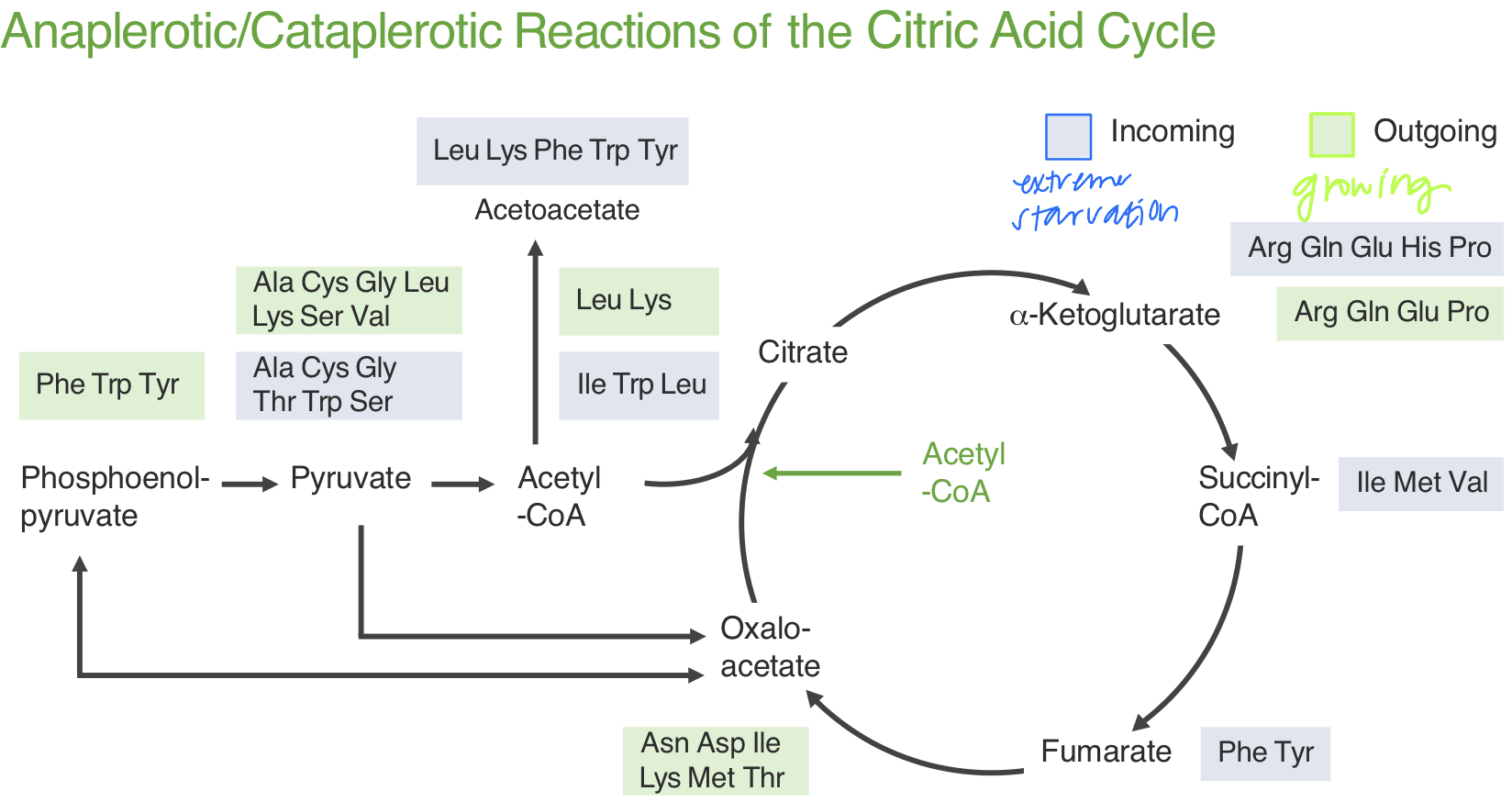
- Identify entry points of fats and proteins in cellular respiration
- Proteins → amino acids (different processes) → acetyl co A
- Fats → fatty acids → acetyl CoA via Beta oxidation
- Proteins → amino acids (different processes) → acetyl co A
- Describe key intermediates, key regulators, and negative feedback mechanism of cellular respiration
- Pyruvate = key intermediate
- via ALT w/ B6→ alanine (cytosol)
- Cahill cycle: allows for recycling of hepatic glucose from skeletal muscle alanine via ALT & for detoxification of NH4+ from proteolysis via the hepatic urea cycle
- --| glycolysis by inhibiting PK & → + gluconeogenesis
- Pyruvate → alanine → glucose (in the liver)
- via pyruvate carboxylase + biotin (B7) + bicarb → OAA (mitochondria)
- PC = first enzyme of gluconeogenesis
- Activated by acetyl CoA
- via PDH (E1,2,3 + 5 cofactors) → acetyl CoA (mitochondria)
- via LDH + niacin (B3) NADH + H+ → lactate (cytosol)
- Cori cycle: anaerobic conditions
- Pyruvate + NADH + B3 → lactate → glucose (liver)
- Key intermediates of TCA
- Citrate: allosteric effector
- alpha-ketoglutarate: nitrogen metabolism
- succinyl CoA: heme synthesis (vampires succ blood)
- succinate: odd chain fatty acid synthesis
- fumarate: nucleotide metabolism (running on fumes)
- OAA: gluconeogenesis
- Glyoxylate cycle: anabolic pathway similar to TCA in prokaryotes/fungi
- citrate, isocitrate, succinate, fumarate, malate, OAA
- IC OAA SFMate (I C Odd SF Mate)
- Amino acid metabolism: (ScOAK)
- Alpha ketoglutarate
- Succinyl CoA
- OAA
- Shuttle system: Citrate & malate (Corvette & Maserati)
- Negative feedback of TCA
- ATP and NADH inhibit isocitrate DH & alpha ketoglutarate DH (succinyl CoA also inhibits A-KG-DH)
- ATP also inhibits glycolysis & pyruvate oxidation
- Pyruvate = key intermediate
%%B11. Glycolysis and Pyruvate Metabolism%%
- Describe the process of glycolysis
- Occurs in cytoplasm, glucose → 2x pyruvate + 2 ATP + 2 NADH
- Possible when O2 is low
- Has energy consuming and energy producing phases
- Describe Phase 1 of glycolysis → energy consuming
- ATP investment
- \
- First priming reaction, uses up ATP (glucose → G6P via HK)
- \
- First isomerization (G6P → F6P via PHI)
- \
- Second priming reaction, uses ATP (F6P → F16P via PFK-1)
- \
- Cleavage of 6 C sugar → 2 x 3 C sugar phosphates (F16P → DHAP and G3P via aldolase)
- \
- Second isomerization (DHAP → G3P via TPI)
- ATP investment
- Describe Phase 2 of glycolysis
- 6.) G3P → 1,3 BPG via G3P DH * no ATP, oxidation reaction!
- 7.) 1,3 BPG → 3 PG via PK *__substrate level phosphorylation__
- 8.) 3 PG → 2 PG via PGM (important intermediate is 2, 3 BPG which binds to hgb and favors O2 release)
- 9.) 2 PG → PEP via enolase
- 10.) PEP → pyruvate via PK *makes ATP
- Describe enzymes that are regulated in glycolysis
- enzyme not fully active, large negative delta G
- Hexokinase
- Activated by: glucose
- Inhibited by: G6P (muscle), negative feedback
- PFK-1: 2 binding sites for ATP (lots of ATP bind allosteric site)
- Activated by: F26BP (liver; strong)
- increased insulin → activates PFK-2 → F26BP → + PFK-1
- Inhibited by ATP, low pH (m), citrate (L)
- increased glucagon --| PFK-2
- fatty acid synthesis → ATP & citrate --| PFK-1
- Activated by: F26BP (liver; strong)
- Pyruvate kinase: basically irreversible, generates ATP
- Activated by: F16BP
- Inhibited by: ATP, alanine, acetyl coA
- Describe pyruvate metabolism
- Explain how glycolysis can operate under anaerobic conditions
- Describe the reason of pyruvate dehydrogenase and its regulation
- Explain how inhibitors of pyruvate metabolism lead to lactic acidosis
- Hexokinase
^^B12. Gluconeogenesis and glycogen metabolism - Benmerzouga^^
- Discuss gluconeogenesis and its importance in glucose homeostasis
- Compare between glycolysis and gluconeogenesis including hormonal regulation of the processes
- Describe the metabolism of fructose and galactose
- Apply your knowledge of metabolic pathways to clinical scenarios: classical galactosemia, hereditary fructose intolerance, peripheral insulin resistance, etc
- Describe the key steps in glycogen synthesis and glycogen degradation
- Recognize the two key enzymes involved in glycogen synthesis and the two main enzymes in glycogen degradation
- Describe the regulation of glycogen metabolism by insulin, epinephrine, glucagon, glucocorticoids, and growth hormones
- Apply the concepts of glycogen metabolism to clinical scenarios