L17: Temperature - Thermal Physics
Learning Outcomes
Understand the relationship between energy and temperature at the molecular level
State the SI unit for temperature.
Convert between Celsius and Kelvin
Calculate linear and volume expansions due to temperature change.
Kinetic Energy
A particle with mass moving with speed has kinetic energy:
In other words the property of kinetic energy s a consequence of their motion.
SI Unit of energy: Joule (J), where
For particles, the total kinetic energy is the sum of individual kinetic energies:
Key point: remains constant when temperature () is constant.
Average energy is calculated as:
The average energy also remains constant, leading to the definition of temperature.
Molecular Behavior
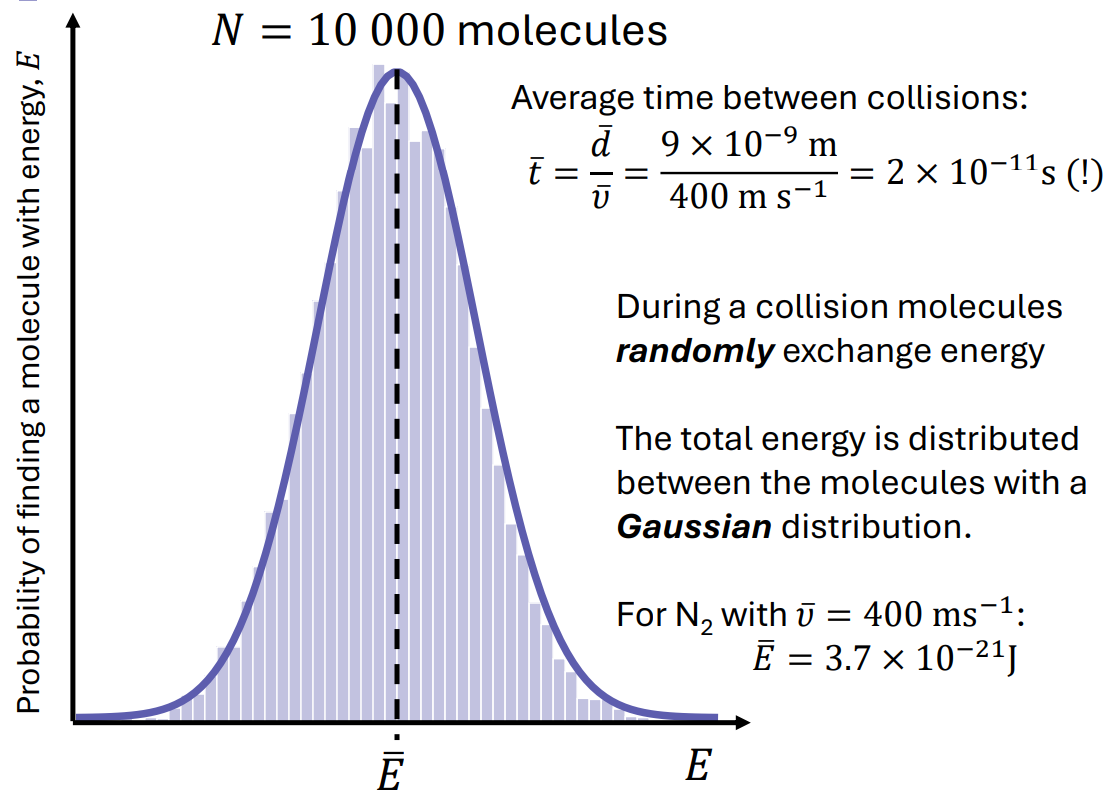
Don’t really need to know this they key point is statistics can be used to calculate the average energy.
Example: gas at 1 atm and 0 °C.
molecule mass:
Average speed:
Probability of finding a molecule with energy .
Average time between collisions:
During collisions, molecules randomly exchange energy.
Total energy is distributed among molecules following a Gaussian distribution.
For with :
This corresponds to the average kinetic energy per molecule.
Temperature and Thermal Energy
(average energy) = 'Thermal Energy' =
is proportional to the constant
= Boltzmann's Constant =
Rearranging the equation makes: temperature proportional to the average kinetic energy.
For the molecule:
SI Base Unit: kelvin (K)
1 kelvin ≡ change in temperature that results in a change of thermal energy of
Temperature is a positive scalar.
Charles’ Law for Gases
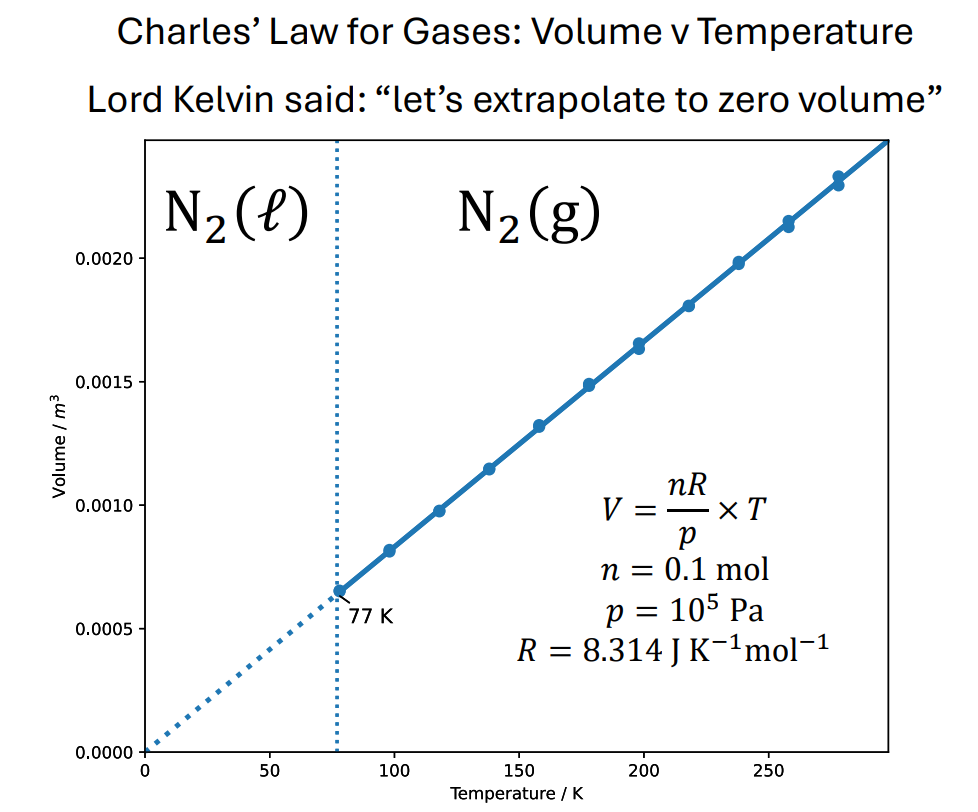
Relates Volume and Temperature
As the temperature of a gas increases, the volume expands proportionally, provided pressure remains constant.
Lord Kelvin extrapolated to zero volume.
Volume can not be lower than zero, thus the temperature must also not be lower than zero.
Temperature Scales
The kelvin scale is an absolute temperature scale.
Because the lowest possible temperature on the kelvin scale is ‘absolute zero’ (0 K).
There is no negatives.
In contrast to the absolute temperature scale, Relative temperature scales are set using physical properties but are defined using a difference in temperature between two states.
Celsius scale:
Celsius used pure ice melting / water boiling and divided by 100.
Fahrenheit scale:
Fahrenheit used a freezing ‘brine solution’ and human body temp!
'Degrees' is only used for relative temperature scales (°C, °F) not Kelvin.
Temperature Conversions
Kelvin scale: Absolute temperature scale where 0 K is absolute zero, with conversions given by .
Water freezes at 0 °C.
.
The temperature of boiling liquid nitrogen at atmospheric pressure is 77.2 K.
Human body temperature is approximately 37 °C.
Finding the difference in temperature between the freezing and boiling points of water.
In both the scales there is a difference of the same magnitude (100 °C and 100K).
Thermal Expansion
Many material and chemical properties change with temperature, including volume and electrical resistance.
Changes of volume with temperature is thermal expansion.
Thermal Expansion Applications
Problems arise when two materials with different thermal expansion properties are in contact.
Example: Metal (Au, Ti) dental fillings expand differently from tooth enamel, causing pain or cracks. Modern dental filling composite materials are designed to match tooth enamel expansion.
Thermometers are based on the principle that some physical property of a system changes as the system’s temperature changes, such as the volume of a liquid or dimensions of a solid.
Equations for Thermal Expansion
Linear Thermal Expansion:
≡ coefficient of linear expansion (units: K⁻¹)
Volume Expansion:
≡ coefficient of volume expansion (units: K⁻¹)
and give the change in length and volume expressed as a fraction of the initial length and volume.
Understanding Fractional Change
= change in as a fraction of
= % change in
If , then
If thermal expansion causes a 10% change in the length of an object, then
Thermal expansion has increased the length of the object by a factor of 1.1.
Summary
Temperature measures the average kinetic energy of a substance.
SI unit for temperature: kelvin (K).
The kelvin scale is based on absolute temperature.
Other scales (e.g., Celsius) are based on temperature differences.
Conversion between temperature scales:
Linear/volume expansion due to temperature change:
(linear expansion)
(volume expansion)