GOVT 2305.004 - American National Government Lecture Notes (Exam 2)
Judicial Branch
The Role of the Judiciary in the Public Policy Process
Federal Courts often decide the constitutionality of laws -- the power of judicial review (Marbury vs. Madison in 1803).
Keep in mind throughout that along with federal courts there are state courts and local courts (and this is where the vast majority of the criminal and civil actions are adjudicated). Our focus is mostly on the federal courts.
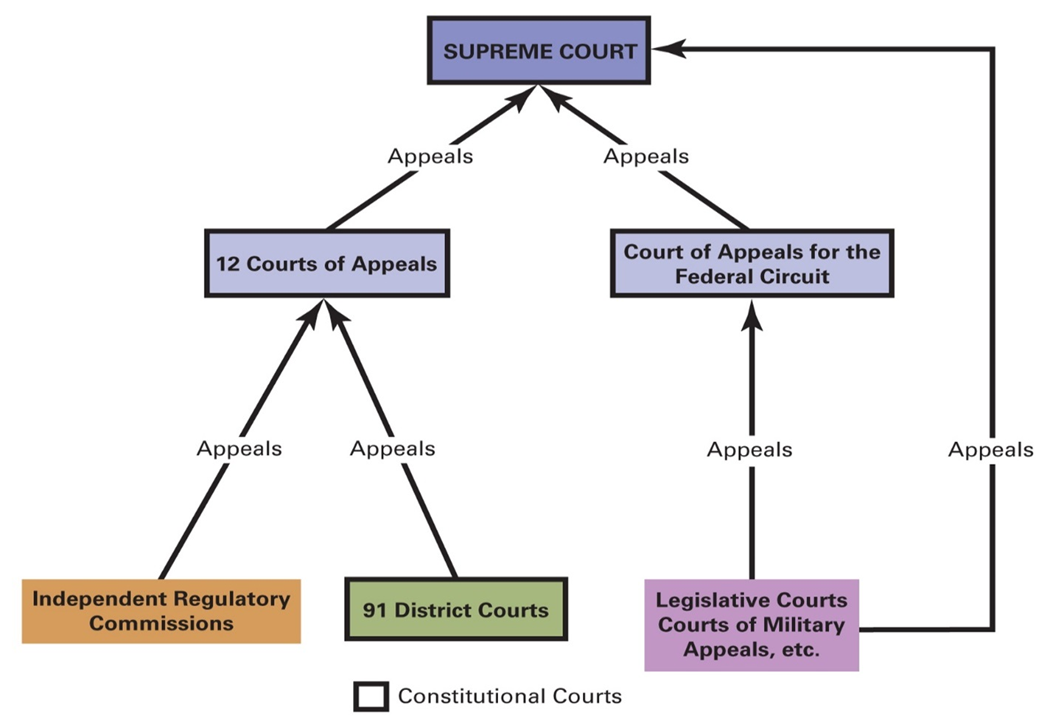
District Courts
The 91 District Courts (678 judges).
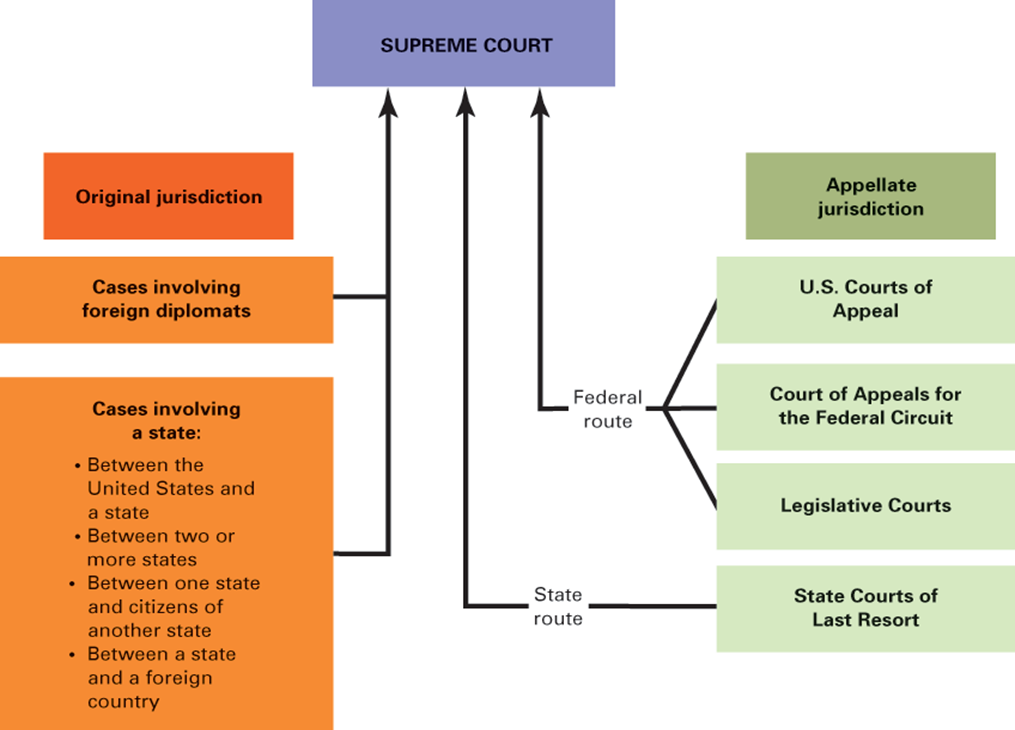
Original jurisdiction for such things as federal crimes, civil suits, supervision of bankruptcy proceedings, and review of actions of some administrative agencies.
Appeals Courts
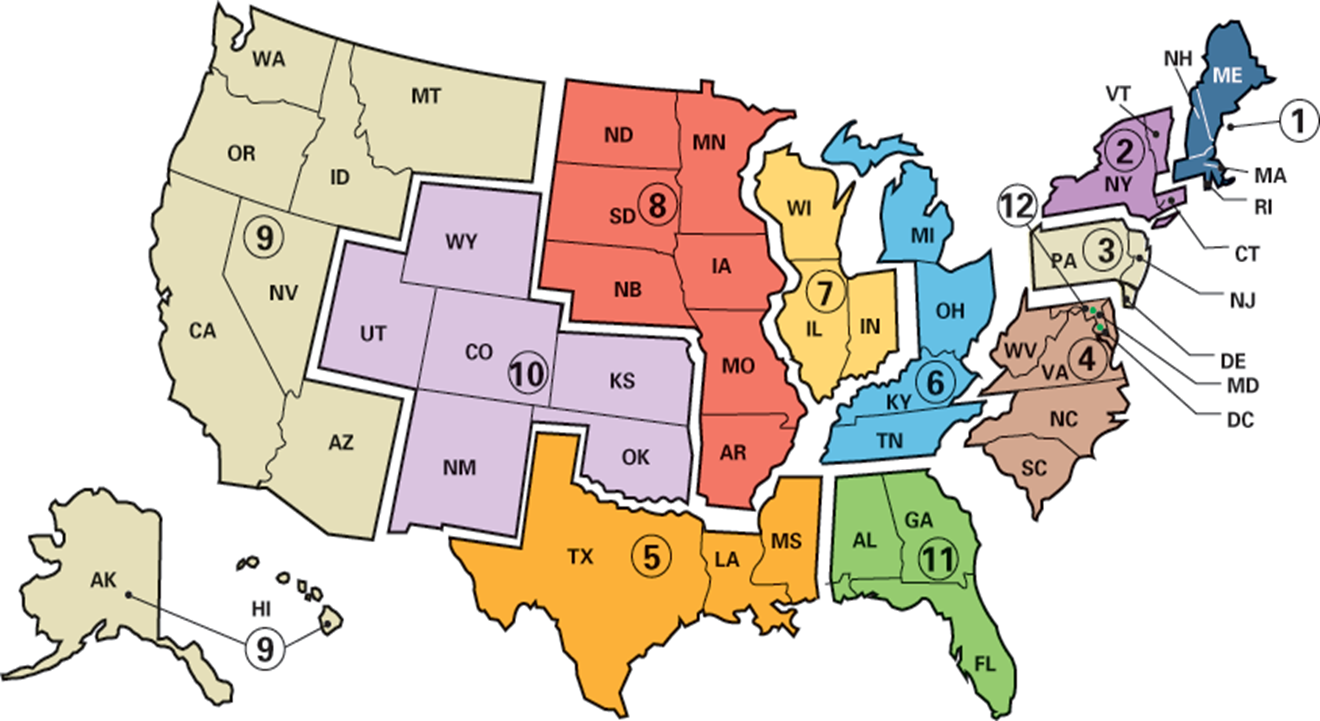
There are 12 circuits (including one for the District of Columbia), and another specialized circuit for a total of 13 (179 Judges).
These Courts have the power to review all final decisions of district courts and can review decisions by federal regulatory agencies.
Cases are generally heard by a three-judge panel.
The focus of the proceeding involves correcting errors of procedure and law which might occur in the original proceedings; they do not hold trials; their decisions become precedent.
Supreme Court
The Court 9 justices (8 associates and one Chief Justice).
The Court has some original jurisdiction, but most of what it hears comes from lower federal courts (60% of its docket), most of the rest comes up from the state courts of last resort.
All cases it hears must involve a substantial federal question.
District & Appeals Court Judges
All are appointed for lifetime appointments by the president with Senate confirmation. Can only be removed through impeachment.
Federal District Court Judges: senatorial courtesy.
Federal Appeals Courts Judges: Presidents generally have more influence
U.S. Supremacy Court
Criteria used by presidents in choosing nominees:
Experience in judicial positions
Characteristics: race, gender, and geography
Partisanship and ideology
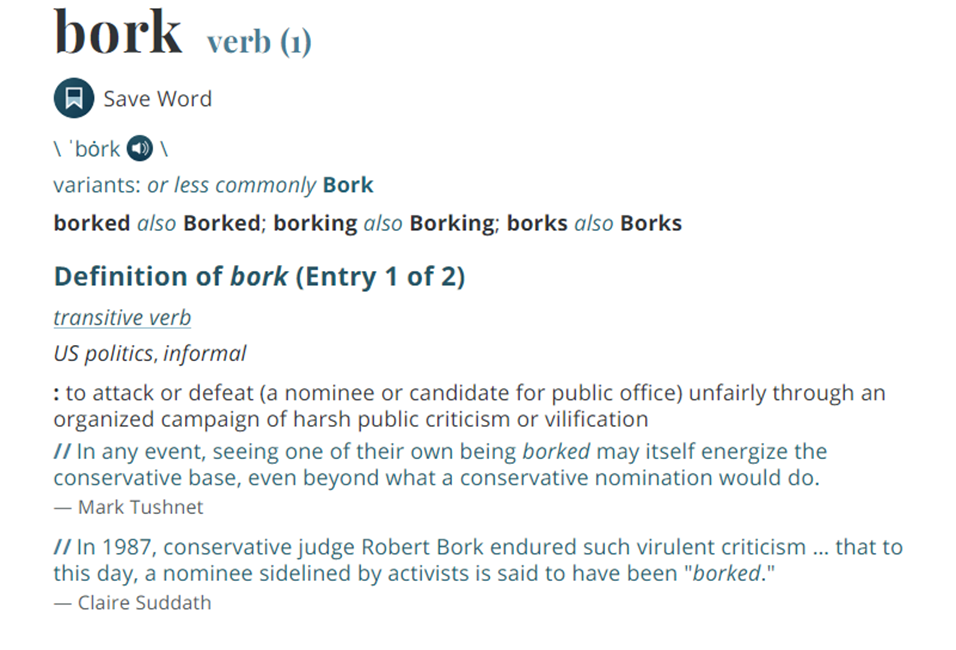
--Not all presidential nominations to the bench are accepted by the Senate (e.g., Bork, Ginsburg).
-Fun fact: If you are denied a supreme court nomination, it is called “Getting Borked.”
Keep in mind that the judicial selection is quite different at the state level . . .
Partisan elections
Non-partisan elections
Retention elections (Missouri Plan)
Appointment (by governor, legislature, or some combination)
How do cases come before federal courts?
Federal judges are restricted by the Constitution to deciding actual disputes (not hypothetical ones).
Not everyone can take a case to federal court. The vast majority of laws that are broken are state and local laws. Litigants must have standing to sue and cases must be judiciable disputes. Which means a case must concern the LAW and can only be settled by the LAW.
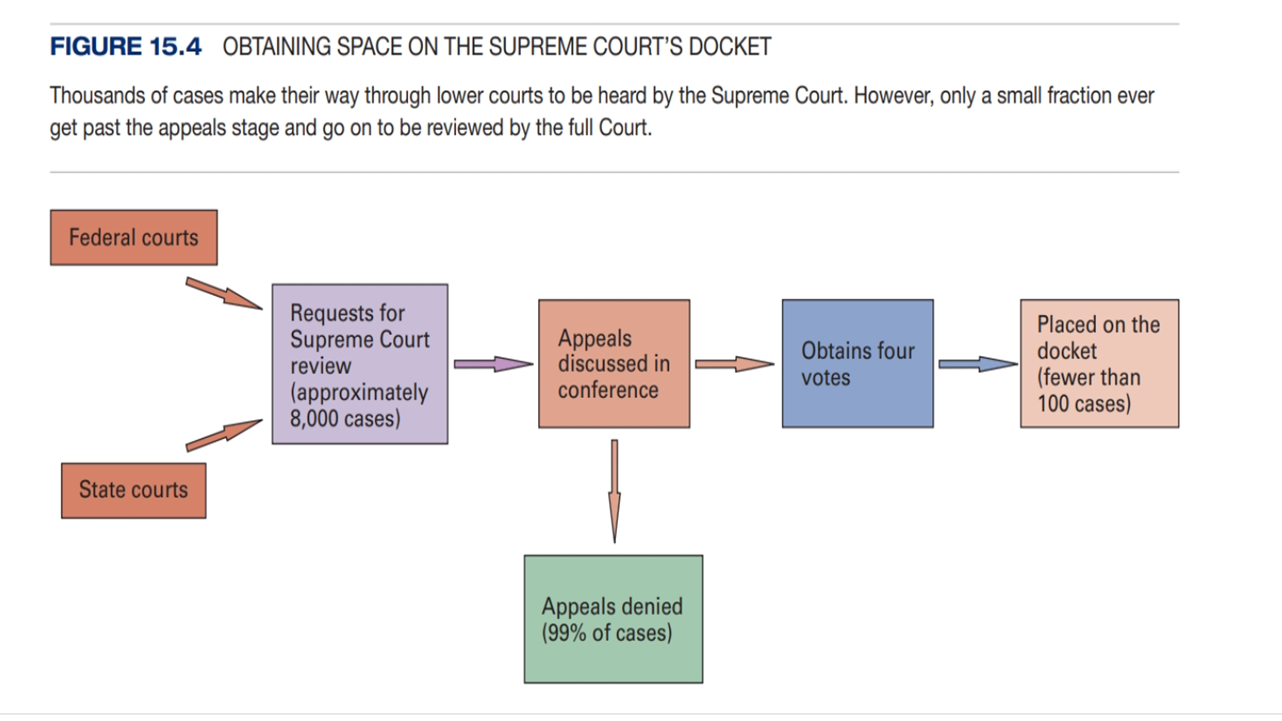
Getting to the Supreme Court
Deciding which cases to hear allows the Supreme Court control over its agenda than lower courts.
Cases involving major federal issues, often when lower court rulings are in conflict, are the ones most likely to be heard by the Supreme Court.
In weekly conferences, the justices meet to decide on an agenda
Deciding to Decide: A writ of certiorari requires the approval of four judges (“Rule of Four)”.
writ of certiorari: a formal document calling up the case from a lower court.
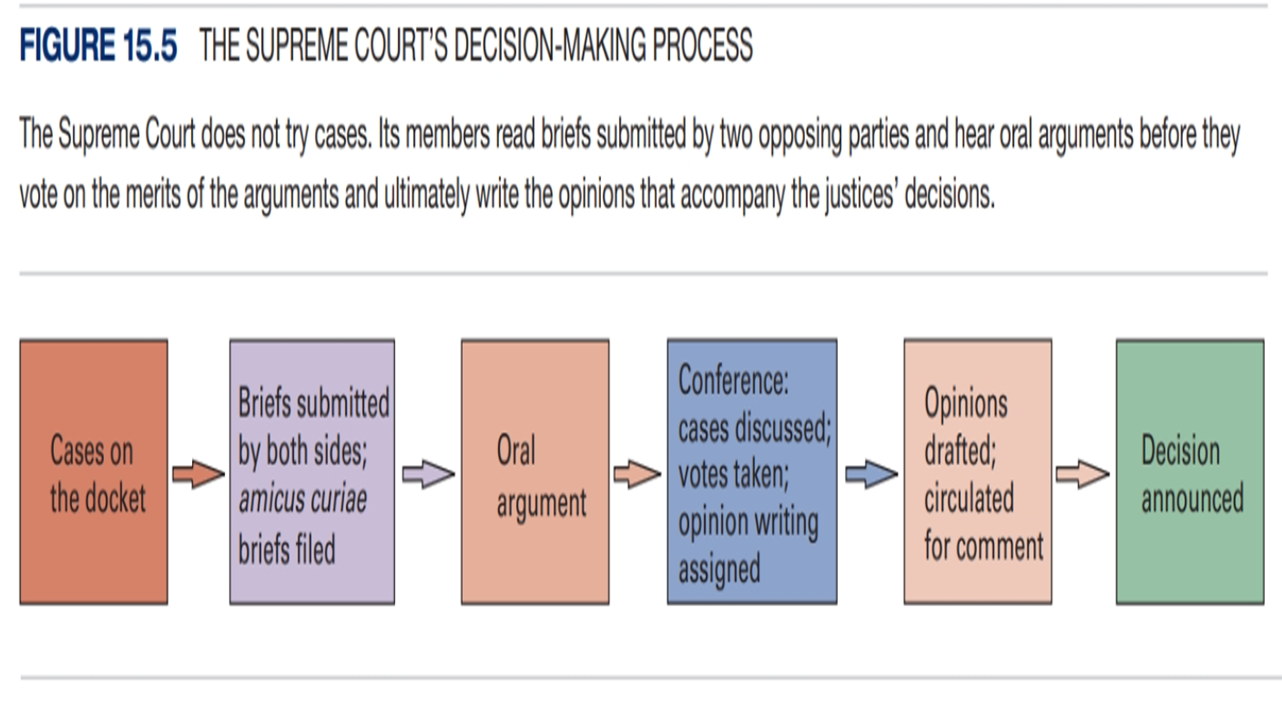
Making Decisions on the Supreme Court
At least 6 justices must participate in a case and cases are decided by majority rule. Five votes in agreement are necessary for the opinion and for the decision to serve as precedent.
Majority Opinion
Concurring Opinions
Dissenting Opinions
Basis of Judicial Decision Making
Decisions are often based on the idea of precedent. Many cases are settled on the principle of stare decisis.
Precedent: the way similar cases were handled in the past is used as a guide to current decisions.
stare decisis: “let the decision stan;,Thisd”, meaning that an earlier decision should hold for the case being considered.
But often times, the courts confront issues that have no precedent. What do the judges do in these situations?
Some say that judges should rely on the original intent (originalism). This view holds that judges should determine the intent of the framers of the Constitution and decide cases in line with that intent.
Others point out that original intent is difficult to determine, and if it could be determined perhaps it should not necessarily be followed. These individuals say that the Constitution was written in broad language for a reason – so judges can base decisions on current societal standards.
Ideology often plays an important role in judicial decision-making – e.g., whether the judge is a liberal or conservative; how they view the role of judges in the political system, etc.
Judicial decision-making is also influenced by amicus curiae briefs from interest groups and public opinion.
Judicial Decisions and Public Policy
There are disagreements about the proper role of the federal courts. Some favor judicial restraint (judges adhere closely to precedent and play a minimal policy role, deferring to legislatures). Others favor judicial activism (judges are less deferential to elected officials and may even chart new constitutional ground).
Do not confuse judicial activism or restraint with liberalism or conservatism.
The courts are careful about using their power, they restrain themselves in an effort to preserve the legitimacy of the court.
The Supreme Court prefers to avoid overturning federal laws and has done so infrequently. Most statutes held to be unconstitutional are from the state and local levels.
The federal courts also tend to stay away from political questions that involve conflicts between branches of government.
Civil Rights
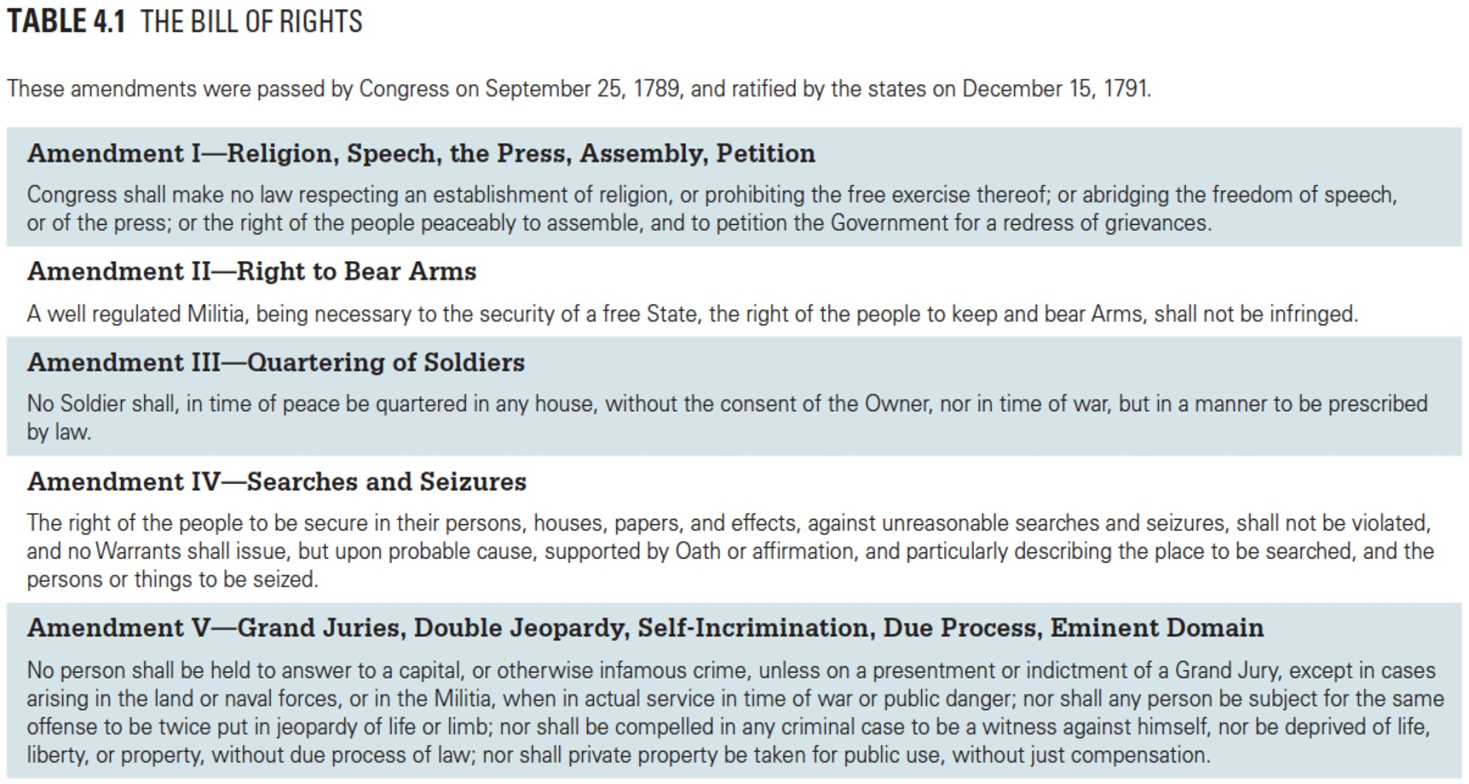
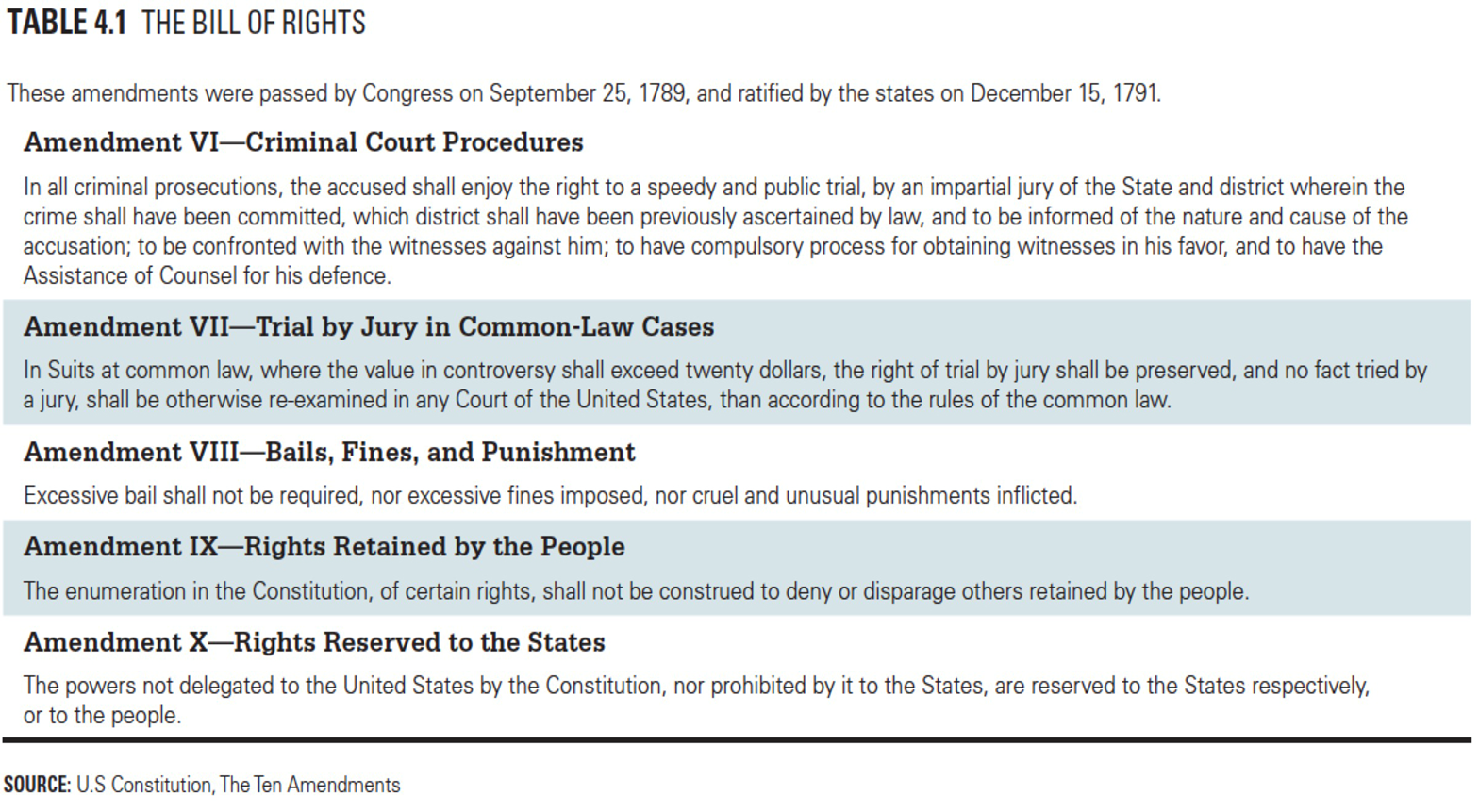
Look carefully at the 1st Amendment:
“Congress shall make no law respecting an establishment of religion, or prohibiting the free exercise thereof; or abridging the freedom of speech, or of the press; or the right of the people peaceably to assemble, and to petition the Government for a redress of grievances.”
For a long time this meant that the Bill of Rights restrained only the national government, not the state governments.
The central idea was moderating the National, not the state, government.
Individual Liberties
Some things to keep in mind as we examine these individual liberties:
Note that freedoms are not absolute.
Often these liberties are in competition and a tradeoff must be made.
The Constitution is written in very broad language.
Changes over time in what is meant by the broad language used in the Constitution. New issues arise that require the Supreme Court to step in to decide what is and what is not constitutional.
While the Supreme Court plays a large role in clarifying what is Constitutional and what is not, the Congress, the President, and state governments play a large role too. Decisions by the Supreme Court are rarely self-enforcing.
→ Civil rights are about equality in the eyes of the law
→ Civil liberties govern the relationship between the state and the individual. Civil rights limit comparative treatment of citizens by the government
→ We are examining the concept of civil rights on the bases of: ↳ Personal freedom (from chattel slavery) ↳ The franchise (voting rights) ↳ Racial equality beyond the ballot ↳ Recent developments in gender and sexual orientation discrimination
No images, diagrams, or graphs. The slide contains bullet points with an indented list.
The United States was a highly unequal society at its founding
Slavery is a grave stain on the entirety of human history
The mass enslavement of hundreds of thousands and eventually millions of people of African descent
These slaves were largely held in the South, where soil and weather were suitable to large, labor-intensive agriculture; however, slavery existed elsewhere in the colonies as well
From the first arrival of African slaves in Virginia in 1619, their number would increase considerably and become a core issue of American politics, which still can be felt in the present day
Slavery is not a uniquely American story
It was practiced in societies all over the world for thousands of years
In the 18th century, slavery was still widely practiced around the globe, but America’s role as a colony played a significant part in slavery’s importance in the American story
It was not eliminated with the words "We hold these truths to be self evident, that all men are created equal." Nor was it ended by the Constitution or the Bill of Rights
• Abolitionism was a political movement in favor of abolishing slavery—that is, to prohibit one person from owning another person as property
• Abolitionism had existed as an idea for centuries; it picked up steam in the 17th and 18th centuries as Enlightenment ideals began to cast doubt on the morality of the institution
• Groups formed in the early United States arguing that slavery was an intolerable institution and needed to be eliminated
The introduction of new slaves from Africa was banned, and all but southern states came to outlaw the practice
Yet, the legal existence of slavery was upheld by the Supreme Court in the infamous case Dred Scott v. Sandford (1857)
Tensions rose steadily throughout the 19th century, culminating in the election of Abraham Lincoln as president in 1860
This conflict became so fraught that it eventually resulted in the American Civil War, a brutal and bloody conflict in which the Union army of the northern states defeated the pro-slavery Confederacy
President Abraham Lincoln shifted the focus during the war from the long-standing policy of negotiation and concession with southern states to a demand of absolute surrender and the abolition of slavery
After the Civil War, the United States ratified three new amendments to the Constitution:
The Thirteenth Amendment prohibited slavery
The Fourteenth Amendment did several things, including regulating citizenship standards, guaranteeing "equal protection of the law" to all people, and adding the Due Process Clause
The Fifteenth Amendment guaranteed that the right to vote could not be infringed on the basis of race or for a person having previously been a slave
While the Thirteenth Amendment was largely effective, it would take many years before the promises of the Fourteenth and Fifteenth Amendments would be realized
→ In the immediate aftermath of the Civil War, northern troops maintained an occupation of the devastated South and enforced a rapid equalization of politics, economics, and society
→ For the first time, Black people were able to register and vote in large numbers. Some ran for office and won seats in Congress
→ Hiram Revels became the first Black senator in 1870. This was a brief flourishing known as Reconstruction, which was fiercely opposed by white southerners
→ Reconstruction failed, and the federal government ceased its efforts to force southern whites to extend rights to the formerly enslaved populations
After Reconstruction, a clear divergence emerged between de jure and de facto rights in the South ↳ De jure, which means "in law," refers to the situation as described by the prevailing law. By this standard, the Fifteenth Amendment clearly provided the right to vote to, at least, Black men. And some would read the Fourteenth Amendment as prohibiting discrimination against women as well. ↳ In fact, or de facto, this was not the case. Southern states passed a series of laws, called Jim Crow laws, that enforced segregation and effective political disenfranchisement across the South.
For an entire century after emancipation, political equality was an illusion for southern Black Americans
These were periods not only of formal discrimination but also of violence
The 1921 Race Massacre in Tulsa, Oklahoma
In addition to enslaved Black people, an even larger slice of society also suffered substantial political, economic, and social discrimination: women
At the time of the founding, most women could not vote or own property apart from the supervision of a man
That more American women had the right to vote in 1790 than in 1820 is an indicator that rights do not change in just one direction; they do not move inexorably toward equality.
Property requirements for political rights discriminated against all but the most wealthy. Religious minorities, such as Catholics and Jews, also faced discrimination in some places.
Though these forms of discrimination pale in comparison to the institution of slavery and were far less systematic and consistent, they do indicate that founding-era America was unequal on a large number of dimensions.
Property requirements for political rights discriminated against all but the most wealthy. Religious minorities, such as Catholics and Jews, also faced discrimination in some places.
Though these forms of discrimination pale in comparison to the institution of slavery and were far less systematic and consistent, they do indicate that founding-era America was unequal on a large number of dimensions.
→ Systemic discrimination is achieved through oppressive and restrictive laws as well as bureaucratic rules that effectively limit someone's right to access a service or participate in the system
Throughout the 19th century, as abolitionists were advancing their cause, another movement grew throughout the country—one to give women the right to vote
These activists became known as suffragettes
These pressures culminated in a national push to grant the franchise to women through a constitutional amendment. There was opposition, however—and not all of it from men
Ultimately, women did receive the right to vote across America through the Nineteenth Amendment, ratified in 1920
It is important to note that Black women in the South remained unable to vote in large numbers, despite these de jure rights
It would take many decades more for anything approaching de facto racial voting equality to emerge
This was substantially achieved with the passage of the Voting Rights Act of 1965
→ For decades after the Civil War, schools across the United States were segregated, either formally or informally.
→ Other key aspects of civil life also featured extensive discrimination. Public transportation, private businesses, and a wide variety of other services were provided separately to white and non-white clients.
→ For decades, the Supreme Court upheld policies such as these as lawful ↳ Plessy v. Ferguson (1896) ↳ Infamously, the court held that segregated services, such as for public transportation, did not violate the Fourteenth Amendment, because they were "separate, but equal."
→ Brown v. Board of Education (1954) ↳ The lawyers of the NAACP convinced the Court that separate could not be equal in questions of public education. True equality required integrated attendance of the same schools
→ Today, no school system is formally segregated, but racial segregation in housing, coupled with neighborhood-based school districts, has led to an increase in informal school segregation
One proposed path to resolve these disparities was for colleges to take affirmative action to actively increase the number of minorities in their school
In many cases, this involved creating quotas or other such systems to guarantee that the school’s admitted class would be racially diverse
These systems required the universities, including public universities, to observe an applicant’s race and treat them differently based on their race. White students claimed this violated the Equal Protection Clause
→ This persisted into the late 1970s, when the Supreme Court ruled that quotas and other numerical and deterministic forms of affirmative action were unconstitutional, though softer forms would be allowed
→ Are affirmative action programs a good thing? ↳ Conservatives and liberals tend to answer this question differently ↳ which was exemplified by a 5–4 decision of the Supreme Court in 2007 ↳ Parents Involved in Seattle Schools v. Seattle School District No.1
→ The conservative position focuses on the process ↳ Chief Justice Roberts: "The way to stop discrimination on the basis of race is to stop discriminating on the basis of race"
→ The liberal position focuses on the outcomes ↳ Justice Breyer: race-conscious affirmative action is necessary to make up for centuries of discrimination and abuse
One of the key components of systemic discrimination has persisted into the twenty-first century: housing segregation
Most cities and towns in America are informally separated into racial clusters, with neighborhoods primarily containing white residents and other neighborhoods primarily containing other races
→ This sorting is partly a byproduct of individual choices and preferences, but it also reflects business and government policy.→ Specifically, various levels of the government worked together with lending banks for decades to promote housing segregation through the selective offering of competitive mortgage rates by race and location.
→ The government helped create and promote color-coded maps by neighborhood, indicating areas that would be restricted to white homebuyers and areas where Black homebuyers would be allowed to purchase at fair rates.
Housing disparities have contributed substantially to the increasing wealth gap between white and Black Americans
According to the Brookings Institute, the typical white family in 2016 had about 10 times as much wealth as the typical Black family (McIntosh et al. 2020)
Just as the legal right to vote did not end legal discrimination against Black Americans, so too did sex discrimination persist throughout the 20th century
Sex continued to be considered in education—specifically at universities—all the way into the early 1970s. In specific cases, such as martial academies and within the U.S. military, discrimination persisted into the 1990s and early 2000s
Classifications based on sex are not treated with the same level of scrutiny as those based on race. While any race-based classification is highly suspect and must meet the strictest scrutiny to be judged constitutional, sex-based classification can further reasonable goals
"The biological differences between the sexes mean that there are situations in which classifications are justified"—Justice Ruth Bader Ginsburg
→ Judges use a hierarchy of tests, some harder than others, and apply different tests to different suspect classifications:
↳ Strict Scrutiny: For example, discrimination based on race receives the most demanding test, which requires the government to prove that its policy is "narrowly tailored" to achieving a "compelling government interest." The government rarely wins such a case.
↳ Intermediate Scrutiny: Discrimination on the basis of sex has been given a test called intermediate scrutiny, which requires the government to prove only that its policy is "substantially related" to an "important government interest."
↳ Rational-basis Scrutiny: This merely requires the government policy be "rationally related" to a "legitimate government interest." The government rarely loses cases under this standard.
If this system seems convoluted and indirect, you are not alone
Even Supreme Court Justices, such as former Justice Antonin Scalia, have argued that this system is indirect and incoherent
LGBTQ+ Rights
The most significant developments in civil rights over the last 40 years have been in the area of LGBTQ+ rights
Less than two decades ago, homosexual sex was criminalized in many places in the United States. Opposition to sexual-preference equality was a bipartisan position
However, in just the last 20 years, all of these positions have reversed. Today, because of a number of Supreme Court rulings, homosexual sex is entirely lawful
Lawrence v. Texas (2003)
Obergefell v. Hodges (2015)
The United States has made a considerable amount of progress toward legal equality since its founding. Today, the letter of the law almost never makes legal distinctions by race
There is another way to be unequal before the law, and one that is much harder to root out: when the application of seemingly egalitarian laws is itself unequal
Though laws may be written in a race-blind fashion, there is substantial evidence that they are not enforced equally
Consider the roles of four important groups in the criminal justice process: police, prosecutors, judges, and juries
Police officers represent an essential first step in the criminal justice system and are tasked with identifying and investigating crimes
Bureau of Justice Statistics survey in 2015 found that Black and Hispanic Americans were more than twice as likely to have experienced a use or threatened use of violent force from a police officer (U.S. Department of Justice 2018)
Another important group of actors are prosecutors. They have the essential job of deciding who to charge and for what crimes. At trial, it was common for prosecutors to weaponize race, especially in selecting jury members
↳ Batson v. Kentucky (1986): This led to the creation of rules that prohibit striking jurors from trials solely based on raceConsider the role of case deciders: judges and juries. They ultimately decide the outcomes of cases and the sentences imposed. A developed literature of psychological research indicates that they will struggle to do this without bias
→ America was founded as a highly unequal society, with the extensive practice of slavery and the denial of basic political and property rights to women
→ In the more than 240 years that have passed since the founding, many of these formal and legal forms of discrimination have been repealed and reformed
→ Today, the country is considerably more equal than at its founding, but some disparities persist
Civil Liberties
→ Limitations on government’s power to take actions against the interests of citizens
→ These are core protections against harsh, excessive, or unjustified treatment by the government
→ Protection of civil liberties vary widely across societies
→ Similar to other Western democracies, the United States' position on civil liberties is informed by the classical liberalism of the Enlightenment and the Western philosophical tradition
→ These liberties are sometimes called individual liberties. Focusing on the individual rather than the collective ↳ They are not static and vary across place and time
No images, diagrams, or graphs are present on the slide.
Core disputes among Framers of the Constitution was over the level of power and centralization of the national government
Federalists prevailed, and the government became substantially more powerful and centralized than had existed under the Articles of Confederation
However, a concession by the Federalists revolved around the explicit protections for civil liberties
Explicitly defining liberties allows for their protection, but potentially neglecting civil liberties not mentioned
Main Constitution would not include the protections of liberties, but a set of amendments would be considered immediately after
The Bill of Rights is the 10 amendments considered immediately after
Additional rights/liberties were not included
Many countries follow what is known as Civil Law or Roman Law
This is achieved by writing voluminous codes of laws and regulations for every possible situation
However, the Bill of Rights is vaguely worded
Due to this, civil liberties have largely been the domain of judges who interpret the text of the Bill of Rights
Some argue that norms of legal interpretation structure these choices
Others argue that judges pursue their own policy preferences
Freedom of Speech (Amendment I) - Prohibition of prior restraint is a hallmark of free expression law in the United States - Prior restraint: censoring speech or a publication before it is actually made - Government regulations of speech must be content neutral; they cannot favor some ideas over others - Most forms of expression (symbols, music, dancing, etc.) are speech and are protected - There are some possible limitations on speech (such as censoring loud speech at night), but protections are very broad - Unpopular and offensive speech is protected. Hateful speech is protected. Discriminatory and bigoted ideas are protected by the First Amendment
Freedom of Religion (Amendment I) ↳ Establishment clause: prohibits government from respecting an establishment of religion ↳ Bars government from supporting one religion over others ↳ Embodies the idea of separation of church and state
Free Exercise Clause guarantees individuals the ability to freely exercise the religion of their choice
Freedom of Religion (Amendment I)
Limits: religious conscience does not justify committing crimes
↳ Including the use of substances used in religious eventsThe Religious Freedom Restoration Act
↳ Impose a higher standard on government laws that happen to limit religious expression
↳ More laws struck down on a state-by-state level regarding the violation of religious liberties
→ The Right to Bear Arms (Amendment II)
↳ Second Amendment meant to protect both collective and individual liberty to possess weapons
↳ This is a hotly debated topic
↳ Resolved in District of Columbia v. Heller
↳ Weapons regulations must reach a high burden to be constitutional
↳ Efforts to eliminate weapons in jurisdictions are now blocked
↳ McDonald v. Chicago
↳ Clarified that the right to bear arms was one of the types of fundamental liberties that also limit state and local governments as well
↳ New York State Rifle & Pistol Association v. Bruen
↳ Expanded protections beyond the home: the right to possess weapons for self-defense extends into most (but not all) places and aspects of life
↳ The specific boundaries of this right remain unclearText slide with bullets discussing the Second Amendment and key court cases related to the right to bear arms.
→ Protection against Search and Seizure (Amendment IV) ↳ Police power among the greatest that a government possesses ↳ Ability to use force and intrusion to find, stop, investigate, and punish wrongdoing ↳ The Fourth Amendment, contains safeguards against unwarranted (and unreasonable) searches and seizures
No images or diagrams present.
→ Protection against Search and Seizure (Amendment IV) ↳ Search: When the government looks for information, whether physical or intangible, that a person reasonably expected to remain private ↳ Seizure: When the government takes things or arrests a person ↳ These actions require a warrant—a judge has to approve it beforehand ↳ Judge serves the role of an independent determiner
→ Protection against Search and Seizure (Amendment IV) ↳ Despite protection, why do many police searches and arrests occur without warrants? ↳ The Fourth Amendment lacks a clear enforcement mechanism ↳ For this reason, the Supreme Court created the Exclusionary Rule as an enforcement mechanism
No images or diagrams present. The slide contains text elements discussing the Fourth Amendment and the Exclusionary Rule.
Protection against Search and Seizure (Amendment IV)
Exclusionary Rule
Prohibits the government from using evidence obtained in violation of the Fourth Amendment at trial
This removes the incentive for police to break the law and encourages them to pursue their investigation within the bounds of the Constitution
→ Liberties of Defendants (Amendments V-VIII)
↳ "I plead the Fifth": Liberty against self-incrimination, no person can be compelled to incriminate themselves through testimony
↳ You can be compelled to testify against someone else
↳ These protections reduced in civil litigation
↳ Miranda v. Arizona, the Supreme Court ruled that police must remind citizens of their right to remain silent
↳ Miranda Rights: Police must remind citizens of their right to remain silent, which is derived from the Fifth AmendmentThe slide contains no images, graphs, or tables. It is text-based and lists key points related to civil liberties.
Liberties of Defendants (Amendments V-VIII)
↳ The Sixth Amendment guarantees that a person will get to confront the witnesses or evidence brought against them in a criminal trial
↳ The Confrontation Clause guarantees that if the state is going to use allegations against a defendant, the person making those allegations will have to come to the trial and state them to the court
↳ The accused will then have the opportunity to respond to them through cross examinationLiberties of Defendants (Amendments V-VIII)
The Eighth Amendment prohibits the state from using any cruel or unusual punishments
This is a crucial aspect to the debates over the legality of the death penalty
Although executions remain constitutional and certain states have banned them, the punishments are not to be unduly painful or harmful to the sentenced person
It also prohibits the execution of minors and those with mental disabilities
Due Process
Included in the Fifth Amendment
"No person shall be… Due Process
As interpreted by the Supreme Court there are two different components
Procedural due process: an undefined set of minimal standards of official process before the government can take action against a citizen (hearings and notice and procedural steps)
Substantive due process: trickier concept and contains judge-made law on what the state cannot do to citizens
Based off the idea that certain types of policies are substantively a violation of citizens’ libertiesdeprived of life, liberty, or property without due process of law"
This is repeated in the Fourteenth Amendment, ratified in 1868
Who enjoys these protections? ↳ United States citizens ↳ People within the United States and its territories
The government may not violate these liberties for foreign visitors, undocumented immigrants, or any other group of non-citizens in the country
Outside of the United States the situation is less clear
Federalism and One-Way Laboratories of Civil Liberties ↳ Argument for federalism is that states can be "laboratories of democracy" ↳ States may pursue different policies ↳ Creates a marketplace for policy across the country
Are there laboratories of democracy on civil liberties? ↳ Yes ↳ States can experiment with civil liberties policy, but only in one direction: more, rather than fewer liberties
The Framers were forward thinking with the Bill of Rights. However, the Bill of Rights was meant to solve the political problems of the 18th century
Due to this, judges—most often Supreme Court Justices—flesh out the meaning of the provisions within the Bill of Rights
In order to solve problems that were not present in the 18th century
Political Parties
Political Parties: organization of people established to win elections
↳ Includes professionals and volunteers who recruit and help candidates win election and assist votersParties in the United States do not have formal memberships for individual voters
↳ Some states allow voters to affiliate with a party when they register to vote
↳ Data on how many voters "identify" with each party are based on opinion pollsMany founding fathers warned against the development of political parties
Parties developed anyway to serve certain functions (Aldrich 2011): ↳ Organize Congress and government more generally ↳ Organize campaigns and mobilize voters ↳ Manage nominations and provide a career path for ambitious politicians
1796-1816 - Federalists vs. Democratic-Republicans
1820-1824 - Democratic-Republican Party dominates, but fractures in 1824
1828-1852 - Democrats vs. National Republicans/Whigs
1856-1860 - Whigs succeeded by Republican Party. Democrats split North/South in 1860
1864 – Current - Democratic and Republican Parties
A timeline from 1796 to the present showing the evolution of the two-party system in the U.S. with key periods and competing parties noted in circular labels above the line.
→ United States has an electoral system with single-member districts ("winner takes all"), plurality winners ("first-past-the-post")
→ Single-member district = one representative for each district
→ Contrast with multi-member districts
→ Plurality = candidate with the most votes wins
→ Contrast with majority system: Candidate needs > 50 percent to win
→ Duverger's Law: Electoral systems with single-member districts and plurality winners tend to produce two parties
Other factors reinforce Duverger's law:
- Separately elected president; all states except Maine and Nebraska allocate Electoral College votes winner takes all
- State ballot access laws
- Strategic behavior by Democrats and Republicans
Third parties represent views and promote policies not addressed by two major parties
↳ Ex: Libertarian Party formed because economically conservative and socially liberal policy views cannot fit within either Democratic or Republican partiesThird parties can influence development of major party platforms
↳ Ex: Progressive Party split from the Republican Party in the early 20th century to push for 8-hour workday, women’s suffrage, and restrictions on campaign contributions, among other policiesFactions within major parties can morph into third parties
↳ Ex: Southern Democrats formed Dixiecrat Party in 1948 to oppose racial integrationMeaning of "conservative" and "liberal" has changed over time
Both parties are responsive to shifts in public opinion and minor party challenges in order to maintain their status
Federalists/Whigs/Republicans (conservative) in 1800s favored a strong central government and import tariffs while Democratic-Republicans/Democrats (liberal) favored decentralization and free trade
Civil Rights—Democratic-Republicans/Democrats included conservative southern elites until the mid-20th century, whereas Republicans were the anti-slavery, pro-union party. By the 1960s, Democrats became the proponents of strong civil rights
The political realignment of the South since the 1960s set the scene for the modern Republican and Democratic parties
As of January, 2023, there are no independent or minor party members of the House of Representatives, and three independent U.S. Senators—Kyrsten Sinema of Arizona, Angus King of Maine, and Bernie Sanders of Vermont
But Sinema was elected as a Democrat and Sanders has run for the Democratic presidential nomination twice
At the state level, there are no independent or minor party governors, and 99 percent of the more than 7,000 state legislators are Democrats or Republicans
The adoption of direct primaries for most offices decreased the influence of the party organization over nominationsThe development of mass communication (radio, then television, then the internet) made it possible for candidates to communicate with voters directly rather than relying on the party to run their campaigns
Candidates also developed their own fundraising abilities
Today, parties are what John Aldrich calls service organizations
At the top are the Democratic and Republican National Committees
The national committees are responsible for coordinating overall election strategy, raising money, and running the party's national convention every four years.
The national committees consist of a national chair and members drawn from all 50 states.
Both parties also have two congressional campaign committees: - Democratic Congressional Campaign Committee / Democratic Senatorial Campaign Committee - National Republican Congressional Committee / National Republican Senatorial Committee
Both parties also have state party organizations in all 50 states
Following the establishment of mass parties, state organizations tended to be the most important, and state leaders came together every four years to organize a convention and nominate a candidate for president
State parties are less important in modern presidential politics due to (1) adoption of the modern rules for nominating presidential candidates, and (2) nationalization of fundraising since the 1960s
Both parties are also organized at the local level, although the strength of local party organizations varies significantly
The most basic distinction between primaries is whether they are closed or open
In a closed primary system, voters can declare a party affiliation when they register to vote, and only those voters registered for a certain party are allowed to vote in that party's primary
An open system is the opposite: any registered voter can participate in the primary for any party, and information on who voted in which primary is not public
→ In a closed system, nominations are made by true party loyalists, which almost guarantees a candidate acceptable to the party leadership. However, candidates have little incentive to appeal to independents
→ An open system gives voters maximum flexibility and is more likely to result in a candidate who has broad appeal, but it may result in a candidate who is not acceptable to the party leadership
→ California and Washington recently adopted a "top two" primary ↳ In this system, all candidates from all parties run in a single primary. The top two finishers regardless of party run again in the general election
→ Historically, presidential nominees were chosen at national conventions held every four years
→ Each state had a certain number of delegates, but state party leaders typically controlled the votes of their delegates
→ The bargaining that went on between party leaders led to the phrase "smoke-filled room"
→ As late as 1968, Hubert Humphrey won the Democratic nomination at the convention without entering a single primary; only 13 states held presidential primaries.
→ Following the 1968 election, first the Democrats and then the Republicans adopted party rules that created the current systemNow, each state has a certain number of delegates at the national convention who are pledged to specific candidates for at least one ballot
Pledged delegates are selected in primaries or caucuses. A caucus is a meeting that voters attend at a particular time and place
Nominees are chosen at the national convention by majority vote
In addition to pledged delegates, the Democrats have a number of "super delegates" chosen by virtue of their position (e.g., national committee member or Member of Congress)
Beginning in 2020, super delegates cannot vote on the first ballot
→ In 2024, incumbent President Joseph Biden withdrew as a candidate after the primaries but before the convention.
→ Democrats nominated Vice President Kamala Harris at the convention.
→ The closest precedent was 1968, when incumbent Lyndon Johnson withdrew March 31 and Democrats nominated Vice President Hubert Humphrey.
• The platforms adopted by the Democrats and Republicans summarize their positions on important national issues
• The 2016 Democratic platform addressed 94 separate issues organized into 13 general areas; the 2016 Republican platform addressed 87 issues organized into six areas
• Conventions were held virtually in 2020 due to the pandemic. Republicans simply continued their 2016 platform
• Platforms are not binding on candidates, but an incumbent who strays too often may face a primary challenge in the next election cycle
In geographic terms, the dominant difference between the parties today: Democrats win cities, Republicans win rural areas, and the suburbs are the battlegroundA study by the Pew Research Center released in June 2020 finds that the primary demographic variables associated with party identification are race and ethnicity, education, age, gender, and religious affiliation
Republicans, like other conservative parties before them, are associated with business interests. The connection is particularly strong with small businesses; connections with larger companies are more mixed and vary by industry
Many executives of high-tech companies as well as entertainment companies support the Democrats
Labor unions (except for the Teamsters) have been a strong part of the Democratic coalition for decades, although labor unions have been declining in terms of both economic and political strength since the 1970s
Evangelical Christian organizations are important players in Republican politics
Once the election is over, parties become an important force in organizing governmentCongress is explicitly organized along partisan lines
The Speaker of the House is invariably the leader of the majority party in the House
The chairs of every committee in both the House and the Senate are from the majority party; the majority of members of every committee are from the majority party; even the majority of staff assigned to each committee are from the majority party
Partisanship in Congress is extremely high right now
There is little question that the two parties in Congress are as internally homogeneous and as distinct from one another as they have ever been
The parties are also relatively evenly matched; the majority party in Congress typically has a small margin
The result is that very few pieces of significant legislation have been passed in recent years, even when one party held majority power
Democrats and Republicans have often been criticized for failing to provide voters with a clear choice that the winning party would implement following the election
Party discipline and homogeneity were particularly low during the middle of the 20th century
Conservative Democrats controlled the "solid South"
Moderate to liberal "Rockefeller Republicans" in the Northeast
The Responsible Party model assumes parties are homogeneous and candidates will compete for the support of the median voter
But recently, both parties seem intent on mobilizing their bases
If one party wins a clear victory, it may implement policies that much of the country views as too extreme
If the parties divide control or if one party wins a narrow victory, the result is likely to be gridlock
Organized Interests
Organized interests vs. interest groups ↳ "Organized interests" include organizations that do not have members or supporters, but that may seek to influence politics and public policy, e.g., business firms ↳ There are many other kinds of organizations that exist for nonpolitical purposes but that occasionally get involved, e.g., nonprofit organizations like private hospitals and schools ↳ Public agencies like state and local governments and public universities are also organized interests ↳ Interest groups—organized interests that have members—include labor unions, trade and professional associations, and "citizen groups"
→ The Problem of Factions: What are factions?
↳ "a number of citizens, whether amounting to a majority or a minority of the whole, who are united and actuated by some common impulse of passion, or of interest, adverse to the rights of other citizens, or to the permanent and aggregate interests of the community" (Madison 1787)
→ Are there variants in the type of faction? Yes
↳ Majority Factions: political parties
↳ Minority Factions: organized interests or interest groupsFreedom of association is protected by the First Amendment
One person's "special interest" is another person's democracy in action
Organized interests serve useful functions
Influence the selection of representatives, beginning at the nominating phase
Provide representation on specific issues important to a subset of the governed
Provide information to policy makers that is not widely available
Provide information regarding how policy may affect their own stakeholders
→ Classical Pluralism: optimistic view of the role of organized interests
↳ There are numerous interests in society, and all have the same liberty to organize
↳ There is no official hierarchy of interest organizations. They can compete for supporters, media attention, reputation, and so forth
↳ Policy making authority is distributed throughout government; no office has a monopoly
↳ Organized interests are free to address all such authorities
→ The implication is that the policy outputs will be a relatively unbiased reflection of the interests in society
A major flaw in the pluralist argument is the Collective Action Problem ↳ As noted by Olson (1965), people free ride and would rather let others do the work of advocating for public policies rather than contribute their own resources ↳ Solution: a group may provide selective incentives ↳ Material Benefits ↳ Solidarity Benefits ↳ Expressive Benefits ↳ These are different than purposive benefits, which are dependent on the group achieving its political or policy goals ↳ Different kinds of interest organizations are subject to free riding to very different degrees
→ Business Firms ↳ Not subject to collective action problems—they have owners and employees who get the material selective benefits of profits and wages ↳ Large firms hire government relations specialists ↳ Small firms may hire contract lobbyists on an ad hoc basis or act through trade associations
Non-profit organizations
These include private schools, hospitals, churches, philanthropic organizations, and arts and cultural organizations
They also have employees and members who join for nonpolitical reasons
They also may belong to trade associations
But 501c3 organizations cannot engage in partisan campaign activities and are limited to insubstantial amounts of lobbying
There are loopholes to the limit on lobbying
→ State and Local Governments and Public Institutions
↳ It may seem normal to think of state and local governments as the target of organized interests rather than organized interests themselves, but many actions taken by the federal government impose costs on state and local governments, make money available to them, or otherwise affect their own policy decisions.
↳ Similarly, other public institutions, like state universities, have strong interests in federal policy.→ Trade Associations
↳ Interest groups whose members are other organizations
↳ They suffer from collective action problems; however, they do provide selective incentives through the forms of:
↳ Information
↳ Networking
↳ Training Activities, and so forth
→ Some countries have peak associations that speak on behalf of entire sectors of the economy or society, but U.S. pluralism is not that hierarchical
→ Professional associations are similar except their members are individuals, e.g., the American Bar Association→ Labor Unions ↳ Checkered history in the U.S. ↳ Late 19th and early 20th centuries: opposed (sometimes violently) by businesses and elected politicians ↳ Following the 1935 National Labor Relations Act unions were: ↳ Officially recognized by federal law ↳ Able to file complaints against employers regarding unfair labor practices ↳ Were once major players in Democratic Party politics
Private sector unions have been in decline since the 1960s
Currently, less than 10 percent of nonagricultural, private sector workers are unionized
Increased international competition has affected many manufacturing industries
Many states have adopted "right-to-work" laws that prohibit fees charged to nonmembers to support collective bargaining activities. The result is free riding
Recent Supreme Court ruling holds that right-to-work must apply to all public sector unions
→ Citizen Groups - Most diverse type of membership organization - Members share an interest in a particular cause or set of issues rather than an industry, occupation, or employer - Subject to the most severe free rider problems - Tend to be 501c4 "social welfare" non-profit organizations - Cannot have partisan politics as the primary focus, yet frequently adopt a particular ideology that aligns with a political party - Examples of citizens groups include - National Rifle Association, the Sierra Club, The League of United Latin American Citizens - Have been on the rise since the 1960s, but lack the financial resources of business firms and trade associationsExtent to which organized interests participate in elections varies
501c3 nonprofit organizations and public agencies cannot participate in partisan elections
Business firms, trade associations, and professional associations rarely endorse or publicly support candidates
They do not want to antagonize large numbers of potential customers, employees, or members
Many (but by no means all) business firms and trade and professional associations make campaign contributions or independent expenditures
Labor Unions are active in elections
↳ Most unions are allied with the Democratic Party
↳ Teamsters Union is an exception
↳ Communicate with their members about policy issues
↳ Well known for voter mobilization effortsCitizen groups participate in elections in various ways
↳ Communicate with their own members and donors about issues and specific candidates
↳ Groups with large numbers of members may mobilize voters
↳ Some citizen groups also make campaign contributions or independent expendituresCampaign Contributions and Spending ↳ The amount of private money in U.S. elections distinguishes them from elections in other countries ↳ Campaign contributions and spending are protected by the First Amendment to the Constitution ↳ Supreme Court ruling in Buckley v. Valeo (1976) ↳ The only contributions that may be limited are contributions made directly to a candidate or party ↳ Candidates and parties can spend as much as they can legally raise from private donors ↳ But contributions and spending may be required to be disclosed to the public
Unions and corporations cannot contribute directly to a candidate for Congress or the presidency. Labor unions developed the political action committee (PAC)
PACs:
Raise money from individuals (such as union members or business firm employees) to make campaign contributions
Became the embodiment of "big money" in the 1980s and 1990s
Union PACs employ selection strategy:
Primary goal is to affect the partisan composition of Congress
Business and trade PACs tend to follow an access strategy:
The goal is to be on good terms with whomever controls power
→ Some PACs are not affiliated with a "parent" organization
→ What influence do PACs have on policy and politics?
↳ Statistical studies testing the influence of PAC contributions on roll call votes in Congress are generally inconclusive
↳ Possibility of reverse causation
↳ Influence is not likely to be found in final roll call votes. More likely to be in the details of legislation or in stopping bills from coming to a final vote→ Independent Expenditures are expenditures that are not made in consultation or cooperation with, or at the request or suggestion of, any candidate, or their authorized committees or agents, or a political party committee or its agents
→ Super PACs
↳ Sole purpose is to make independent expenditures
↳ Contributions to and spending by Super PACs are not limited
↳ Can evade public disclosure requirements, a practice known as dark money
↳ Money is transferred among multiple organizations and then spent by a Super PAC
↳ Makes it difficult to identify the original sources of spending on independent advocacy
Elon Musk appears to be an exception to the rules.Musk is the world's richest person. Individuals with enough resources to affect collective outcomes by themselves are not subject to collective action problems.
Musk is reported to have spent over $250 million promoting Trump and other Republican candidates.
It would be illegal to donate even a small fraction of this amount to parties or candidates.
But it is perfectly legal to spend it himself or donate it to a Super PAC.
→ Lobbyists ↳ Term originated in the 19th century: advocates who would loiter in the lobby of a hotel or the Capitol building ↳ First Amendment of the U.S. Constitution protects the ability "to petition the Government for a redress of grievances" ↳ Outright bribery has always been illegal ↳ Professional lobbyists are only required to: ↳ Register with Congress ↳ Comply with certain public disclosure requirements ↳ Disclosure was completely ineffective until the mid-1990s
Lobbying the President
Access to the President and White House Staff is limited
A few organized interests important to the President’s election may get a meeting
The White House sometimes organizes lobbying campaigns by allies who support its proposals
Lobbying the Legislature
↳ Lobbying most likely to influence public policy occurs in the legislature
↳ Direct lobbying: consists of communicating directly with elected legislators or their staff
↳ Indirect (grassroots) lobbying: communication with a group’s supporters or the general public in an effort to get them to contact their representativesLobbying the Legislature
How well does lobbying work?
Difficult to say; generally lobbying is unobserved
A great deal of money is spent on lobbying, so clients must believe it is valuable
1995 Lobbying Disclosure Act
Requires that professional lobbyists register and identify their clients, the general issues they work on, and the amount they spend on lobbying efforts, but not who they meet with or what they say
→ Lobbying the Bureaucracy
↳ Many policy decisions are made by administrative agencies
↳ Congress often passes legislation that sets forth general goals and principles but leaves it to administrative agencies to fill in the details by writing regulations
↳ The Administrative Procedure Act requires a period for public comment on proposed regulations before they can be adopted
↳ Organized interests may also try to influence administrative agencies informally by providing scarce information
→ Lobbying the Courts ↳ Most court cases do not involve public policy questions, and courts rarely make policy ↳ Organized interests may challenge policy decisions based on statutory interpretation or compliance with the Constitution ↳ Some organized interests file amicus curiae briefs—briefs by non-litigants that inform the court of context and the practical consequences of a decision
→ Some citizen groups file test cases designed to shape the interpretation of laws or the Constitution ↳ They must find a private party willing and qualified to serve as plaintiff ↳ The most famous example is probably Brown v. Board of Education
Review
Study for Midterm
Federal Courts
-The difference between Criminal and Civil Cases
-Know that the court deals with and identifies a Justiciable Dispute.
-What is and is not a justiciable dispute?
-The importance of Amicus Curiae briefs
-The difference between Original Jurisdiction and Appellate Jurisdiction
-How are Judges and Justices nominated?
-Know the difference between District Courts and the Supreme Court
-What is the Court of Appeals?
-What is Senatorial Courtesy?
-Why is it important?
-What are the important aspects that the senate consider when hearing a supreme court nominee?
-Why is the Supreme Court so important?
Civil Rights and Civil Liberties
· What are civil liberties?
· Does the First Amendment address only freedom of expression?
· What is the Free Exercise clause?
· What is the Exclusionary Rule?
-What is Abolitionism?
-What is Affirmative Action?
-What is the difference between de jure and de facto?
-What is the Equal Protection Clause?
-What was Reconstruction?
-What is Redlining?
-What is a suffragette?
-What is the difference between civil liberties and civil rights?
· Did the Civil Rights Act of 1964 and the Voting Rights Act of 1965 only address African Americans?
· What is the difference between de jure segregation and de facto segregation?
· What was Reconstruction?
· What event ended Reconstruction?
· What is Affirmative Action?
Political Parties
-What is a caucus?
-What is a closed primary system?
-What is an open primary system?
-What is a coalition?
-What is a Congressional campaign committee and what is their purpose?
-What is a direct primary?
-What is Duverger’s Law?
-What does it explain about the American political system?
-What is a “median voter” ?
-What is a political platform?
-What is a plurality vote?
-What does it mean when a political system is a “winner takes all,” system?
-Who were the “Rockefeller Republicans?”
-What is the “Solid South?”
Organized Interests
-The effect of money in Politics
-Classical pluralism
-The Issues with and Solutions to Free-riding.
-What is a collective action problem?
-Know the difference between actual and potential groups.
-Know what a Single Issue group is.
-Know what Lobbying is
-What is a contract lobbyist
-Indirect (or grassroots) lobbying
-Direct lobbying
-How Lobbyists can be useful to Politicians.
-Know what Litigating is.
-Know the Types of Interest Groups.
-Lobbying Disclosure Act
-Administrative Procedure Act
-Voter mobilization?
-How do we mobilize voters 😊?
-Peak Association?
-What is a Selection strategy?
-What is a Selective incentive?
-What is a Super PAC?
-What is a 501c3 organization?
-What is a 501c4 organization?