Lecture 22: Antimicrobial Drugs
Antibiotic: antimicrobial medications naturally produced by micro-organisms
commonly used as a synonym for antibacterial.
First antibiotic: penicillin
discovery of penicillin:
colones were smaller around penicillium mold
penicillium mold makes chemicals called penicillin
Antimicrobial Drug Terms
Antimicrobial action can either kill microbe or inhibit the growth of microbe:
“-cidal”: kills microbes
Bactericidal: Drugs that function by killing the targeted microbe.
“-static”: inhibits microbe growth
keeps microbe from growing long enough for immune system to kill it
Bacteriostatic: Drugs that inhibit the growth of the microbe. This allows the host's immune system enough time to clear the infection.
Examples of drugs that kill or inhibit growth of microbes:
antibacterial
anti-fungal
anti-protozoan
anti-helminthic
antiviral (inhibits replication)
Designing a Good Antimicrobial Drug
Selective Toxicity: hurts microbes more than the host
The principle of designing a drug that harms the microbe significantly more than the host
targets structures or processes unique to the microbe = drug target
Drug Target: the part of the microbe that is affected by the drug
most drugs bind to molecule or structure in microbe and breaking it
blocks microbe from functioning properly and ultimately leads to its death
Common Drug Targets
Drug Targets for Antibacterial Drugs:
Cell Wall
Cell Membrane
Ribosomes
Metabolic Pathways
DNA/ RNA synthesis
Targeting the Cell Wall
Drugs that target the cell wall:
inhibit peptidoglycan synthesis
All drugs in this category are bactericidal
all Kill bacteria
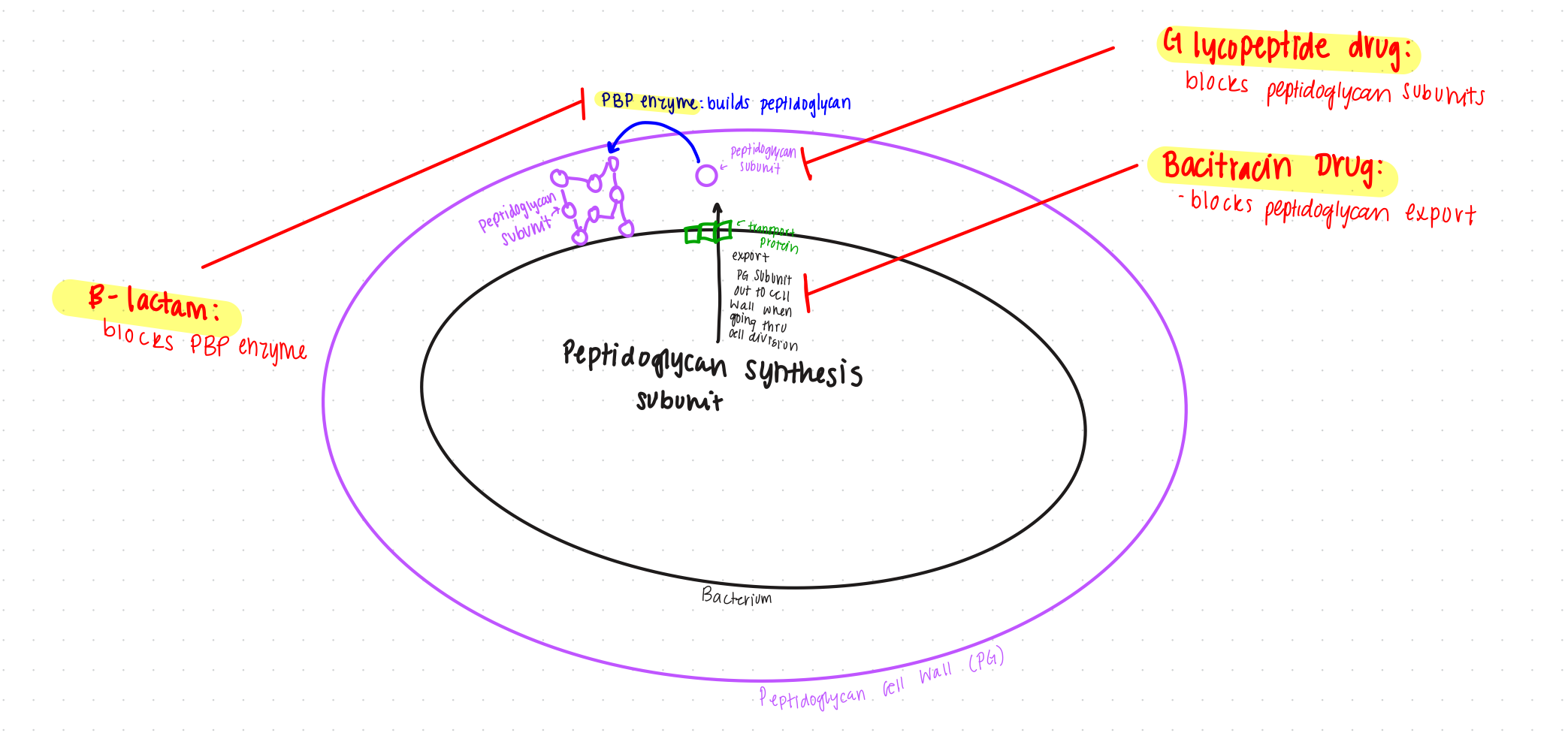
Bacitracin: prevents transport of peptidoglycan subunits out of the cell wall
bactericidal drug
Target: cell wall
Mechanism:
during cell division, peptidoglycan subunits are exported out of the cell wall
Bacitracin blocks the peptidoglycan subunits from being exported
Glycopeptides: bind peptidoglycan subunits so they can’t be incorporated
bactericidal drug
Glycopeptide Antibiotic: Vancomycin
Target: cell wall
Mechanism:
after export, peptioglycans subunits are suppose to be bound to other existing peptidoglycan subunits to build cell wall
glycopeptide drug bind to peptioglycans subunits instead, preventing them from being incorporated into cell wall
Beta-lactams: bind and block penicillin binding protein (PBP) enzymes so it can’t build peptidoglycan
bactericidal drug
Glycopeptide Antibiotic: Penicillin
Target: cell wall
Mechanism:
PBP enzyme: builds peptidoglycan, takes peptidoglycan subunits and incorporates them into existing peptidoglycan cell wall
beta-lactam blocks PBP enzyme from building peptidoglycan cell wall
called beta-lactams because of their chemical structure, containing beta-lactam rings
Targeting the Cell Membrane
Drugs that target the cell membrane:
All drugs in this category are bactericidal
all Kill bacteria
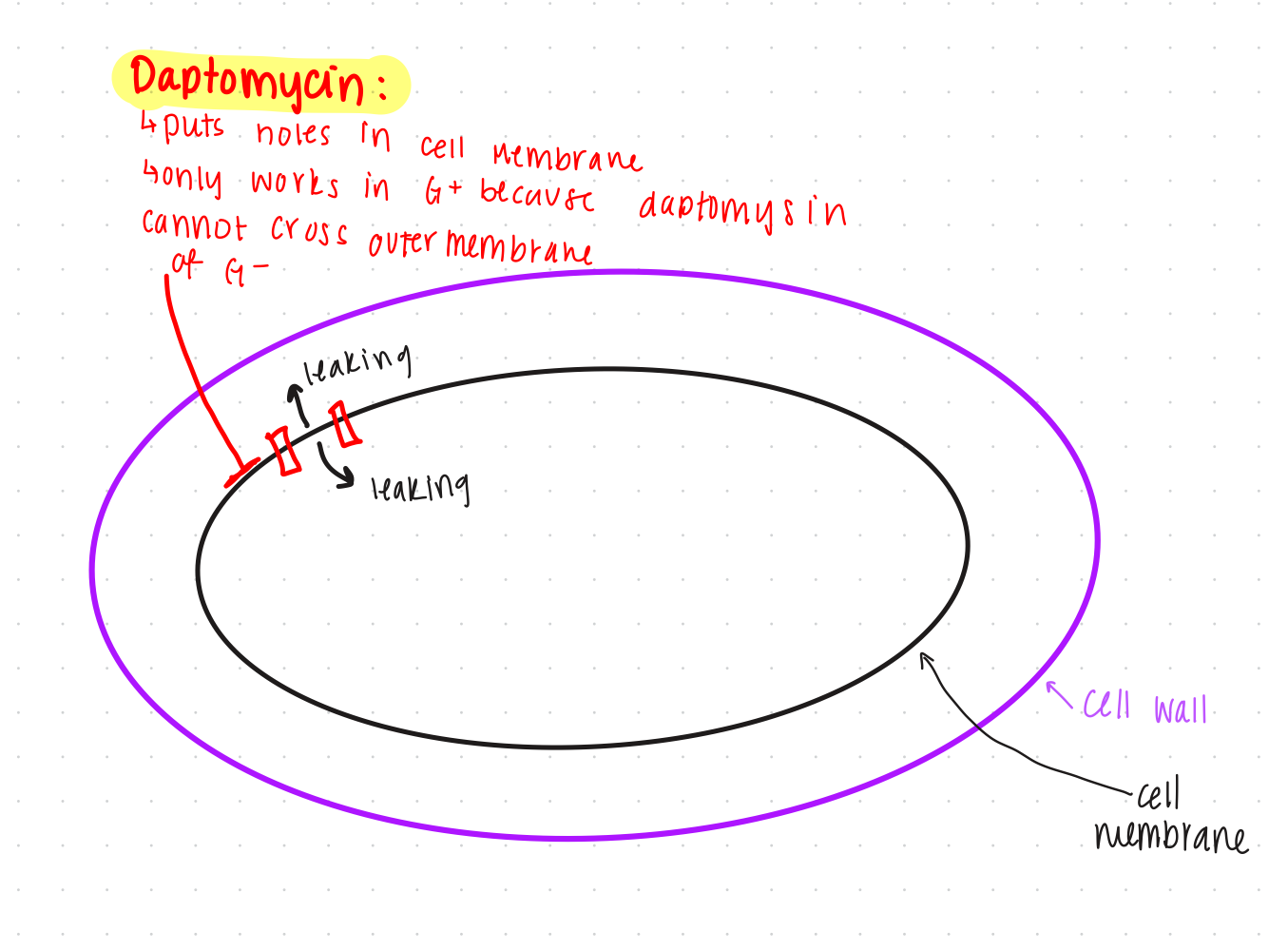
Daptomycin: target Gram positive cell membrane and pokes holes in it
bactericidal drug
Target: Gram positive cell membrane
Mechanism:
pokes holes in cell membrane
causes cell to leak, leading to cell death
only works in gram positive cells because daptomysin cannot cross the outer membrane of gram negative cells
Memory Device: daptomycin has + sign in name so it targets gram positive, polymyxin does not so it targets gram negative
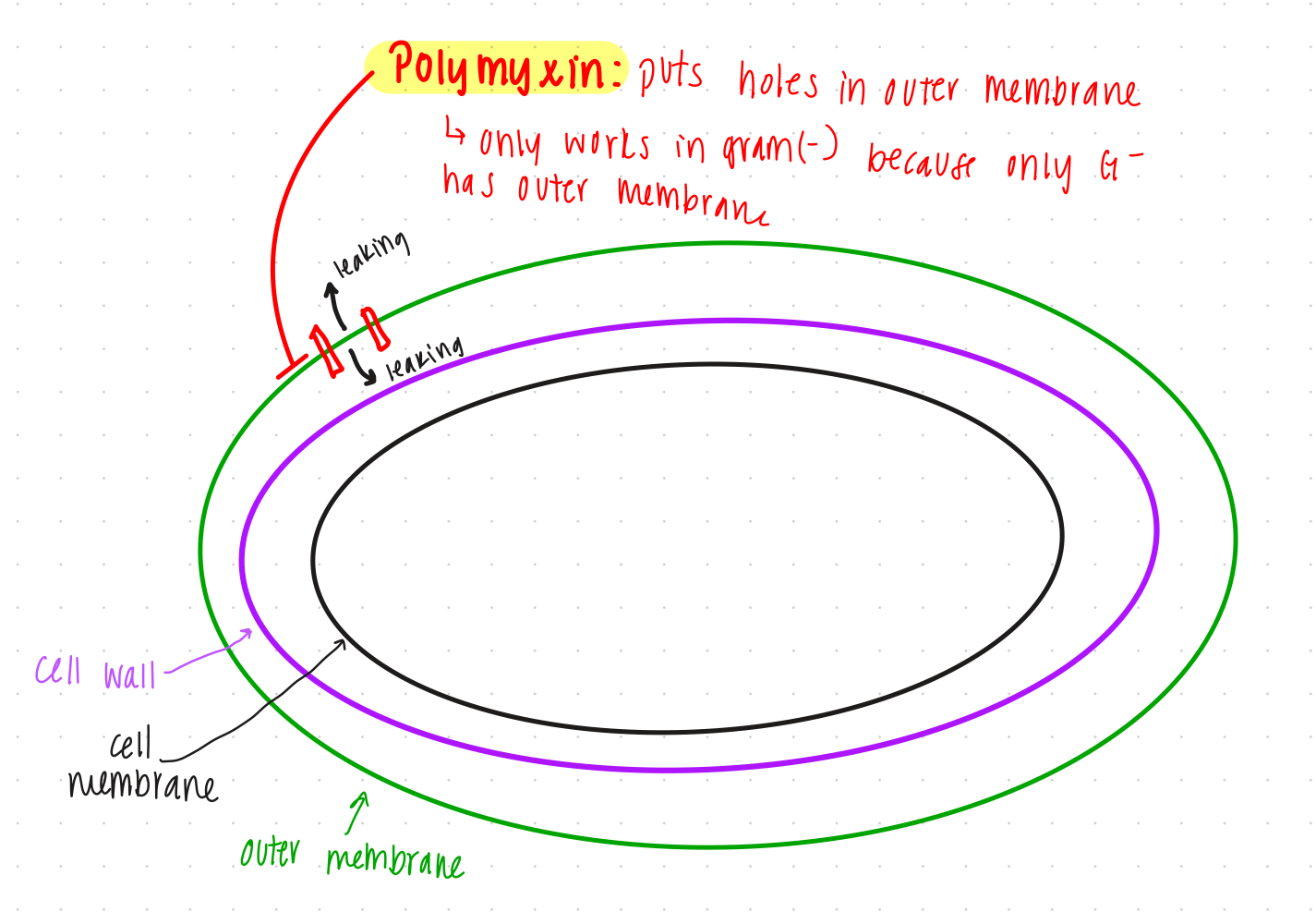
Polymyxin: target Gram negative outer membrane and pokes holes in it
bactericidal drug
Target: Gram negative outer membrane
Mechanism:
pokes holes in outer membrane
causes cell to leak, leading to cell death
only works in gram negative cells because only gram negative cells have an outer membrane
Targeting Nucleic Acid Synthesis
Drugs that target Nucleic Acid (RNA or DNA) Synthesis:
All drugs in this category are bactericidal
all Kill bacteria
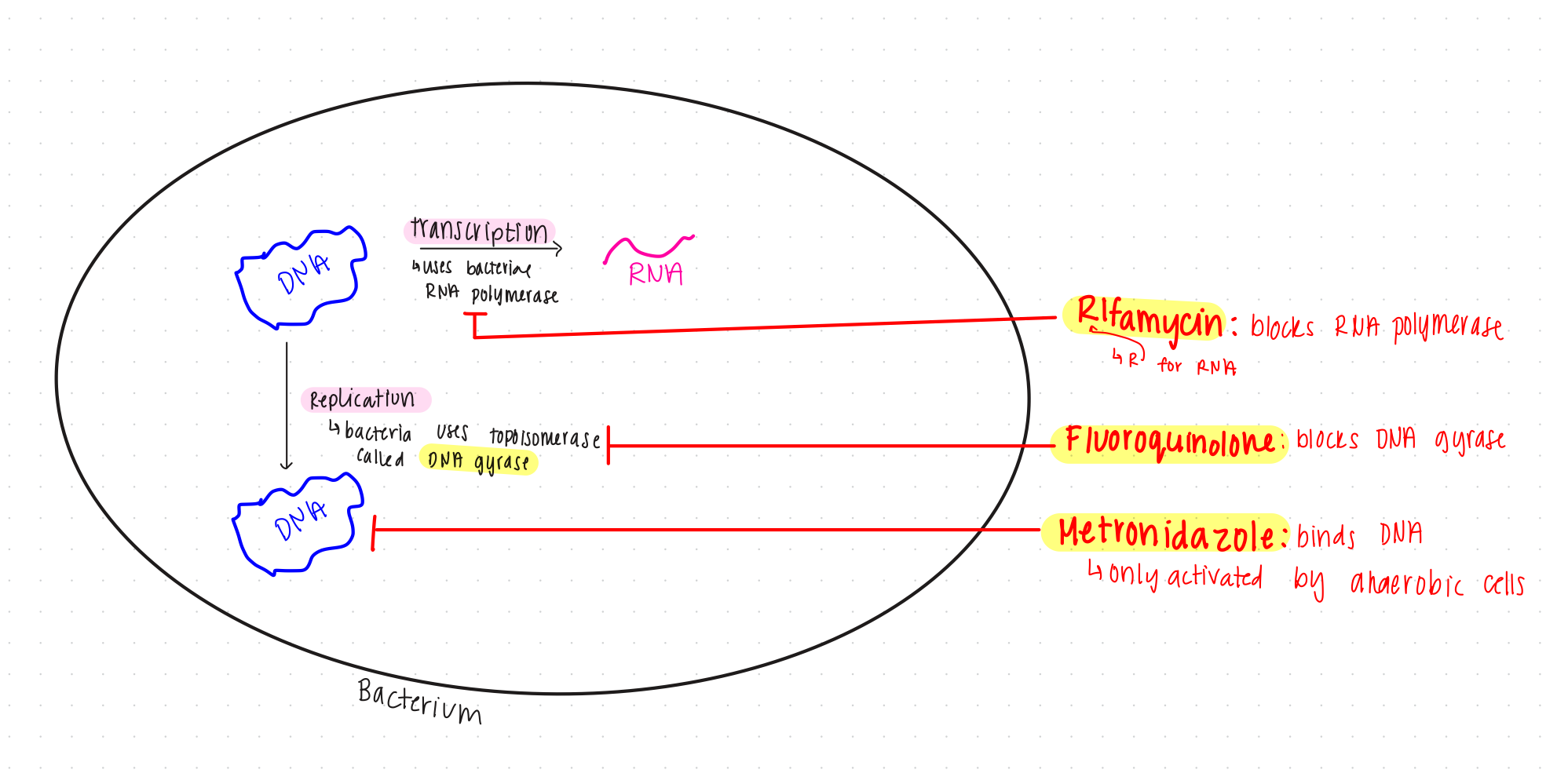
Rifamycin: blocks RNA polymerase
bactericidal drug
Target: bacterial RNA synthesis
Mechanism:
during transcription, bacteria uses bacterial RNA polymerase to build RNA
Rifamycin blocks bacterial RNA synthesis during transcription
Memory device: Rifamycin and RNA both starts with R
Fluoroquinolone: blocks DNA gyrase
bactericidal drug
Target: DNA synthesis
Mechanism:
during replication, bacteria uses topoisomerase to relieve the torsional strain called DNA gyrase
Fluoroquinolone blocks DNA gyrase
Memory Device: "Fluoro"/"Flurry" as in spinning/gyrating.
Metronidazole: binds DNA and blocks it
bactericidal drug
Target: DNA synthesis
Mechanism:
Metronidazole binds DNA itself and blocks it
only active in anaerobic cells
Memory Device: no oxygen left, you have “met” your end
Targeting Protein Synthesis
Drugs that target Protein Synthesis:
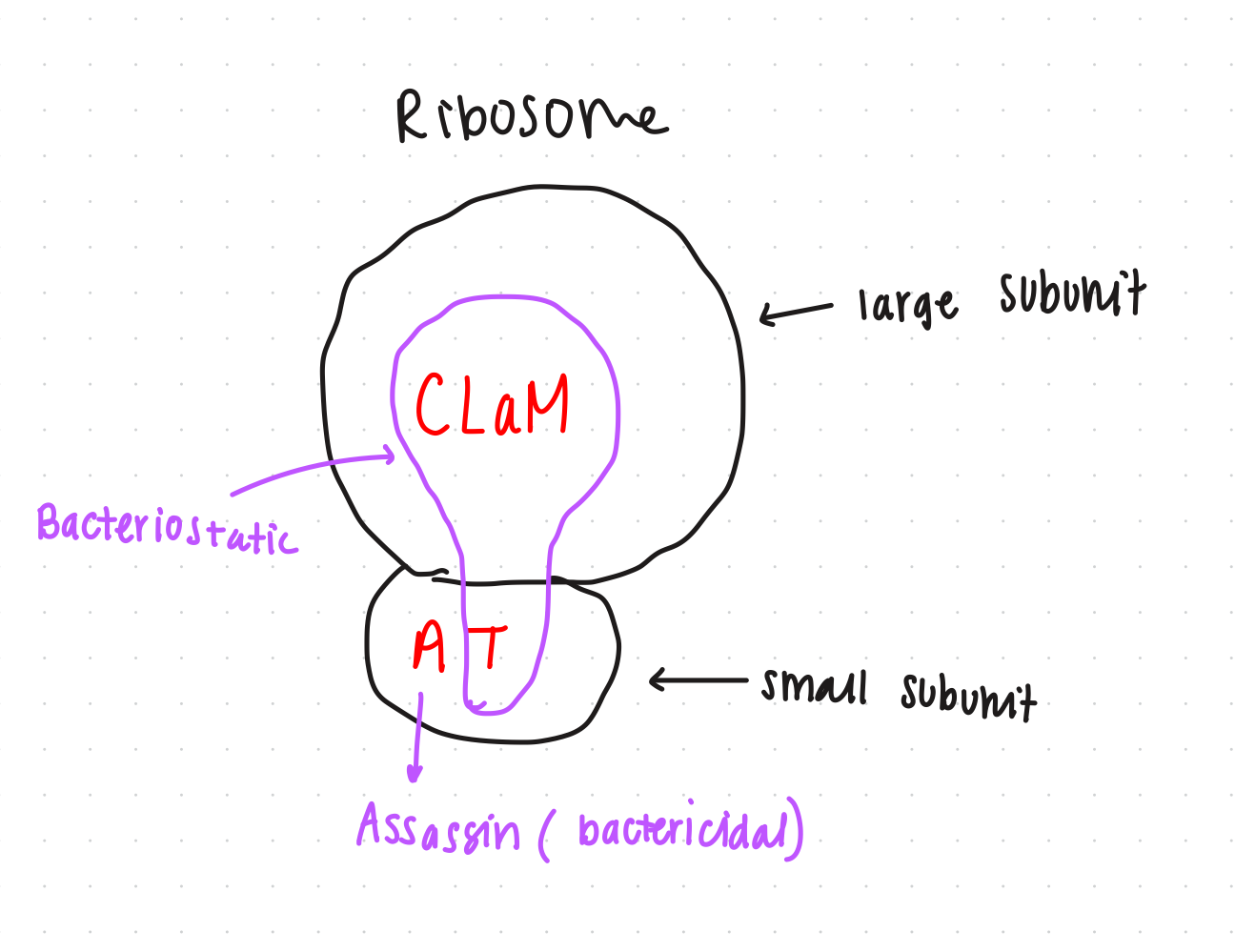
Chloramphenicol: binds to the large ribosomal subunit to stop protein synthesis.
bacteriostatic drug
Target: large ribosome subunit
Lincosamides: binds to the large ribosomal subunit to stop protein synthesis.
bacteriostatic drug
Target: large ribosome subunit
Macrolides: binds to the large ribosomal subunit to stop protein synthesis.
bacteriostatic drug
Target: large ribosome subunit
Aminoglycosides: binds to the small ribosomal subunit to stop protein synthesis.
bactericidal drug
the only bactericidal in the group of drugs that target protein synthesis
memory device: A for Aminoglycoside is also for Assassin
Target: small ribosome subunit
Tetracyclines: binds to the small ribosomal subunit to stop protein synthesis.
bacteriostatic drug
Target: small ribosome subunit
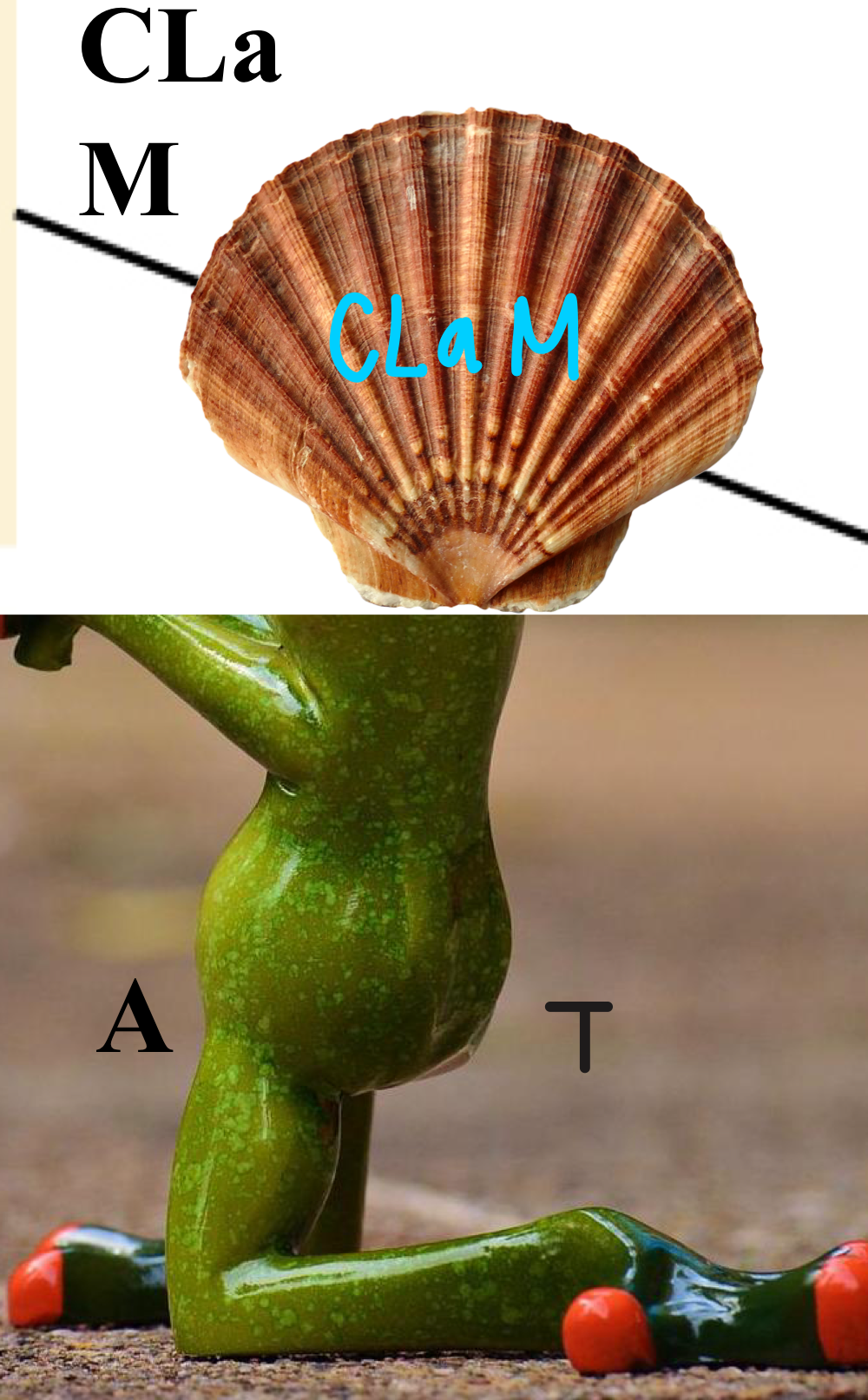
Memory Device:
C.L.a.M. = target the large ribosome subunit
C: Chloramphenicol
L: Lincosamides
a: and
M: Macrolides
A. T. = target the small ribosome subunit
A: Aminoglycosides
T: Tetracyclines
Targeting Metabolic Pathways
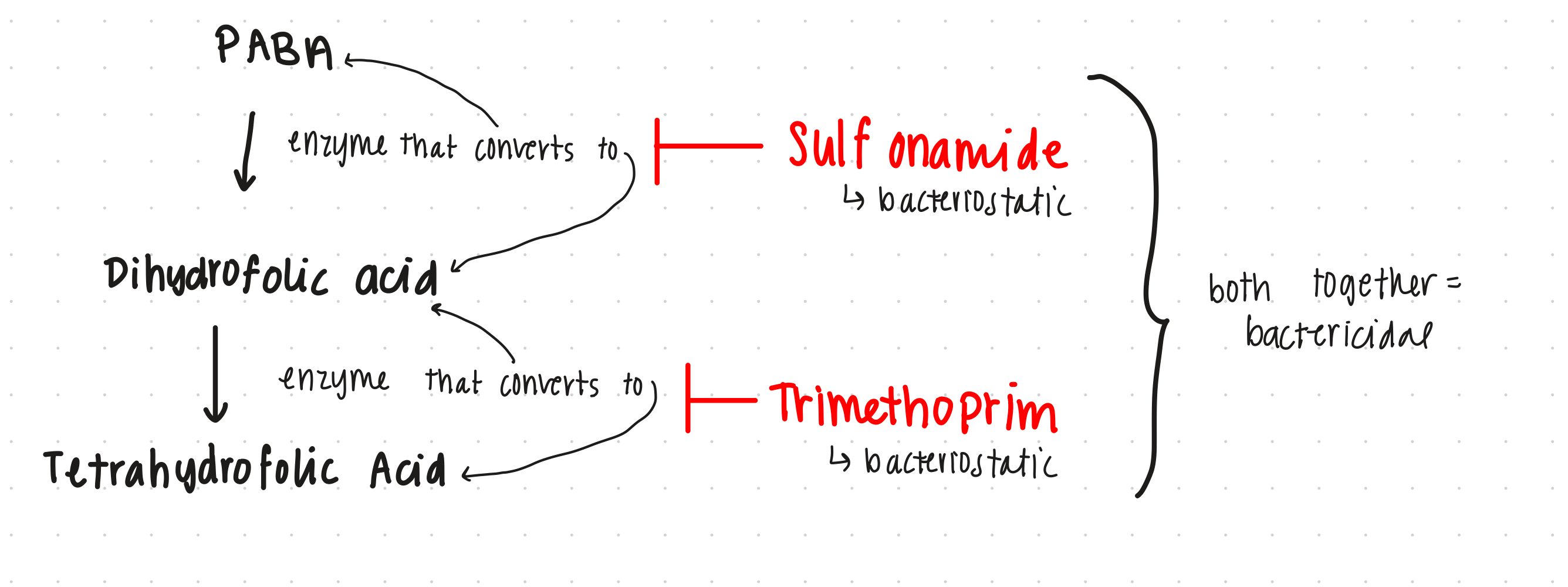
Pathway for making Folic acid:
PABA: chemical precursor for building folic acid
enzyme converts PABA into Dihydrofolic acid
Dihydrofolic acid formed
enzyme converts Dihydrofolic acid into Tetrahydrofolic acid
Tetrahydrofolic acid formed
Drugs that target Folic Acid Synthesis (metabolic pathway):
All drugs in this category are bacteriostatic
but if sulfonamide and trimethoprim are given together, they are bactericidal
Sulfonamides: blocks enzyme from converting PABA into Dihydrofolic acid
individually, bacteriostatic drug
Target: folic acid synthesis (metabolic pathway)
Mechanism: Sulfonamides fits into active site of enzyme where PABA normally fits, so enzyme can’t find PABA and cannot catalyze the reaction
blocks the synthesis of folic acid
Trimethoprim: blocks enzyme from converting Dihydrofolic acid into Tetrahydrofolic acid
individually, bacteriostatic drug
Target: folic acid synthesis (metabolic pathway)
Mechanism: Trimethoprim fits into active site of enzyme where Dihydrofolic acid normally fits, so enzyme can’t find Dihydrofolic acid and cannot catalyze the reaction
blocks the synthesis of folic acid
Drugs that target Mycolic Acid Synthesis (metabolic pathway):
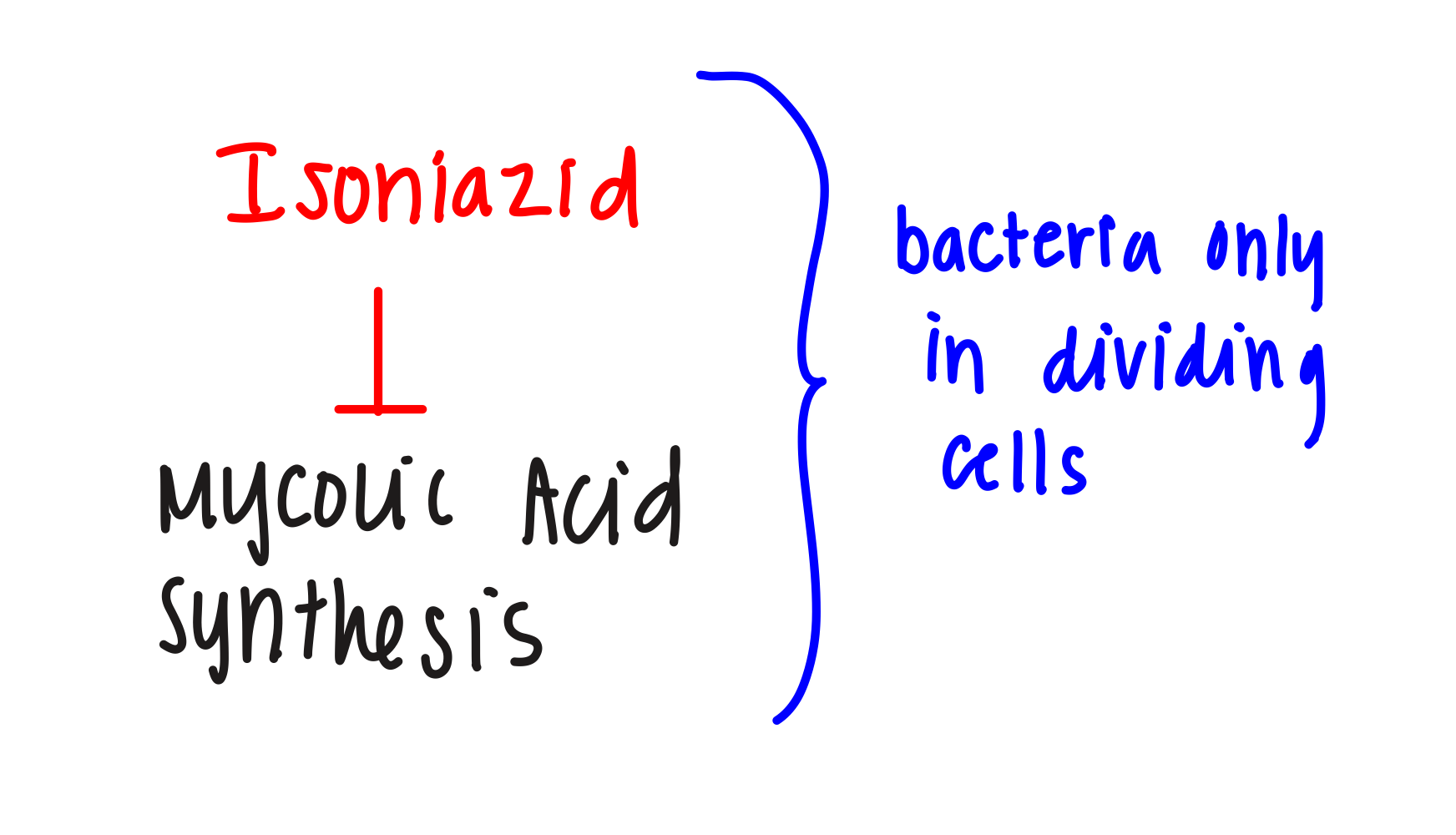
Isoniazid: weakens mycolic acid cell wall in mycobacterium species
bactericidal drug, but only when cells are dividing
problem for cells like tuberculosis because they don’t divide often
Target: mycolic acid synthesis in cell wall of mycobacterium (metabolic pathway)
Mechanism:
prevents bacteria from making more mycolic acid during cell division
Spectrum of Activity:
Broad Spectrum: target a wide range of bacteria, including gram positive or gram negative bacteria
Narrow Spectrum: target a limited range of bacteria, usually only gram positive or only gram negative bacteria
Anti-fungal Drugs
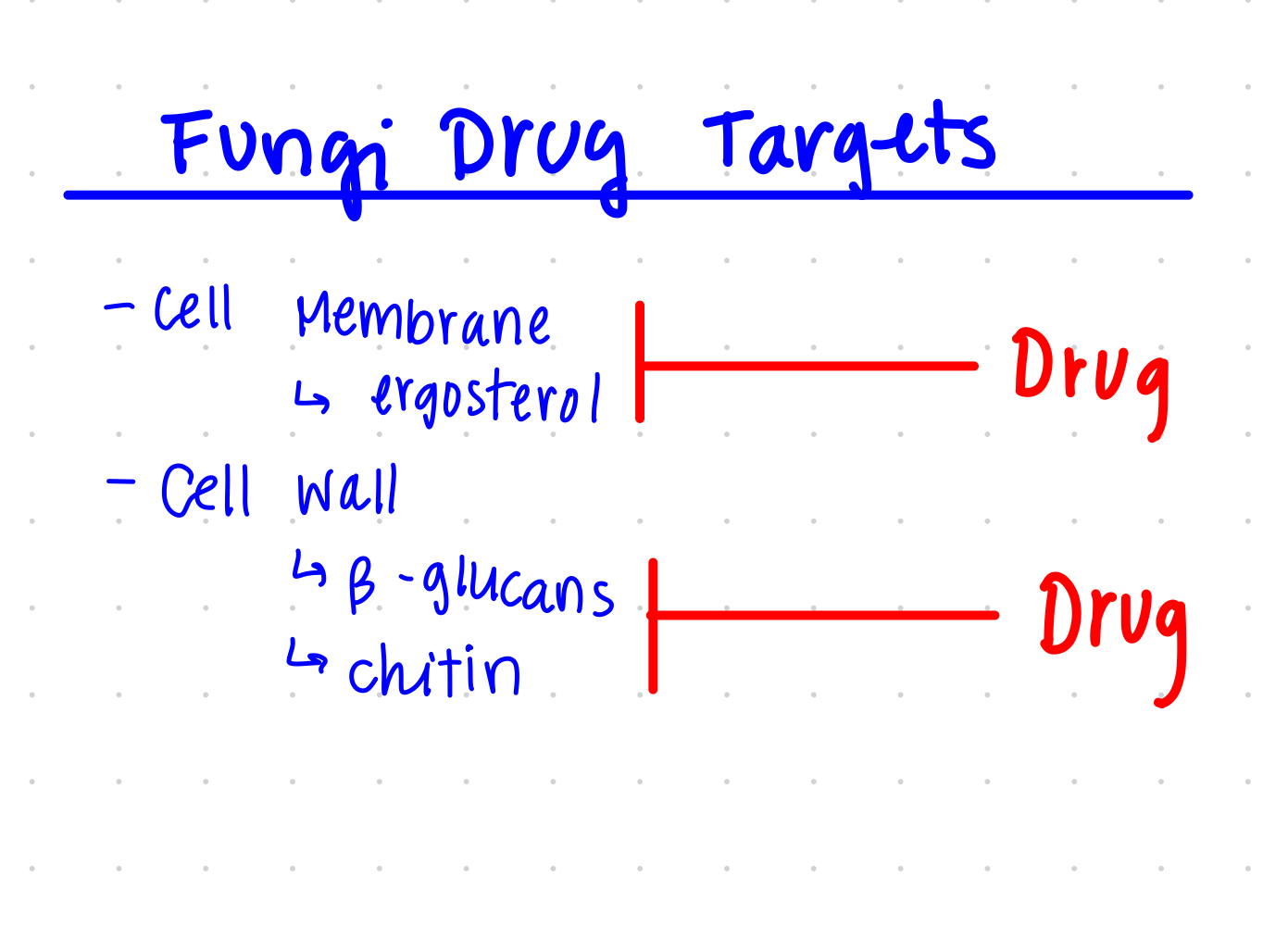
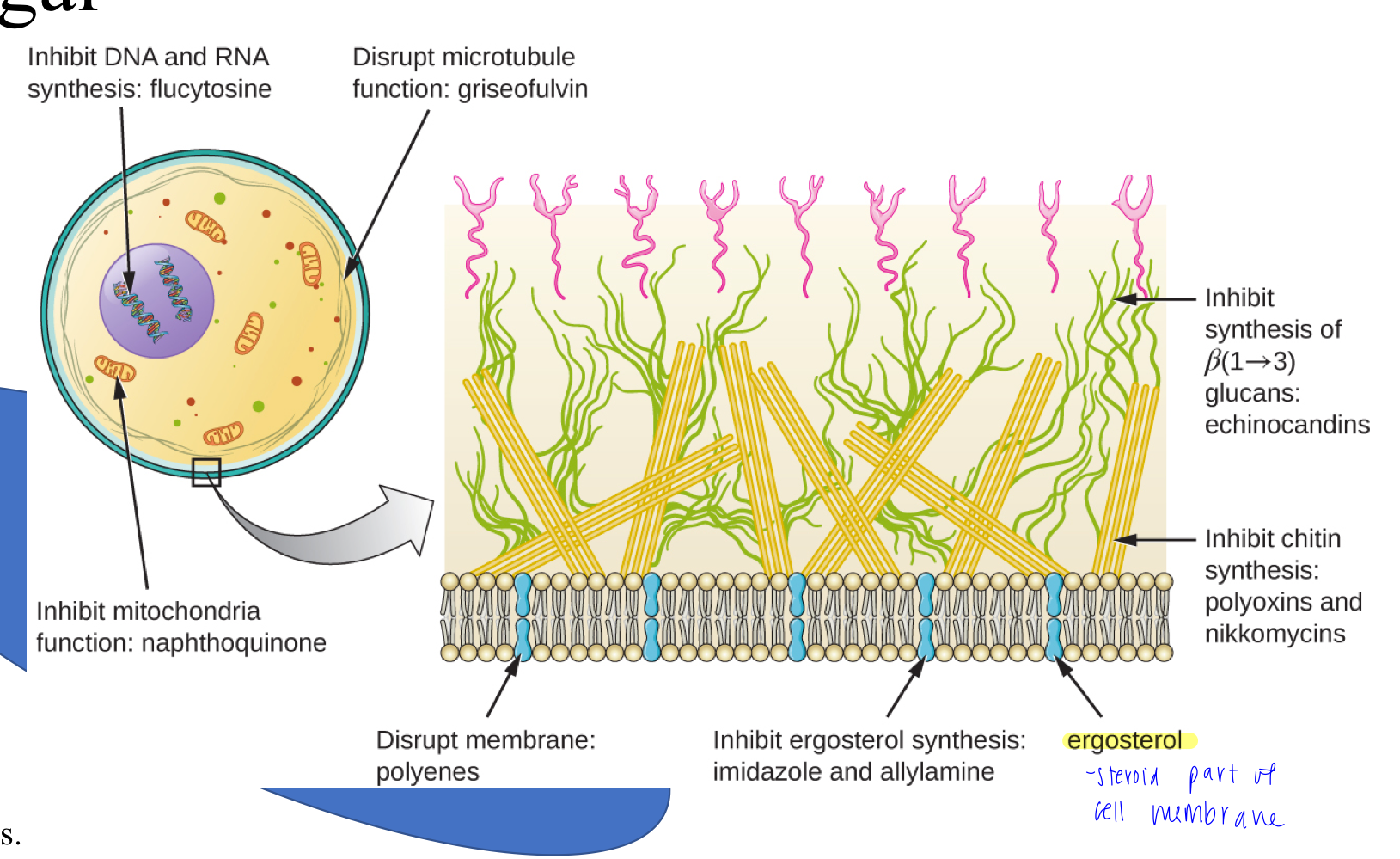
Three targets for Anti-fungal Drugs:
ergosterol: steroid that is part of structure of fungi cell membrane
beta glucans: part of fungi cell wall
chitin: part of fungi cell wall
Anti-Viral Drugs
Herpes
Acyclovir: herpes drug; viral enzymes convert acyclovir into active form that blocks DNA synthesis
target: DNA synthesis (nucleic acid synthesis)
Mechanism:
only active inside of cell that are infected with herpes virus
enzyme within infected herpes virus cell converts acyclovir into active form
acyclovir then blocks DNA synthesis
HIV
HIV Drug targets:
fusion / entry
fusion inhibitors: drugs that block membrane fusion, preventing virus from entering cell
reverse transcriptase
reverse transcriptase inhibitors: keep viral RNA from being copied into DNA
integrase
integrase inhibitors: prevents viral DNA from being integrated into host cell genome
protease
protease inhibitors: block viral proteins from being made
SARS-CoV-2
SARS-CoV-2 Drug targets:
entry
drug uses antibodies bind to receptors and prevent entry
drug binds to protease that would normally help virus with getting into cell
protease
protease inhibitors: block viral proteins from being made
replicase (viral RNA synthesis)
drugs are nucleoside analog that give viruses lots of mutation materials
virus is so mutated that it is not able to function
Route of Administration
Route of Administration include:
intravenous ( )
intramuscular ()
oral
topical routes
Interaction of Drugs within the Body
Tissue Distribution: where drug goes in the body
some drugs are more effective different parts of the body
Metabolism: where in the body does the drug go to be metabolized
Excretion of Drug: The speed at which the body breaks down a drug
determines the dosage frequency (e.g., once daily vs. four times daily).
Drug Resistance
Susceptible: drug works to kill or inhibit growth of pathogen
refers specifically to the pathogen.
A pathogen is susceptible when a drug effectively kills it or inhibits its growth.
Resistant: drug DOES NOT work to kill or inhibit growth of a pathogen
also refers specifically to the pathogen.
A pathogen is resistant when it has developed a mechanism to avoid or neutralize the effects of a drug, making the medication useless against it.
It is never the patient who is "resistant" or "susceptible" to an antibiotic; it is the pathogen causing the infection.
Resistance Mechanisms
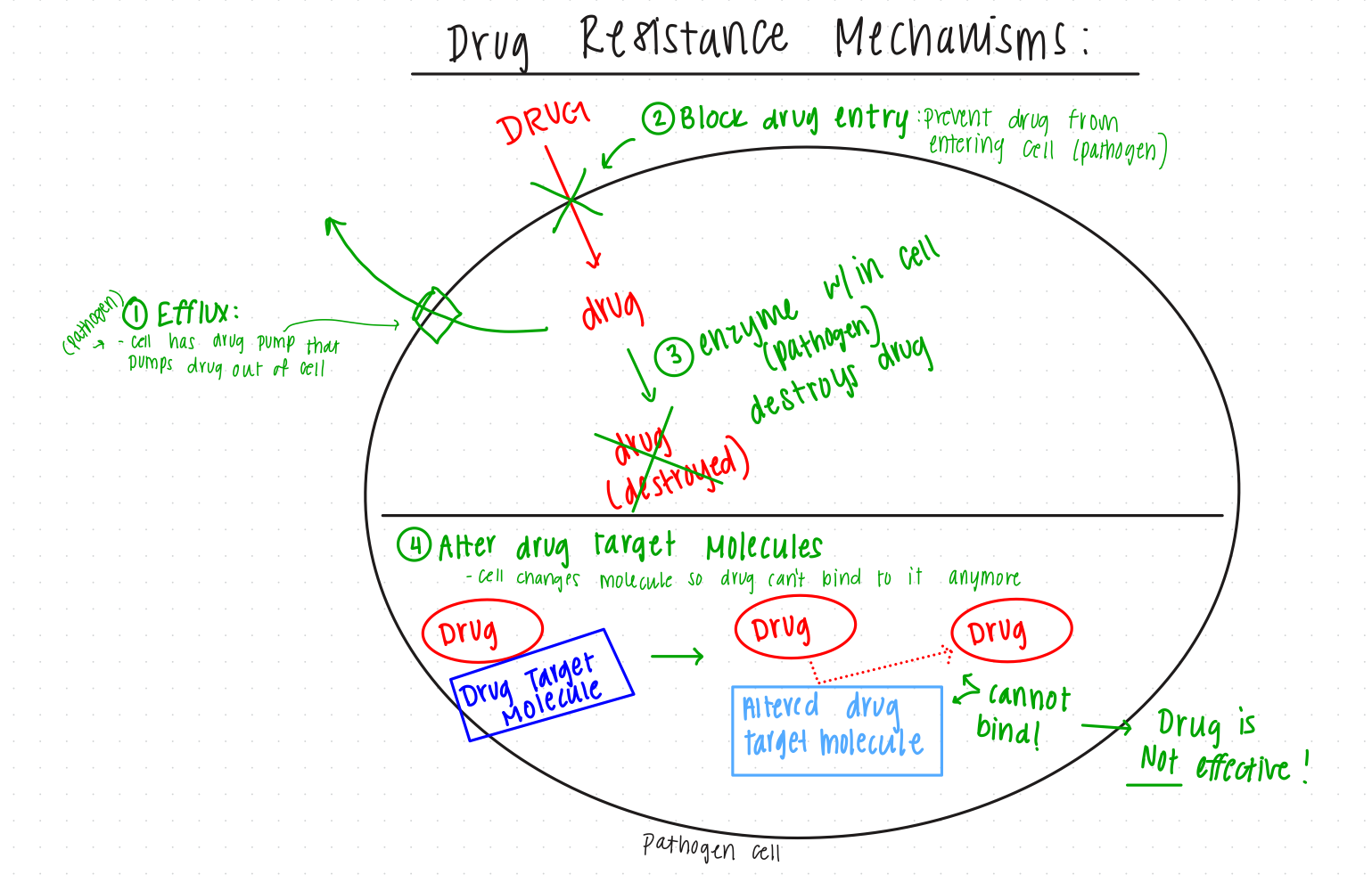
Pathogens utilize four primary strategies to resist the effects of antimicrobial drugs:
Efflux: cell (pathogen) has drug pump that pumps drug out of cell
The pathogen possesses pumps located on the cell surface.
As the drug enters the cell, these pumps actively transport the drug molecules back out before they can reach their target.
Blocking Drug Entry: prevent drug from entering cell (pathogen)
Pathogens prevent the drug from entering cell in the first place
example: gram negative bacteria naturally resistant to some drugs that cannot pass through cell membrane
Enzyme Inactivates Drugs: enzyme within a cell (pathogen) destroys drug
The cell produces specific enzymes that chemically destroy or modify the drug.
This can involve cutting the drug molecule into pieces, causing a protein-based drug to unfold, or otherwise altering it to render it inactive.
Examples:
Beta-lactamase: An enzyme that specifically breaks bond in ring structure found in beta-lactam drugs (like penicillin)
type of drug resistance to drugs that target cell wall
Carbapenemase: An enzyme that breaks carbapenem drugs by breaking their structure
type of drug resistance to drugs that target cell wall
Altering Drug Target Molecule: cell (pathogen) changes molecule so drug can’t bind to it anymore
Drugs typically work by binding to a specific molecule (the drug target) to block a process
The pathogen mutates the gene for that target molecule, but can still function normally
The drug can no longer bind to the altered target
drug is not effective anymore
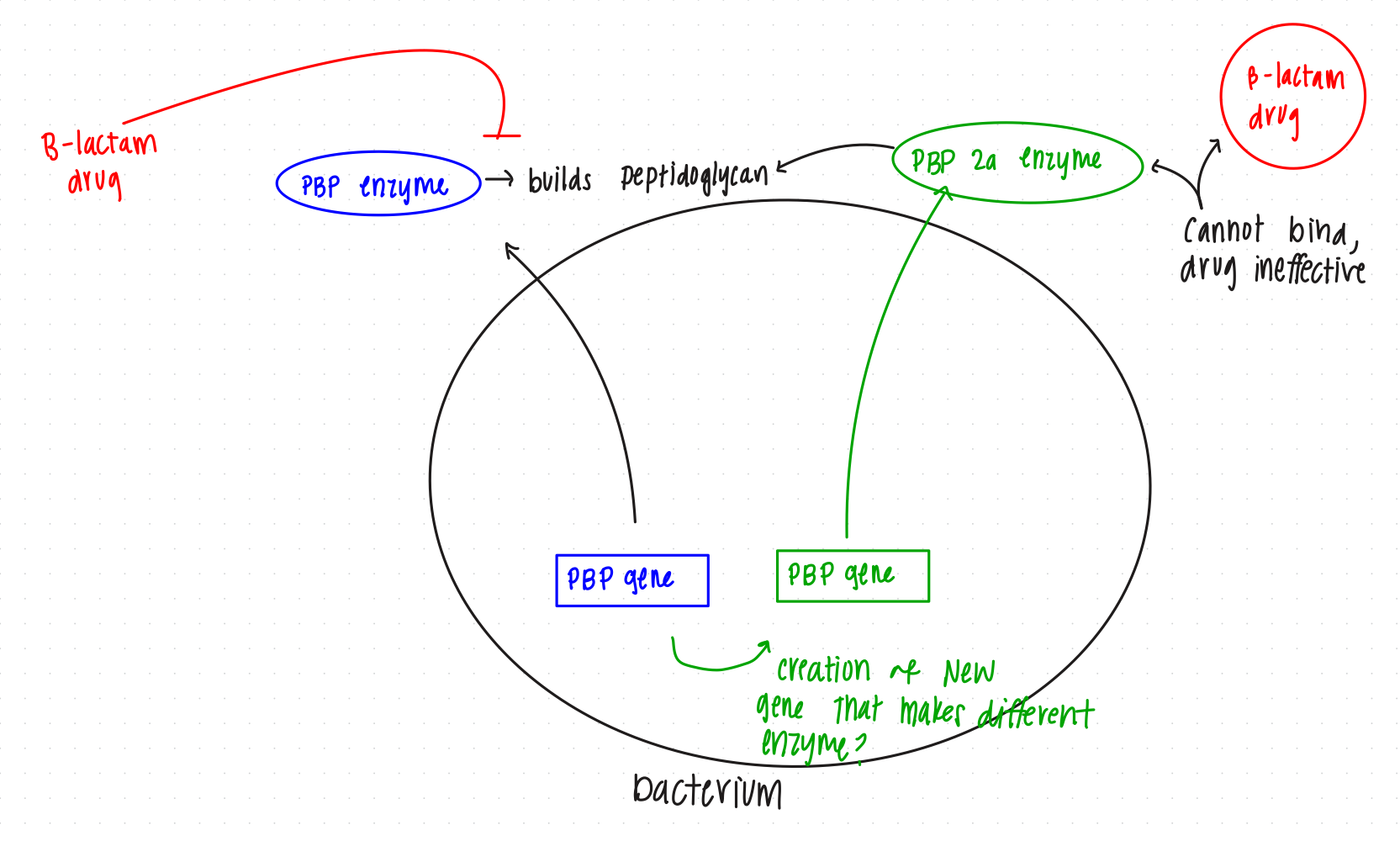
Example: MecA gene (MRSA - Methicillin Resistant Staphylococcus Aureus):
bacteria have PBP gene that codes for PBP enzyme (builds peptidoglycan)
beta-lactam drugs bind and block PBP enzymes so it can’t build peptidoglycan cell wall
MRSA still have regular PBP gene, but also evolved an additional PBP gene, called MecA gene
MecA gene encodes a different type of PBP enzyme, called PBP 2a enzyme
enzyme builds peptidoglycan but beta-lactam drugs can no longer bind to it
makes drug ineffective
How is Resistance Acquired?
Random Mutation: Resistance begins with a random mutation in a single cell within a population of susceptible cells.
This mutation might create a new gene or alter an existing protein.
mutation is completely useless until drug comes into environment
Selection Pressure: drug present in environment and kills all cells that are susceptible to the drug, allowing only single mutated cells to survive
When a drug is introduced, it kills all susceptible (S) cells
The resistant (R) cell survives.
Vertical Gene Transfer: The resistance gene is passed from the surviving parent cell to its offspring during cell division.
The resistant (R) cell that survived replicates rapidly, since it has no competition for resources
Horizontal Gene Transfer: Resistance genes can be shared between pre-existing cells and becomes resistant
occurs via:
Transformation: pre-existing cell picks up DNA from the environment.
can occur within different species
how drug resistance can jump species - another pathogen picks up resistance gene, making it now resistant too
Transduction: drug resistant DNA transferred via viruses.
occurs within the same species
Conjugation: Direct cell-to-cell transfer of drug resistant DNA
occurs within the same species

Spread of Resistance in Communities and Agriculture
Person-to-Person: Resistance spreads through the community from an initially infected individual with a drug resistant pathogen, to other patients or healthcare providers.
Agricultural Use: Antibiotics are given to livestock prophylactically (before they are sick) to increase growth yields
this constant exposure to antibiotics encourages development of antibiotic resistant bacteria
antibiotic bacteria can move to humans by:
Meat: antibiotic meat is improperly cooked or handled
Produce: Animal feces containing resistant bacteria are used as fertilizer for vegetable crops, which then enter the human food supply.
While the CDC regulates person-to-person spread, the FDA regulation of antibiotics in agriculture is poor and less stringent.
Antibiotic Stewardship
Healthcare Provider Responsibility:
Avoid mis-prescription and over prescription
Reserve "last resort" antibiotics for when truly need
Follow hospital guidelines to halt spread of disease
Patient Responsibility:
Follow instructions exactly: take the all antibiotics and do not skip doses.
understand that bacterial antibiotics are not effective for viral or fungal infections
Government and Public:
monitoring and regulation by CDC and FDA