Formulas
Topic 1:
GNP = GDP + earning abroad - earnings from the foreigners here
NNP = GNP - depreciation
National income = NNP - indirect tax
Personal income = NI - corporate tax & undistributed profit - social security
GDP Expenditure approach:
Y= C + I + G + NX
Topic 2
Classical Aggregate function:
Y=real output
=fixed short-run capital stock

Marginal Product of Labor (MPN)
measures the extra ouput generated by one additional unit of labor, given that the capital stock is fixed
MPN = labor demand

MC = marginal cost
W = wage
MPN = Marginal product of labor (marginal benefit)
P = price
real wage = w/p
Profit maxing
P = MR = MC
Labor Demand
ND = f(W/P)
Labor Supply
NS = g(W/P)
Shifter of the curve
increase in tech or capital stock
change in worker preference
exp: desire for more leisrue, leads to less labor supply)
change in population
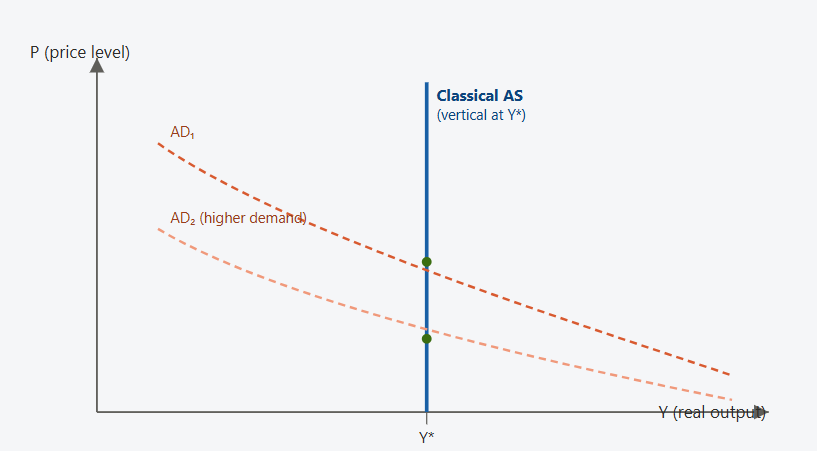
Classical Aggregate Supplu
AS is vertical bc change in price level does not effect the production
Topic 3
The Quantity Theory of Money
it determines the price level
Fisher
MV=PY
money supply x how fast it circulate = total sales (price x quantity)
m=money supply
v = velocity of money (how many time the same dollar bill is spent a year)
M and P must change porportionally
Cambridge
M = MD=kPY
Money supply = Money demand =a constant x Price x Output
if k = 1/v
m= , which is mathematically identical as fisher’s equation
Classical AD curve
through using the equation to check each price level
Money supply determins price

Loanable funds (a fixed size pie)
S = I +(G-T)
Saving = investemnt + gov deficit

Crawding out: Loanable funds market will offset any single change in the economy
EXP: government spend more wont change the AD bc
GOv spending rises = interest rises = Investment decreases

Topic 4
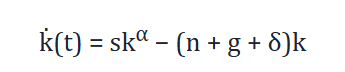
Sollow Equation
Explaination
= saving rate x output per effective worker
n = how fast the work force is growing
g = how fast the technology/knowledge is growing
depreciation
