Chapter 15: DNA and RNA
Heredity (Genetic Inheritance)
Passing on of features from parents to offspring by means of genes.
Genes
Sections of DNA that causes the production of a specific protein.
Characteristics
Controlled by gene, arise from the interaction of heredity and environment.
e.g. hair colour, eye colour, height
Gene Expression
The way genes are decoded in the cell and used to make a protein.
Chromosomes
Made of 60% protein and 40% DNA.
Genes are located along the chromosome.
Contains large sections that do not contain genes (Non-Coding DNA), found within genes and between genes.
Locus
Location of gene on a chromosome.
DNA
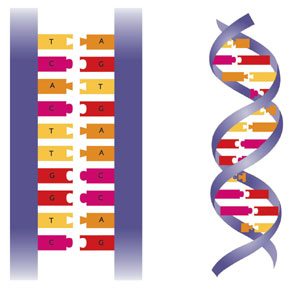
Made up of 4 chemicals called bases.
Adenine
Thymine
Guanine
Cytosine
Complimentary Base Pairs:
Adenine & Thymine
Guanine & Cytosine
DNA consists of double helix structure and is twisted into a spiral.
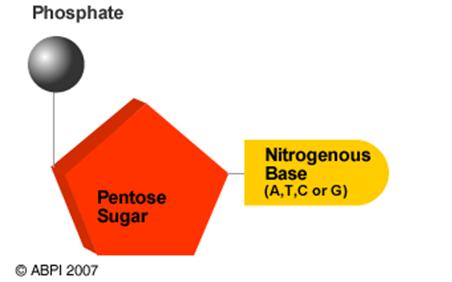
Made up of units called nucleotides.
Nucelotides
Phosphate + 5 Carbon Sugar + Nitrogen Containing Base
Polynucleotides
Chains of nucleotides
DNA Structure was discovered by James Watson and Francis Crick
Purines and Pyrimidines
Purines: double ringed molecules
Adenine, Guanine
Pyrimidines: single ringed structures
Thymine, Cytosine.
Adenine and Thymine form 2 weak hydrogen bonds
Guanine and Cytosine form 3 hydrogen bonds
DNA Replication
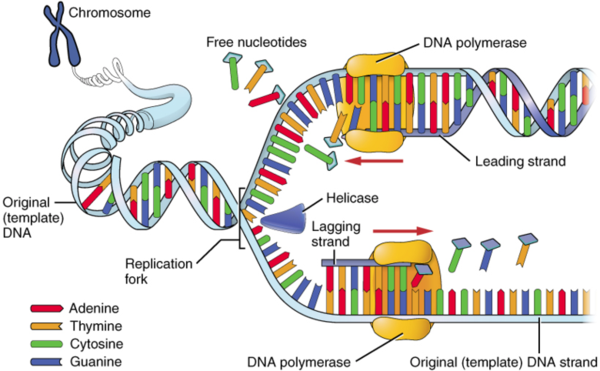
Double helix unwinds.
DNA helicase breaks hydrogen bonds between base pairs.
Free floating bases in the cytoplasm enter the nucleus.
Incoming bases attach to their complementary bases (2 exact replicas of the orignal DNA molecule)
Each new DNA rewinds to form a double helix.
Each new DNA molecule is identical to the original and eachother, and contains half new and half old DNA (semi-conservative).
DNA Profiling
DNA Extraction
DNA is released from cellsRestriction
Isolated DNA is cut using restriction enzymes.
Each restriction enzyme is specific to a base sequence.Separation
DNA is separated according to size by a process called Gel Electrophoresis.
DNA is negatively charged and moves towards the positive end.
The smallest lightest pieces move the furthest. Larger fragments move the least.
This leaves distinct bands in the gel. (radioactive mateial added to make image).Patterns are compared
Every DNA profile is unique.
Application of DNA Profiling
Crime
Blood, hair, seme or salive left at a crime scene could incriminate or eliminate a suspect.Medical
Paternity and maternity cases can be resolved. Blood sample is taken and DNA profiles examined.
Genetic Engineering
Isolation
Cutting
Insertion
Transformation
Expression
Isolation
DNA released from donor cell.
Gene of interest isolated.
Bacterium DNA also released.
Plasmid isolated.
Restriction
Restriction enzymes cut DNA at restriction sites.
Same enzyme cuts donor DNA and bacterial DNA.
Insertion and Ligation
Isolated gene is placed into the vector and joins it.
DNA ligase is placed into the vector and joins it.
DNA ligase acts like glue and sticks pieces of DNA together.
Ligation results in recombinant DNA.
New DNA = hybrid.
Transformation
Recombinant DNA is introduced to bacterial cell.
If bacterial cell uptakes recombinant DNA it is transformed.
Cloning
Bacterial cell replicates by binary fission.
Each new cell is identical to the parent.
Expression
Organism with recombinant DNA produces desired protein
When protein is produced in large amoounts it is isolated and purified.
Genetic Screening
Testing DNA for the presence or absence of a specific gene or altered gene.
Adult Screening
Can be used to identify if an adult is carrying a defective gene. This gene may effect their own health or their childrens health.
e.g. Cystic Fibrosis, Cancer, Haemochromatosis.
Embryonic/Foetal Screening
Cells taken from embryo/placenta/fluid around baby and tested for genetic defects.
RNA
RNA contains 4 bases.
Adenine
Uracil
Guanine
Cytosine
Differences between RNA & DNA
- RNA is single stranded
- RNA contains ribose, not deoxyribose
- RNA contains uracil instead of thymine
Protein Synthesis
DNA is a template for RNA, RNA makes proteins.
Initiation
DNA unwinds in the nucleus and the bonds between the bases break down (helicase)Transcription
RNA nucelotides outside the nucleus move across the nuclear membrane.
These bases line up with the complementary DNA strand.
RNA polymerase joins the bases to make messenger RNA (mRNa).Translation
mRNA moves into cytoplasm and attaches to ribosomes.
(ribosomes are made of ribosomal RNA (rRNA) and protein)
(Cytoplasm contains transfer RNA (tRNA))
tRNA are attached to mRNA.
Each tRNA has an anticodon that is complementary to codon on mRNA.
This ensures amino acidds are in the correct sequence to form a protein.
tRNA moves through ribosome until a stop codon is reached.
Amino acids that detach from tRNA bond together (peptide bonds).
Protein folds into its shape.

DNA and RNA work in sets of 3 called codon. Each codon makes one amino acid.
Every gene has:
Start Codon - Beginning of gene, not involved in protein production.
End Codon - End of gene, not involved in protein production.
Series of codons inbetween - specify a protein.