Module 9 Notes Age of Jackson
The Age of Jackson, 1824 - 1844 Lecture Notes
The Politics of Nation-Building After the War of 1812
Because the US had a one-party system following the War of 1812, contending interest groups no longer took their differences into the political arena. Except for the Supreme Court, the national government became almost irrelevant to the domestic economy.
The Democratic-Republicans in Power
Once the Federalists were out of the way, the Democratic-Republicans did not need to follow a strict party line, and they even began to adopt many Federalist measures. In 1815 and 1816, Republicans enacted high tariffs and established a national bank. Some Democratic- Republicans, such as Henry Clay, wanted the national government to adopt measures that would have made the nation economically self-sufficient (the American System), but Presidents Madison and Monroe had constitutional misgivings about federal aid going to internal improvements.
American System
create a second Bank of the United States
enact protective tariffs
spend federal money on internal improvements
Additionally, grants for such internal improvements provoked sectional conflict.
Monroe as President
James Monroe was elected President in 1816 and reelected in 1820. He was determined at all costs to preserve national harmony. When a major financial panic swept the country in 1819, Monroe did nothing to control it or to mitigate its effects because he felt the president should stand above such matters. At the time, most Americans agreed. What is remarkable, however, is that Monroe provided no leadership in the controversy over Missouri.
The Missouri Compromise
The Missouri controversy arose when the Missouri territorial assembly applied for statehood in 1817. Missouri would be a slave state, and many Northerners already resented what they believed to be the South’s over-representation in the House of Representatives. James Tallmadge of New York persuaded the House of Representatives to reject Missouri’s
application unless it abolished slavery. The South considered Missouri’s admission crucial. At this time, there were eleven slave states and eleven free states.
Congress debated the issue in December 1819 and worked out a compromise. Missouri was allowed to become a slave state, but Maine was also allowed statehood as a free state. More important, Congress banned slavery from any part of the Louisiana Purchase (except for Missouri) north of latitude 36 degrees 30 minutes North. Even more important, the Missouri controversy demonstrated a fundamental rift between North and South.
Postwar Nationalism and the Supreme Court
Between 1801 and 1835, John Marshall served as chief justice of the Supreme Court and used his position to encourage the growth of the nation. Because he believed that the Constitution existed to protect the industrious, whose exertions to enrich themselves would benefit the entire nation, he sought to protect individual property rights against government interference, especially from the state legislatures. In a series of decisions, Marshall limited the powers of the states, usually by holding them to a strict observance of contracts.
Nationalism in Foreign Policy: The Monroe Doctrine
When Spain’s colonies in Latin America rose in rebellion, the US responded favorably toward the new nations. In Europe, however, the ruling classes feared that rebellion might prove
contagious, and France was encouraged to squelch Spain’s rebellious colonies and, perhaps, to keep them for France. Neither Great Britain nor the US would tolerate French involvement in Latin American affairs, and England asked the US to cooperate in preventing it.
John Quincy Adams (President Monroe’s Secretary of State) persuaded President Monroe that the US alone should guarantee the independence of Mexico and the states in South and Central America. In 1823, Monroe issued the Monroe Doctrine, warning European nations to stay out of the Western Hemisphere. The Monroe Doctrine had no real effect when it was
first proclaimed, but indicated America’s growing self-confidence. In promising not to interfere in European internal affairs, America detached itself from worldwide struggles against tyranny and betrayed part of its revolutionary heritage.
The shift of American focus from Europe to national affairs was one of the important themes of the period following the War of 1812.
Adams and the End of the Era of Good Feelings
President Monroe supported John Quincy Adams to succeed him. It seemed a good choice. Adams was an intelligent person with a keen interest in scientific progress. His first loyalty was to the nation rather than any section. He was, however, a “gentleman” in an age of rising democracy and a nationalist in an age of growing sectionalism. He nearly lost the election of 1824, and his term in office was bound to be a failure. The “era of good feelings” could not last in a society of so many contending interests.
Overview
By the 1830s, the US was a democratic society with notable limitations. Women and African Americans continued to be denied political and legal rights, and among white males the inequality between rich and poor grew wider.
Democracy in Theory and Practice
Americans in the 1820s and 1830s no longer feared that democracy would lead to anarchy. Each individual was to be given an equal start in life, but equality of opportunity did not mean equality of result. The American people were happy to accept a society of winners and losers.
The Democratic Ferment
Democratic ideals had a real impact on the American political system. Nearly all adult white males gained the right to vote whether or not they had property. Offices that had been appointive – such as judgeships or the electoral college – were made elective. The greatest change took place in the style of politics. Professional politicians emerged, actively seeking votes and acting as servants of the people.
Men such as Martin Van Buren in New York extolled the public benefits of a two-party system, and political machines began to develop on the state level. National parties eventually developed, the Democrats and the Whigs. Although political parties often served special economic interests, it should be remembered that American politics always retained a strong republican ideology and that all parties sought to preserve equality of opportunity. The Whigs and Democrats differed on whether this could be done best with or without active intervention by the national government, but neither party gave much thought to extending rights to anyone other than adult, white males. It was left to other, more radical, parties to argue the cause of African Americans and women.
Democracy and Society
Despite persistent and growing economic inequality, Americans generally believed they had created an egalitarian society, and in many ways they had. Political equality for all white males was a radical achievement, and Americans came to prefer the “self-made” man to one who had inherited wealth.
Democratic Culture
The democratic ethos also affected the arts in this period. Artists no longer worked for an aristocratic elite, but for a mass audience. Many writers and painters pleased the public by turning out Gothic horror stories, romantic women’s fiction, melodramas, or genre paintings that lovingly depicted the American way of life.
Jackson and the Politics of Democracy
The Election of 1824 and John Quincy Adams’s Administration
The election of 1824 furthered Jackson’s political career even though he lost the election. The election began as scramble between four men – John Quincy Adams, William Crawford, Henry Clay, and
Andrew Jackson. Because no one received a majority of the electoral votes, the House of Representatives had to decide the election, and its choice came down to Adams or Jackson. When Clay gave his support to Adams, the House elected him president. Adams began his administration under a cloud of suspicion (“corrupt bargain”) because it was widely believed he had “bought” the presidency (He appointed Clay – secretary of state).
Jackson Comes to Power
Jackson’s supporters, who will become the Democrat Party, were well organized for the election of 1828. The Democrats appealed to sectional self-interest and pioneered the art of making politics exciting to the average man, but the greatest asset the Democrats had was Jackson himself. Rigid and forceful, Jackson was accepted as a true man of the people, and he defeated Adams easily in this election, especially in the slaveholding states.
Jackson’s triumph was a personal one: he stood on no political platform. As President, he democratized the office by firing at will whichever officeholders he did not like and appointing those that supported him (spoils system), defending the practice by asserting the right of all men to a government post.

Indian Removal
Jackson inherited the Indian removal policy from previous administrations and carried it to its harshest conclusion. He agreed with southern states that the federal government had not pushed the Indians hard enough. When the Cherokee nation resisted removal, Jackson asked Congress to take stern action. In 1830, Congress voted to dispossess the Cherokee, and in 1838, the US Army forced the Indians to move west in a march that killed approximately 4,000 people (1/4 of their population) (The Trail of Tears).
The Nullification Crisis
The South believed they had reason to fear a strong national government that might someday decide to do something about slavery. Led by John C. Calhoun, southern intellectuals began working out a
defense of state sovereignty. The first major controversy between federal authority and states’ rights came when South Carolina objected to the high tariff of 1828. The South, however, trusted Jackson to be sympathetic, and South Carolina took no action on the 1828 tariff. By 1832, the Carolinians had come to distrust Jackson, partly as a result of a personal feud between Jackson and Calhoun, but mainly because South Carolina feared a forceful president and Jackson rejected the idea of state sovereignty.
The Bank War and the Second Party System
One of the most important actions taken by Jackson was his destruction of the Bank of the United States. “The Bank War” was a symbolic defense of democratic values and led to two important results – economic disruption and a two-party system.
Mr. Biddle’s Bank
Although the Bank of the US contributed to the economic growth and stability of the US, it had never been very popular. In a democratic era, it was open to charges of giving special privileges to a few. Its manager, Nicholas Biddle, was a competent man who looked and behaved like an aristocrat. Also, in an era of rising democracy, the Bank possessed great power and privilege without accountability to the public.
The Bank Veto and the Election of 1832
Jackson came into office suspecting the Bank of the US and made vague threats against it. Biddle overreacted and asked Congress to recharter the Bank in 1832, four years before the old charter was due to expire. Henry Clay took up the Bank’s cause, hoping that congressional approval of the Bank would embarrass Jackson.
When Congress passed the new charter, Jackson vetoed it on the grounds that the Bank was unconstitutional, despite a Supreme Court decision to the contrary. Jackson claimed he vetoed the Bank charter because it violated equality of opportunity and Congress upheld the veto (or failed to override it (depending on your point of view)). Clay and Jackson took their argument to the public in the election of 1832 where Jackson’s victory spelled doom for the Bank.
Killing the Bank
Jackson showed his opponents no mercy and proceeded to destroy the Bank by withdrawing the
government’s money and depositing it into selected state banks (“pet banks”). Jackson’s destruction of the Bank cost him support in Congress, especially in the Senate, where fears of a dictatorship began to emerge.
More on the Bank…
Today, the federal government has such power and influence over the nation’s economy that it may be difficult to understand why people were so strongly opposed to a national bank. The first Bank of the United States had been chartered in 1791, under the leadership of Alexander Hamilton. It was a private corporation, only partially owned by the government, and its profits went to stockholders. But the bank had three important and unique privileges. First, the federal government deposited all tax receipts into the bank. Second, the bank made short-term loans to the government. Third, and most important, the national bank refused to accept notes from other banks in individual states unless those banks had enough gold and silver to back up their paper. At that time, all official U.S. money was in coin, but banks issued “bank notes” – pieces of paper with a promise to pay a stated value in gold or silver when they were redeemed or brought back to the bank. These notes could be traded for goods and services, and so they functioned as paper money. If banks issued too much paper money, though, inflation would result – prices would rise, and the dollar would be worth less – and if the banks did not have the assets to back up their promises, people would be left holding worthless paper, the financial system could crash. To Jeffersonian Republicans, though, the bank seemed elitist. Private stockholders earned interest on government deposits. And in the South and West, money had always been in short supply. Southerners and westerners believed that the development of their regions depended on access to money and credit – which the national bank did NOT give them. The bank’s charter expired in 1811, and the Jeffersonian Republican Congress did not renew it. But the result was just what Hamilton had feared – inflation and confusion over the value of bank notes. To provide for a sound national currency, Congress chartered a second Bank of the United States in 1816, again for twenty years.
|
And again, it was resented as elitist – by state and local bankers who resented its privileges, and by people in new states and territories who needed access to money and credit.
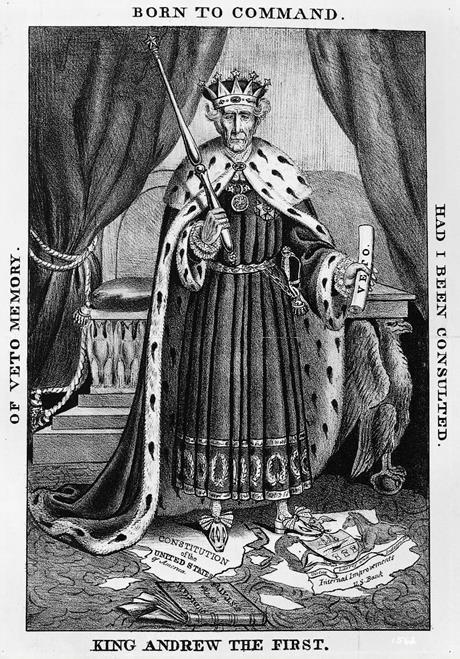
When Congress voted to renew the bank’s charter early, President Jackson vetoed the bill with a speech railing against monopoly and privilege. Until that time, presidents had rarely used the veto to override the wishes of Congress. But his veto was popular, and after his re-election in 1832, he issued an executive order ending the deposit of government funds into the Bank of the United States. By issuing an executive order, he was essentially refusing to enforce the act of Congress that had chartered the bank. Jackson’s acts served as precedents that would concentrate power in the executive branch. (In the political cartoon, Jackson is shown as a king trampling both the U.S. Bank and the Constitution. He holds a veto in his hand.)
The Emergence of the Whigs
Opposition to Jackson formed the Whig party. (In the old British political system, they had two parties – the Tories and the Whigs. The Tories usually supported the king and the Whigs were typically against his policies. So therefore, the Whig Party (in the United States) is formed in opposition to “King Andrew”.) Along the way, the Whigs absorbed the Anti-Masonic party, which had suddenly flourished after 1826 when it attacked the Masons as a secret, privileged elite. The Anti-Masons brought with them to the Whig party a disgust of “loose” living and a willingness to use government powers to enforce “decency.” Furthermore, Jackson’s financial policies (Specie Circular) led to a runaway inflation, followed by an abrupt depression.
The Rise and Fall of Van Buren
Jackson chose his friend and advisor, Martin Van Buren, as his successor. The Whigs, still
unorganized, presented Van Buren with little opposition in the election of 1836, but Van Buren’s inauguration coincided with the arrival of the depression of 1836/1837, for which he and the Democrats were blamed (Martin Van “Ruin”).
In 1840, the Whigs were fully organized and had learned the art of successful politicking. They nominated William Henry Harrison, a non-controversial war hero, and built his image as a common man who had been born in a log cabin. As his running mate, the Whigs picked John Tyler, a former Jacksonian, because he would attract some votes from states’ rights Democrats. Harrison and Tyler (“Tippecanoe and Tyler too”) beat Van Buren, although the popular vote was close.
Heyday of the Second Party System
The election of 1840 signalled the emergence of a permanent two-party system in the US. For the next decade, Whigs and Democrats evenly divided the electorate. Although there was much overlapping, both parties attracted distinct constituencies and offered voters a clear choice of programs.
Democrats Whigs |
|
De Tocqueville’s Wisdom
Alexis de Tocqueville, the French visitor who made so many astute observations about life in Jacksonian America, praised most aspects of American democracy but warned of disaster in the future if while males refused to extend the liberties they enjoyed to women, African Americans and Indians