7.3 Computing Trigonometric Functions
Computing Trigonometric Functions of Common Angles
The lecture emphasizes methods to compute trigonometric functions for specific common angles, notably the acute angles π/6, π/4, π/3, and the quadrantal angles 0, π/2, π, and 3π/2. These angles are fundamental because their trigonometric values are frequently used in various mathematical contexts, including calculus, physics, and engineering.
Two primary approaches are used for these computations:
Right Triangle Approach: This involves constructing reference triangles with known side ratios and using basic definitions of sine, cosine, and tangent.
Unit Circle Approach: This involves using the unit circle (a circle with radius 1 centered at the origin) to find the coordinates corresponding to these angles, which directly give the sine and cosine values.
Key Angles and Their Significance
π/6 (30°): Corresponds to a 30-60-90 triangle with side ratios 1:√3:2.
π/4 (45°): Corresponds to an isosceles right triangle with equal legs.
π/3 (60°): Also associated with a 30-60-90 triangle, with roles of the sides reversed relative to π/6.
Reference Triangles for Common Angles
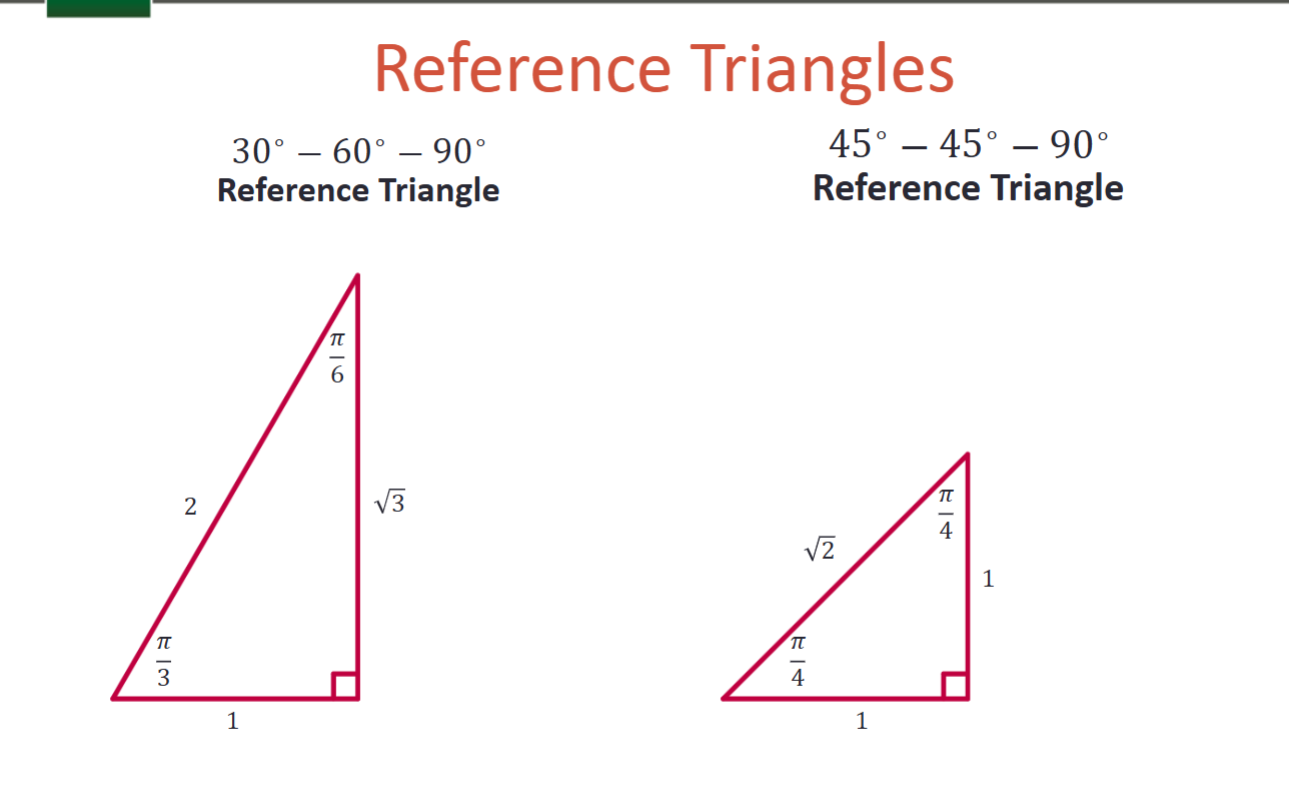
These special triangles provide the basis for exact trigonometric values:
30°−60°−90° Triangle:
Short leg opposite 30° is 1.
Longer leg opposite 60° is √3.
Hypotenuse is 2.
The Ratio for this triangle is always, 1: √3: 2
The lengths of the sides don’t have to be these lengths but this is always the ratio between them.
So the values of the 6 trig functions is always the same (below)
From these, the exact values:
sin(π/6) = 1/2
cos(π/6) = √3/2
tan(π/6) = 1/√3
sin(π/3) = √3/2
cos(π/3) = 1/2
tan(π/3) = √3
45°−45°−90° Triangle:
Legs are equal, each of length 1.
Hypotenuse is √2.
The ratio for this triangle is always 1:1:√2
Exact values:
sin(π/4) = √2/2
cos(π/4) = √2/2
tan(π/4) = 1
These triangles serve as models to derive the values for the respective angles on the unit circle.
Completing Trigonometric Function Tables
Students are tasked with filling tables that list the six primary trigonometric functions—sine, cosine, tangent, cosecant, secant, and cotangent—for specific angles, both in radians and degrees. For example:
For θ = π/6 (30°):
sin(π/6) = 1/2
cos(π/6) = √3/2
tan(π/6) = 1/√3
csc(π/6) = 2
sec(π/6) = 2/√3
cot(π/6) = √3
These exercises reinforce the understanding of the relationships between the functions and their exact values.
Example Application of Trigonometry in Right Triangles
Given specific measurements, such as hypotenuse length or an angle, students learn to find unknown side lengths and trigonometric values:
Example: A right triangle with a hypotenuse of 5 feet and an angle of 30°:
The legs can be found using sine and cosine:
Opposite leg: 5 × sin(30°) = 2.5 ft
Adjacent leg: 5 × cos(30°) = 5 × (√3/2) ≈ 4.33 ft
Using calculators: For angles like π/8 radians (~22.5°), approximate lengths of hypotenuse and other legs can be obtained numerically, rounded to three decimal places.
Trigonometric Functions of General Angles
Beyond acute angles, the lecture extends to angles in standard position, where the terminal side of the angle intersects the coordinate plane at a point (x, y). Here:
The distance r from the origin to the point (x, y) is given by:
r = √(x² + y²), which is always positive.
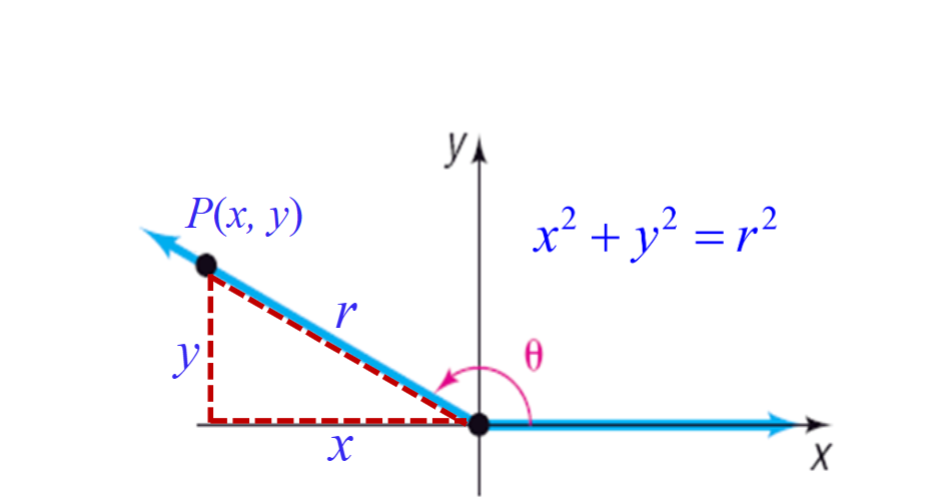
The trigonometric functions are defined as:
sin(θ) = y / r
cos(θ) = x / r
tan(θ) = y / x (x ≠ 0)
csc(θ) = r / y (y ≠ 0)
sec(θ) = r / x (x ≠ 0)
cot(θ) = x / y (y ≠ 0)
This framework allows computation of trigonometric functions for any angle, not just the common ones, by identifying the point on the terminal side.
Determining the Signs of Trigonometric Functions by Quadrant
The signs of the six functions depend on the quadrant in which the terminal side of the angle lies:
Quadrant I: All functions are positive.
Quadrant II: sin and csc are positive
cos and sec are negative; tan and cot are negative.
Quadrant III: tan and cot are positive
sin, cos, csc, sec are negative.
Quadrant IV: cos and sec are positive
sin, csc, tan, cot are negative.
Example Conditions:
If sin(θ) > 0 and cos(θ) < 0, then θ is in Quadrant II.
If csc(θ) < 0 and cot(θ) > 0, then θ is in Quadrant III.
If tan(θ) > 0 and sec(θ) < 0, then θ is in Quadrant III.
Identifying the quadrant helps determine the signs of all six functions when their values are known or given.