Kohlberg
Aims
The aim was to understand the development of moral reasoning in individuals. He had 3 main points to study:
To explore the stages of moral development and how they relate to reasoning processes.
To investigate how people's moral reasoning evolves through critical periods in their lives.
To promote a deeper understanding of the ethical decision-making process and how social situations influence moral judgment.
Procedures
75 American urban & middle class boys were used, at the beginning of research were 10-16 years old, by the end of the research were 22-28 years old
Longitudinal study followed the development of the same boys for 12 years
Interviews were used to test the moral reasoning, which produced qualitative data
There was 10 hypothetical moral dilemmas, each presenting an issue between 2 moral issues
Each participant had to discuss 3 of these dilemmas, prompted by a set of ten or more open-ended questions
Analysis of the boys’ answers showed common themes that reflected their stages of moral development- stage theory constructed
Each boy was re-interviewed every 3 years
Findings
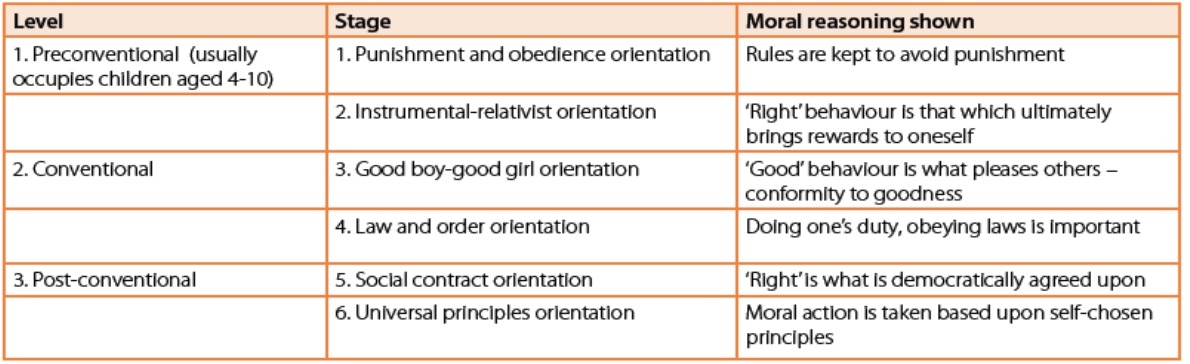
Stages come one at a time and always in the same order
There is no skipping of stages, indicating a clear progression in moral reasoning as age increases
Children can mobve through at various speeds, and can be found half in and out of different stages
Cross Cultural Differences:
Additional samples from Great Britain, Canada, Taiwan, Mexico & Turkey were alos interviewed to gain a cross-cultural comparison.
Middle class children in all cultures progressed quicker than lower class children.
Taiwanese boys aged 10-13 tended to give ‘classic’ Stage-2 responses.
Middle-class urban boys aged 10 in the US, Taiwan and Mexico showed the order of use of each stage to be the same as the order of its difficulty or maturity.
In the US, by age 16, Stage-6 was rarely used. At age 13, the good-boy, middle stage (Stage-3) was not used.
Mexico and Taiwan showed the same results except that development was a little slower.
At the age of 16, Stage-5 thinking was much more obvious in the US than either Mexico or Taiwan.
Religion had no effect. No important differences were found in the development of moral thinking among Catholics, Protestants, Jews, Buddhists, Muslims or atheists.
Conclusions
Stages are invariant & universal, meaning that people world-wide go through the stages in the same order
Each new stage represents a more equilibriated form of moral understanding which results in more logically consistent & morally mature form of understanding
Evaluation
Dilemma’s are artificial so lack ecological validity
The boys were aged between 10-16, and have never been married or placed in a situation remotely like the Heinz dilemma
Sample is biased
androcentric, and men’s morality is based off abstract principles of law & justice, while women’s is based on principles of compassion & care
Dilemmas are hypothetical
In a real situation you will have real consequences so would subjects act the same as they say they would in the real situation? This raises questions about the validity of Kohlberg's stages of moral development, as actual moral decisions may be influenced by emotions, social context, and personal experiences that are not captured in hypothetical scenarios
Social desireability bias & investigator bias
Self-report methods were used, so this can allow ablity for participants to present themselves in a good light, people may describe their moral behaviour idealistically rather than what they would do
Investigator bias in interpreting responses, as each interviewee may interpret responses differently for participants due to liking them or building a relationship with them
Interviews were conducted
Allows qualitative data, which means that participants can provide an in-depth answer
Varied sample
The sample includes a range of social classes & nationalities
Cross-sectional study was carried out which allows for comparisons across different age groups, providing insights into the developmental stages of moral reasoning