The Public Trust: Ditching the Dogma
The Rise of Conservation
Until early 1900s, resources exploited for economic gain without conscience
Conservation: the greatest good for the greatest number in the long term: Pinchot (1905)
The Public Trust Doctrine
Trust Resource (water, shoreline, fish, maybe wildlife)
Trustee (State)
Beneficiary (public)
Settlor (whoever granted it)
Some History
Romans: air, the rivers, the sea and the seashore were incapable of private ownership and dedicated to the use of the public
English: the king owned “nature” including wildlife, but managed it for the well
being of the public
Americans: Early supreme court decisions (e.g., Martin v. Waddell 1842 [fishing in navigable waters], Geer v. CT [wild fowl]) said everything the King owned was now held in trust by the state (i.e., states are the trustees for citizen beneficiaries)
Public Trust Doctrine in NC
Says that marine life is the public enjoyment
In Texas, all wild animals are property of people in the state
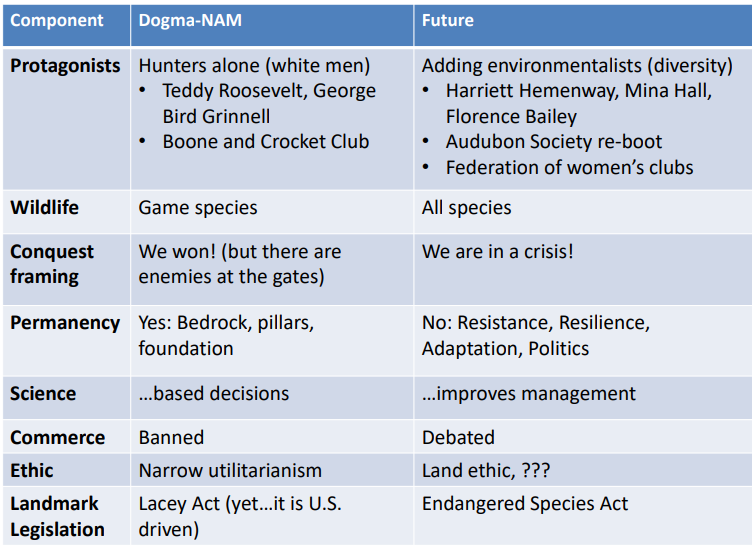
The Dogma = a lot of the NAM
"I really liked seeing that Shane Mahoney is with your team. I'm pretty sure I am one of his biggest fans! The man is a conservation god!"
Dogma: things we feel like we should believe in without evidence
Emergence of the North American Model (NAM)
1995
Used ethos, pathos, logos
The Dogma
“Bedrock principles of the NAMWC ultimately led to a continent-wide resurgence of wildlife at a scale unparalleled in the world.”
“These principles have served wildlife conservation well beyond hunted species and helped sustain the continent’s biodiversity.”
“>50% of the global deterioration in the conservation status of birds, mammals and amphibians is concentrated in…eight/195 countries (4%) – Australia, China, Colombia, Ecuador, Indonesia, Malaysia, Mexico, and the United States.”
The model’s 2 basic tenets:
that our fish and wildlife are reserved for the onon-commercial use of the individual hunters and anglers
and are to be managed in such a way that their populations will be sustained at optimal levels forever—are elaborated by seven concise stipulations
The seven sisters or pillars of the doma
The Public Trust (doctrine)
property clause
treaty clase
10th amendment gives states control unless U.S. wants it even on private land
Commerce Clause (Especially in fisheries)
Supremacy Clause (preemption and savings: US wins but some state law can co-exist)
Prohibitions on Commerce
Commerical fisheries
Many non-game species
Fur-bearers
“Amphibian and reptile product dealers (ARD) permit“ required of residents but not nonresidents in FL
Guides
High fence hunting
Constantly Changing
Democratic Rule of Law
a) What does this mean?
b) Most wildlife management decisions are not made democratically (majority rule)
c) There is no evidence that wildlife management is more democratic in NA than anywhere else with a nominally democratic form of government
Hunting Opportunity for all
a) The NAM was built on taking hunting from the masses
b) It does not exist in an 80% urban nation
…but Hunters Have Funded management
Hunting = centerpiece of “user-pay, user benefit” conservation funding system
– P-R Act alone has contributed >$10 billion to state agencies for land acquisition & wildlife restoration projects/activities
– ~60% of state agency budgets comes from hunting & angling
Problem: Hunting participation is declining…
Non-Frivolous Use
a) What does this mean? ($, food, fun) b) Who decides? c) It’s constantly changing…
International Resources
Maybe if you’re talking about the Canadian border
Scientific Management
Science is not a tool for determining what ought to happen.
Science derives facts about nature than can make us more successful in efforts to achieve what we want to happen for moral, economic, political, and value based reasons.
Dogma Test
I give you a claim from NAM debates and you decide if it is based on logic and/or empirical evidence
What should you look for?
Empircial evidence?
Logical support?
Belief that it is not to be doubted?
Be prepared to defend your opinion
Organ and Mahoney
Giving control of wildlife management to private entities will weaken the role of professional wildlife managers employed by public agencies
If the PTD erodes then the public’s connection to wildlife will erode
Without PTD the public will lose the ability to challenge decisions made by private landowners.
Stober
The importance of the PTD is a myth perpetuated by environmentalists
Safe harbor agreements are an example of how private landowners can conserve wildlife without needing PTD
Making wildlife private property will make landowners better stewards (better than politicians doing it now)
Condy
More land is protected for wildlife conservation by private landowners who essentially own wildlife than by the government in the nation of South Africa.
Not caring for things one does not own is the oldest of human instincts (so people wont care about PTD wildlife).
People abusing resources in protected areas “puts to the sword” the concept of PTD management of nature.
Public lands cannot be closed when they are too full of people but private lands can.