1.8 | Primary Productivity (Photosynthesis)
Overview
primary productivity - rate that solar energy is converted into organic compounds(glucose, cellulose) via photosynthesis over time
Measured in kcal/m²/year (energy/area/time)
Primary productivity can be seen as the rate of photosynthesis of all producers in an area over a given period of time. Since photosynthesis leads to growth, one can think of primary productivity as the amount of plant growth in an area over a given period of time. High primary productivity leads to high plant growth, which again leads into lots of food and shelter for animals.
Ecosystems with high primary productivity are usually more biodiverse than ecosystems with low primary productivity
Calculating Primary Productivity
Respiration loss: plants use up some of the energy the generate via photosynthesis by doing cellular respiration.
gross primary productivity - the total amount of sun energy that plants capture and convert to energy(glucose) through photosynthesis.
net primary productivity - the amount of energy(biomass) leftover for consumers after plants have used some for respiration
net primary productivity = gross primary productivity - respiration loss
Ecological Efficiency
The portion of incoming solar energy that is captured by plants and converted into biomass(NPP or food available to consumers). Generally, only 1% of all incoming sunlight is captured and converted into gross primary productivity via photosynthesis. Of that 1% only about 40%(0.4% overall) is converted into biomass/plant growth.
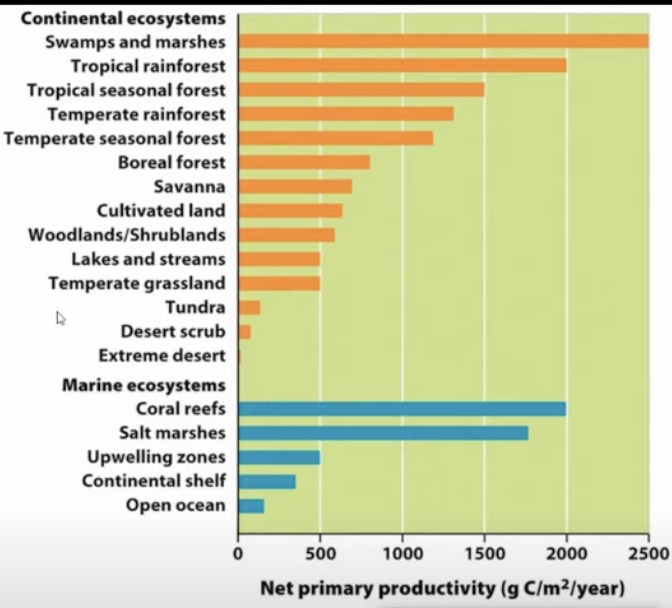
Some ecosystems are more efficient than others
Trends in Productivity
The more productive a biome is, the wider the diversity of animal life it can support. Water availability, higher temperature, and nutrient availability are all factors that lead to high NPP
Shortage of any of these three factors will lead of decreased NPP (desert with low H₂O and nutrients, tundra with low temperature and low liquid H₂O, or open ocean with low nutrients).