Criminal Justice Notes
Rule of law → everyone is treated equally under the law
Rule of man
Large Group 1/10/25
Criminal Law
Nature & Purpose of Law
A rule of conduct, generally found enacted in the form of a statue, that proscribes or mandates certain forms of behavior
Black’s Law Dictionary → widley sited
Henry Campell Black → first and most widley used Law Dictionary
Statutory Law → written or codifed law
“law on the books”
as enacted by a government body or agency to make laws
Case Law → the body of the judicial precendent
legal reasoning and past interpretations of statutory law
judge made law
Basics
These crimes not only offend victims, but disrupt the peaceful order of society
Ex: Murder, Rape, Robbery, Assult
Part I Offense, UCR (Uniform Crime Report)
Civil Law
Types of Law
Govern relationships between people, nusinesses, and other organizations and agencies
Relationships are between “parties”
Separate from criminal law
Contracts, divorces, child support and custody, wills, property, libel, etc.
Administrative Law
Types of Law
Regulations that governments create to control industries, businesses, and individuals
generally a breack of admin law is not a crime
Settlements are most common
Tax laws, health codes, pollution and waste disposal, vehicle registration, building codes, etc
Statutory Law
Types of Law
Laws on books:written: codeified
Acts of Legislatures
PENAL LAW
Substantive Criminal Law
Procedural Law
Penal Code
The written, organized, and compiled form of the criminal laws of a jurisdiction
USC ( United States Codes)
Nebraska State Law
Omaha Municipal Code
Case Law
Types of Law
Judicial Decisions or “the law of precedent”
PRECEDENT
Precedent
ensures previous judicial decisions are authoritativley considered in future cases
Large Group 1/17/25 - Crime Picture
Crime Data & Social Policy
Overview of criminal activity
If used properly, it can be a useful tool in deterimining social policy
Decision makers at all levels use data to implement and evaluate criminal justice programs
Many “get tough” policies stem from data suggesting existing programs were ineffectice
Crime is very complex and hard to quantify
arguments regarding many things including which crimes to include and which ones to exclude
public opinion about crime is not always realistic
The Collection of Crime Data
Crime statistics come from two major sources:
The FBI’s Uniform Crime Report(UCR)
Sometimes reffered to as the UCR/NIBRS program
Release an annual overview of major crime called Crime in the United States
National Crime Victimization Survey(NCVS)
Created by the Bereau of Justice Statistics(BJS)
UCR Program
Development of the UCR Program
1930: Congress authorized the US attorney general to survey crime in America
FBI was tasked to implement the program
They built off of earlier efforts by the International Associations of Chiefs of Police (IACP)
Today, 18,000 law enforcment agencies provide crime information
Data comes from city, country, university, college, tribal, and state departments
Hierarchy Rule = The only crime counted into statistics is the most severe crime even if multiple crimes were committed
NIBRS Revamp
National Incident-Based Reporting System
1988- UCR revamp with development of NIBRS
Now, more agencies are able to furnish enhanced data on more crimes
Not a new program or list, but simply an enhanced version of the previous UCR program
Under the UCR/NIBRS program, the original Part I, and Part II offences are bing replaced with specifics
Part I Offenses
Broken into two categories: violent crime and property crime
Aggravated assault, forcible rape, murder, and robbery are classified as violent while arson, burglary, larveny-theft, and moter vehicle theft are classified as property crimes
Part I offenses are collectivley reffered to as Index Crimes
Part II Offenses
The following categoies are tracked:
simple assault, curfew offenses and loitering, embezzlement, forgery and counterfiting, disorderly conduct, driving under the influence, drug offenses, fraud, gambling, liquor offenses, offenses against the family, prostitution, etc.
NIBRS Transition
NIBRS implemented to improve the overall qualtiy of crime data collected by law enforcement, captures details on each single crime incident- as well as on seperate offenses within the same incidnet- including information on victims, known offenders, relationships between victims and offenders, arrestees, and property involved in the crimes
NIBRS Components:
What are issues with NIBRS?
There are crimes that were never reported to the police or were never caught
The Dark Figure of Crime → term employed by criminologists and sociologists to describe the amount of unreported or undiscovered crime
National Crime Victimization Survey
Based upon victim self reports and not on police reports
First conducted in 1972
Early data changed the way that criminologists and others thought about crime
Conducted by the Bureau of Justic Statistics
Published annually: Criminal Victimization & Crime and the Nation’s Households
Large Group 1/24/25 - Elements of a Crime
What is the criteria for a crime to have been committed?
Actus Reus
Latin for „Guilty Act“
An act in violation of the law
Generally, someone must commit a voluntary act before he/she is subject to criminal santions
Exceptions:
Robinson v California (1962)
elliminated the ability to prosecute people for an offense of „status“
drug user
homeless person
theif
murderer
Cannot be arrested for being one of the above
Inchoate Offenses
An offense not yet completed
also, an offense that consists of an action or conduct that is a step toward the intended commissions of a crime
Conspiracy to committ…
Mens Rea
Latin for „Guilty Mind“
The state of mind that accompanies a criminal act
The extent in which a person can be held criminally responsible depends on the nature of their mental state
Exceptions:
Strict Liability Offenses
special category of crime that does not require Mens Rea
These offenses make it a crime to simply do something wrong without intention of violating the law
traffic violations
parking violations
other minor offenses
statutory rape
Four types:
Purposful → is an act that is undertaken to achieve some goal
Knowing → behavior is undertaken with awarness. A person wo acts purposefully, always acts knowingly, but a person can act in knowing way, without criminal intent
Reckless → behavior is activity that increases the risk of harm
Negligent → behavior refers to a situation where the person should have known better, and the act, or faliure to act, endangers others
Concurrence
The concurrence of an unlawful act and a culpable mental state
Concurrence requires that the criminal act and mental state occur together
Actus Reus + Mens Rea occuring concurrently = crime
Motive
Motive is not the same thing as Mens Rea
A motive refers to a person‘s reason for committing a crime
It is not an essential feature of crime
Battery → is a specific common la misdemeanor, although the term is used more generally to refer to any unlawful offensive physical contact with another person, and may be a misdemeanor or a felony, depeneding on the circumstances
Laws of Omission → an omission to act can only be criminal when the law imposes a duty to act. Falure or omission to act is only criminal in three situations. 1) when there is a statute that creates a legal duty to act, 2) when there is a contract that creates a legal duty to act, 3) when there is a special relationship between the parties that creates a legal duty to act
One voluntary act is enough to fulfill the coluntary act requirment. This if a coluntary act is followwed by an involontary once, the court may still impose criminal liability depending on the circumstances
Large Group 1/31/25 - Crime Typologies
a classification of crimes along a particular dimension, such as legal category, offender, motivation, victim behavior, or chaaracterisitcs of individual offenders
attempts to simplify crimes by indentifying homogenous groups of crime behaviors
Categories of Crime Typology
One of the simplest ways that law enforcement tries to accomplish this:
violent crime
property crime
Crime Typology also tries to highlight crimes that are of special importance or social relevence
Gun Crime
2nd Amendment concerns
Annually, 1 million serious offenses involve use of a handgun
In a typical year, 10,000 murders are committed with a firearm
Nearly 20% of state prison inmates were armed at the time of their crime
Drug Crime
Sudden Fall - 96 men, including 75 SDSU students were arrested in a JTF operation
„This operation shows how accessible and pervasive illegal drugs continue to be on our college campuses and how common it is for students to be selling to other students“
Drug crimes alone are themselves criminal…but more and more drugs are being linked to more sever criminial behavior
Drug Crimes substantially increased between 1984 and 2002
18% of referrals to US attorneys compared to 31%
Crimes against Women
Victimization against women is a special area of concern
Both UCR/NIBRS and NCVS keep statistics relating to gender
Statistics generally show that women are victimized less often than men in every category except rape
when women become victims of violent crime, however, they are more likley than men to be injured
a larger proportion of women make modifications in the way they live because of the treat of crime
women, especially in cities, have become careful about where they travel, and time of day that they leave their homes
Crimes:
Date rape
familial incest
spousal abuse
stalking
explotation of women through social-order offenses
prostituion
52% of surveyed women report that they were physically abused
18% of women say there were the victim of a complete or attepted rate
76% of women who had been raped or physically assulted since age 18 were assaulted by a parter/date
Crimes against the Elderly
Relative to other age groups, older victims rarely appear in criminal statistics
This suggests that victimization decreases with age
Older people are more likley to live in a secure area and provide their own security
The NCVS does survey people 65 and older and they are more likley than younger people to:
be victims of property crime
face offenders who are armed with guns
be victimized by strangers
be victimized in or neat their homes during daylight hours
report their victimization to the police
be physically injured
Physical Abuse:
Physical & Institutional
Finanfial & Con Artisits
Crimes against the elderly is likley to change significantly in the coming years
Hate Crimes
Criminal offense committed against a person,property, or society that is motivated, in part or in whole, by the offender’s bias against a race, religion, disability, sexual orientation, or ethnicity/origin
The majority of hate crimes include:
intimidaiton
vandilism
simple assault
aggravated assault
a few robberies and rapes
Small Group 2/19/25 - 4th Amendment Challenges
4th amendment → the right of the people to be secure in their persons, houses, papers, and effects, against unreasonable searches and seizures, shall not be violated, and no Warrants shall issue, but upon probable cause, supported by Oath or affirmation, and particularly describing the place to be searched, and the persons or things to be seized
When can they search me?
require probable cause
When can they search my vehicle?
require probable cause
When can they search my home?
require a warrant except on special cases
Large Group 2/21/25 - Evidence-Based Policing
The Broken Window Theory
idea of how our surroundings effect our behavior
The Abandoned Car Experiment
The Bronx and Palo Alto car experiment(1969) was a social psychology study conducted by Zimbardo to explore the impact of the environment on human behavior, partivularly vandalism and crime
The Experiment
Two identical cars were abandoned in different locations:
The Bronx, NY
a low-income, high-crime area
low socioeconomic status
high property crime rate
Palo Alto, CA
a wealthy, low-crime area
End:
Bronx → the car in the Bronx was attacked within minuers of its abandonment
within 24 hours of its abandonment, everything of value has been stripped from the vehicle
car’s windoes were smashed in, parts torn, upholstery ripped, etc
Palo Alto → the vehicle sits idle for more than a week untill Zimbardo deliberatley smashed a window
soon after people joined in on the destruction
It is beleived that, in a neighborhood such as the Bronz where the history of abandoned property and theft and more precalent, candalism occurs much more quickly as the community generally seems apathetic. SImilar events can occur in any civilized community when pushed
Broken WIndows Theory
Zimbardo - 1969
George Kelling & James Wilson - 1982
address the problems when they are small
repair the broken windoews within a short time, and the tendency is that candals are much less likley to break more windows or do furthur damage
Case Studies
New York City
Mayor Giulliani hired William Bratton as police commissioner
Instituted an enforcement of “Quality of life” offenses
Subway fare evasion
public intoxication
public urination
Graffiti
“Squeegee Men” → people who try and clean cars when they stop at lights
Cabaret Law → places that host live music with alchol sales
Increase in Stop-and-Frisk
2001 study of crime trends in NY City
rates of both petty and serious crime fell significantly
crime continued to decline for the following ten years
Other studies do not show a cause-and-effect relationship
May be part of a broader trend across the US
other cities experienced drops in crime
39% drop in unemployment may play a part
Albuquerque
American Westerners use roadways the same as Easterners use the Subway
Safe Streets Program
Saturation Patrols → if a location does not need all the officers, officers can be relocated to a location that requires more
Sobriety Checkpoints
DWI Program
Safe-Ride Program → dial a number to get a free ride home
car accidents and injuries decreased
Lowell,Massachusetts
Havard University and Suffolk University researchers identified 34 Crime “Hot spots”
in half of the spots, authorities cleared trash, fixed streetlights, enforced building codes, discouraged loitering, made more misdemeanor arrests, and expanded mental health services and aid for the homeless
in the other hald, no changes were made
the areas that recieved additional attention experienced a 20% reduction in calls to the police
the study concluded that cleaning up the physical enviornment was more effective thann misdemeanor arrests and that increasing social services had no effect
Chicago
low income Chicago residents have beeen able to create over 800 community gardens and urban gardens out of burnt buildings and vacand lots
now, these neighborhoods have become go-to-food destinations
lowered temperatures in cities, increased socialization, reduced stress, and taught children about nature
Netherlands
Researchers funded a series of controlled experiments to determine if the effect of existing visible disorder (such as litter or graffiti) increased other crim such as theft,littering, or other antisocial behavior
Researchers then secretly monitored the locations
as the situation deteriorated, it led to an increase in other antisocial behaviors
their observations supported the theory
the conclusion was published in the journal Science:
“One example of disorder, like graffiti or littering, can indeed encourage another, like stealing”
Small Group 1/25/25
Kansas City Police Experiment
Saturation patrols - do they work?
research questions:
would citizens notice changes in the level of police patrols and crime?
would different levels of visible police patrol affect recorded crime or the outcome of victim surveys?
would citizens fear of crime and attendant behavior change as a result of different patrol levels?
would their degree of satisfaction with police change?
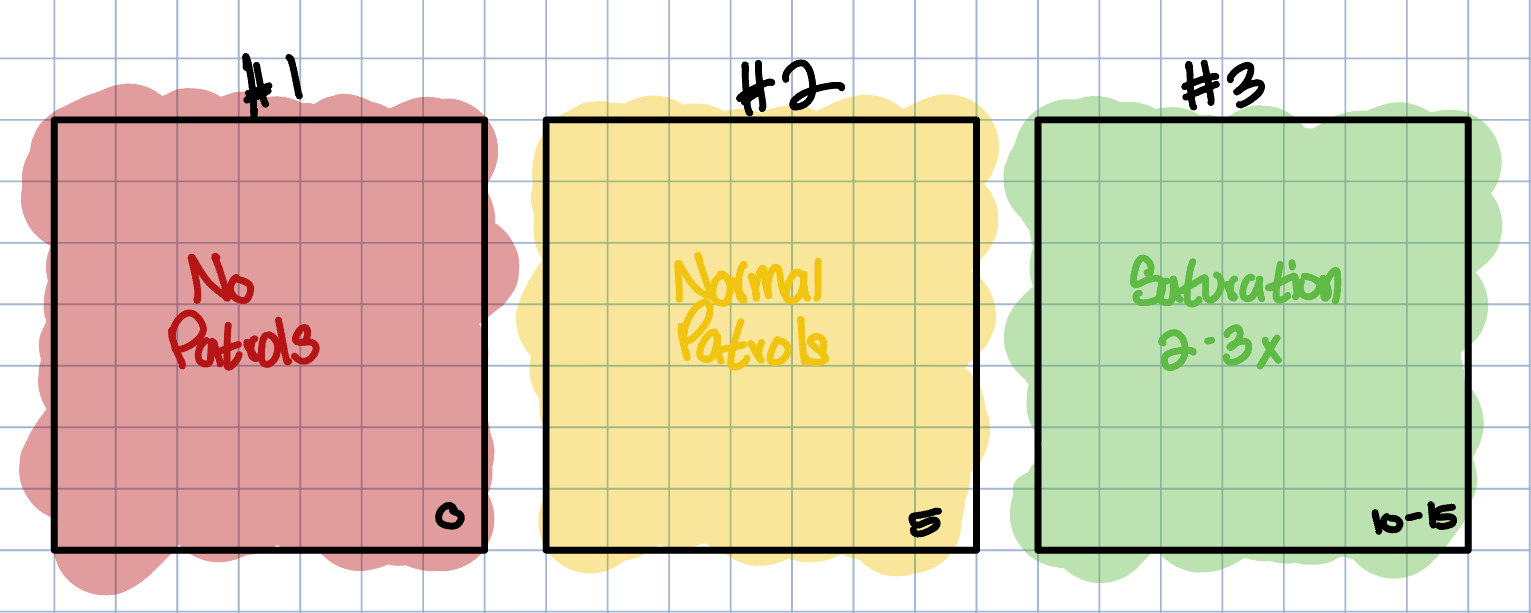
upheld for 12 months
victim surveys, reported crime rates, arrest data, a survey of local business, attitudinal surveys, and trained observers who monitored police-citizen interactions were used to gather data
taken before the start of the experiment
Take-aways
citizens did not notice a difference when the frequency of patrols was changed
increasing or decreasing the level of patrol had no significant effect on resident and commericail burglaries, auto thefts, larcenies involving auto accessories, robberies, or vandalism-crimes
the rate at which crimes were reported did not diffr significantly across the experimental beats
citizen reported fear of crime was not affected by different levels of patrol
citizen satisfaction with police did not vary
Conclusion
routine preventive patrol in marked police cars has little value in preventing crime or making citizens feel safe and that resources normally allocated to these activites could saftely be allocated elsewhere
crime prevention was more highly dependent on the willingness of citizens to report suspicious and/or criminal behavior to Police
Philadelphia Foot Patrol Experiment
established 120 areas that were high crime areas
in 60 of them, they placed foot patrols
from 10am-6pm they had 2 officers
from 6pm-2am they had 2 officers
from 2am-10am no foot patrol
in 60 of them, they changed nothing
Results:
23% reduction in crime in the foot patrol areas
vehicle crime also decreased
officers build connections with the community
Potential Issues:
man-power/ officer quantity
climate
walkability
Minneapolis Domestic Violence Experiment
Cases used in this study were misdemeanor assault calss
both the victim and offender needed to still be present when the police arrived, to be included in the study
51 officers participated in the study:
send the abuser away for eight hours, or
advice and mediation of disputes, or
make an arrest
last for 17 months and included 330 cases
found that arrest was the most effective
found that offenders assigned to be arrested had lower rates of re-offending than offenders assigned to counseling or temporarily sen
Large Group 2/28/25 - 4th Amendment Challenges: Detainment and Stops
What is a police “stop” → an officer stopping and asking for ID
an investigative stop occurs when a police officer briefly detains you because of a “reasonable suspicion”
a modest amount of suspicion is enough for a brief stop, but a vague hunch is not
rights in case of a stop:
the stop must be no longer and no more intrusive than necessary to confirm or allay the officer’s “reasonable suspicion” of criminal activity
a stop of several minutes is acceptable (SC - 20min)
once the “reasonable suspicion” of criminal activity underlying the stop has ended, the police cannot continue to detain you
how do I know if i can leave:
courts have held that, if a police officer takes and keeps your driver’s license or identification card, you have been “seized” under the Fourth Amendment
you may ask, “Am I free to leave?” If the answer is “no”, you are, at the least, detained
Probable cause can only exist where there are facts that would lead a reasonable person to conclude that a crime has occured
Stop & identify
there are no laws in the US that require you to carry ID if you are not driving
Stop & Identify law → if an officer stops and asks for your ID
the officer may also search your person if they have reasonable suspicion
4th Amendment Scenarios
Scenario #1 → plain clothes officer sees two men walk back and forth across a street and stare at a store window 24 times and then talk at the end of each run. They then meet with a 3rd man. He suspects that they are casing a job and approaches them, identifies himself as an officer, pats them down, and finds weapons on 2 of them
this stop was not only legal, it established much of the foundation
Terry v Ohio
officer is entitled for the protection of himself and others in the area to conduct a carefully limited search of the outher clothing of such persons in an attempt to discover weapons which may be used to assault him
Terry stops
investigative stop - 5 minutes
Scenario #2 → two officers observed 2 men waling away from one another in an alley near an area with a hugh drug traffic rate. They stopped the men and asked him to identify himself and explain what they were doing
this was not legal
Brown v Texas
there wasn’t a reasonable enough suspicion to suspect either of these guys. detaingin appelant to require him to identify himself consituted a seizure of his person subject to the requirment of the 4th amendment that the seizure be “reasonable”
high crime area does not equal reasonable suspicion
Scenario #3 → a man is standing in a chicago neighborhood, known for heavy narcotic trafficking. He’s holding an opaque bag when he sees a police officers enter the area. He runs and when patted down, has a weapon and is placed under arrest
yes, the stop was legal becuase he took off running when he saw the police
Illinois v Wardlow
“Headlong flight” is the consummate act of evasion; it is not necessarily indictive of wrongdoing, but it is certainly suggestive of such
Scenario #4 → police in miami recieve an anonymous tip that a black male in a plaid shirt waas standing near a bus stop carrying a gun. They find 3 black guys, one with a plaid shirt. They frisk the guy with a plaid shirt and find a gun without a license and under the age of 18
no, not legal - an anonymous tip was not enough to justify a stop
Florida v J.L.
it was based on a tip and not police observations
anonymous tip + police observations = legal
anonymous tip = illegal
a tip must include a form of reliabllity including some form of “predictive information” that gives the officers “means to test the informant’s knowledge or credibility”
Scenario #5 → officers pull over driver for expired license plate and ask driver to exit car. One officer notices a large buldge under his jacket. They frisk him and find a loaded revolver and the driver is arrested and then indicted for carrying a concealed deadly weapon and for unlawfully carrying a firearm without a license
legal
Pennsylvania v Mims
once a cara has been lawfully detained for a traffic stop, the police can order you to get out without violating the 4th amendment
for legitimate concerns of police saftey
Scenario #6 → in 1998, police began setting up vehicle checkpoints around the city to root out illegal drugs. Police would stop a set number of vehicles and conduct an open-view examination of the car or truck from the outside while the other officer would walk around with a narcotivs dog. stops lasted no more than 5 minutes
illegal → could only do checkpoints for illegal immigration and drunk driving
Indianapolis v Edmund
Large Group 3/14/25 - Warantless Searches: Person and Vehicle
Casle Doctrine/4th Amendment Protection → generally speaking, the law maintains that your home is a “castle” and that no one shall enter without a valid warrant
cars are not protected the same way
Carroll v US → big case that sent the standard for car searches
SCOUTUS HOLDING:
the warantless search of a car does not violate the Constitution. The mobility of the automobile makes it impracticle to get a search warrant
Carroll Doctrine → a vehicle can be searched without a warrant as lond as there is probable cause
Chimel v California → authorized to arrest Chimel, but were not authorized to search his home but still did
SCOTUS HOLDING:
an arresting officer may search only the area “within the immediate control” of the person arrested, meaning the area from which he might gain possession of a weapon or destructible evidence. Any other search of the surrounding area requites a search warrant.
Search Incident to Arrest → limited search scope based on the imediate area of control and the arrested person
New York v Belton → officer pulled over a car and arrested them after finding marajuana
case was originally thrown out because he found marajuana after arresting them because they had already been supressed
SCOTUS HOLDING:
when a police officer has made a lawful custodial arrest of the occupant of an automobile, the officer may, as a contemporaneous incident of that arrest, search the passenger compartment of that automobile
SIA - Search Incident to Arrest
when an SIA of a vehicle is justified, the entire passenger compartment and any containers therein may be searched
not trunk
“Plain View” Doctrine → allows an officer to seize, without a warrant, evidence and contraband that are found in plain view during a lawful observation
Horton Test → for the plain view doctrine to apply for discoveries, the three-prong Horton test requires:
the officer to be lawfully present at the place where the evidence can be plainly viewed
the officer to have a lawful right of access to the object
the incriminating character of the object to be “immediately apparent”
Thornton v US → Thorton is legally arrested after police find a plate to a different car on his car, and find cocaine on his person after he gives permission to be searched. Police then search Thortons car and found a gun after Thorton had already exited and been arrested
SCOTUS HOLDING:
the court added that an SIA of a vehicle may be justified even if an occupant has gotten out of the vehicle, closed the door, and walked a short distance away before being arrested
Arizona v Gant → Gant was arrested for driving on a suspended license after exiting his vehicle. He was then locked in the patrol car before the police searched his car and found a firearm and cocaine. Claimed that it was not a reasonable SIA
SCOTUS HOLDING:
revised the opinion of Thorton v US and stated that Belton does not authorize a vehicle search incidient to a recent occupant’s arrest after the arrestee has been secured and cannot access the interior of the vehicle
circumstances unique to the automobile context jusitfy a search incidient to arrest when it is reasonable to beleive that evidence of the offense of arrest might be found in the vehicle
Herring v US → officers arrested petitioner Herring based on an arrest warrant in a neighboring county. A SIA found drugs and a gun. It was later found out that the warrant had been removed months ago but the warrant had never been removed from the database
SCOTUS HOLDING:
arrest was upheld. because of Good Faith Acception
as long as the officers were acting in good faith, the arrest may still be legal
Large Group 3/28/25 - Police Issues & Challenges
Personality and Culture
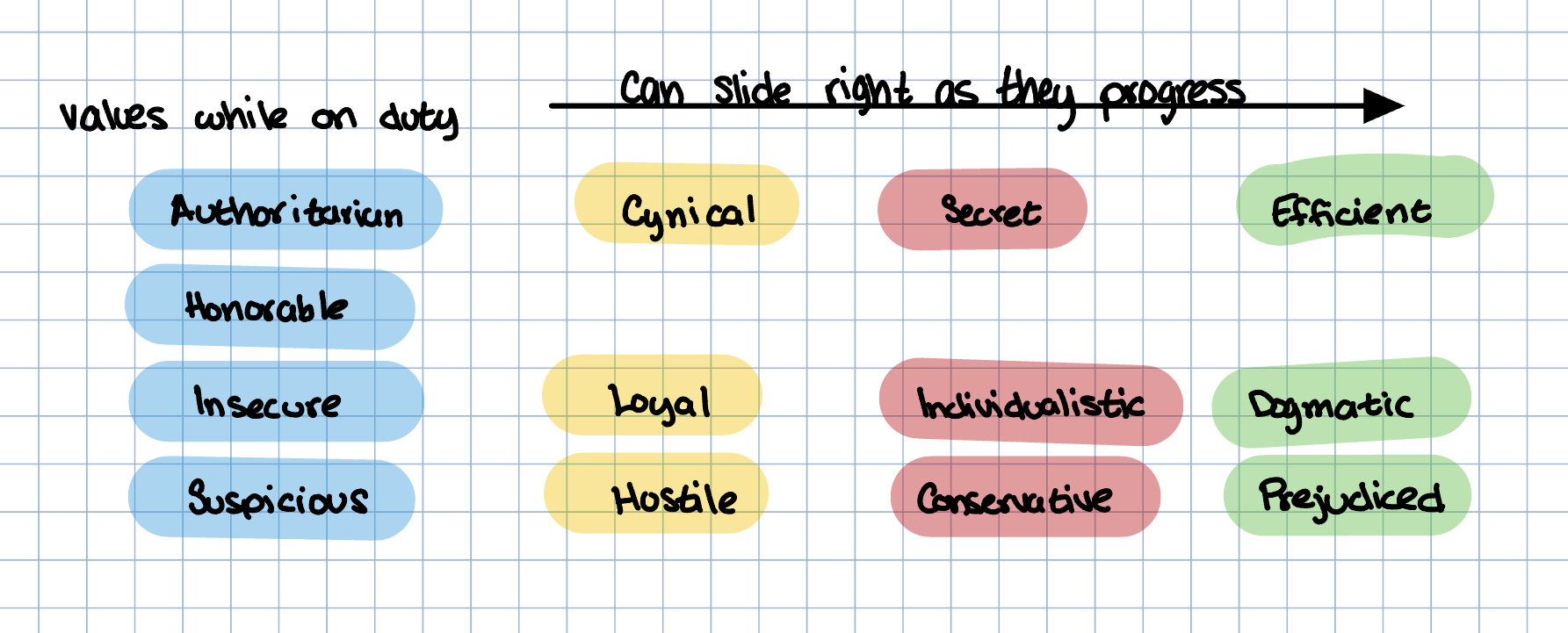
Police Subculture → ser of values, beleifs, and acceptable forms of behavior characterisic of American Police
Police Working Personality
1968 (98)(08) - Herome Skolnick
values and patterns of behavior evidenced by police officers who have been effectivley socialized
Interactions with Police
What are almost all ineractions with the police →
getting arrested, pulled over, etc.
All negative interactions have significant impacts on mental health
Combatting Police Depression
Departments across the ocuntry need to be concerned about the mental health of their officers
community activities with officer
mental health services
chaplin services
Dangers of Policing
Death in the Line of Duty
2024 - 147 deaths
firearm - 52
traffic - 46
2023 - 136
2022 - 224
2021 - 586
Disease & Infected Evidence
AIDS, Hepatitis B, Tuberculosis, and other diseases through infected blood
Breath-Alcohol devices, staples, knives, nails, and bites
Traumatic Experiences
Can’t discount the traumatic events that police are likley to experience
death
shootings
having to take a life
Stress & Fatigue
Large Group 4/4/25 - Chronology of a Criminal Case
Police Custody and Interrogation
Miranda v Arizona → USSC ruled that you cannot be forced to be a witness against yourself, and people need to be read their rights because they may not know they have them
Miranda Warning → Miranda Rights
When arrested:
you will be frisked and your car searched briefly
cop takes you to police station
anything you say can be used at trial
When at station/jail/headquarters:
thorughouly searched
if car impounded, also searched
held in cell of booking process may begin
Booking procedure:
identifying questions
questions about the crime
finger-printed
mugshot photos taken
officially logged into police system
you might be mirandized at this time
Arraignment:
arraigned between 24-48 hours
arraignment is where the county/state/country will officially charges you with crimes
this is also where the judge will set your bail
Bail and Alternatives
released on Own Recognizance (RoR)
Bail- pay your bail…and if you return, the court will give you your money back
Bail Bond- oay about 10% of your bail, and you won’t get it back
Collateral - Sign ownership of something over to court in place of bail
Preliminary Hearing:
first opportunity for defense and accused to view evidence against them
burden of proof is significantly lower than it will be during trial
burden of proof is lower for this
judge will determine if there is enough evidence to continue with proceedings
generally 10 days or so from arraignment
Large Group 4/18/25 -
Mental Competency:
Determined before trial
Incompetent = can’t:
understand charges
understand legal proceedings
assist their defense
requires minimal mental abilities (makes it rare)
if drugs = temporary competnecy : trial
If found incompetent:
sent to mental institution
time frame given (typically 2 years)
reevaluated
committed or released (rare)
N.G.R.I (Not Guilty by Reason of Insanity)
used in 1 out of every 200 cases (.5%)
successful in only 2 out of every 1000
most successful NGRI’s are NOT murder cases
once committed, spend 2-9 times longer than if convicted
Nebraska = M’Naghten Rule
NGRI if…
1) did NOT understand what they were doing
or, if he did know it
2) did NOT know it was wrong
50% of states use
decided by a Jury
have to convince members of the jury that you didn’t understand or know it was wrong
M’Naghten Rule → a rule determining insanity
The Durham Ruke → a person is not criminally responsible for his or her behaivors if the person’s illegal actions were the result of some mental disease or defect
Andrea Yates
drowned her 5 kids in the bathtub
suffered from postpartum depression
relativley common for new mothers
postpartum sychosis
breaks from reality and much less common
successfully pleaded not guilty by reason of insanity
currently resides in a mental institution
Large Group 4/25/25 - Sentencing Phase
If Found Not Guilt
you are essentially free to go at the time
Double Jeopardy is attached
You can still be sued in civil court
OJ in Civil Court
Ordered to pay $33.5 million to Goldman family
auctioned his Heisnam Trophy
Liquidated $500,000 in property
If Found Guilt
Somtimes depends on whether:
The case is a misdemeanor or felony
If there is a plea agreement
State v Federal
Misdemeanor Cases
sentencing may happen within just a few seconds, or could be about one week
crime may not be very significant, or a plea bargain is in place
Also, you may get a report to jail date
Felony Cases
Depends on what the charge is, and what state you are in (Also State v Federal)
Judge can remand you after adjudication
Sentencing may take up to one month
Why so long
The Pre-Sentence Report (PSR)
a probation officer will create a pre-sentence report to give to the district court judge, and will interview you to obtain information for the report. The PSR will cover a number of personal topics as your prior criminal reocrd, employment hisotry, health, family background and other topics.
Sentencing Hearing
If a sentencing hearing is held, the judge frequently hears testimony from the prosecution, the defense attorneys, friends and family, and the defendant, before passing sentencing
Victim-Impact Statements → give the victims a chance to speak their mind and get some “power” back
Sentencing Possibilites
The judge has several punishment options that he can impose during sentencing. Those options can be imposed singularly or in a combination with othere
If you have been convicted, a judge can order you to:
Pay a fee
Pay resititution to the victim
Go to jail or prison
Serve a period of time on probation
Do community service
Complete educational, counseling or treatment programs
How much discretion does a Judge have?
State v Federal
There are federal sentencing guidlines and manditory minimums
There are some states that have passed sentencing guidelines or mandatory minimums
Mandatory Minimums
many states have passed laws that rpovde for mandatory sentencing for certain crimes, such as child molestation or drunken driving
If you are convicted of one of those crimes, the judge has little discretion in sentencing and must follow the guidelines provided in the law
Large Group Notes 5/9/25 - Prison Subculture
Society Behind Bars
Much like the subculture of police, there is a similar subculture in jails and prisons
residents from their own customes, beliefs, value systems and lifestyles
varies between jail and prison
varies from prison to prison, region to region
Society Within A Society
prisons are a form of total institution
a total institution is an enclosed area where residents share all parts of their daily lives
Inmates sleep, ear, work and relax together. Generally speaking, there are no parts of daily life undertaken seperatly, or privatley, from the rest of the prison population
Prison Code
the prison code is the set of norms, or the expected behavior, of the inmates
think of it as an unofficial rulebook for inmates
Generally speaking, it is very similar throughout the nation’s prisons
one well-known prison study identified five central elements of the prison code. Elements are:
don’t interfere wit other inmates or tell on other inmates
mind your own business
don’t whine or complain
don’t exploit other inmates, and always keep your word
don’t trust prison guards of staff
Prison Language
Celli → cell mate
Fish
Ace Deuce
Pruno → variation of alcohol
Brake Fluid → mental health medication
Chomo or Chester → child molester
Old Head
Square John → someone who follows the rules
Dings → mentally ill inmates
Swag Man
Punks
Hacks
Prison Hierarchy
almost a reverse hierarchy outside of prison
cop-killers at the top
Murders
Gang members
rapists
child Molesteres- other crimes against children
Institutional Rape
the Prison Rape Elimination Act (PREA) of 2003 requires that federal, state and local correctional facilities maintain and enforce a zero-tolerance policy toward sexual assault for both inmate-on-inmate and staff-on-inmate misconduct
In 2011-2012, an estimated 4 percent of state and federal prison inmates and 3.2 percent of jail inmates reported experiencing one or more incidents of sexual victimization by another inamte or facility staff in the preceding 12 months or since admission to the facility