Ch. 1
AP Bio Notes (Ch. 1)
Intro and Themes in Biology:
Broadly defined, biology is the study of living things and how they interact with each other and their internal and external environments
Natural Sciences - the sciences concerned with the physical world and its phenomena (event/occurrence) and processes. These can be further divided into the life sciences (the study of living things) and the physical sciences (study of the nonliving things).
- Some refer to the natural sciences as “hard sciences” because they rely on the use of quantitative data (recorded observations that can be quantified; note data are plural, a datum is singular) as opposed to “soft” sciences that rely more on qualitative assessments (descriptions or other observations based on qualities rather than on measurements).
Scientific Inquiry -
When doing science you have to do it in an open way
- Your results need to be available for fellow scientists so that they can try/test it themselves to see if it can be repeated – if it can’t be repeated then we can see that something is wrong
- Letting your work to be checked by other people allows science to be self-correcting (other people will try to see if you made mistakes and then if you have they’ll let everyone know that there are mistakes so we can fix them and find the actual truth and not the biased results)
- Everyone should be skeptical of what you’re doing – the process falsification comes into play (where people try to tear your work apart, to find the weak spots, find issues, to see if they can do it themselves, or if something went on that you didn't understand)
- The ideas that can survive scrutiny are how we can continue to build science, to get better and to know more
Scientific Reasoning -
Inductive reasoning - makes a generalization from specific observations and facts. Uses a bottom-up approach
EX: If an individual gets stung by a bee, a wasp and an ant -- all of which belong to the insect order Hymenoptera -- that person might infer that all hymenoptera have stingers. (In reality, that conclusion would not be correct because stingless hymenoptera are known.)
Deductive reasoning - uses available information, knowledge, or facts to construct a valid conclusion. Uses a top-down approach. Uses generalities to predict specific results that can be tested
EX: A scientist who discovers a previously unknown type of wasp -- and has the general belief that all wasps have stingers as reasoned above – may reach the specific conclusion that the newly found wasp has a stinger. An experiment would have to be conducted to see if this is indeed true.
Descriptive science - (aka discovery science) describes and documents observations. It usually involves the use of inductive reasoning
Hypothesis-based science - begins with specific questions or problems and formulates potential answers or solutions to those questions/problems that can be tested. This usually involves deductive reasoning
The Process of Science -
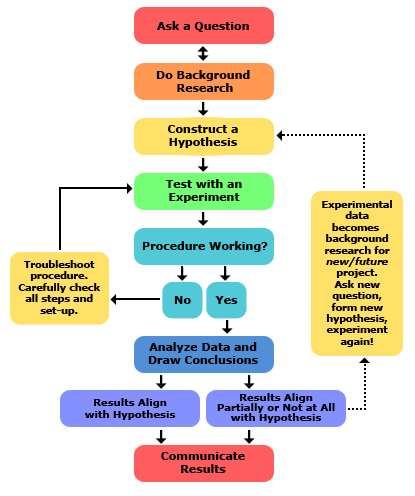
The general process when trying to discuss science and trying to understand it: Scientific method
Scientific Method -
The Scientific Method is the process that describes how scientists perform investigations to provide a systematic and rational approach to answer questions about the natural world. The goal is to eliminate bias and be as objective as possible. This can also be used by people that are not scientists
- When you are curious about something you want to do an experiment to try to figure out what happens and you might have a hypothesis in mind (a prediction–something that you can come up with and later will be verified by other people–what you think will happen)
- You do experiments to check if your hypothesis is supported – keep doing the same experiment to try and verify that it is really supported
- If your hypothesis is not supported – change your hypothesis because of the new results and then you can test that
- Nothing in science (experiments, ideas, processes) should be something that you do once – you keep doing it and share with other people once you’ve got your results to see if you have done something correctly. If you get enough predictions confirmed then you can try to work towards a theory (explanation)
- Sir Francis Bacon (1562-1626) (an English philosopher, scientist, statesman and author) is credited as the first person to document the process
- Hypotheses are usually stated in an “if … then …” format
EX: “If I replace my battery, then my car might start,” or “if I fill my empty gas tank, then my car might
start.”
- A valid hypothesis must be testable and falsifiable, meaning that experimental results can disprove it
- Each experiment should have one or more variables and one or more controls
* A variable is any component of an experiment that can be measured and changed
* A control group is the group in the experiment that is not manipulated in any way. It serves as the basis for comparison to the experimental group, which can have only one of its variables manipulated at a time
Hypothesis - best described as a prediction. Something you can come up with and later one will be verified by other people and oftentimes your hypothesis might be one part of this overarching theory idea (Hypothesis is usually specific. Can become a theory)
Theory - an explanation. A lot of evidence that backs it up, it’s not something that one person did. Something that was checked by many scientists over decades (Theories are usually broad.)
Basic science - (aka “pure” science) is pursued simply to gain and expand knowledge
Applied science - (aka “technology”) is to solve real-life problems
Some scientific discoveries are made by serendipity (purely by accident).
Feedback Regulation - (feedback and control)
This means if something within a living organism changes, we have two different ways to respond to that change
- Negative feedback: this is the most common (long term)
- If something is going up, it will go back down
EX: body temp went up → you will sweat, and body temp will go back down
EX: you eat a bunch of twinkies, blood sugar goes up, body releases insulin which makes
blood sugar go back down
That’s negative feedback, it opposes whatever change has occurred. This is what helps us stay alive!
- This helps so that if we get warm our body won’t tell us “let’s stay warm” and then die of a fever or if we get cold and our body wants to stay cold, we won’t die of hypothermia. Feedback regulation helps us make sure that we are in this “sweet spot” that exists for ourselves chemically to make sure we stay alive. And negative feedback is a huge part of that
- Positive feedback: this is where you GO with the change (occurs at specific times)
- This is very useful if you have a set result that you’re trying to get to
EX: you have a cut, so your body will try to repair it by making it clot, and after
the clotting it will scab over and will continue to do so until the wound is entirely covered
EX: birth, go with these contractions, do more of them, do them faster until we get to a child being born
We have end results that we have to get to and so positive feedback, while it doesn't exist indefinitely, it will occur for periods at a time to allow us to get to these specific ends
- If something drops, you basically say let’s drop it some more. If something goes up, let’s increase it some more, and that will happen in our bodies, but it’s only at specific times, but the short-term positive feedback can be very useful
Big Idea 1 - “the process of evolution drives the diversity and unity of life”
Life is connected in similarity and differences
- We have the same genetic code and method of mutation which makes us all different – allows us to have different structures which allow for different functions/jobs/abilities in which these different structures/functions allow for evolution to occur
- Some individuals can survive and reproduce better with their particular traits/version of something which allows whole species to change and sometimes become new species over time – mutations occur in which we will have something new and better
- These individuals with the new and better thing will survive better and have more children and they will become more successful and this will keep going
- The geography of the earth will change given enough time and so the environment will shift – what’s good now will stop being good later and so evolution will kick in again. Evolution doesn’t have one set goal or one set trait that’s always good
Big Idea 2 - “biological systems utilize energy (ATP) and molecular building blocks (DNA, proteins) to grow, reproduce (split in 2), and to maintain homeostasis (balance, symphony/harmony)”
- We have specific molecules that work together to allow us to live
- There will be lots of things to do with energy (ATP–seen in most organisms)
- DNA and proteins carry out the functions we need to get bigger – need to grow and reproduce (can only split in 2 if you are big enough–need to reproduce so there is more of you)
- You have to have homeostasis/balance to grow and reproduce – need balance because if not you are going to die
- Hormones/local regulators/signals are what let us stay balanced and help us survive
Big Idea 3 - “living system store, retrieve, transmit and respond to information essential to life processes”
How we’re able to store (DNA) the information that really says who we are, how we’re going to function
- We can detect things and respond to them (like from our environment) – if it’s cold outside or if something is running at us or we can tell if it’s raining. We are able to react and deal with changes in our environment
EX: if raining you might go and find shelter, if cold you might shiver or put more clothes on
- Characteristics of life is often called this response to stimuli and heredity (ability to store info, to pass it on, produce children, which is critical for us to last long term)
* Individual organisms aren’t going to make it forever but by reproducing you still have some individuals of a species that can keep going
Big Idea 4 - “biological systems interact, and these interactions possess complex properties”
Sometimes referred to as (complex characteristic) emergent properties (the sum if greater than the parts – none of the individual tissues (the muscle, the nerves, skin) that we have in our bodies, none of them individually, can do what a stomach can do, but if we mix them together in just the right way they can now do these characteristics/functions that they weren’t able to do as one single piece). These things are all interacting to allow things to function and those interactions are complex and they allow complex things to occur
EX: a car–a motor can’t be a car, the tires can’t be a car, a seat is not a car, none of the pieces allow you to do the function that an entire car lets you do, it only functions as a car if you put all those pieces together in a specific way
EX: many organisms need another organism to be present so they can survive (they eat the other) or it could be that be that one is living in something that the other produced or they’re eating the waste that the other produced
Properties of Life -
All living things share several key characteristics or functions:
Order: Living things are highly organized coordinated structures composed of one or more cells. Single-celled organisms are unicellular and organisms with more than one cell are multicellular. Cells are made of atoms that form molecules. Molecules, in turn, make up organelles or other specialized structures in cells. In multicellular organisms, cells form tissues (groups of cells that carry out specific functions). Tissues form organs (major body structures with a distinct function) and organs can function together to form organ systems
Response to Stimuli: Organisms respond to a diversity of environmental stimuli (sing. stimulus) (For example, plants can bend toward light or change colors as seasons change. Animals can run away from predators, or search for mates when they perceive certain chemical cues. Even bacteria move toward certain chemicals (a positive response) or away from others (a negative response).)
Reproduction: All living things reproduce (produce more of themselves). Single-celled organisms reproduce by duplicating their genetic material (DNA), doubling their contents, and then dividing in half between two daughter cells. In contrast, most multicellular organisms produce specialized reproductive cells (eggs from females and sperm from males) that fuse to produce a zygote that develops into a genetically unique individual that displays combined characteristics representative of its parents
Growth and Development: Organisms grow and develop according to individual-specific and species-specific instructions coded in their genetic material (DNA)
Regulation: All living things require multiple regulatory systems to coordinate all their functions (Examples include: waste removal, movement of nutrients and other materials throughout the organism, and thermoregulation.)
Homeostasis: Most systems in living things function optimally within a narrow set of conditions (e.g., temperature, pH, ion and other chemical concentrations) that must constantly be maintained (Temperature regulation in mammals, through the mechanisms of sweating or shivering, and structures such as blubber and fur are good examples of this)
Energy Processing: All living things need a constant source of energy (Organisms such as plants make their own food by capturing energy from the sun, which they convert into chemical energy (e.g., sugars). Organisms such as animals and fungi take in food from external sources.)
Use of Water: All living things require water. Water makes up between about 65% and 95% of all living things and most chemical reactions in living things take place in water
Adaptation and Change: Once formed, an organism’s genetic make-up stays the same even though its appearance changes as it grows. However, with time, the genetic make-up of populations can change if environmental conditions change. This results in the appearance of adaptations
- An adaptation is any feature that allows an organism to thrive and enhances its successful reproduction
Death: All living things eventually die. Consequently, they cease to use energy, grow, respond to stimuli, reproduce, maintain homeostasis or exhibit any of the other characteristics of living things. After death, the molecules and atoms that make up living things are recycled in the environment
Levels of Organization of Living Things -
Living things are highly organized and structured and can be studied at many levels ranging from atoms (what all living and nonliving things on Earth are made of) to the biosphere (all the areas on Earth that support life).
- Such a progression, or ranking, from smallest (e.g., atoms) to largest (e.g., biosphere) is called a hierarchy
- Every level of the biological hierarchy has its own characteristics or properties
- Higher levels of the hierarchy are more complex than lower levels, but include all the properties of the levels below them
The biological hierarchy consists of atoms, molecules, organelles, cells, tissues, organs, organ systems, organisms, populations, communities, ecosystems, biomes and finally the biosphere
- Atoms are the smallest and most fundamental units of matter and consist of a nucleus surrounded by electrons
- Molecules consist of at least two atoms joined together by chemical bonds. The most important molecules in living things are large (and called macromolecules) and usually consist of many small repeating units
- Macromolecules in living things can join together to form organelles, which are the small units – each with a specific function – inside cells (Examples are the nucleus, mitochondria, chloroplasts, and ribosomes.)
- Cells are the fundamental units of living things and the smallest biological entities considered to be alive. Organisms with only one cell are unicellular. Those with more than one cell are multicellular
- Prokaryotes are single-celled organisms without a nucleus or membrane-bound organelles. Eukaryotes are single- or multi-celled organisms – the cells of which have a nucleus and membrane-bound organelles
- In large organisms, cells combine to form tissues – groups of cells that carry out specific functions (Examples are bone and blood in animals or epidermis (outer covering) in a plant leaf.)
- Organs (e.g., a stomach in an animal or root in a plant) are collections of tissues that work together to carry out specific functions
- Organ systems (e.g., digestive system in animals, vascular system in plants) contain groups of organs
- Organisms are individual living things (e.g., tree in a forest, bacterium in a petri dish, fish in a ocean).
- Populations are collections of individuals of the same species that exist together in a given area and are close enough together to interact (e.g., a herd of elephants or a stand of red oak trees).
- Communities are all the populations of living things in an area (e.g., all the fish and other marine organisms in a coral reef or all the plants, animals, fungi and bacteria in a forest).
- An ecosystem consists of all the living (biotic) things in an area as well as the non-living (abiotic) components such as the atmosphere, water, rocks, etc.
- Biomes are large-scale geographically recognizable areas with distinctive climates and animal and plant communities (e.g., deserts, grasslands, tropical rain forests, arctic tundra).
- The biosphere is the area on Earth where life exists. It includes land, water and the atmosphere. It exists about 8 km (5 miles) above and below the land surface
The Diversity of Life -
The source of this diversity is evolution as a result of natural selection, the process of gradual change during which new species arise from older species
A phylogenetic tree summarizes the evolution of various life forms on Earth.
- Woese demonstrated that life on Earth evolved along three lineages now called domains
* These are the Bacteria, Archaea and Eukarya
* The Bacteria and Archaea are prokaryotic and microscopic and differ in terms of their genetics and chemistry of their cell walls
* The Eukarya are all the other living things on Earth. They include familiar groups such as all the animals, plants, and fungi as well as many lesser known major groupings collectively known as the Protista. All Eukaryotes have cells with a nucleus and membrane-bound organelles
How Organisms are Classified -
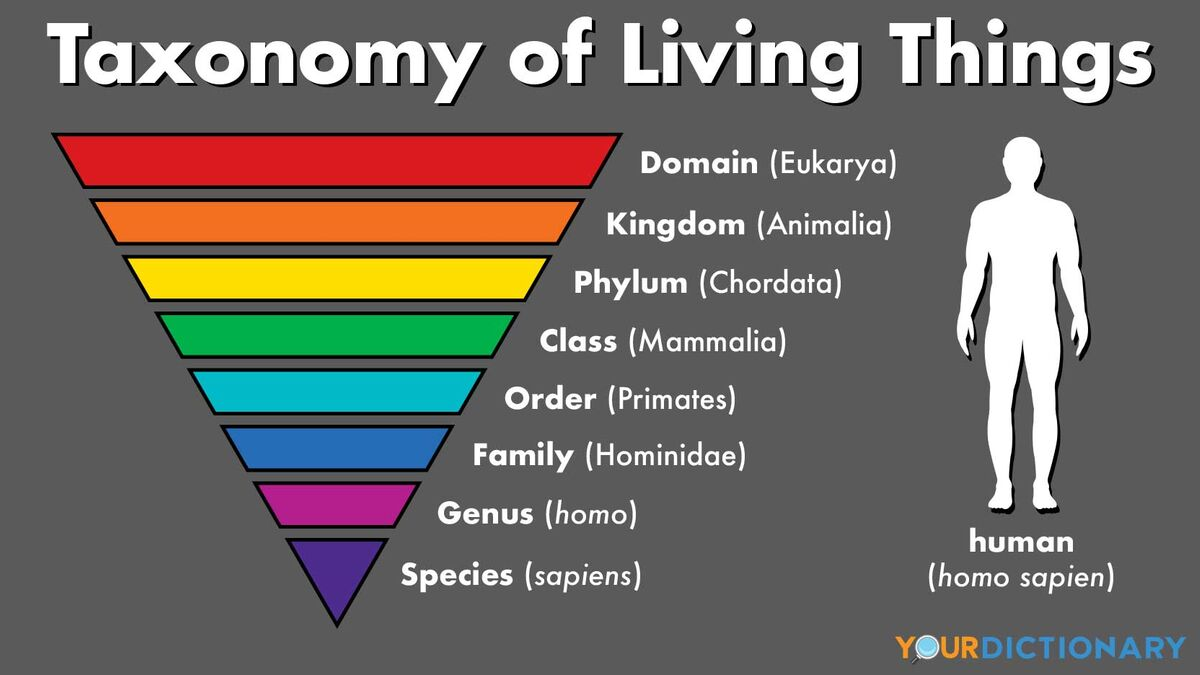
Taxonomy is the science of naming, describing and classifying all living things on Earth. Taxonomists use a combination of available morphological, genetic, biochemical and behavioral data to identify, describe and place organisms (living, currently undescribed and extinct) in groupings (taxa; singular taxon) from largest and most general (domain) to smallest and most specific (species or subspecies) based on shared characteristics (Developed by eighteenth century Swedish botanist Carl Linnaeus.)
- Genus - Every species receives a unique, two-word Latin name called its scientific name, which is italicized
* The first word identifies the genus to which an organism belongs
* The second defines the species
* Consequently, Homo sapiens (human beings) and Homo neanderthalensis (Neanderthals) are two separate species but both belong to the genus Homo