4.4 - Bioenergetics
4.4.1 Photosynthesis
4.4.1.1 Photosynthetic reaction
Photosynthesis uses energy to change carbon dioxide and water into glucose and oxygen
Photosynthesis takes place in chloroplasts - they contain a green pigment called chlorophyll that absorbs light
Photosynthesis is endothermic:
Means that energy is transferred from the environment to the chloroplasts by light
Word equation for photosynthesis:
carbon dioxide + water →light glucose + oxygen
Chemical symbol equation for photosynthesis:
6CO2 + 6H2O →light C6 H12 O6 + 6O2
4.4.1.2 Rate of photosynthesis
The limiting factors of photosynthesis:
Intensity of light - at night light can be the limiting factor
Temperature - in winter temp can be the limiting factor
Concentration of CO2 - if it’s warm enough and bright enough it usually is the limiting factor
Amount of chlorophyll - can be affected by a disease or a lack of nutrients
Means that rate of photosynthesis is reduced because they can’t absorb as much light
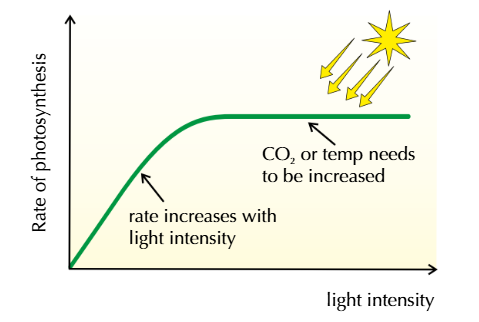
Light intensity:
Light provides the energy needed for photosynthesis
As the light level is raised the rate of photosynthesis increases steadily - but only until a certain point
Beyond that, it won’t make a difference as it is no longer the limiting factor
Temp or concentration of CO2 is now the limiting factor
Concentration of Carbon dioxide:
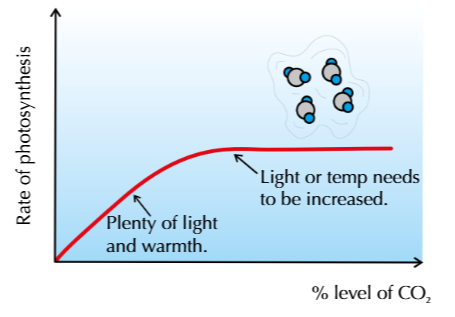
Affects photosynthesis as it is one of the raw materials needed for photosynthesis
Concentration of CO2 will only increase the rate of photosynthesis only up to a certain point
CO2 is no longer the limiting factor
Temperature:
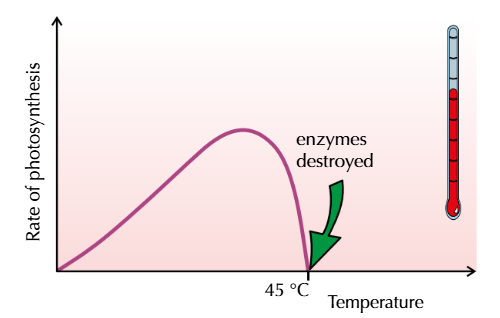
Temp affects the rate of photosynthesis because it affects the enzymes involved
If the plant is too cold then the enzymes needed work slowly
If the plant gets too hot the enzymes needed get denatured (active site shape changes) so no enzyme-substrate complexes can be formed
Happens at about 45 degrees Celsius
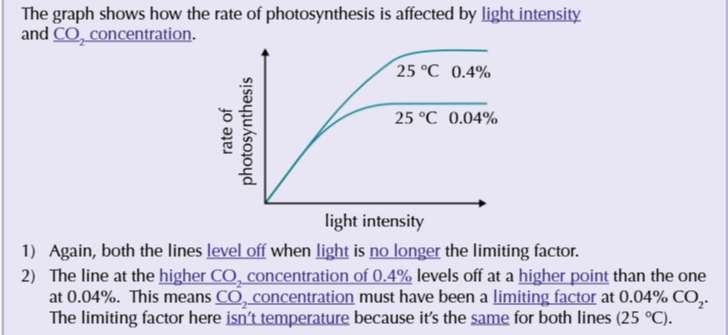
Graph example that shows more than one limiting factor:
REVISE REQUIRED PRACTICAL 6 FROM PMT
Inverse square law:
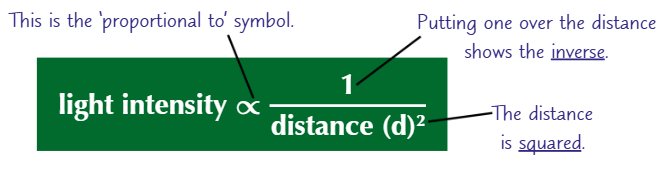
Distance and light intensity are inversely proportional
As the distance increases the light intensity decreases
Equation for inverse square law -
OR
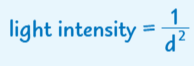
Light intensity is measured in arbitrary units (a.u.)
How greenhouses can be used to gain the maximum rate of photosynthesis while still maintaining profit:
Temperature -
Greenhouse gases help to trap the sun’s heat so that the temp doesn’t become the limiting factor
In winter (no sun) - farmers may use a heater to keep the temp at ideal levels
In summer - farmers may use shades and ventilation to reduce the temperature
Light intensity -
Farmers may supply artificial light at night give plants the energy they need to carry out photosynthesis
Concentration of carbon dioxide -
Farmers may use a paraffin heater - as it burns it releases carbon dioxide as a by-product
Keeping plants enclosed makes it easier to keep them free from pests and diseases
Farmer can easily add fertilisers to the soil to provide minerals needed for healthy growth
Adding magnesium ions also help with the production of chlorophyll so more light can be absorbed for photosynthesis
However -
Sorting all this out costs money
Therefore farmers must supply the right amount of heat, light and CO2 and nothing more so that you don’t waste money
Must provide just the right conditions tho so that the farmers can harvest plants more often
These crops can then be sold
4.4.1.3 Uses of glucose from photosynthesis
C - Cellulose: glucose is converted into cellulose for making strong plant cell walls
R - Respiration: releases energy from glucose which is used for many things
O - Oils or fats: glucose is turned into lipids for storing in seeds
P - Proteins: glucose is combined with nitrate ions (absorbed from the soil) to make amino acids which are then made into proteins
S - Stored as starch: starch is insoluble which makes it better for storing than glucose as a cell with lots of glucose may draw loads of water and swell up
4.4.2 Respiration
4.4.2.1 Aerobic and anaerobic respiration
Respiration = the process of transferring energy from glucose, which goes on in every cell:
Respiration is exothermic - transfers energy to the environment
Transfers energy used for all living process -
Energy is used to build up larger molecules from smaller ones
Like proteins from amino acids
Energy is used in animals for movement (muscle contraction)
Energy is used to keep body temp steady in a cold environment in animal and birds
Respiration in cells can take place aerobically (using oxygen):
Is the most efficient way to transfer energy from glucose
Takes place in the mitochondria
Goes on all the time in plants and animals
Word equation:
glucose + oxygen → carbon dioxide + water
Symbol equation:
C6 H12 O6 + 6O2 → 6CO2 + H2 O
Respiration in humans can take place anaerobically (without oxygen):
Happens in the cytoplasm of muscle cells
Happen when your body can’t supply enough oxygen to your muscles
Start doing both types of respiration
It is the incomplete breakdown of glucose making lactic acid -
Word equation = glucose → lactic acid
Does not transfer as much energy as aerobic respiration because the glucose isn’t fully oxidised
Glucose needs oxygen to be fully broken down and release all of its energy
Anaerobic respiration in plants and yeast:
Happens in the cytoplasm of plant cells and yeast cells
Anaerobic respiration in yeast cells is called fermentation
In bread making - carbon dioxide from fermentation makes the bread rise
In beer and wine-making - the fermentation process produces alcohol (ethanol)
Word equation for anaerobic respiration in plants and yeast cells:
glucose → ethanol + carbon dioxide
4.4.2.2 Response to exercise
Muscles need energy from respiration to contract - more muscle contraction means more energy and increased respiration:
Means you need to get more oxygen into cells
Breathing rate and breath volume increases and heart rate increases
To get oxygenated blood around the body faster and to supply the muscles with more oxygenated blood
If insufficient oxygen is supplied anaerobic oxygen is supplied -
Anaerobic respiration takes place in the muscle cells
The incomplete oxidation causes a build up of lactic acid and creates an oxygen debt
During long periods of vigorous exercise -
Muscles become fatigued and stop contracting efficiently
Oxygen debt:
Oxygen debt = the amount of extra oxygen the body needs after exercise to react with the accumulated lactic acid and remove it from the cells
Oxygen reacts with the lactic acid to from CO2 and water
Means that you have to keep breathing hard for a while even after you stop exercising to get more oxygen in your blood
Heart rate and breathing rate stays high whilst there are high levels of lactic acid and CO2
Also, blood that enters your muscles transports the lactic acid to the liver where it is converted back into glucose
4.4.2.3 Metabolism
Metabolism = the sum of all the reactions in a cell or the body:
All of these metabolic reactions are controlled by enzymes
Energy transferred by respiration in cells is used by the organism for the continual enzyme controlled processes of metabolism that synthesize new molecules
Metabolism includes:
Conversion of glucose to starch, glycogen and cellulose
Starch - an insoluble storage molecule in plant cells
Glycogen - an insoluble storage molecule in animal cells
Formation of lipid molecules from a molecule of glycerol and three molecules of fatty acids
Glucose is combined with nitrate ions to make amino acids - which are then made into proteins
Glucose is broken down in respiration
The breakdown of excess proteins to from urea for excretion in urine