Inheritance and evolution
Keywords Glossary
Word | Definition |
Chromosome | A thread like structure made of DNA that is in the nucleus of the cell – contains genes |
Mitosis | Cell division – the cell divides once to form two genetically identical daughter cells.
|
Meiosis | Cell Division – the cell divides twice to form 4 genetically different daughter cells. These cells only have half of the genetic information of the original parent cells |
Clones | Two individuals that are genetically identical (formed by mitosis) |
Gametes | Sex cells e.g. egg and sperm in animals pollen and egg in plants
Contain half the normal amount of DNA |
Haploid | A cell that only has one of each chromosome – gametes Cell with half the normal amount of DNA |
Diploid | A cell that has two of each chromosome – body cells Cell with the full amount of DNA |
Gene | A length of DNA that codes for a protein – proteins control traits (characteristics) of the cell and organism |
Allele | A different version of the same gene e.g. blue or brown eyes |
Dominant | An allele which needs only one copy to be seen in the phenotype |
Recessive | An allele that needs two copies to be seen in the phenotype |
Homozygous | An individual in which both alleles are the same (TT) |
Heterozygous | An individual who has two different alleles (Tt) |
Phenotype | What an individual looks like due to the alleles they have e.g. brown eyes |
Genotype | What alleles an individual has e.g. BB |
Co-dominance | Two alleles where both are seen in the phenotype of a heterozygote |
Carrier | Someone who is heterozygous for a recessive disease. They don’t have any symptoms but can pass the allele on to their children |
Polygenic | A trait under the control of many genes |
Genome | All of the DNA in an individual of that species |
Cell Division – Chromosomes
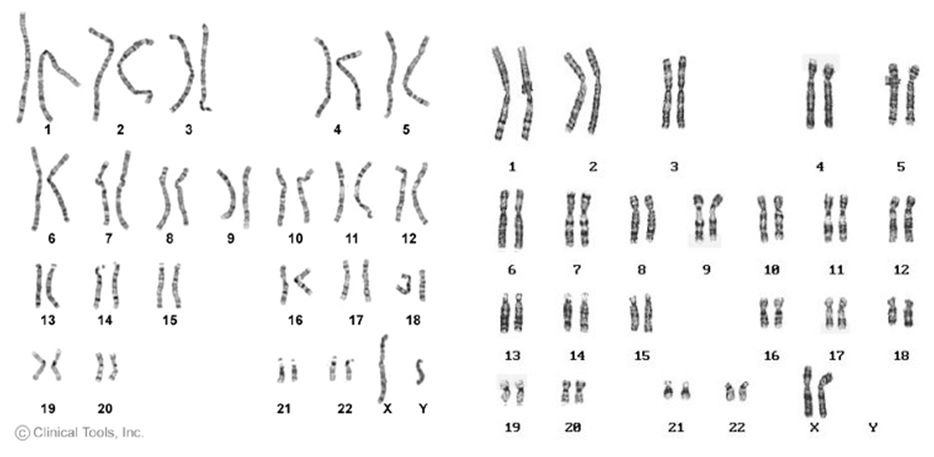
Every plant and animal cell has a nucleus containing thread-like structures called chromosomes.
Chromosomes carry genes, which control the characteristics of the organism.
In body cells (somatic cells), chromosomes are found in pairs, one from each parent.
The full set of chromosomes is called the diploid number. In humans, this is 46 chromosomes (23 pairs).
Chromosomes only become visible under a microscope when the cell is about to divide.
Extension
Chromosomes are long thread-like structures made of DNA.
Normally, they are not visible under a light microscope.
Before cell division, chromosomes replicate, forming two daughter strands that remain attached at the middle, creating an X-shape.
These X-shaped diagrams are often used to represent chromosomes.
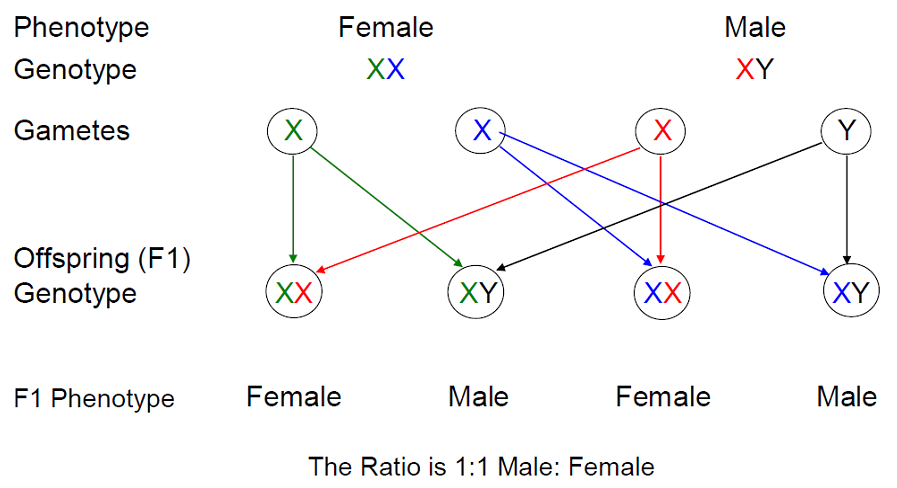
Human sex chromosomes differ: Male = XY, Female = XX.
Cell Division
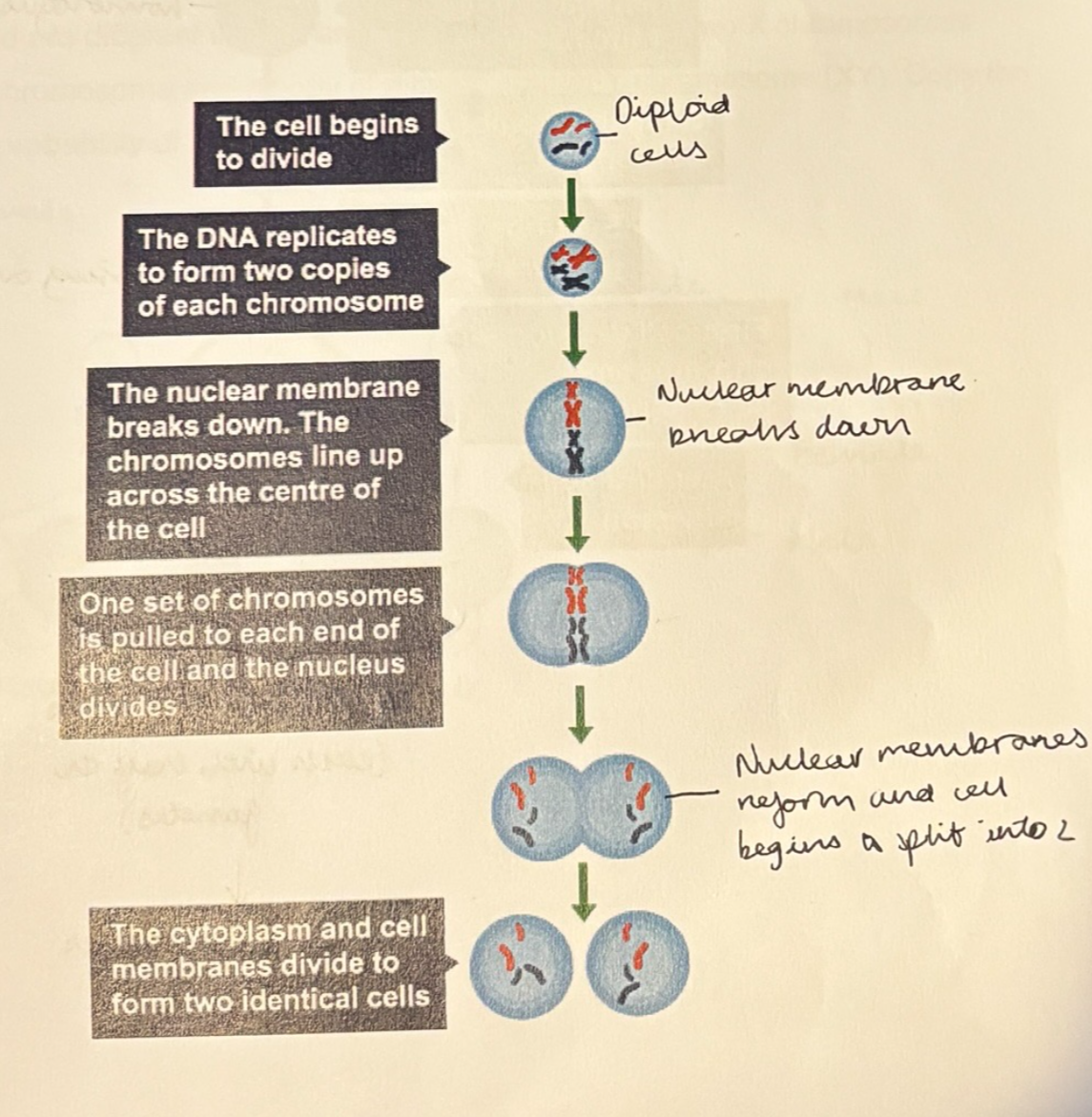
When a cell divides, it produces daughter cells.
There are two types of cell division: mitosis and meiosis.
Mitosis
Produces two genetically identical daughter cells (clones) with the diploid number of chromosomes.
Used for:
Growth of new cells
Repair of damaged tissues
Asexual reproduction
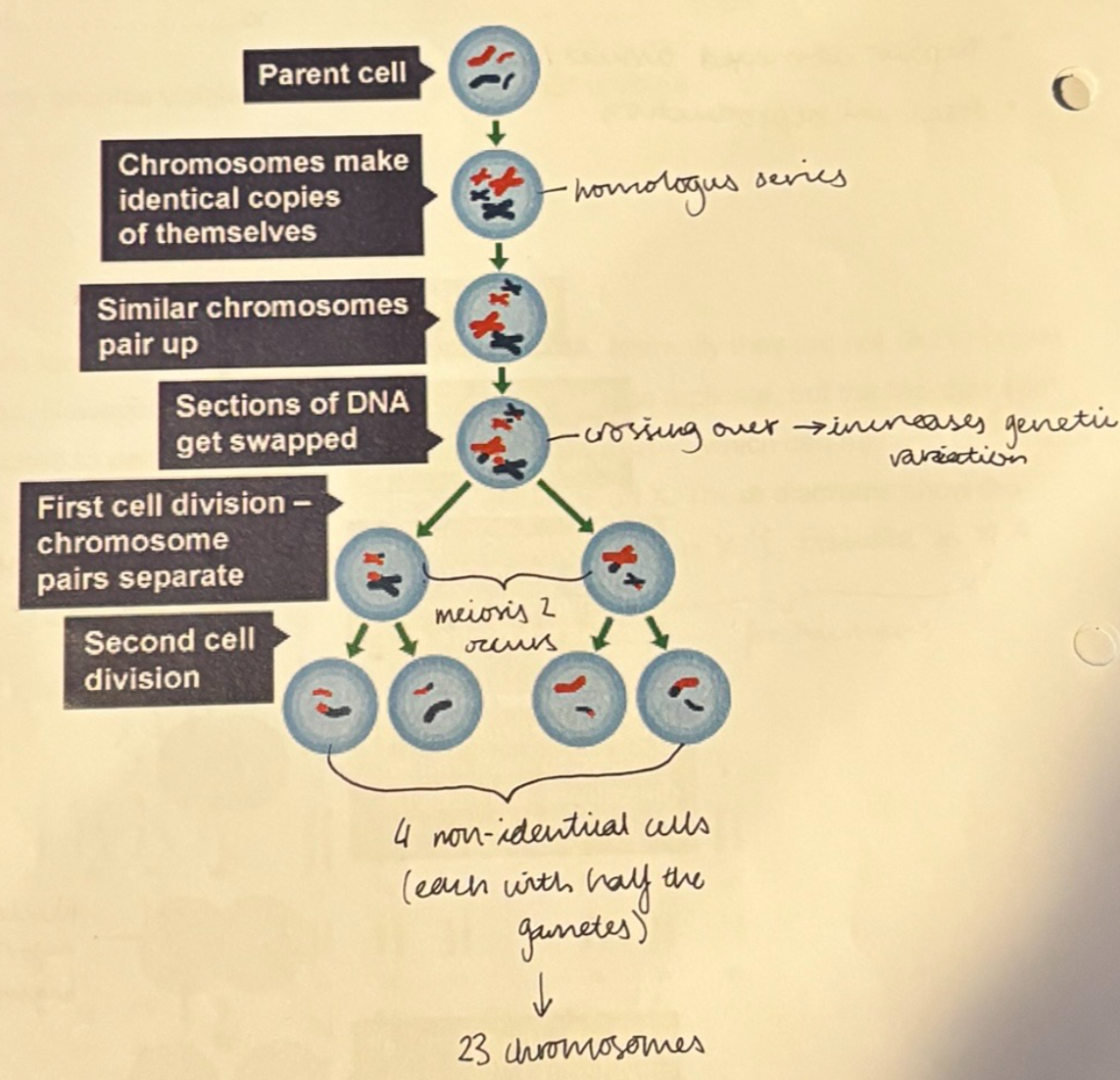
Meiosis
Produces four daughter cells with half the normal number of chromosomes (haploid, n).
Chromosomes are randomly sorted, so daughter cells are not genetically identical.
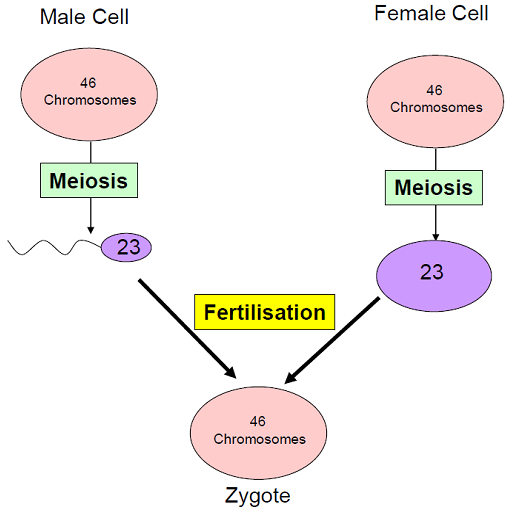
Haploid gametes are necessary so that after fertilisation, the zygote has the correct diploid number.
Meiosis is used to make sex cells (gametes) and contributes to genetic variation in sexual reproduction.
Inheritance
Sex Determination
Humans have 23 pairs of chromosomes.
22 pairs are the same in everyone; the last pair are the sex chromosomes.
Females have two X chromosomes (XX).
Males have one X and one Y chromosome (XY).
The combination of sex chromosomes determines the probability of having a boy or girl.
Genes and Alleles
Genes are sections of DNA on chromosomes that control specific traits, e.g., blood group, tongue rolling, ear lobes.
Each gene is found in the same position on both chromosomes, so you have two copies of each gene.
Different forms of a gene are called alleles.
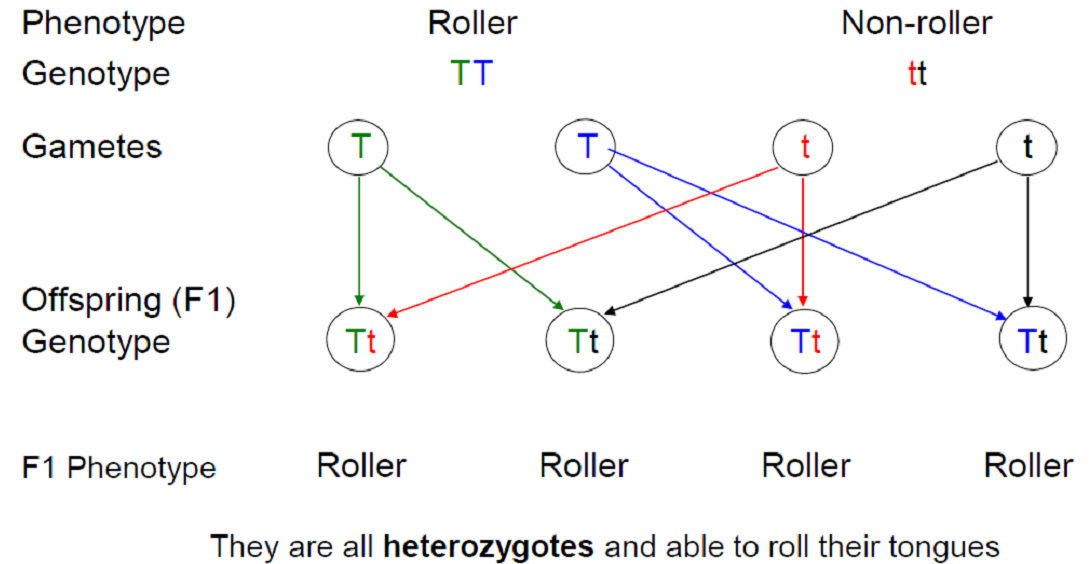
Example: Tongue rolling gene – allele T allows rolling, t does not.
TT = can roll tongue
tt = cannot roll tongue
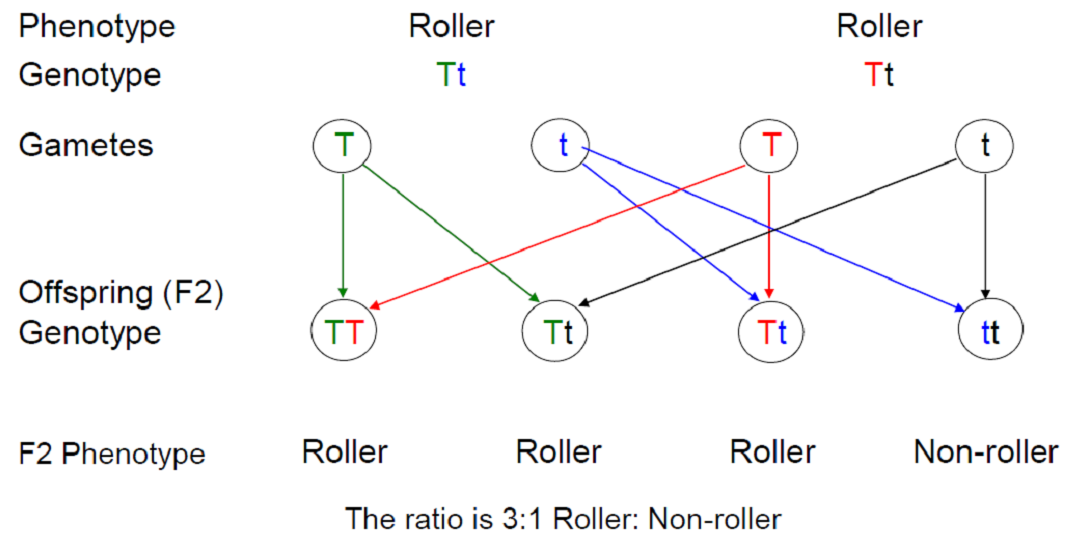
Tt = can roll tongue (T is dominant over t)
An individual with two identical alleles (TT or tt) is homozygous.
An individual with two different alleles (Tt) is heterozygous.
Genotype = the alleles an individual has for a trait.
Phenotype = the visible expression of that trait.
A heterozygote for a recessive genetic disease is called a carrier.
Co-dominance
Sometimes one allele does not have dominance over other. The phenotype shows a mixture of the two. You can get true breeding strains of snapdragons with red or white flowers. If homozygous red flowered plants (RR) are crossed with homozygous white flowering plants (WW), all the resulting heterozygous plants have pink flowers (RW).
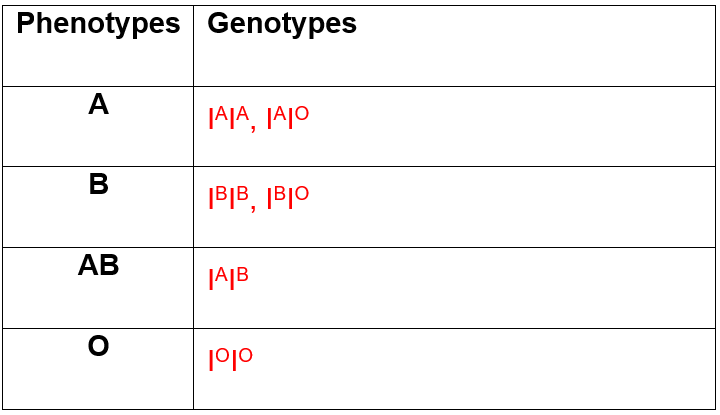
Blood groups also show co-dominance. There are three alleles IA and IB are co-dominant and IO is recessive. Complete the following tables for the possible genotypes of the four possible phenotypes.
It is frequently more complicated than this:
In all the examples we have looked at a trait is controlled by a single gene. This is known as monogenic. However, many traits are controlled by multiple genes so that working out the inheritance is much more complicated. Resent estimates put the number of genes controlling skin colour at over 200. This type of inheritance is known as polygenic.
Examination Tips
Ensure you know the difference between genes and alleles. This is frequently used to differentiate the top candidates.
Don’t take short cuts - always put all the steps in your genetic diagrams. There are frequently marks allocated to them
Extension
Sex Linkage
A woman can be a heterozygote for a trait on the X-chromosome but a man can’t as he only has one X. If a man has a recessive allele on his X-chromosome then it will show in his phenotype. This is why some traits are more common in men than women. E.g. colour blindness, haemophilia, and crown baldness.
Genetic Disorders
These result from changes in the DNA. Most are due to gene mutations; e.g. cystic fibrosis, sickle cell anaemia. Others are due to large changes; Down's syndrome is where the individual has three copies of chromosome 21.
Cystic fibrosis is recessive disease; you need two copies of the faulty allele have the condition. The symptoms can lead to damaged lungs and poor digestion. Carriers have no symptoms..
Huntington's disease is caused by a dominant allele. It causes the sufferer’s nervous coordination and brain function to deterioration, ultimately resulting in death.
Sickle cell anaemia is recessive and affects the structure of haemoglobin, resulting in red blood cells changing shape. The cells carry less oxygen and have trouble travelling through capillaries. Carriers are thought to have protection against malaria.
The Father of Genetics
Gregor Mendel, an Austrian monk, discovered the principles of genetics. He worked on pea plants, publishing his results in 1866. He did not know about genes but realised that something, which he called factors, must exist, being passed from parents to offspring.
Unfortunately, his work was not widely read so when Mendel died in 1884 he was unrecognised as a scientist. The importance of his work was not realised until sixteen years later when a Dutch biologist discovered it and understood its significance.
Variation
Variation is the differences in characteristics between individuals of the same species.
Variation | Definition | Examples |
|---|---|---|
Continuous | Data with no natural boundaries; can take any value | Height, body mass |
Discontinuous | Data with natural boundaries; no intermediate values | Blood group |
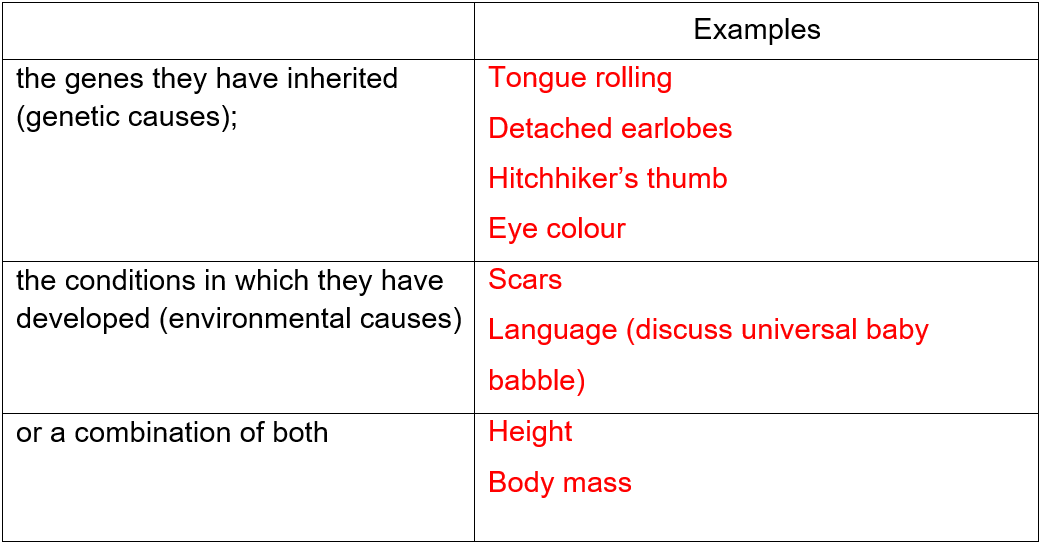
Differences in characteristics can be caused by:
Genetic factors: genes inherited from parents
Examples: tongue rolling, detached earlobes, hitchhiker’s thumb, eye colour
Environmental factors: conditions in which the individual develops
Examples: scars, language
Combination of both genetics and environment
Examples: height, body mass
Causes of genetic variation
Meiosis: produces four daughter cells that are genetically different from each other and the parent cell.
Mutations: random changes to an organism’s DNA.
Random fertilisation: which sperm fertilises which egg occurs by chance.
Evolution
Evolution is the change in species over time.
Although discussed since Ancient Greece, it was Charles Darwin who explained how evolution occurs through natural selection, making it widely accepted scientifically.
All living and extinct species are descended from simple organisms over 3 billion years ago, sharing a common ancestor.
Species
A species is a group of individuals that can reproduce to give fertile offspring.
New species evolve when a group of individuals is isolated for a long period. Differences accumulate, preventing breeding with the original population, forming a new species.
This process creates a branching “tree of life” as species diverge over time.
Evidence for evolution
Fossil record: shows how organisms have changed over time and helps construct family trees.
Comparative anatomy: organisms with similar structures are grouped together; e.g., all mammals have similar skeletons and hair. Closer similarities indicate a more recent common ancestor.
Shared genetic code: all living things use the same DNA code, suggesting life originated once.
DNA comparisons: species with more similar DNA are more closely related.
Observed evolution: examples include peppered moths in the 19th century and antibiotic resistance in bacteria.
Natural Selection
Charles Darwin’s theory explains how populations change over time.
Observations during his five-year HMS Beagle voyage, combined with studying selective breeding, helped him develop the theory.
He delayed publication of his theory for 20 years while gathering evidence.
Summary
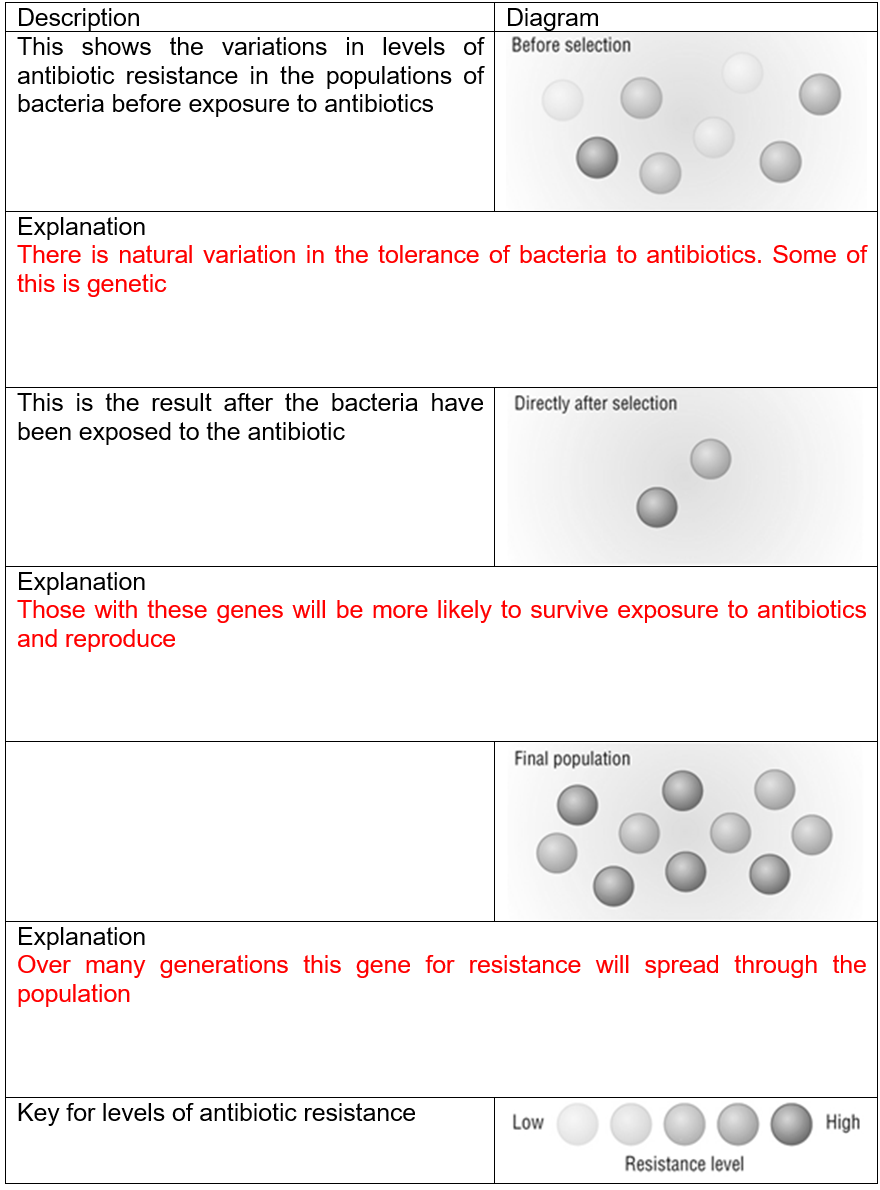
Natural variation exists between individuals in a population.
Some of this variation is genetic, caused by mutations.
Certain individuals may have alleles that make them more likely to survive and reproduce.
These alleles are passed on to offspring, who are also more likely to survive and reproduce.
Over time, beneficial alleles increase in frequency, while harmful alleles decrease.
Example – Cheetahs becoming faster
There is natural variation in the speed of cheetahs.
Some of this variation is genetic.
Faster cheetahs are more successful hunters, so they are more likely to survive and reproduce.
Their offspring inherit the genes for speed and are also more likely to survive and reproduce.
Over generations, the allele for speed spreads through the population, making cheetahs faster overall.
Why are bacteria becoming resistant to antibiotics?
Antibiotics are a class of drugs that kill bacteria.
Causes of Antibiotic Resistance
Not completing a full course of antibiotics allows some bacteria to survive and develop resistance.
Overuse of antibiotics for viral infections, such as the flu, increases the chance of resistance.
Excessive use in agriculture, e.g., adding antibiotics to cattle feed, can promote resistant bacteria.
Antibiotic resistance can make common infections harder to treat, increase the risk from minor wounds, and make surgery more dangerous due to bacterial infection.
Selective Breeding
Humans can apply selective pressure, similar to natural selection, to change plants and animals over time.
This process, called artificial selection or selective breeding, produces new varieties with desired traits.
It involves choosing organisms with preferred characteristics and breeding them.
Selective breeding reduces genetic diversity, which may result in the loss of other useful traits.
Basis of a Selective Breeding Programme
Choose two individuals of the same species to produce offspring that combine qualities from both parents. Example: a Labradoodle from a Labrador and a Poodle.
Breed from the best individuals of a variety, e.g., the fastest greyhound, to gradually improve the breed over generations.
Breeding Animals
Select the desired male and female and allow them to mate under controlled conditions.
Artificial Insemination: semen from a selected male is collected by a vet and used to fertilise females, e.g., in cattle.
Allows semen from one male to fertilise many females across different locations.
Plant Breeding
Select two plants and transfer pollen from the anther of one plant to the stigma of the other using a paintbrush.
Take precautions:
Remove anthers from the receiving flower to prevent self-pollination.
Cover the flower with a transparent plastic bag to prevent accidental pollination from other plants.
Economic Importance of Selective Breeding
Humans have used selective breeding since the development of agriculture.
Modern farm animals are bred for high-quality meat and increased yield.
Crop plants are bred for high grain yield, disease resistance, and faster growth.
Stem length of crops like wheat has been reduced to make harvesting easier.
Scientists are developing crops resistant to drought and extreme weather to improve agriculture in challenging regions.