Lesson 9: A-a Gradient Summary
Lesson 9: A-a Gradient
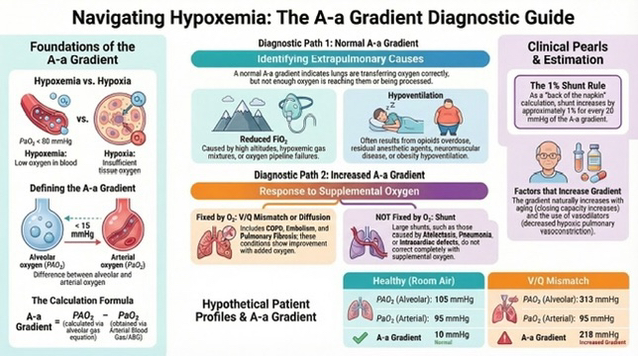
The A-a gradient is the difference between alveolar oxygen (PAO2) and arterial oxygen (PaO2).
Importance of A-a Gradient Calculation
Essential for diagnosing hypoxemia by indicating venous admixture amount.
Requires the alveolar gas equation for PAO2 and arterial blood gas (ABG) for PaO2.
Types of Hypoxemia and A-a Gradient
Normal A-a Gradient Causes: Low FiO2, hypoventilation.
Increased A-a Gradient Causes: Diffusion limitation, V/Q mismatch, shunt.
Supplemental oxygen improves oxygenation in hypoxemia except in cases of shunt.
Definition of Hypoxemia
Occurs when PaO2 < 80 mmHg.
Hypoxia refers to insufficient oxygen at the tissue level.
Hypoxemia Diagnostic Algorithm
First step: Calculate A-a gradient.
Common Causes of Hypoxemia
Normal A-a Gradient: Low FiO2, hypoventilation from opioid overdose, residual anesthetic agents, neuromuscular disease, obesity hypoventilation.
Increased A-a Gradient: V/Q mismatch (most common cause), diffusion impairment (e.g., pulmonary fibrosis), large shunts
A-a Gradient Calculation Example
Formula:
Example:
Estimation of Shunt
Rough estimate: shunt increases by 1% for every 20 mmHg increase in A-a gradient.
Example: A-a gradient of 218 mmHg suggests a shunt of approximately 11% ().
Factors Increasing A-a Gradient
Aging, use of vasodilators, right-to-left shunt, diffusion limitation due to thickening of alveolo-capillary membrane.