Chapter 8
1/12
- @@Eurocentrism is the ideology that Europe is kind of the center of the world and that it is Humans that are the center of the world ( everyone else was backwards )@@
- Europeans got to modernity first so they were the best ( European ego blasts ) ( everyone else has to catch up )
- Europeans couldn’t have had their advancements without others advancements before them
- the printing press also advanced the ideas of Europe
- Europeans cultural flowering was much longer that those of other societies
- When they found the Americas they took a rise to power over more land a people
- European dominance was often met with resistance, but it endured
- Non-Europeans used Europeans ideas to their advantage
- European ideas were adapted to the local circumstances
- Europeans gained big time on their ideas but other did too
1750-1900
- the time is referred to as the European moment in history and the LONG 19th century
- the two major developments took place in the LONG 19th century
- Creation of a new Modern society
- growing ability of modern societies to exercise enormous power and influence over the rest of human kind
CREATION OF A NEW MODERN SOCIETY
- time period includes the French and Industrial revolution
- Powerful, transorfitice ideas developed
NEW IDEAS
- end social inequality ( end of poverty )
- ordinary people should participate in political life ( VOTING )
- smaller nations should replace large empires
- women’s equality
- end of slavery
ENORMOUS POWER OF MODERN SOCIETIES
modern societies were able to exercise enormous power and influence over the rest of humankind
HOW WAS THE ENOURMUS POWER ACHIEVED
- economic penetration
- military intervention
- diplomatic pressure
- missionary activity in independent
ANTHROPOCENE = THE AGE OF MAN- because humans were the active agent of change
Modern Era = The Age of Revolution'
- Major political changes take place in the time period
- 4 major political revolutions take place known as the atlantic revolutions
- United States
- France
- Hati
- latin Americas
ATLANTIC REVOLUTIONS
What to know?
- The effect they had on women’s rights
- the political and social similarity and difference with each other
- how revolutions were inspired by other revolutions
- how people identified themselves and the key people in the revolutions
IDENTIFY A SIMILARITY BETWEEN THE REVOLUTIONS _______ AND _________
IDENTIFY AND EXPLAIN A CONTINUITY FROM REVOLUTIONS ( WOMEN’S RIGHTS DIDN”T CHANGE )
- The enlightenment and colonizations of the New World led to revolutions
- Siomay is Hati
a pamphlet called common sense led to a good amount of revolutions
Atlantic revolution in a global context ( making it distinctive )
- took place from the early 18th - mid 19th
- Revolutions were closely linked( jefferson was the US ambassador to France at the start of the French Revolution
- They shared a common set of ideas ( based off of Enlightenment) ( liberty, equality, free trade, religious tolerance, popular sovereignty, republicanism )
- Impact
- abolishment movement to end slavery
- extinction of the right to vote
- constitutions
- greater equality for women
- nationalism
- ideas of equality
American revolution
- As a result of the American revolution and they pushed for
- voting rights
- more rights for women
- development of constitution
- an end to slavery
- Colonists initially had no desire to break from England
- Socially the door was open for something new because there was
- @@no established church@@
- very few social classes
- no real nobility
Result: a unique opportunity for economic gain!
1/17
The French Revolution
- thousands of french soldiers assisted American colonists against the British
- IMPACT: They felt underrepresented within their own government
- RESULT: They drew up the DECLARATION OF THE RIGHTS OF @@MAN@@ AND CITIZEN ( no women )
1/18
FRENCH REVOLUTION:
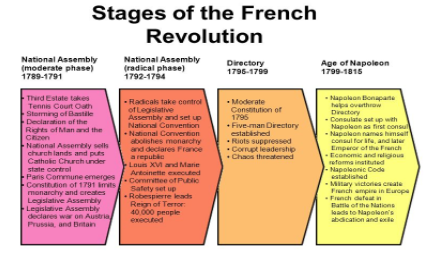
- a sharp economic slump in 1787 and 1788 (triggered by bad harvests) sealed the start of the French Revolution. Bread prices rose too high- people were starving
- members of the Third Estate ( First class, Middle Class, Poor Class ) ( Social Structure ) organized as the @@“National Assembly”@@ and claimed sole authority to make laws for France! (The 3rd Estate was the overwhelming majority population)
MIDDLE CLASS DEMANDING CHANGE:
- Enlightenment thinking influence a lot of change
tas reform thoughts
- the middle class pushed Parliament to change so that each representative had a vote, not 1 vote per estate (there were 3 estates)
Result: king opposed → riots began → king folded → revolution was under way
- despotism: the exercise of absolute power, especially in a cruel and oppressive way
- The monarch has power to call the Parliament to meet (the parliament doesn’t meet unless the monarch tells them to)
THE STORM OF BASTILLE:
- Large arms store and prison
- SYmbol of tyranny
- When it was stormed it only held 7 prisoners
- SHows the power of the King
- Holds all the gun poweder
- Kind filled with all of the people that were wrongfully charged
- Persian joined the French
CHANGES IN SOCIAL RELATIONS
- peasants burned lords’ castles, burned documents of dues and payments
- @@priests were put under government authority@@
- The church was now taxed on their lands because it would then take the burden off of the 3rd Estates
- church lands were sold to raise revenue
- monarchs were executed
- @@French revolutionaries felt like they were starting a new France!@@
Identify and Explain the Changes and continuities in the rights of women.
CHANGES CAUSED BY THE FRENCH REVOLUTION
- some supported women's political rights (because women helped in the revolution)
- women sought rights (but didn't get rights). However, this was the foundation for modern feminism
- people saw themselves connected as a nation (not a small community)
- Catholic Church lost power as registrations (birth, marriage, death) started to be done at the state level
- MODERN FEMINIST MOVEMENT
- They acquired wealth through registration
1/20
Robespierre led radicals against the monarch, and was the symbol of the revolution
(was inspired by Rousseau's democratic ideas)
REIGN OF TERROR
- Law of Suspects
- Going after people and killing them who had any other ideas other than Revolutionares
- Necessary to stop anti-Revolutiones
- Committee of public safety went through and killed all of the people
- Killed a lot of people
- his desire to rid people of power (even moderates) led to his arrest & guillotining
- 4 years later (1799) the revolution's final phase began with Napoleon Bonaparte
(Bonaparte: general who converted the republic to an authoritarian empire)
Napoleon and War
- rom 1803 to 1815, France was engaged in the Napoleonic Wars
Napoleonic Wars: wars fought against various allied European nations
- 1803: @@Napoleon sold France's Louisiana Territory to the U.S. ($15 million: Louisiana Purchase) Purpose: to raise money for future wars@@
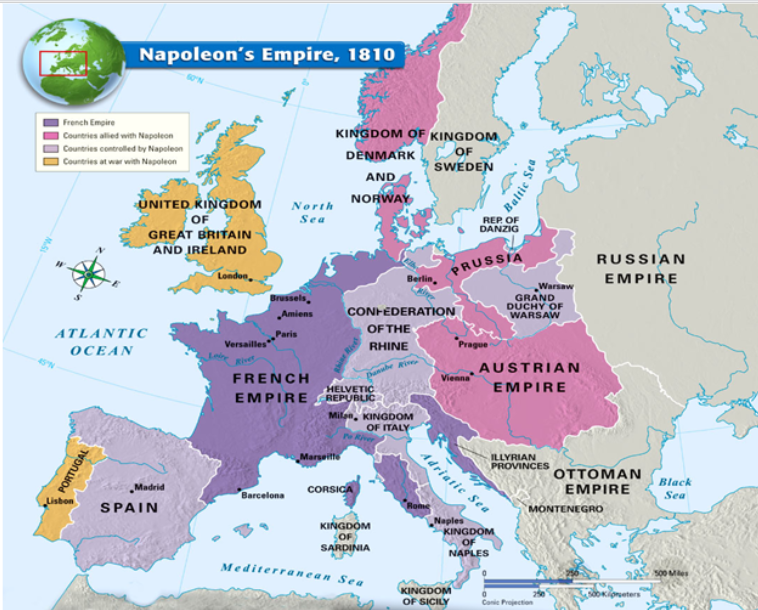
- October 1805: British wiped out Napoleon’s fleet but by December his army defeated the Austrians & Russians (his greatest victory) Impact: broke up the Holy Roman Empire & created the Confederation of the Rhine
- (1806) many German states allied with France with Napoleon as “Protector” (made up of 16 German minor states allied with France- 19 more later joined)
Purpose: create a buffer between France in the event of aggression from Austria, Prussia, or Russia * the 15+ million people living within the Confederation provided a physical barrier against enemies on France's eastern borders * Napoleon desired this after defeating Austria and Russia at the Battle of Austerlitz
- One important result of nationalism is the breakup of empires! (A must-know for the exam)
- People outside of France were making Nationalist ideas because they didn’t like Napoleon because he wanted to conquer them
SOCIAL CHANGES UNDER NAPOLEON
- <<reestablished a French aristocracy (eliminated in the French Revolution),<<
handing out titles of nobility to loyal friends and family
* reflected French Revolution principles
* creating one law code for France
* divided civil law into personal status, property, and acquisition of property
- French Revolution ended when Napoleon staged a coup d’etat which abolished the Directory (he appointed himself France’s “First consul”) in November 1799
- middle class or was instrumental in creating change in Europe
- Napoleon helped spread ideas of the French Revolution
- Napoleon's liberal reforms did not include universal male
<<WE WANT SUFFRAGE<<
]]CONGRESS OF VIENNA]]
After Napoleon’s defeat, what happens to the lands controlled by France? Does it remain under the control of France or should lands be “returned”?
- Because Napoleon’s done they wanted to change allys and feel back into their smaller states
- Napoleon’s invasion of Russia Empire failed and some members changed sides (after all
it was formed with Napoleon as Protector but he was no longer in power by this time)
@@SCORCHED EARTH POLICY@@
- when russians burnt their land
- when france came they couldn’t eat off of that land
- they couldn’t sleep comfortably
- Because they couldn’t eat they had to go back home
1/31
Haitian Revolution 1794-1804
- it was bound to happen because
- there were many social inequalities
- people were heavily exploited as they were the major producers of sugar and coffee in world market (2/5 of all sugar and 1/2 of coffee in the world came from here)
- inspired by the French Revolution (Saint Domingue was a French colony)
- very deadly and also unique (slaves became free, equal, and independent)
- the colony of Saint Domingue became known as Haiti (meaning “mountainous” or “rugged”)
- whites were killed or fled
- economy switched from exporting to producing for itself Results:
- \
- slavery became more important since exports from Haiti fell
- \
- demand for sugar exports grew in the Caribbean & North America (more money to be made)
- an important outcome of the revolution was "black" defining political citizenship
\*Haiti became the world’s 1st Black republic!
Jean-Jacques Dessalines = Haiti’s 1st head of state
Latin American Revolutions 1810-1826
- occurred for several reasons
- political and social inequality existed
- peninsulares (they have the control) ( born in Spain)
- creoles (elites feared lower classes & nonwhites- feared another Haiti)
- mestizos
- mulattoes
- Native Americans/Africans/Zambo (zambo/sambo=African & American Indian)
- -Enlightenment ideas
- Napoleon's actions (overthrows the Spanish Monarchy) video describing what Latin America is (for those who need it)
- successes of other revolutions
- as people saw themselves united against the Spanish, a nativism movement arose: . Had little support though
Simon Bolivar
Venezuelan political leader- instrumental in Latin American independence movement
- He was inspired by Napoleon but was not interested that Napoleon named himself Emperor so Simon named himself a liberator
- Was a Crole
- \
- He was educated by Enlightenment ideas from his tutors
- "the Liberator"- he liberated Bolivia, Colombia, Ecuador, Peru, & Venezuela from Spanish rule
- wrote "Letter From Jamaica" describing his vision of a South American republic (civil war erupted in Venezuela: he fled to Jamaica where he wrote the letter)
Jose de San Martin
- Argentinian statesman
- helped lead revolutions in Argentina and Chile that led to liberation from the Spanish
- led revolts in Peru- though Bolivar in the end liberated Peru (San Martin & Bolivar couldn't work together)
1/2
Abolition of slavery
- slavery began to be viewed as unnecessary for economic success since wealthiest regions didn't use slavery (England and New England used free labor)
- slave rebellions occurred due to Enlightenment ideas of equality
- British Parliament passed the Slave Trade Act (1807)- slave trade was made illegal (but slave trade continued)
- Brazil was the last country in the western world to abolish slavery (1888)
- People whom were breaking the law had smaller ships so that it wasn’t that obvious that they were holding slaves
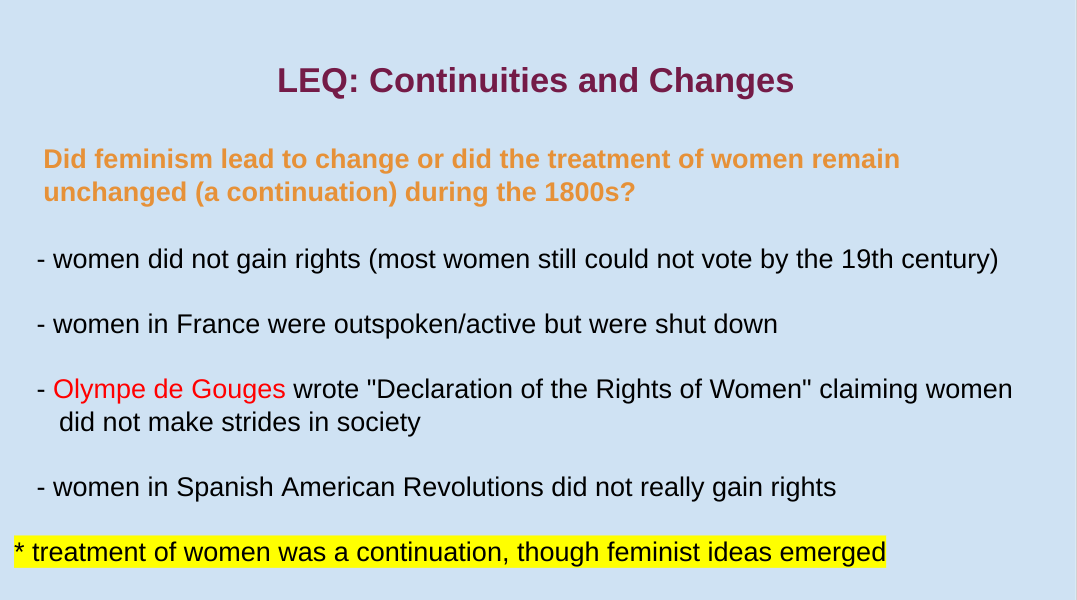
Feminism
- French women of all classes participated in the Revolution (felt deserving of rights similar to man)
- Enlightenment helped create feminist ideas that spread due to
- some men also believed that women deserved rights
- ]] considered American feminism birthplace]]
- They don’t get rights right away due to the Civil War
- Black American MEN get the right to vote before women
Nationalism
nationalism= identification with one's own nation and support for its interests
- when people display nationalism, they claim loyalty to a nation of people (loyalty is not to a king or empire)
- ^^a nation with its own independent government = a nation-state^^
- bonds that create a nation-state include a belief in a common ethnic ancestry, a national language, a shared culture, a shared religion practiced by most, and territory that is "their land"
Rise of New States
- Italy and Germany were new states by 1871
- both had been disunited since the fall of the Roman Empire (neither was a major colonial power in 16th or 17th centuries. Why? Lacked political unity)
^^*Nationalism brought people together but led to the breakup of empires (Holy Roman Empire fell and was replaced by Confederation of the Rhine)^^
- 19th century European nationalism led to fighting to control Asian & African colonies