1. Socio-economic integration
Slides
Hartmut Esser’s theory of integration (used to be linear)
Acculturation - knowledge, lang, skills, education
Interaction - social relations, network position, social capital
Identification - values and norms, subjective feeling of belonging
Placement - social rights, citizenship, economic position
- integration cannot be captured by a single indicator

Labor market integration - how do migrants find a job?
quality of job: security, payment, status
match bet. educational lvl obtained and educational lvl required for job
Educational mismatch: over-education = acquired lvl of education is higher than required lvl for occupation
=> lower income, lower well-being, lost human capital for receiving society
under-education → higher income among migrants than among natives (insufficient lang skills & lack of supportive parental resource)
Education =/= skills
Formal education vs informal (e.g. training on the job, self-learning etc.)
Over-education debate
a. Human capital variation - over-education is justified
educational mismatch =/= skills mismatch
b. Skills under-utilization - over-education not justified
Indiv. cannot tap their full potential bc of institutional, social and discriminatory barriers
Over-education: Recognition of credentials
in some “certificate-based” countries (e.g. Germany, Austria) employment is acquired by possessing occupation-specific vocational certificates
Individual-lvl explanations for migrants’ labor market position
Human capital (incl. lang)
Social capital
Discrimination
Human capital
- education: skills, credentials (degrees) + unobservable traits
- work experience, training
more valuable if acquired in CD (country-specific capital)
educational degree in CO vs CD → limited transferability of human capital = cost of international migration
Ethnic educational inequalities
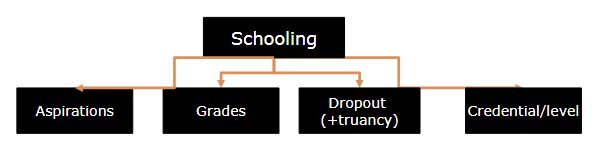
Effect of ethnic bg on education outcomes - micro lvl
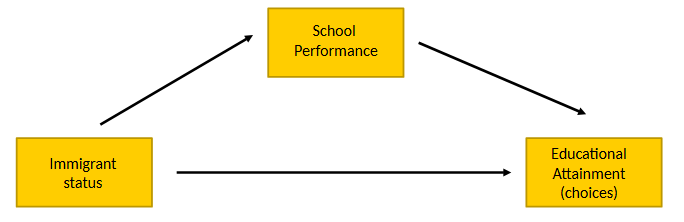
Primary effects - effect of ethnicity on school perfomance
Mechanism: SES, limited lang skills & cultural resources, poor networks
Secondary effects - effect of ethnicity on choices (e.g. track choice) for students w similar school performance
Mechanism: opportunity costs of studying, perceived value of education, limited info, anticipation of discrimination
Teriary effects? - differential treatment/ bias by teachers (in advice, grading etc)
Social capital
Resources embedded in social connections (Coleman):
instrumental support - concrete physical help with moving, housing etc
informational support - giving info about how things work in CD/ opportunities
emotional support
Strong ties (friends, family) VS weak ties (colleagues, neighbors, acquaintances)
Granovetter (1973): weak ties are more valuable bc they provide us with non-redundant info
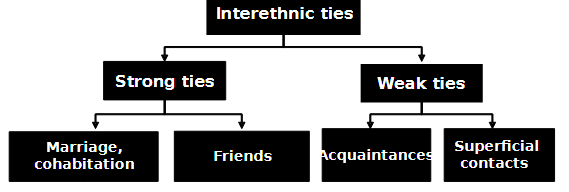
Bonding ties (w. co-ethnics, have solidarity and trust) VS bridging ties (w. natives, provide access to new resources and info)
bridging ties - more advantageous bc contact w natives gives more info, they are socialized w system and familiar w labor market culture + have better average education and higher positions
bonding ties - can ease entry into labor market withing first years of migration (same lang, familiarity w customs and norms, family relations + ethnic labor markets)
Labor market chara. affect migrant integration
- labor market flexibility - impacts employer’s decision-making
in inflexible market - migrants might be seen as a “risk” bc their productivity is more difficult to asses → migrant unemployment is higher in countries w strict market regulations
- demand for low-skilled labor - low-paid, unstable, often shunned by natives
facilitates job-search for migrants → migrant unemployment is lower in countries w big demand for low-skilled labor
Heath et al. (2008) - The Second Generation in Western Europe: Education, Unemployment, and Occupational Attainment
ethnic stratification happens
Topic of paper: socioeconomic integration of 2nd gen., focusing on inequalities in education and labor market
focus on children of pre-1973 labor migrants from Southern Europe gone to Western/Northern Europe
1st gen migrants can be at a disadv bc migration is disruptive
lack of fluency in majority lang
possession of foreign educational credentials
foreign work experience
2nd gen have more fluency, domestic qualitifications etc - do they do better?
20th century - guest worker migration
Education of 2nd gen
track placement (academic vs vocationa) in countries like Austria, Germany, NL is crucial for futural edu opportunities
in UK, Denmark, FR, Norway - comprehensive syst where selection is delayed
Some patterns:
minorities whose parents are from less-developed non-European origins tend to have much lower edu attainment/ qualifications than the majority group
however, distinguish between ethnic inequalities on attainment tests taken during the period of compulsory schooling (primary effects of minority status) and continuation rates after the end of compulsory schooling and on into higher education (secondary effects).
e.g. in Britain, minorities such as Caribbeans and Pakistanis have lower attainment in the examinations taken at age 16 than does the majority population but have higher continuation rates and higher participation rates in tertiary education
potential reasons: higher aspirations, expectations of discrimination in labor market
In terms of continuation in education, or highest educational qualification, second-generation women tend to fare better than their male counterparts in many of the countries
Western European countries provide rather uniformly unfavorable environments for the education of second-generation Western Asians
2nd gen in labor market
patterns follow those of education
ethnic penalties (?)
Minorities from less-developed nonEuropean origins tend to have substantially higher risks of unemployment than their respective majority groups
the ethnic penalties with respect to unemployment are broadly similar for women and men
occupational attainment - picture is not quite so negative: there are few significant ethnic penalties for those who actually are in work, whereas in Austria, Belgium, France, Germany, and the Netherlands, substantial ethnic penalties accrue in access to the salariat, in addition to those found for unemployment.
in Austria, Belgium, FR, DE, NL cumulative patterns of disadvantage: Second-generation Turks in Belgium or Germany, for example, are disadvantaged in their educational attainment; after controlling for educational level, they are additionally disadvantaged in obtaining jobs; and even those who obtain jobs are disadvantaged in access to higher-level professional and managerial positions.
Explanations of ethnic inequality
Socioeconomic bg
origin is determined by social class and education of parents - not accurate bc parents might have taken low lvl job in CD bc of not recognized credentials not bc they lack the education
Do patterns of social reproduction work the same for children of migrants as for majority pop: is there interaction effect bet social origins, minority status and educational attainment?
Can social bg explain the educational and labor market inequalitiies
social bg explains at least half of the educational gaps
unclear about labor market
socioeconomic background generally has a much larger effect on educational outcomes than it does on labor market outcomes net of education
additional mechanisms beyond socioeconomic background are needed to account for the remaining minority disadvantages either in educational or in labor market outcome
Language and knowledge
Language difficulties could in principle be implicated in explaining both educational and labor market disadvantage - is it the case for 2nd gen?
most 2nd gen born in CD are fluent in majority lang
still possible that lang difficulties have effect on education and labor market achievement (2nd gen still lag behind majority in reading f.e.)
Parents’ lack of fluency in the majority language might be an additional source of disadvantage in the educational sphere
Turkish parents are less knowledgeable about the German educational system and how to navigate it and has used this to explain why secondgeneration Turkish children are less likely to choose certain types of schools.
Lack of knowledge about opportunities in the labor market might be another possible mechanism explaining minority disadvantage.
Aspirations and family mobilization
parents of the second generation have higher aspirations for their children’s education and that migration can be regarded as being, for many individuals, part of a social mobility project for their family
high levels of parental aspirations can in part explain the net advantage (after controlling for social background and prior academic attainment) that the children of immigrants demonstrate in obtaining the Baccalaureat
Parents’ aspirations for their children may be based on their relative standing in their country of origin rather than on their standing in the country of destination. The relatively high aspirations of migrants therefore might reflect the fact that a given level of formal qualifications may have higher standing relative to the origin country’s educational distribution than the same nominal qualification has in the destination country
Although the second generation generally appears to have high aspirations, evidence nonetheless suggests that some secondgeneration groups might be risk averse in their educational choices in the sense of choosing more applied subjects, such as law, medicine, and business, in higher education than do majority students
2nd gen might choose more applied subjects because they expect discrimination in the labor market and hence opt for courses with more certain labor-market prospects
Social context or ethnic segregation
ppl of shared bg live close tgt
The usual idea is along the lines of human capital externalities, e.g., clustering in disadvantaged milieux leads to lower aspirations because of peer pressure or to lesser communal knowledge about the educational system
results from Norway: academic composition of the school, not the ethnic composition, has significant effects both on grades and on continuation rates
before we can safely conclude that social deprivation rather than ethnic concentration plays the major role, we need studies that disaggregate the second generation into different minorities
ethnic group size has a significant positive effect on the probability of employment for the second generation but no effect on earnings
We might well expect that lack of bridging social ties might explain some of the disadvantages in the labor market experienced by some minorities. Conversely, bonding social ties might be a source of advantage in certain occupational niches
Discrimination, racism and access to citizenship
interactions are found to be fraught with tensions, and official figures show that black students have much higher rates of school exclusion than their white peers
teacher racism +e.g. Denmark teachers tend to have lower expectations of children from immigrant backgrounds and that this can explain up to 20% of the ethnic test score gap for the second generation
There is also evidence of racism on the part of white students toward their minority peers.
Expectations of discrimination within the labor market could also be important in decisions about whether to drop out of school or to continue with further education
If returns are lower for the children of immigrants, then they will have less incentive to continue within the educational system. As we reported above, the returns probably are the same for the second generation as they are for the majority population, although that is not to say that minority children themselves are aware of this
Difficulties in gaining access to citizenship might be regarded as a form of institutional discrimination and might in principle impact employment opportunities, especially in the government sector
Other details
European countries vary considerably in their degree of “ethnic exclusionism”, their levels of racist attitudes, the degree to which they exhibit ethnic rather than civic conceptions of the nation, the strength or presence of antidiscrimination legislation, and the ease of gaining citizenship
economic conditions within a country are also likely to be relevant
Entry to the labor market is a particular problem for most minorities, with substantial ethnic penalties with respect to employment in all the Western European countries under consideration
Aside from social background, language fluency, differential aspirations, social capital, and contextual effects, prejudice and discrimination all figure in the European debates