Ch. 10 -- Speech Sound Disorders
Introduction
- %%Speech sound disorder%%: refers to problems in producing the sounds of a language
- %%Articulation disorders%%: refers to process of producing speech sounds (motor)
- %%Phonological impairment%%: challenges with the speech sound system of language (language)
- %%Childhood Apraxia of Speech (CAS)%%: refers to problems with motor planning
- Aka Developmental Apraxia
- Articulation: mild-moderate; child is typically understood most of the time
- Phonological system impairments/CAS: highly unintelligible speech; severe-profound
- 80% of kids with speech sound disorders need therapy
- Phonology includes the study of
- Syllables/word shapes/structures
- Phonemes and %%allophones%% (set of multiple possible spoken sounds used to pronounce a single phoneme. For example, /p/ (as in pin) and /p/ (as in spin which is less aspirated) are allophones for the phoneme /p/)
- Prosody/%%suprasegmentals%% (intonation and stress)
- The remediation process focuses on reorganizing the child’s phonological system by helping the child learn to produce and acquire phonological patterns
The Speech Mechanism
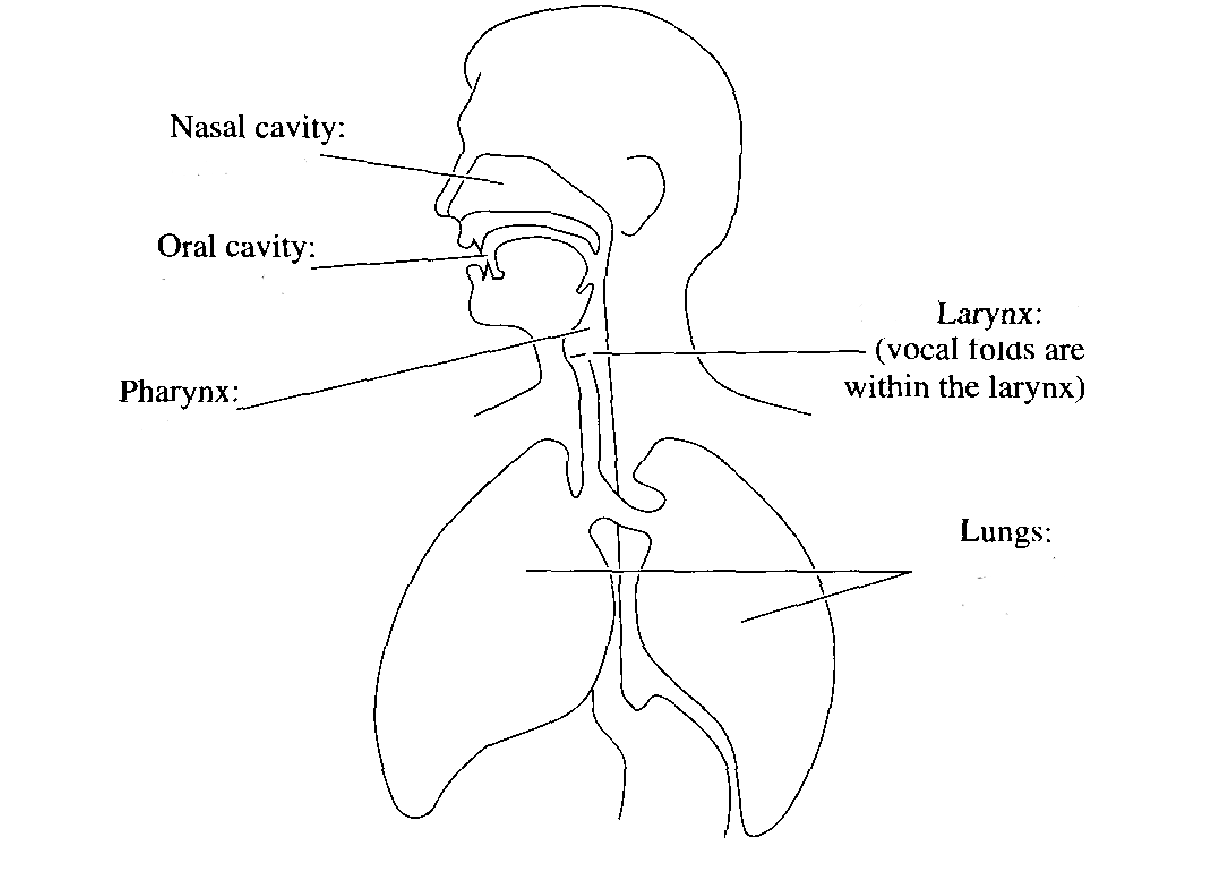
- 6 major subsystems are used in the production of speech
- Respiratory
- Diaphragm
- Trachea
- Larynx
- Velopharyngeal
- Oral/nasal cavity
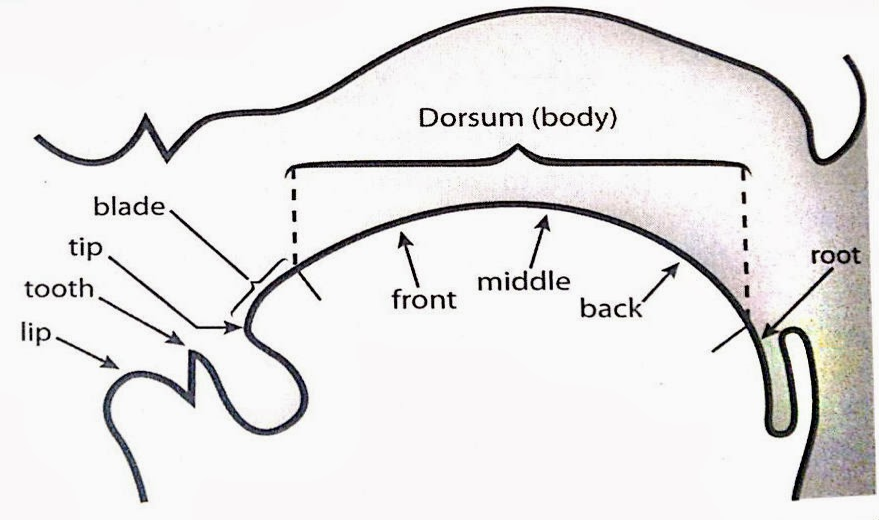
- Major articulator: tongue
- Tip (apex)
- Blade
- Back (dorsum)
- Root
- Body
Phonemes
- A phoneme is the smallest arbitrary unit of sound in a given language that can be recognized as being distinct from other sounds in that language
- English phonemes are divided into consonants, vowels, phonemes
- Position of the consonant in the word: initial, medial, final
- Consonant is described by its position in a word relative to the vowel the terms prevocalic, intervocalic, and postvocalic
- Nose (CVC) (n is %%prevocalic%% – before the vowel)
- Bunny (CVCV) (n is %%intervocalic%% – between the vowels)
- Can (CVC) (n is %%postvocalic%% – follows the vowel)
- Consonants are described by their place, manner, and voicing
- %%Manner%% refers to what happens to the air flow through the resonance and articulatory systems
- %%Obstruent%%: consonants that involve some type of constriction of the air flow – stops, fricative, and affricates
- %%Sonorant consonants%%: (nasals, glides, liquids) are made with a relatively open vocal tract
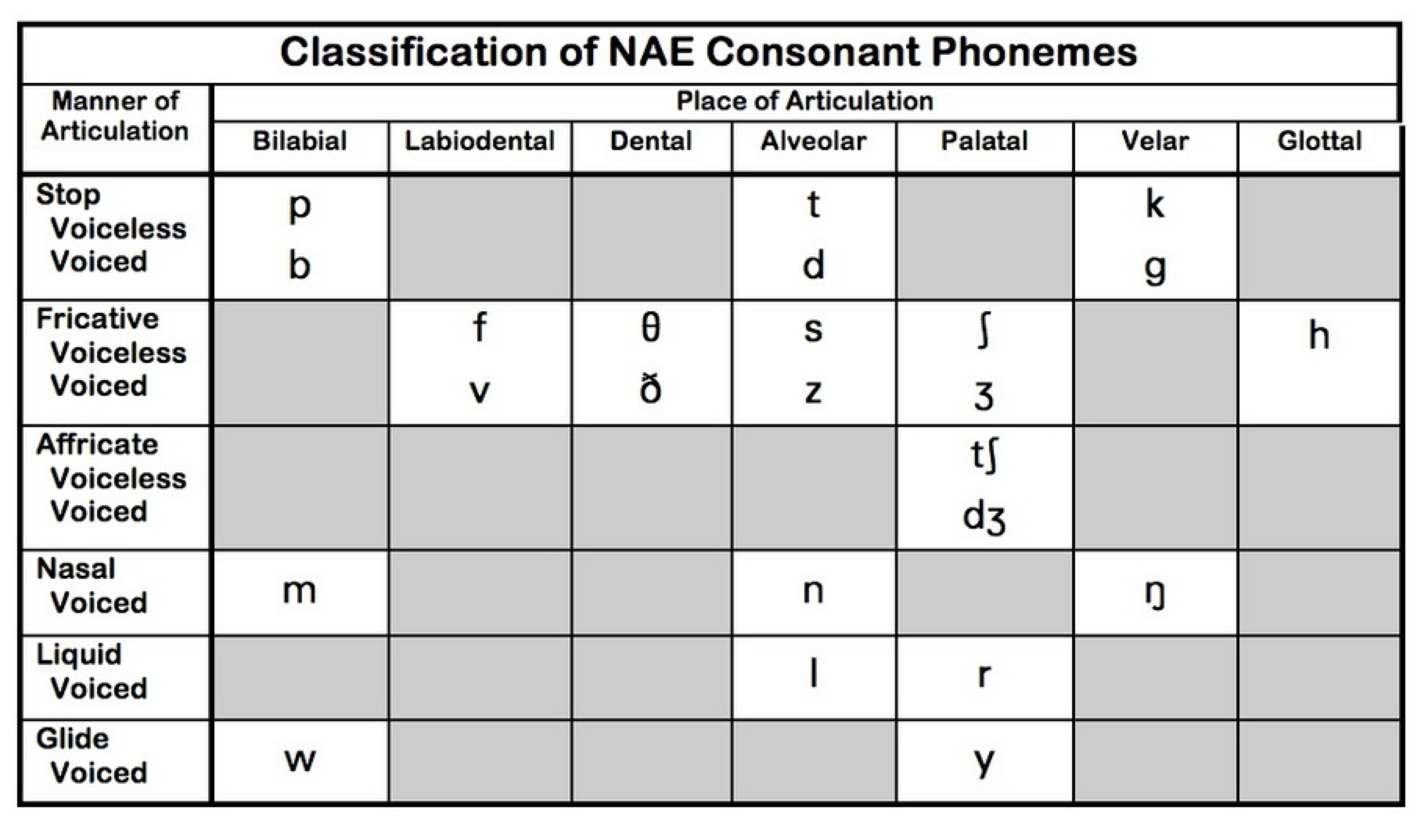
Manner of Articulation
- %%Stops%%
- /p, b, t, d, k, g/
- Complete closure of the vocal tract; pressure builds and then is released
- Also called plosives or stop-plosives
- %%Fricatives%%
- Noisy sounds caused by a turbulent air flow as the air stream goes through a narrow constriction
- Voiced: Th sound Them; V sound Vote; Zh sound Vision; Z sound Zoo
- Unvoiced: Th sound Thin; F sound Face; Sh sound She; S sound So; H sound He
- %%Affricates%%
- Includes a stop and a fricative release
- Voiced: J sound Joy
- Unvoiced: Ch sound Cheese
- %%Nasals%%
- /m, n, ng/
- Airflow goes through the nasal cavity
- %%Glides%%
- /w, j (like in “you”)/
- Semivowels
- Relatively open vocal tract during production
- They are usually produced with the tongue moving or “gliding” to and from a position associated with a neighboring vowel sound
- Voiced
- Beginning of wet, we, you and yes
- %%Liquids%%
- /l, r/
- Similar to glides, but have a bit more vocal tract obstruction than the glides or vowels
- Examples: rain, liquid
Place
- %%Bilabials%%
- /p, b, m, w/
- First placement of a w
- Produced by the 2 lips coming together and with some lip rounding
- %%Labiodentals%%
- /f, v/
- Lower edge of the upper incisors coming into contact with the upper edge of the lower lip creating a slight constriction in the air flow
- %%Interdentals%%
- /th/ voiced and voiceless
- Tongue tip protrudes slightly and touches the edges of the upper incisors, creating a slight constriction over the tongue tip
- %%Alveolars%%
- /t, d, s, z, l, n/
- Constriction created by the tongue tip coming into contact with the alveolar ridge
- the part of the hard palate right behind the teeth
- Most commonly produced in English (50%)
- /t/ most commonly occurring of all sounds
- %%Palatals%%
- /ʃ, ʒ, tʃ, dʒ, r, j/
- Some part of the tongue comes into contact with the hard palate
- %%Velars%%
- /k, g, ng/
- Elevating the back of the tongue to the soft palate
- %%Glottal%%
- /h/
- Air stream through a partial opening of the vocal folds
Voiced/Unvoiced
- Movement of the vocal folds
- %%Voiced%%: vocal folds are vibrating during a sound production
- %%Voiceless%%: vocal folds are not vibrating
- %%Cognates%%: sounds in English language that vary only in terms of voicing
Vowels
- %%Vowels%%:
- Voiced and are not nasalized
- Open vocal tract
- Sonorants
- Described by identifying where the tongue is in relation to the palate using the terms: high, mid, low
- Described whether the tongue is near the front, middle (central), or back of the mouth
- Lax (shorter in duration, produced with less muscle effort) or tense (long vowels, more effort)
- %%Diphthongs%%: 2 vowels are blended together, creating a change in the vocal track
- 2 vowels, 1 phoneme
- All syllables must have a vowel, diphthong, or a vocalic/syllabic consonant to form the nucleus (ba)
- %%Open syllable%%: when a syllable ends with a vowel (CV)
- %%Closed syllable%%: when the syllable ends with a consonant (VC, CVC)
%%Speech Sound System%%
- Nasals, stops, and glides are acquired earliest
- Followed by fricatives, affricates
- Lastly liquids
Acquisition
Prelinguistic Stages
- Includes the time before the child’s first word
- %%Reflexive vocalizations%%: cries, coughs, hiccups
- Non reflexive vocalizations: sounds that eventually will be shaped into the adult form of words
Stage 1 Phonation Stage
- Birth-1 month
- Reflexive vocalizations
- Crying, fussing
- Similar to syllabic nasals and vowels
Stage 2 Coo and Goo Stage
- 2-3 months
- Productions are acoustically similar to back vowels or to syllables consistent of back vowels and consonants
- Primitive, precursors to consonants
Stage 3 Exploration and Expansion Stage
- 4-6 months
- Vocal play
- Repetitions of vowels, squeals, “raspberries”
- Might produce CV syllables; marginal babbling
Stage 4 Canonical Babbling
- 7-9 months
- %%Reduplicated babbling%%
- Vocalizations become longer; CV syllables
- More closer approximate adult speech
- Mama
- Stops, nasals, glides, short (lax) vowels
Stage 5 Variegated Babbling
- 10-12 months
- A greater variety of CV sequences noted
- Adult-like intonation patterns
Later Stages
- First birthday transition from babbling to meaningful speech
- First Word Stage: around 12 months
- By 15 months the child has 15 words
- %%Protowords%%: well-defined meaningful sound patterns produced by young children that apparently are not modeled on any adult words
- Mi for blanket
- Link between babbling and adult like speech
- 50 words at 18 months
- 1000 words by 36 months
- Syllabic structures become more complex, with consonant clusters and multisyllabic productions beginning to appear
Phonological Deviations
- Speech sounds can be discussed in terms of phonological patterns which are accepted groupings of sounds within an oral language
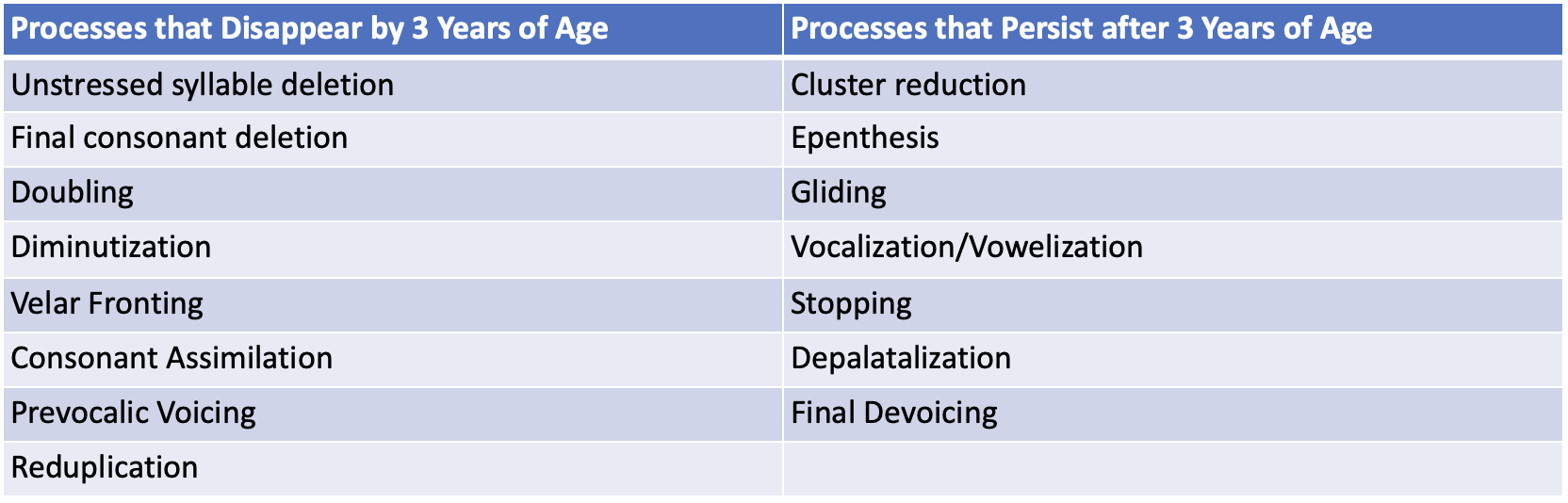
- Speech pattern errors have been referred to as %%phonological processes%%
%%Omissions%%
- Simplifications of the word to one syllable
- Rabbit – ra
- Weak syllable deletion
- Unstressed syllable is omitted
- Banana-nana
- Multi syllabicity
- Difficulty producing all the syllables and sounds in a multisyllabic word
- Ambulance-am:ance
- Singleton consonant omissions
- Bat-ba
- Happy – ha:i
- Pot - ot
- Final consonant omissions
- Common in children with phonological process disorders
- %%Consonant cluster%%: adjacent consonants in the same syllable
- Green:gr
- Consonant cluster reduction: one consonant is omitted in a syllable
- Spoon-poon
- Consonant cluster deletion: the omission of all consonants in the cluster
- Tree-ee
- Extremely uncommon for people to delete the initial consonant sound - even with disordered language
%%Substitutions%%
- Fronting: a sound made the back of the mouth is substituted by a sound produced in the front (only position switches)
- Cup-tup
- Backing: is the reverse of fronting; anterior sound is replaced by a back or posterior sound (only position switches)
- Tie-kie
- Stopping: refers to the use of a stop for a “nonstop” consonant (only manner switches)
- Sun-tun
- Gliding: /w, j/ is used for another consonant, typically a liquids
- Light – jight
- Vowelizations
- Substitution of a pure vowel for a vocalic liquid (liquid with a vowel in front of it)
- Paper- pepu
- Palatalization and depalatalization
- The palatal feature is added or omitted
- Sheep-seep (depalatalized)
- See-she (palatalized)
- Affrication and deaffrication
- Refers to the addition or loss of the combination of a stop and fricative
- Chair-tair/shair (deaffricatoin)
- She-che (affrication)
Major Assimilation
- %%Assimilation%% involves a sound in a word taking on a characteristic of another sound in the same word
- Soap – poap
Glottal Stop Replacement
- %%Glottal stops%% are used by some children to “mark” the final consonant in a word until the sounds are developed
- Also children with repaired cleft palates and velopalatal insufficiency
Syllable-Structure/Context-Related Changes
- %%Metathesis%% occurs when 2 sounds or syllables in a word change places
- Ask – aks
- %%Migration%%: only one sound moves
- Snake- naks
- %%Coalescence%%: 2 sounds in a word are replaced by a single sound which has the features of the 2 replaced sounds but is neither of the original sounds
- spoon – foon
- S: unvoiced, fricative, alveolar
- P: unvoiced, stop, bilabial
- F: unvoiced, fricative, labiodental (the middle of alveolar and bilabial)
- %%Reduplication%%: is the repetition of phonemes or syllable
- Bottle- baba
- %%Epenthesis%%: insertion of a/ sound
- /uh/ between 2 consonants in a cluster
- Black – bu:lack
- %%Diminutive%%: addition of /i/ at the end of the words
- Pig-piggy
Suppression of Phonological Processes
Phonological Awareness
- %%Phonological Awareness%%: refers to the child’s knowledge that words are made up of smaller, discernable units
- Development of this skill indicates that the person has an awareness of the sound structure or phonological structure of spoken words independent of their meaning
- Strong link between phonological awareness and literacy
- Sound structure enables a child to sound out or decode a word in print
- Metalinguistic knowledge: refers to the child’s ability to reflect on and discuss aspects of language separate from its meaning
- %%Syllable awareness%%: requires knowledge that a word can be divided into large parts
- %%Phoneme awareness%%: child is able to break a word down into its smallest parts
- Factors that influence phonological awareness
- Large vocabulary
- Socioeconomic status
- Print knowledge of the alphabet
- Half of poor readers have an early history of spoken-language disorders
Evaluation of Children with Speech Sound Disorders
- Major Etiological Factors
- Hearing: adequate hearing is needed so that children are aware of the speech and langue being used in their home and surroundings
- Oral Mechanism: need adequate structures used for speech production such as the lips, teeth, tongue, and palate
- Personal Factors: males higher incidence than females, before the age 8, lower the IQ (under 70) the higher the prevalence and frequency of speech sound errors
Assessment: Ethnic Cultural Considerations
- Need to know:
- Which language is used and what the phonological characteristics of the other language are
- How the first language affects the learning of the second language
- How to determine if there is a speech sound disorder in the primary language, the second language, or both
- Assessment includes:
- Sample the speech of adults in the child’s linguistic community
- Obtain information from interpreters/support personnel
- Become familiar with dialectal and language features of the child’s linguistic community
Formal Evaluation
- Formal evaluation
- Case history
- Oral peripheral exam
- Standardized test
- Evaluation of stimulability in differing contexts
- Hearing screening
Tests
- Most tests will assess the child’s production of the various sounds in single word production
- Norm referenced tests allow for comparisons with scores of children who are the same age
- Omissions, additions, substitutions and distortions are noted on the final form
- Arizona Articulatory Proficiency Scale
- Goldman-Fristoe Test of Articulation
- Photo Articulation Test
- Other assessment instruments focus more on phonological processes
- Hodson Assessment of Phonological Patterns
- Khan-Lewis Phonological Analysis - connected to Goldman-Fristoe (take words from GF and analyze it through KL)
- Continuous Conversational speech sample
- See how single word production compares with conversation (single words are typically more intelligible than words used in conversation)
- %%Stimulability%%: the degree to which a misarticulated sound can be produced correctly by imitation (model, instructions where to put the tongue, amplification)
Norms
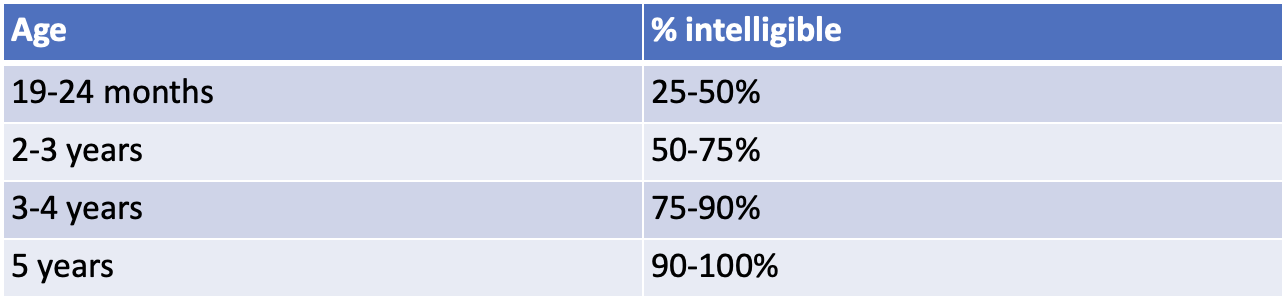
Reporting
- After the assessments, the SLP writes an evaluation report
- Explained orally to the child’s parents
- Summarize pertinent case history information, hearing screening results, oral mechanism examination findings, test results and recommendations
Treatment
Articulation Treatment
- Phonemic-Oriented Approaches
- Some approaches emphasize articulatory placement and motor components
- Traditional approach (Charles van Riper)
- Placement techniques combined with sensory-perceptual training
- Stages of the traditional approach
- Auditory training
- Elicitation of the sound (sound, word, phrase, sentence, conversation)
- Stabilization of the sound
- Carry-over
- Maintenance
Linguistic Based Approaches
- Recognize phonology as a component of the child’ language system
- Intelligibility is increased by helping reorganize the child’s phonological system
- The processing of phonological information is enhanced
- An awareness of patterns is developed
- Cycles of phonological remediation approach:
- A cycle refers to the period of time required for the child to successfully focus on deficient patterns
- Each phoneme or consonant cluster is targeted for approximately 60 minutes; most patterns need to be recycled one or more times
- Cycle principles
- That phonological acquisition is a gradual process
- That children with normal hearing typically acquire the adult sound system primarily by listening
- That as children gain new speech patterns, they associate kinesthetic (movement) with auditory sensations
- That phonetic environment can facilitate correct sound production
- Children need to be actively involved in their phonological acquisition
- Children tend to generalize new speech production skills to other targets (don’t need to train every error sound)
- Need for an optimal match to facilitate the child’s learning
- Early developing patterns are targeted first
- Each session begins with a period of auditory stimulation using slight amplification
- SLP reads a list of words
- 5 picture cards are produced with the child’s target
- Experiential-play and production-practice activities follow the listening activities
- Check stimulability for the next session's target patterns/phonemes
- Session ends with a repeat of the listening activity
- Home program is an auditory bombardment and production practice session