Incident Management
ICS purpose is to ensure responder and public safety, achieve incident management goals, ensure the efficient use of resources.
Roles and Responsibilities:
Command, finance, logistics, operations, planning, command staff
Incident Command System:
Command:
Incident commander is in charge of overall incident. IC may turn over command to someone with more experience in a critical area.
Finance:
Responsible for documenting all expenditures at an incident for reimbursement
Logistics:
Responsible for communications equipment, facilities, food and water, fuel, lighting, and medical equipment/supplies
Operations:
At a very large or complex incident, responsible for managing the tactical operations handled by the IC. Supervises people working at scene.
Planning:
Solves problems as they arise
Develops an incident action plan
Command Staff:
The safety officer monitors the scene for conditions or operations that may present a hazard
PIO (Public information officer) provides media with clear and understandable information
The liaison officer relays info and concerns along command, the general staff, and other agencies.
Mobilization and Deployment:
Check in with IC when you arrive
Report to supervisor for initial briefing
Record keeping allows for tracking of time spent on the actual incident for reimbursement purposes
Accountability means keeping your supervisor advised of your location, actions, and completed tasks
Once incident is stabilized, IC will determine which resources are needed and when to begin demobilization
Medical Branch of Incident Command:
Medical incident command is also known as the medical branch of ICS, with primary roles of triage, treatment, and transport of injured people
Triage Supervisor:
In charge of counting and prioritizing patients. Ensures that every patient receives initial assessment of his or her condition
Do not begin treatment until all patients are triaged
Treatment Supervisor
Locates and sets up the treatment area with a tier of priority of patient
Ensures that secondary triage is performed and adequate patient care is given
Assists with moving patients to the transportation area
Transportation Supervisor
Coordinates the transportation and distribution of patients to appropriate receiving hospitals
Documents and tracks number of transport vehicles, patients transported, and facility destination
Staging Supervisor
Should be assigned when scenes require a multivehicle or multiagency response
Emergency vehicles must have permission to enter the scene and only drive in the directed area
The staging area should be established away from the scene
Physicians on scene:
Make difficult triage decision
Provide secondary triage decisions in treatment area
Provide on scene EMT direction
Provide care in the treatment sector as appropriate
Rehabilitation Supervisor:
Establishes area that provides protection from elements and situation
Rehabilitation is where responder’s need for rest, fluids, food, and protection from the elements are met
Monitors responders for signs of stress
Morgue Supervisor:
works with area medical examiners, coroners, disaster mortuary assistance teams, and law enforcement agencies to coordinate removal of bodies and body parts.
The morgue area should be out of view of the living patients and other responders
Triage:
Primary triage is done on field, secondary is done as patients are brought to treatment area.

Disaster Management:
A widespread event that disrupts the functions and resources of the community, threatening lives and properties
Respond when requested and report
Introduction to Hazardous Materials:
According to the HAZWOPER, first responders at the awareness level should have the following competencies:
An understanding of what hazardous substances are and risks associated with them; An understanding of the potential outcomes of an incident
Ability to recognize the presence of hazardous substances
Ability to identify the hazardous substances if possible
Understanding of the role of the first responder awareness individual
Ability to determine the need for additional resources to notify the communication center
References:
Chemical Transportation Emergency Center (CHEMTREC) is operated by American Chemistry Council; serves as invaluable technical information resource for first responders of all disciplines who are called upon to respond to chemical incidents
Classification of Hazardous Materials:
NFPA 704, Hazardous Materials Classification standard classified hazardous materials according to:
Health hazard or toxicity levels
Fire Hazard
Chemical reactive hazard
Special hazards
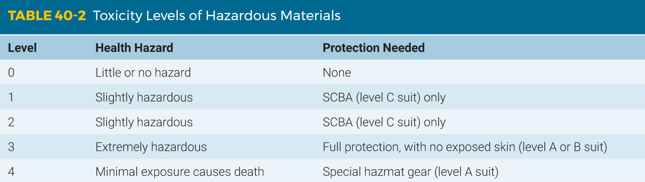
PPE Level:
Level A - Most hazardous, requires fully encapsulated, chemical resistant protective clothing that provides full body protection, SCBA and special, sealed equipment
Level B - Requires nonencapsulated protective clothing or clothing that is designed to protect against a particular hazard. Also requires breathing devices with their own air supply like SCBA and eye protection
Level C - Requires nonpermeable clothing and eye protection, and face masks that filter all inhaled outside air
Level D - Requires work uniform, such as coveralls, that affords minimal protection
All levels require use of gloves