Chapter 9: Motor Speech Disorders
Motor Speech Disorders
- Motor Speech Disorders - Damage to parts of the nervous system responsible for planning programming
- Results from the impairment of muscles to produce speech because they are weak, paralyzed, or uncoordinated
- Apraxia/Dysarthria
Dysarthria/Apraxia: The Football Analogy
- Dysarthria - football players are injured
- Apraxia - the coach is making the wrong play
- Dysarthria - the tongue, lips, cheeks are not working right
- Apraxia - the brain is sending out the wrong message (motor planning problem)
Childhood Apraxia of Speech
- Childhood Apraxia of Speech (CAS) – aka Developmental Apraxia (total loss of speech), Developmental Dyspraxia (not great speech)
- Experts do no agree on its characteristics or cause
- Delayed or mal developed areas of the brain that program movement sequences
- Infrequent
- Characteristics of CAS:
- Simple syllable shapes
- Vowel errors
- Speech sound production is inconsistent
- Intonation/word stress are altered
- Use gestures to supplement speech
- Extensive therapy needed
- drill based work on speech movements
- phonological process remediation
- tactile/gestural approaches (PROMPT approach)
- Nothing has been proven to be uniquely effective
- Examples of different levels of severity in Childhood Apraxia of Speech
Apraxia Facts
- difficulty stringing syllables together in the appropriate order to make words
- minimal babbling during infacy
- difficulty saying long or complex words
- repeated attempts at pronunciation of wrods
- speech inconsistencies
- incorrect inflections or stresses on certain sounds or words
- excessive use nonverbal forms of communication
- distorting vowel sounds
- omitting consonants at the beginnings and ends of words
- seeming to grope or stuggle to make words
- limited vocabulary
- grammatical problems
- problems with coordination and fine motor skills
- difficulties chewing and swallowing
- clumsiness
Acquired Apraxia of Speech
- Acquired apraxia of speech (AOS) is a disorder in the planning and programming of speech movements
- Left frontal lobe brain damage
- AOS does not usually occur independently from Broca’s aphasia
- Characteristics:
- Prosodic abnormalities - slow rate, prolonged consonants and vowels, pauses between words, even stress on syllables
- Impaired speech fluency - (self-corrections, searching for articulatory positions)
- Speech sound errors
- Treatment
- Focuses on improving the ability to program movements of increasingly more demanding syllables, words, and phrases
Dysarthria in Children
- Most commonly associated with Cerebral Palsy (CP)
- Injury to the nervous system that occurs before, at the time of, or shortly after birth
- 1/500 births
- Prenatal - disease or metabolic problems of the mom
- Perinatal - umbilical cord is wound around the neck, premature separation of the placenta, birth process is delayed, trauma
- Postnatal - trauma
Cerebral Palsy
- Cerebral Palsy - Deficits
- Visual
- Auditory
- Intellectual
- Motor Functions
- Speech/Language
- Swallowing
- Motor dysfunction - weak, paralyzed, uncoordinated
Cerebral Palsy: Characteristics
- Communication impairments are common
- 38% of children with CP have articulation disorders/impaired speech
- Motor impairments restrict child’s access to language-learning experiences and opportunities
Speech and Language Development in Children with CP
Speech Development is delayed and impaired
- Respiration
- Reduced vital capacity (the maximum amount of air a person can expel from the lungs after a maximum inhalation)
- Impaired ability to generate/maintain pressure below the VF
- Phonation
- Compromised by impaired tone resulting in breathiness, strangled harshness
- Timing of respiration and laryngeal activity is also disrupted
- Resonance
- Hypernasality and nasal emission
- Articulation
- Hyperextension of the jaw
May use only 1-2 word phrases
Poor speech intelligibility
May rely on AAC device (point to pictures or words)
Cerebral Palsy: Characteristics
- 30%-50% of kids with CP have intellectual disability
- Hearing impairment
- Visual perceptual problems
- Feeding problems
- Growth difficulties
- Emotional/behavioral disorders (i.e. ADHD and learning disabilities)
- Learned helplessness
Classification of CP
- Orthopedic Classification:
based on limbs affected
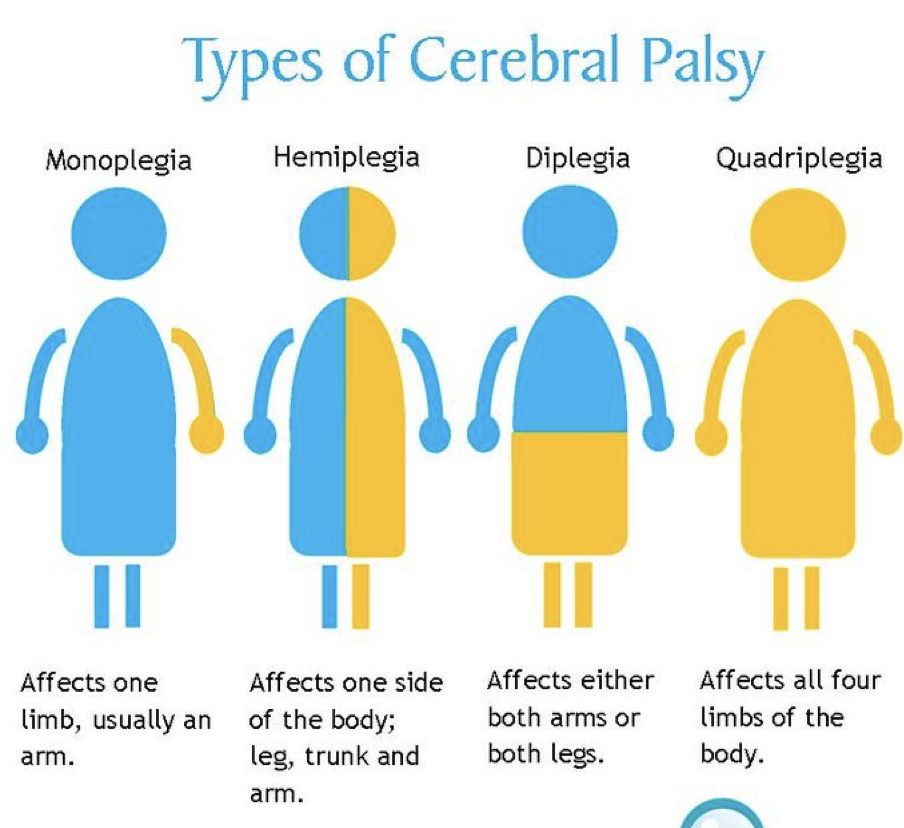
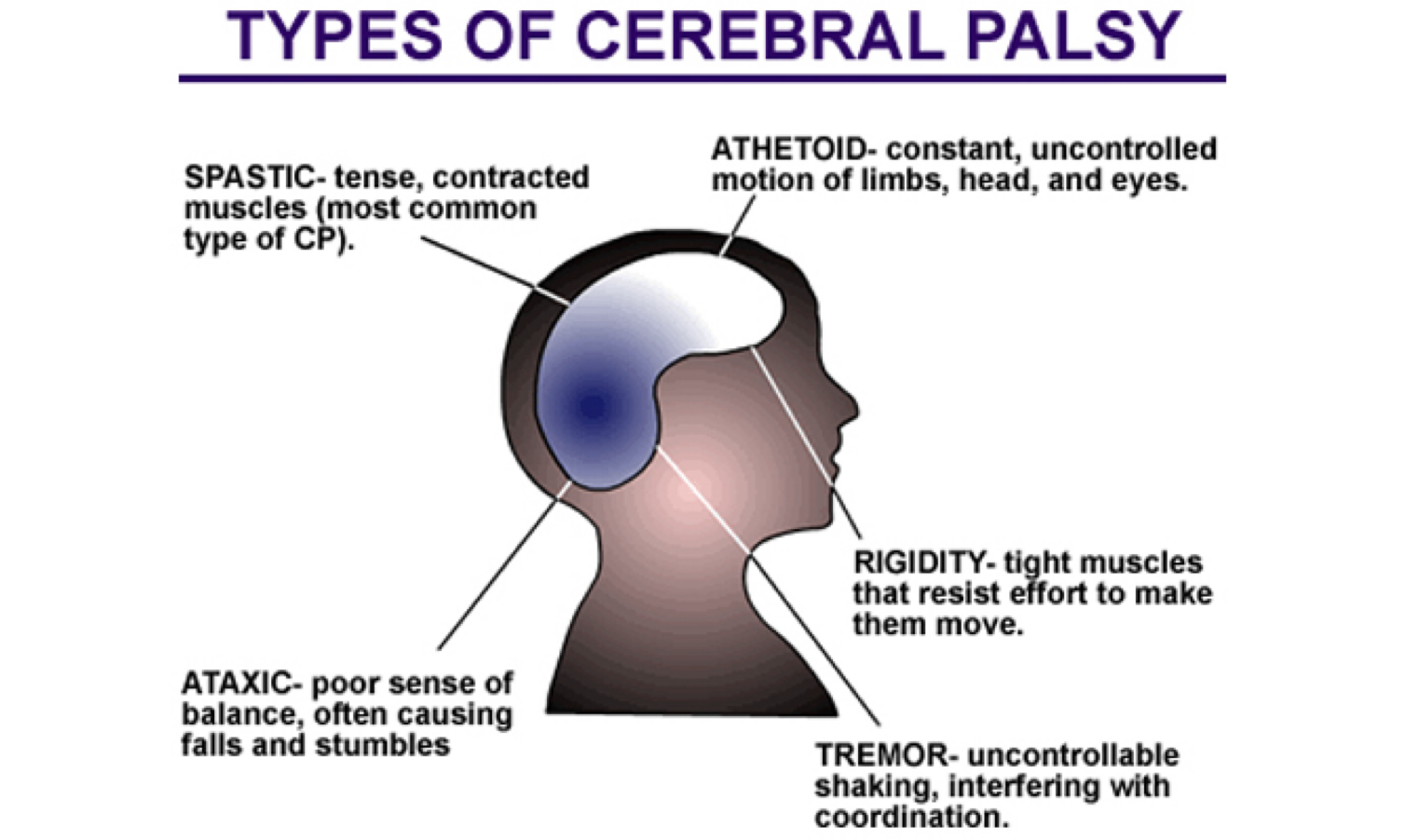
Types of CP: Neuromuscular
Severity: ranges from mild to severe
Judged based on a degree of independence in communication, ambulation, and self-help skills
Spastic CP
- Increased muscle tone (hypertonicity)
- Tense and contracted muscles
- Stiff and jerky movements
- Increased infantile reflexes
- Abnormal resistance to muscle lengthening (muscle shortening)
- Muscle atrophy (weakness)
- Most common form; 70-80%
Athetoid CP
- Fluctuating Tone (hypertonicity to hypotonicity)
- Involves abnormal involuntary movements
- Involuntary movements disappear and tone appears to be normal during sleep and increase with stress
- Writhing and twisting motion
- Interferes with speaking, feeding, reaching, grabbing, etc.
- Basal ganglia and associated components of the extrapyramidal tract
- 20% of the CP cases
Ataxia CP
- Damage to the cerebellum
- Poor balance and lack of coordination
- Wide based gait
- Depth perception usually affected
- Tendency to fall and stumble
- Unable to walk in a straight line
- Movements are characterized by errors in speed, direction, and accuracy
- Lease common 5-10% of cases
Acquired Dysarthria
- Adult - developed speech and language prior to the onset of the disorder
Flaccid Dysarthria
- Interruption of normal input to the muscles from the peripheral nervous system
- Muscle weakness
- Atrophy (wasting)
- Hypotonicity
- Example: Myasthenia gravis
- Speech
- Rate is slow
- Breathy phonation
- Hypernasality
- Articulatory imprecision
- Reduced phrase length
- Little variation in loudness or pitch
- Myasthenia gravis my symptoms
Spastic Dysarthria
- Excessive muscle tone, weakness
- All speech musculature is affected in spastic dysarthria
- Articulatory imprecision, slow rate, short phrases, harsh voice quality, reduced loudness, decreased pitch variation
- Pseudobulbar palsy
Ataxic Dysarthria
- Impairment in coordination
- Movements are inaccurate and dysrhythmic
- Minimal weakness
- Damage to the cerebellum
- Monotonous, impaired stress patterns, rate is slow, vowels elongated
- Intelligibility: mild
Hyperkinetic Dysarthria
- Huntington’s chorea
- It is caused by a gene defect inherited from parents. Symptoms generally appear in midlife. Huntington's disease affects movement, cognitive functions, and emotions.
- Huntington's disease is not curable, but treatments include medications, therapies, and lifestyle changes to help the patient cope with the condition.
- Dystonia
- Unintentional sustained muscle contractions leading to abnormal postures.
- Involuntary movements are superimposed on voluntary movements
- Hypokinetic Dysarthria
- Muscles are rigid, resulting in reduced movement
- Experience resting tremors
- Difficulty starting or stopping movements
- Parkinson’s Disease
- Speech rate is fast (short rushes of speech)
- Melody is flat with monoloudness, monopitch, and reduced intensity
Mixed Dysarthria
- MS – Multiple Sclerosis
- ALS - Amyotrophic Lateral Sclerosis
- Disease processes that affect more than one part of the motor system
Assessment
- Evaluate each subsystem of the speech production process to determine the type and extent of the dysarthria
- Respiration
- Phonation
- VP function
- Articulation
OME
- Determine the anatomic and functional integrity of speech production structures by completing an OME
- Careful examination of the tongue, lips, jaw during speech and nonspeech tasks
Speech Examination
- Diadochokinetic Rates
- Speech Samples
- Speech Assessments:
- AIDS
- Frenchay Dysarthria Assessment
- Determine overall speech intelligibility
Treatment
- Drugs and surgery
- Focus is to improve speech intelligibility
- Kids with CP: respiration
- Adults:
- Dysarthria Compensatory Strategies
- decrease speech rate
- increase volume
- exaggerate articulatory movements
Augmentative and Alternative Communication (AAC)
- May need to supplement speech output with gestures, communication boards
- Augmentative Communication refers to supplementing or augmenting speech using various techniques and aids
- Gestures, electronic devices, low-tech devices such as a communication book
- Sara Pyszka Dyna Vox AAC Cerebral Palsy Success Story
- AAC is slower
- Assess intellectual, sensory, motor and literacy skills prior to deciding on an AAC device for a client
Hands On AAC Device
- Go Talk
- iTalk 4
- TouchChat by Saltillo