ART 101: Unit 4 Exam – Chapters 19, 20 & 21
Unit 4 Exam Overview
Content: The exam covers Chapters 19, 20, and 21.
Question Types:
Matching
True/False
Multiple Choice
Image Identification
Short Answer
Key Terms, Concepts, and Works of Art
Neoclassicism
Key Artwork:
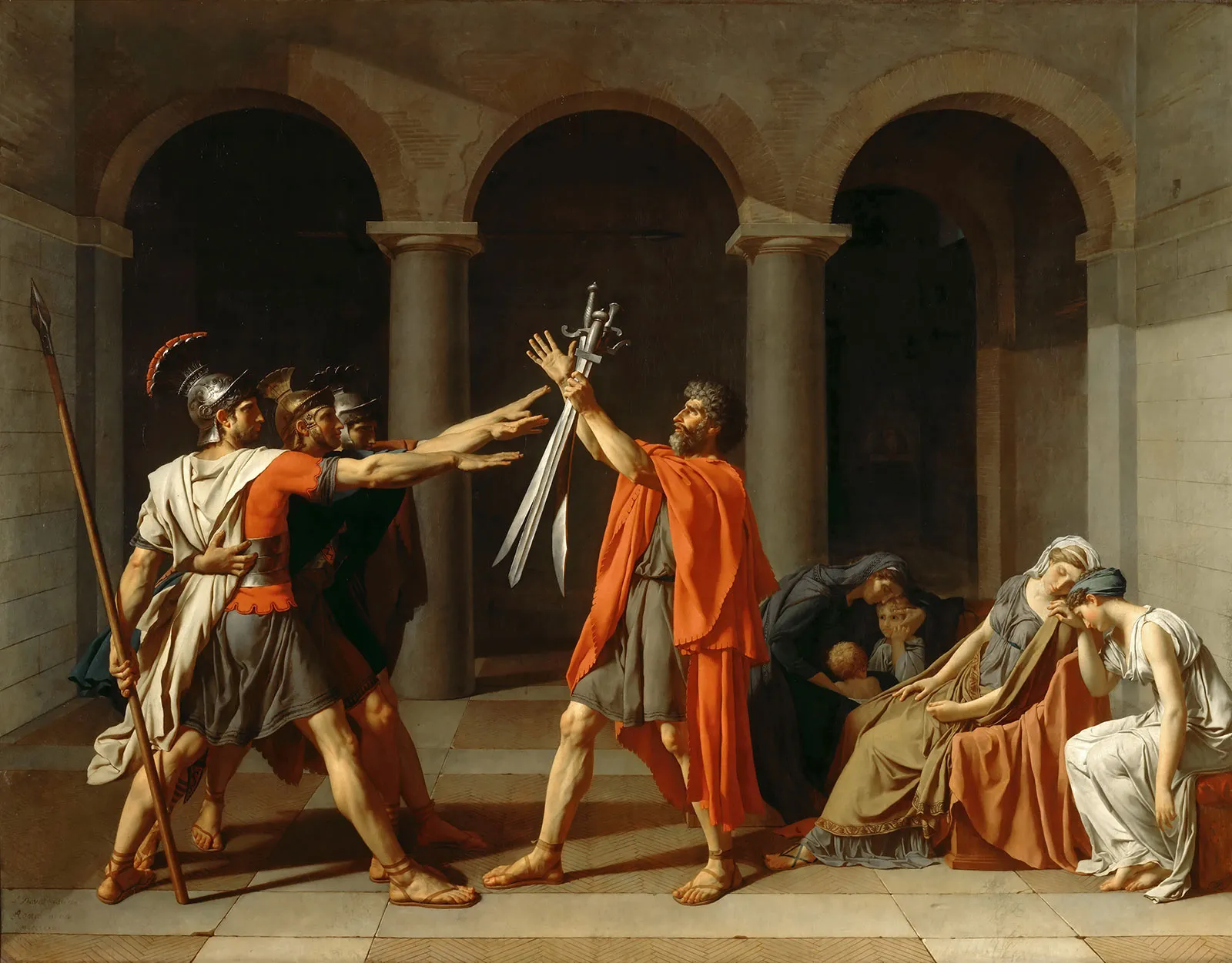
Jacques-Louis David, The Oath of Horatii
Characteristics of Neoclassicism include clarity, order, and adherence to classical themes and forms.
Textbook: David portrayed a dramatic event from Roman history to heighten French patriotism and courage. Three brothers prepare to fight an enemy of Rome, swearing an oath to the empire on swords upheld by their father. To the right, their mother and other relatives collapse in despair. They weep for the men’s safety but are also distraught because one of the enemy men is engaged to a sister of the Horatii. Family is pitted against family in a conflict that no one can win. Such a subject could descend into pathos, but David controlled any tendency toward sentimentality by reviving the Classical balance of emotion and restraint. The emotionality of the theme is countered by David’s cool rendition of forms. The elements of the composition further work to harness emotionalism. Harsh sculptural lines define the figure
\s and setting. The palette is reduced to muted blues and grays, with an occasional splash of deep red. Emotional response is barely evident in the idealized Classical faces of the figures.Several Classical devices in David’s compositional format also function to balance emotion and restraint. The figural groups form a rough triangle. Their apex—the clasped swords of the Horatii—is the most important point of the composition. In the same way that Leonardo used three windows in his Last Supper, David silhouetted his dramatic moment against the central opening of three arches in the background. David further imitated Renaissance canvases by presenting cues for a linear perspective in the patterning of the floor. But unlike sixteenth-century artists, David led his orthogonals into a flattened space instead of a vanishing point on a horizon line. The closing off of this background space forces the viewer’s eye to the front of the picture plane, where it encounters the action of the composition and the canvas surface. No longer does the artist desire to trick observers into believing they are looking through a window frame into the distance. Now the reality of the two-dimensionality of the canvas is asserted.David was one of the leaders of the French Revolution, and his political life underwent curious turns. Although he painted The Oath of the Horatii for Louis XVI, he supported the faction that deposed him. Later he was to find himself painting a work commemorating the coronation of Napoleon. Having struggled against the French monarchy and then living to see it restored, David chose to spend his last years in exile in Brussels.
Neoclassicism
Modern art declared its opposition to the whimsy of the late Rococo style with Neoclassical art. The Neoclassical style is characterized by harsh sculptural lines, a subdued palette, and for the most part, planar instead of linear recession into space. The subject matter of Neoclassicism was inspired by the French Revolution and designed to heighten moral standards. The new morality sought to replace the corruption and decadence of Louis XVI’s France. The Roman Empire was often chosen as the model to emulate. For this reason, the artists of the Napoleonic era imitated the form and content of Classical works of art. This interest in antiquity was fueled by contemporaneous archeological finds at sites such as Pompeii, as well as by numerous excavations in Greece.
Realism
Key Artworks:
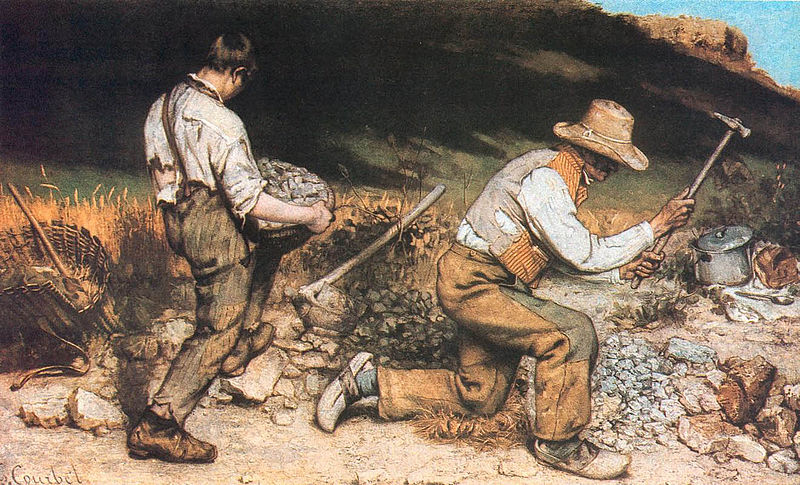
Gustave Courbet, The Stonebreakers
Depicts the harsh reality of labor.
Textbook: Courbet was moved to paint the work after seeing an old man and a young boy breaking stones on a roadside. So common a subject was naturally criticized by contemporary critics, who favored mythological or idealistic subjects. It was not only the artist’s subject matter, however, that the critics found offensive. They also spurned his painting technique. Although his choice of colors was fairly traditional—muted tones of brown and ocher—their quick application with a palette knife resulted in a coarsely textured surface that could not have been further removed from the glossy finish of an Academic painting. Curiously, although Courbet believed that this type of painting was more realistic than that of the salons, in fact the reverse is closer to the truth. The Academic painter strove for what we would today consider to be an almost photographically exact representation of the figure, whereas Courbet attempted quickly to jot down his impressions of the scene in an often spontaneous flurry of strokes. Despite Courbet’s advocacy of hard-core realism, the observer of The Stone-Breakers is presented ultimately with the artist’s subjective view of the world.
Manet, Olympia
Challenges conventions through direct and confrontational representation.
Textbook: One of the first artists to use Titian’s Venus as a point of departure for his own masterpiece was Édouard Manet. In his Olympia ( Fig. 19.14 ), Manet intentionally mimicked the Renaissance composition as a way of challenging the notion that modern art lacked credibility when brought face-to-face with the “old masters.” In effect, Manet seemed to be saying, “You want a Venus? I’ll give you a Venus.”And just where do you find a Venus in nineteenth-century Paris? In the bordellos of the Parisian demimonde. What do these paintings have in common? Where do they depart? What details does Titian use to create an air of innocence and vulnerability? What details does Manet use to do just the opposite?
Salon de Refuses: An exhibition that showcased works rejected by the official Salon, where Manet’s Olympia was displayed.
Manet submitted the work to the 1863 Salon, and it was categorically rejected. He and other artists whose works were rejected that year rebelled so vehemently that Napoleon III allowed them to exhibit their work in what was known as the Salon des Réfusés, or Salon of the Rejected Painters. It was one of the most important gatherings of avant-garde painters in the century.
Rosa Bonheur, The Horse Fair
Celebrates the beauty and power of horses.
Textbook: The Horse Fair is a panoramic scene of extraordinary power, inspired by the Parthenon’s horsemen frieze. The dimensions—more than twice as long as it is high—compel the viewer to perceive the work as just a small portion of a vast scene in which continuation of action beyond the left and right borders of the canvas is implied. The dramatic contrasts of light and dark underscore the struggle between man and beast, while the painterly brushwork heightens the emotional energy in the painting. The Horse Fair was an extremely popular work, which was bought widely in engraved reproductions, cementing Bonheur’s fame and popularity.
Thomas Eakins, The Gross Clinic
Illustrates medical realism with a focus on bodily detail and human emotion.
Textbook: The Gross Clinic—no pun intended—depicts the surgeon Dr. Samuel Gross operating on a young boy at the Jefferson Medical College in Philadelphia. Eakins thrusts the brutal imagery to the foreground of the painting, spotlighting the surgical procedure and Dr. Gross’s bloody scalpel, while casting the observing medical students in the background into darkness. The painting was deemed so shockingly realistic that it was rejected by the jury for an exhibition. Part of the impact of the work lies in the contrast between the matter-of-fact discourse of the surgeon and the torment of the boy’s mother. She sits in the lower left corner of the painting, shielding her eyes with whitened knuckles. In brush technique, Eakins is close to the fluidity of Courbet, although his compositional arrangement and dramatic lighting are surely indebted to Rembrandt.

Academic Art
Characterized by rigid adherence to traditional artistic standards and often associated with prestigious academic institutions in Europe.
Textbook:
The Academy
Ingres’s paintings spoke of a calm, though exotic, Classicism. Delacroix retrieved the dynamism of the Baroque. Goya swathed his canvases with the spirit of revolution. Ironically, the style of painting that had the least impact on the development of modern art was the most popular type of painting in its day. This wasAcademic art, so called because its style and subject matter were derived from conventions established by the Academie Royale de Peinture et de Sculpture in Paris.Established in 1648, the Academy had maintained a firm grip on artistic production for more than two centuries. Many artists steeped in this tradition were followers rather than innovators, and the quality of their production left something to be desired. Some, however, like David and Ingres, worked within the confines of a style acceptable to the Academy but rose above the generally rampant mediocrity.
Impressionism
Textbook:
The very name of their movement was coined by a hostile critic and intended to malign their work. The word impressionism suggests a lack of realism, and realistic representation was the standard of the day.
Key Artworks:
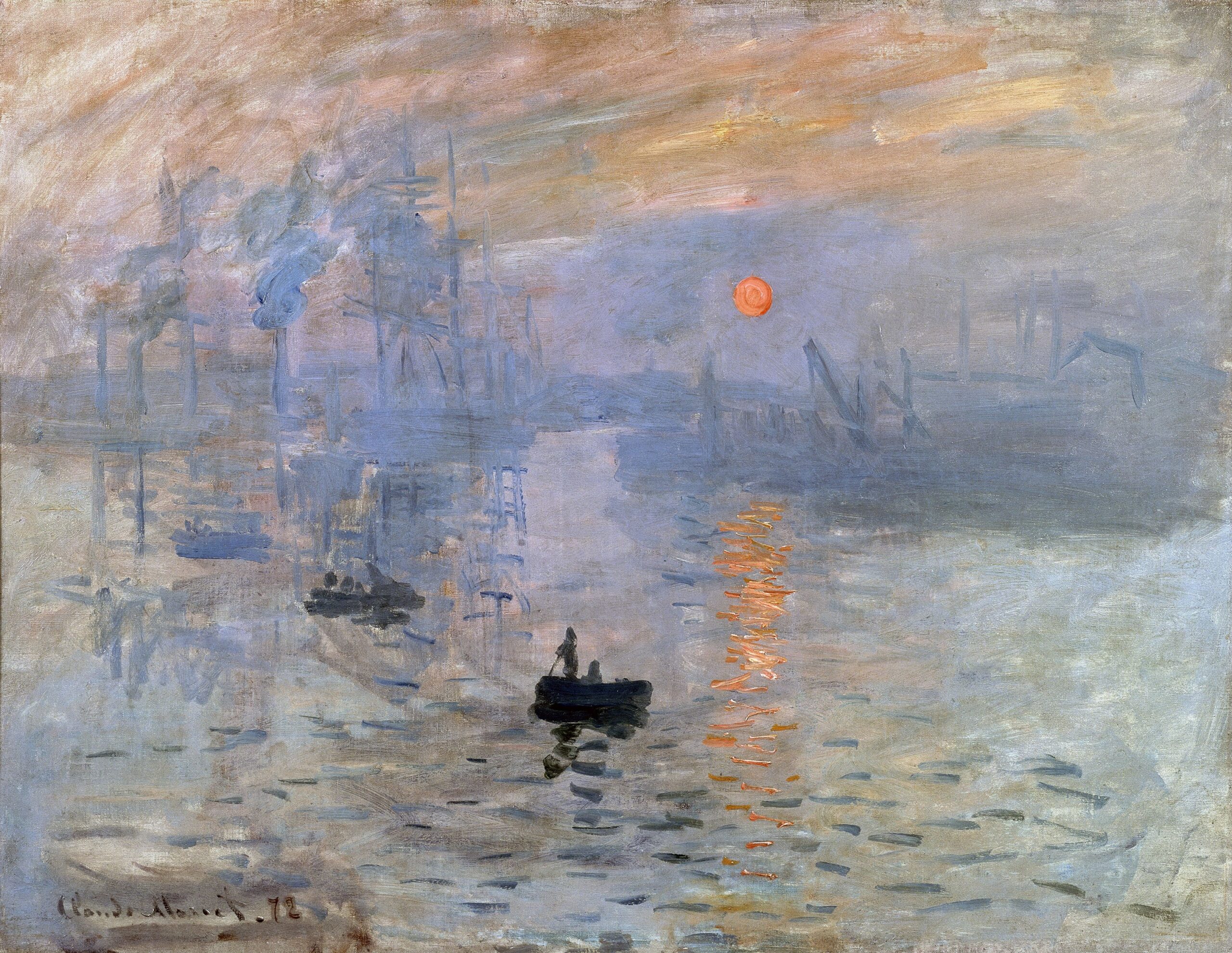
Claude Monet, Impression: Sunrise
Named the movement for its focus on light and color.
Textbook: The most fervent follower of Impressionist techniques was the painter Claude Monet (1840–1926). His canvas Impression: Sunrise inspired the epithet impressionist when it was exhibited at the first Impressionist exhibition in 1874. Fishing vessels sail from the port of Le Havre toward the morning sun, which rises in a foggy sky to cast its copper beams on the choppy, pale blue water. The warm blanket of the atmosphere envelops the figures, their significance having paled in the wake of nature’s beauty.
Claude Monet, Rouen Cathedral
Series highlights changes in light and atmosphere.
Textbook: The dissolution of surfaces and the separation of light into its spectral components remain central to Monet’s art. They are dramatically evident in a series of canvases depicting Rouen Cathedral from a variety of angles, during different seasons and times of day. The harsh stone façade of the cathedral dissolves in a bath of sunlight, its finer details obscured by the bevy of brushstrokes crowding the surface. Dark shadows have been transformed into patches of bright blue and splashes of yellow and red. With these delicate touches, Monet has recorded for us the feeling of a single moment in time. He offers us his impressions as eyewitness to a set of circumstances that will never be duplicated.
Post-Impressionism
Textbook:
During the latter years of the nineteenth century, a group of artists who came to be called Postimpressionists were also united in their rebellion against that which came before them—in this case, Impressionism. The Postimpressionists were drawn together by their rebellion against what they considered an excessive concern for fleeting impressions and a disregard for traditional compositional elements.
Key Artworks:
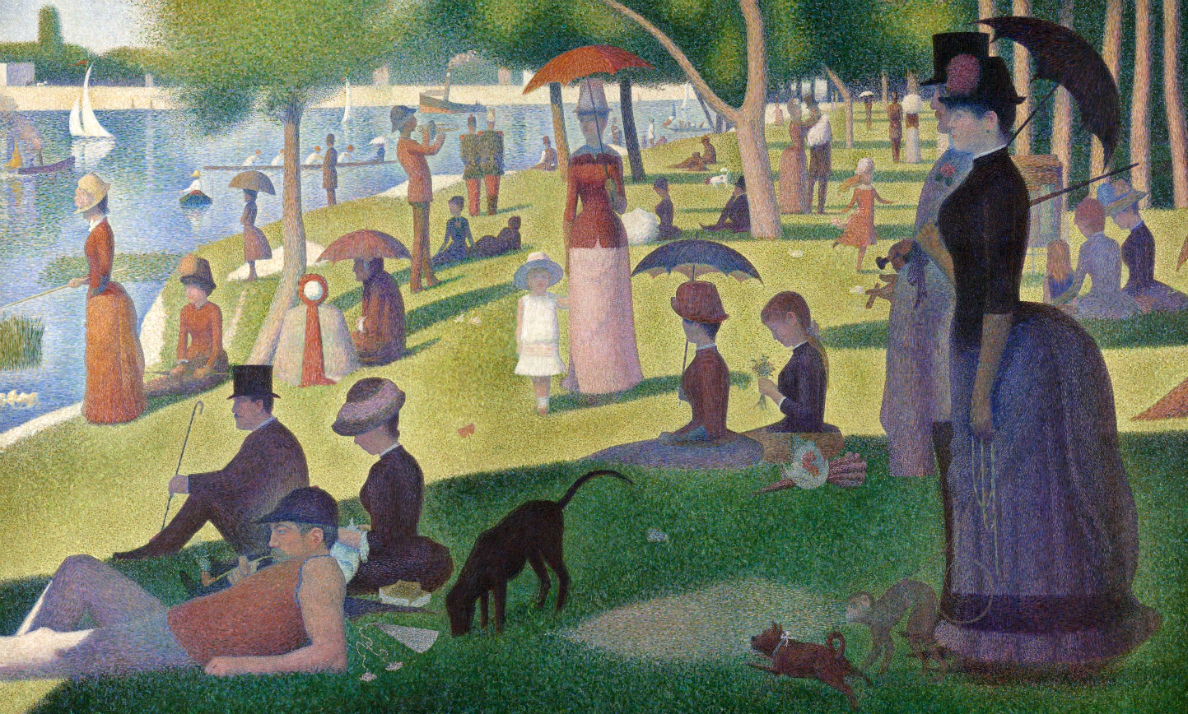
Georges Seurat, Sunday Afternoon on the Island of La Grande Jatte
Introduces pointillism, a technique of using distinct dots of color.
Textbook: A systematic method of applying minute dots of unmixed pigment to the canvas; the dots are intended to be “mixed” by the eye when viewed. Also called “divisionism.”
Textbook: At first glance, the paintings by Georges Seurat (1859–1891), such as A Sunday Afternoon on the Island of La Grande Jatte, have the feeling of Impressionism “tidied up.” The small brushstrokes are there, as are the juxtapositions of complementary colors. The subject matter is entirely acceptable within the framework of Impressionism. However, the spontaneity of direct painting found in Impressionism is relinquished in favor of a more tightly controlled, “scientific”approach to painting.
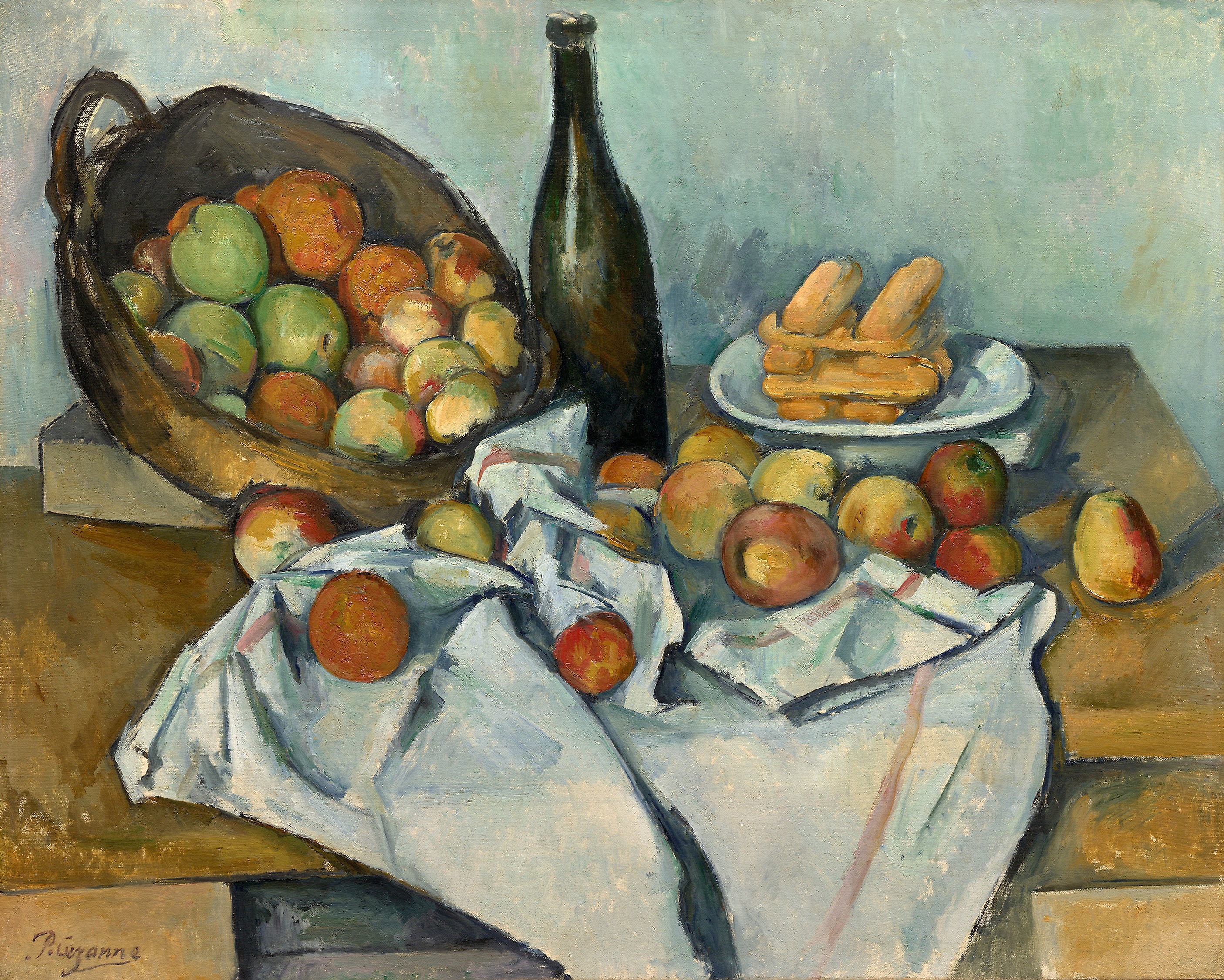
Paul Cezanne, Still Life with Basket of Apples
Focus on structure, form, and perspective.
Textbook: All of the imagery is forced to the picture plane. The tabletop is tilted toward us, and we simultaneously view the basket, plate, and wine bottle from front and top angles. Cézanne did not paint the still-life arrangement from one vantage point either. He moved around his subject, painting not only the objects but also the relationships between them. He focused on solids as well as on the void spaces between two objects. If you run your finger along the tabletop in the background of the painting, you will see that it is not possible to trace a continuous line. This discontinuity follows from Cézanne’s movement around his subject. Despite this spatial inconsistency, the overall feeling of the composition is one of completeness. Cézanne’s painting technique is also innovative. The sensuously rumpled fabric and lusciously round fruits are constructed of small patches of pigment crowded within dark outlines. The apples look as if they would roll off the table, were it not for the supportive facets of the tablecloth.
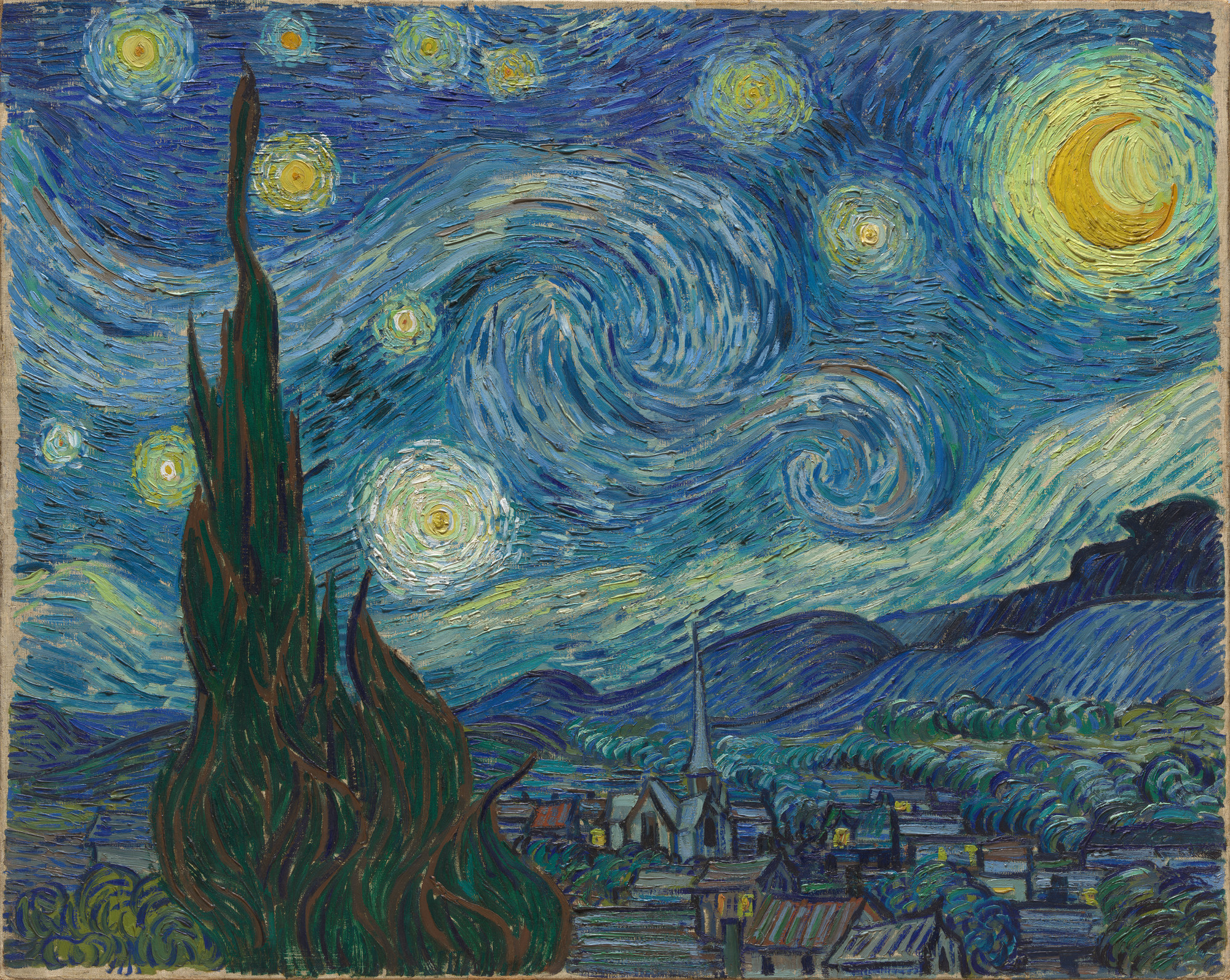
Vincent Van Gogh, Starry Night
Expressive use of color and swirling line, capturing emotional resonance.
Textbook: In Starry Night , an ordinary painted record of a sleepy valley town is transformed into a cosmic display of swirling fireballs that assault the blackened sky and command the hills and cypresses to undulate to their sweeping rhythms. Vincent’s palette is laden with vibrant yellows, blues, and greens. His brushstroke is at once restrained and dynamic. His characteristic long, thin strokes define the forms but also create the emotionalism in the work. He presents his subject not as we see it, but as he would like us to experience it. His is a feverish application of paint, an ecstatic kind of drawing, reflecting at the same time his joys, hopes, anxieties, and despair. Vincent wrote in a letter to his brother Theo, “I paint as a means to make life bearable.… Really, we can speak only through our paintings.”
Expressionism
Textbook: Expressionism; a modern school of art in which an emotional impact is achieved through agitated brushwork, intense coloration, and violent, hallucinatory imagery.
Key Artwork:
Edvard Munch, The Scream
Iconic representation of existential angst and emotional disturbance.
Textbook: It portrays the pain and isolation that became his central themes. A skeletal figure walks across a bridge toward the viewer, cupping his ears and screaming. Two figures in the background walk in the opposite direction, unaware of or uninterested in the sounds of desperation piercing the atmosphere. Munch transformed the placid landscape into one that echoes in waves the high-pitched tones that emanate from the sunken head. We are reminded of the swirling forms of van Gogh’s Starry Night, but the intensity and horror pervading Munch’s composition speak of his view of humanity as being consumed by an increasingly dehumanized society.

Analytic Cubism
Key Artworks:
Picasso, Les Demoiselles d’Avignon
Breaks traditional representation by showing multiple perspectives simultaneously.
Picasso, Guernica
Political statement on war and suffering.
Braque, The Portuguese
Use of geometric forms to depict objects and figures.
Duchamp, Nude Descending a Staircase
Innovative representation of movement and time.
Synthetic Cubism
Key Artwork:
Picasso, La Bouteille de Suze (Bottle of Suze)
Combines collage and painting, focusing on the flatness of the canvas.
Futurism
Key Artwork:
Boccioni, Unique Forms of Continuity in Space
Captures movement and dynamic forms celebrating modernity.
Abstraction
Key Artwork:
O’Keefe, White Iris
Focuses on form and color rather than realistic representation.
Dada
Key Artwork:
Duchamp, Nude Descending a Staircase
Challenges conventional art forms and ideas of beauty through absurdity.
Surrealism
Key Artwork:
Dali, The Persistence of Memory
Examines themes of time and reality through dream-like imagery.
Abstract Expressionism
Key Artworks:
Pollock, One (Number 31, 1950)
Known for action painting, focusing on the physical act of painting.
Color Field Painting:
Rothko, Magenta, Black, Green on Orange
Explores emotional expression through large fields of color.
Pop Art
Key Artworks:
Rauschenberg, The Bed
Combines everyday objects with artistic media to blur boundaries.
Hamilton, Just What Is It That Makes Today’s Homes So Different, So Appealing?
Examines consumer culture and mass media influences.
Warhol, Green Coca-Cola Bottles
Critiques commodification in art and American culture.
Photorealism
Key Artwork:
Flack, World War II (Vanitas)
Combines realistic detail with symbolic elements, reflecting on mortality and consumerism.