5.1.6 Limiting Factors of Photosynthesis
Limiting Factors of Photosynthesis
- Plants need several factors for photosynthesis to occur:
- The presence of photosynthetic pigments
- A supply of carbon dioxide
- A supply of water
- Light energy
- A suitable temperature
- If there is a shortage of any of these factors, photosynthesis cannot occur at its maximum possible rate
- The main external factors that affect the rate of photosynthesis are:
- %%Light intensity%%
- %%Carbon dioxide concentration%%
- %%Temperature%%
- %%If any one of these factors is below the optimum level for the plant, its rate of photosynthesis will be reduced, even if the other two factors are at the optimum level%%
- Although a lack of water can reduce the rate of photosynthesis, water shortages usually affect other processes in the plant before affecting photosynthesis and is therefore not one of the main limiting factors
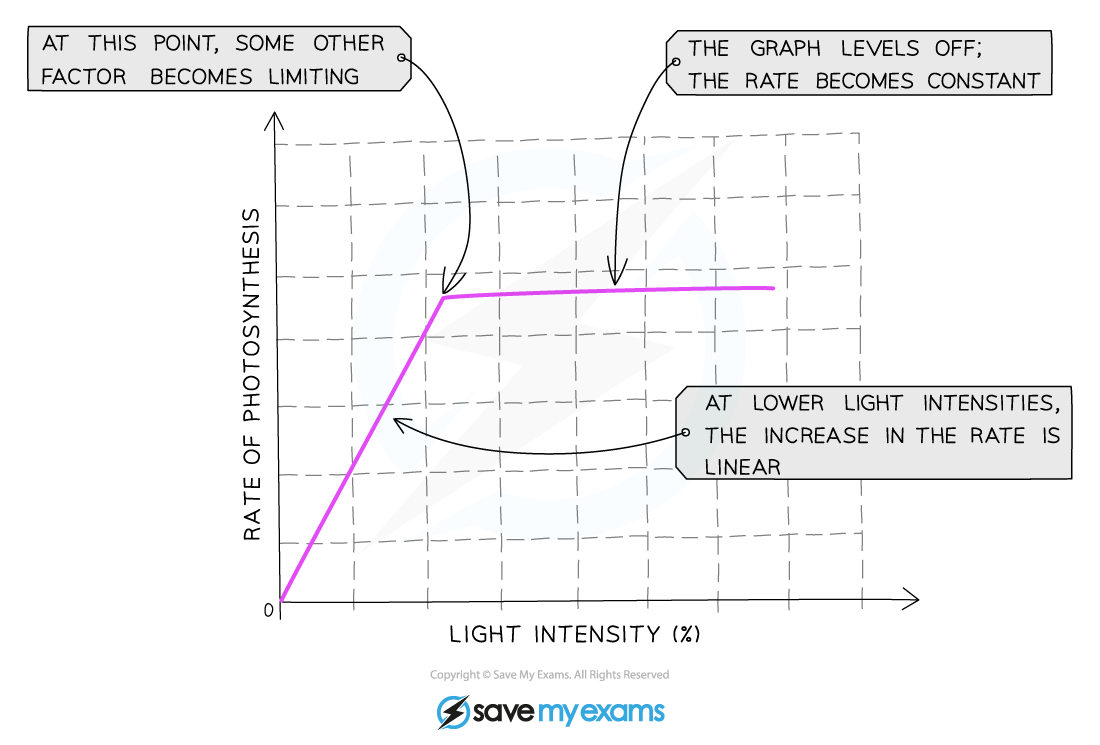
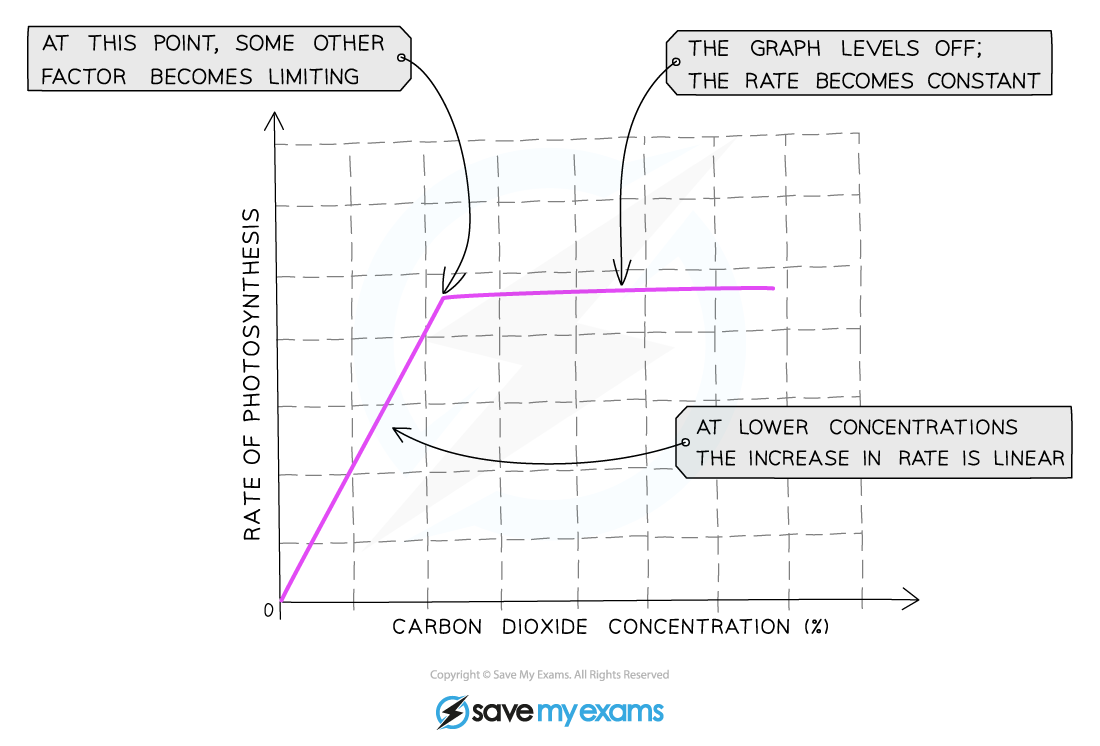
- In the section of the graph where the rate is increasing (the line is going up), the limiting factor is whatever the label on the x-axis (the bottom axis) of the graph is.
- In the section of the graph where the rate is not increasing (the line is horizontal), the limiting factor will be something other than what is on the x-axis – choose from temperature, light intensity or carbon dioxide concentration.
Light Intensity
The rate of photosynthesis increases as light intensity increases:
- The greater the light intensity, the %%more energy supplied to the plant%% and therefore the %%faster the light-dependent stage of photosynthesis can occur%%
- This %%produces more ATP and reduced NADP%% for the Calvin cycle (light-independent stage), which can then %%also occur at a greater rate%%
- During this stage of the graph below, light intensity is said to be a limiting factor of photosynthesis
At some point, if light intensity continues to increase, the relationship above will no longer apply and the rate of photosynthesis will reach a plateau
At this point, %%light intensity is no longer a limiting factor of photosynthesis – another factor is limiting the rate of photosynthesis%%
The factors which could be limiting the rate when the line on the graph is horizontal include temperature being too low or too high, or not enough carbon dioxide
CO2 Conc.
The rate of photosynthesis increases as carbon dioxide concentration increases:
- Carbon dioxide is one of the raw materials required for photosynthesis
- It is %%required for the light-independent stage of photosynthesis%%, when %%CO2 is combined with the five-carbon compound ribulose bisphosphate%% (RuBP) during carbon fixation
- This means the %%more carbon dioxide that is present%%, the %%faster this step of the Calvin cycle can occur and the faster the overall rate of photosynthesis%%
The natural level of CO2 in the atmosphere is 0.04%, it is therefore not advisable to increase the CO2 concentration much higher than this as it can become toxic
The factors which could be limiting the rate when the line on the graph is horizontal include temperature being too low or too high, or not enough light
Temperature
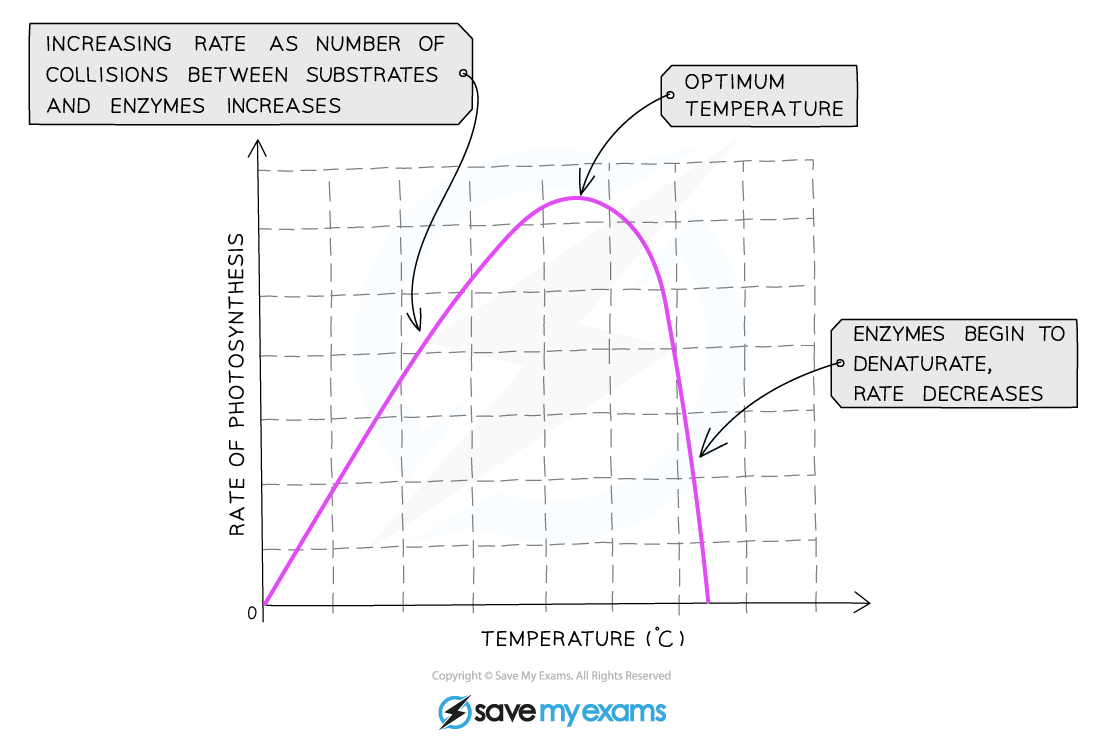
As temperature increases the rate of photosynthesis increases as the reaction is %%controlled by enzymes%%
However, as the reaction is controlled by enzymes, this trend only continues up to a certain temperature beyond which %%the enzymes begin to denature and the rate of reaction decreases%%
For photosynthesis, %%temperature has no significant effect on the light-dependent reactions%%, as these are driven by %%energy from light rather than the kinetic energy%% of the reacting molecules
However, the %%Calvin cycle is affected by temperature%%, as the %%light-independent reactions are enzyme-controlled reactions%% (eg. rubisco catalyses the reaction between CO2 and the five-carbon compound ribulose bisphosphate)
As long as there is %%enough light to produce ATP and NADPH in the light-dependent reaction, increasing temperature up to an optimum temperature%% (this will vary by species and what its natural habitat is) will %%increase the rate of the light-independent reactions and therefore the rate of photosynthesis%%
Increasing temperature %%causes stomata on the leaf to close in order to reduce water%% loss, when the %%stomata are closed CO2 cannot enter the leaves%% - therefore, a balance must be met here
The light-dependent reaction relies on a %%proton gradient forming across the thylakoid membrane - it is important that a too high or too low temperature does not affect the permeability of the membrane which may lead to a dissipation of the proton gradient%%
Agricultural Practices Against Limiting Factors
- In the most sophisticated glasshouses, for example, %%sensors can be used to monitor the light intensity, the humidity of the atmosphere and the carbon dioxide concentration around the crops%%
- This means that plants could continue to grow through the night if they are kept lit with %%artificial lighting%%
- Plants can be %%grown out of their natural season and habitat%% because the temperature can be kept constant all year round
- %%Water can be supplied by irrigation systems%% throughout the glasshouse or fields which sometimes contain added fertilisers or growth nutrients such as nitrates to aid plant growth
- %%Natural pests that may spread disease or eat the crops can be controlled within agricultural setting%%s by pesticides or by separating the plants from unfiltered outside air
- This maximises the yield of the crop
- Farmers have to find a balance between crop yield and the cost of maintaining 24 hour lighting and year-round heating as well as the environmental implications this has