Psychological Assessment of Intelligence
Stanford-Binet Intelligence Scale
Brief Description:
Standardized test assessing intelligence and cognitive abilities in children and adults aged 2 to 23 years old.
Latest edition: Stanford-Binet Intelligence Scale Fifth Edition (SBS5) released in 1986.
Introduced organized administration and scoring instructions, concept of IQ, and alternate items.
Purpose:
Differentiating between mental retardation and specific learning disabilities.
Understanding psychodynamics of individuals struggling in learning.
Identifying gifted individuals.
Studying cognitive skill development from ages 2 to adult.
Making decisions based on examiner's skills and observations during testing.
Stanford-Binet Scoring
Psychometric Soundness:
High coefficients for SB5 Full-Scale IQ and reliability for Abbreviated Battery IQ.
Test-retest reliability coefficients were high.
Test Administration:
Designed for adaptive testing tailored to the test-taker.
Begins at an optimal difficulty level to maximize information collection, facilitate rapport, and prevent examinee fatigue.
Explicit rules for starting, reversing, and discontinuing testing.
Provides prompts for vague responses in verbal items.
Stanford-Binet Scoring Categories
IQ Ranges:
Very gifted, gifted, superior, high average, average, low average, borderline impaired, mildly impaired, moderately impaired.
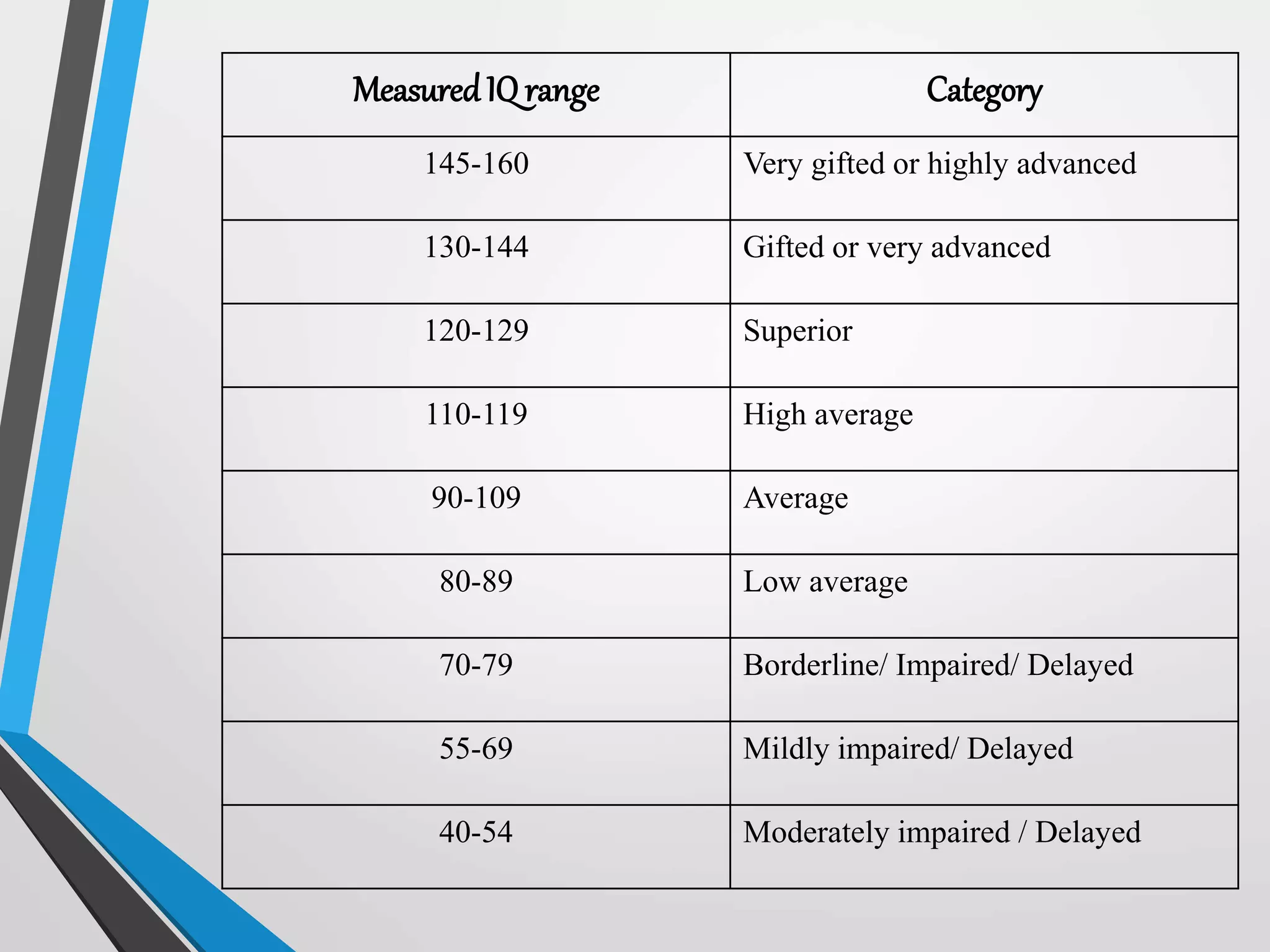
Interpretation:
Labels serve as shorthand reference in psychological reports.
Example summary statement for a student's intellectual ability.
Wechsler Scales
David Wechsler:
Advocated for nonintellective factors in intelligence tests.
Designed Wechsler Adult Intelligence Scale, Wechsler Intelligence Scale for Children, and Wechsler Preschool and Primary Scale of Intelligence.
Tasks Measured:
Various types of tasks assessed in Wechsler intelligence tests for different age groups.
Differential Aptitude TestIn summary, an aptitude test is an instrument utilized to determine and measure an individual's ability to acquire, through future training, some specific set of skills. There are a few well-known published aptitude tests on the market, and for this module, we will discuss the Differential Aptitude Test.
Wechsler noticed issues with Binet scale for adults
Binet scale items were designed for children
Lack of validity when answered by adults
Wechsler's test design differences
Point scale concept used instead of age scale
Inclusion of nonverbal performance scale
Scoring in Wechsler's test
Credits or points recorded for correctly answered items
Test yields total overall score and scores for each content area
Advantages of Wechsler Scales
Allows analysis of individual's ability in various content areas
Standard concept in intelligence testing today
Page 47
Wechsler's Performance Concept
Includes a nonverbal performance scale
Tasks require actions rather than just answering questions
WAIS-IV structure
Individual subtests related to basic skills
Subtests sorted into verbal comprehension, perceptual reasoning, working memory, and processing speed indexes
Interpretation of WAIS-IV results
Provides data for diagnosing conditions
Comparison of index scores and subtest patterns helpful in evaluation
Page 48
Measured IQ Range Categories
Ranges from Superior or Gifted to Profound Retardation
Psychometric soundness of WAIS-IV
Reliability, validity, and overall psychometric soundness established
High internal consistency reliability estimates found
Page 49
Personality Assessment Overview
Personality remains an enigmatic and explored construct
Natural curiosity about behavior differences
Models of Personality Tests
Trait, psychodynamic, situational, interaction, and phenomenological models
Each model focuses on different aspects of personality assessment and explanation
Page 50
Definition of Personality Assessment
Measurement and evaluation of various psychological traits, states, values, interests, etc.
Objective Personality Testing
Utilizes multiple-choice, true/false formats to assess personality aspects
Examples: PAI, MBTI, ASI-5
Common Objective Personality Tests
Assess different aspects of personality for client understanding
Highlight nine tests with varying emphases
Page 51
Minnesota Multiphasic Personality Inventory-2 (MMPI-2)
Developed in 1942, measures psychopathology and diagnoses
Versions: MMPI-2, MMPI-A, MMPI-2-RF
Administration options and scoring methods
Content scales and extended reports for detailed client analysis
Millon Clinical Multiaxial Inventory, Fourth Edition (MCMI-IV)
Based on Dr. Theodore Millon’s personality theory
Aids in clinical insights, diagnostics, and treatment decisions
Introduces Spectrum of Personality Patterns with three levels of functioning
Includes scales for personality disorders, clinical syndromes, and Grossman Facet Scales
Psychological Assessment Objective Personality Tests
Personality Assessment Inventory (PAI)
Designed for clinical diagnoses, psychopathology screening, and treatment planning.
Authored by Leslie Morey, self-administered, measures 22 scales with 344 items.
Organized into validity, clinical, treatment, and interpersonal scales.
Reliability data reported for community-dwelling adults and undergraduate students.
Designed for adults 18+, takes 50-60 minutes to complete, scored using a four-point scale.
Results provide validity scales, clinical scales, treatment scales, and interpersonal scales.
Raw scores converted to T-scores and percentiles, T ≥ 70 indicates scales needing attention.
Beck Depression Inventory-II (BDI-II)
Introduced by Aaron Beck in 1961, latest version in 1996.
Ranked as the top assessment tool for counselors and counselor educators.
Consists of 21 questions rated on a scale from 0 to 3 based on depressive symptoms.
Scores interpreted based on scales, useful for measuring client progress.
Psychological Assessment Objective Personality Tests
Beck Anxiety Inventory (BAI)
Developed by Aaron Beck, assesses anxiety for individuals aged 17 to 80.
Self-report instrument with 21 questions, scored on a four-point Likert-type scale.
Women and young people tend to score higher, scoring higher than men and older individuals.
Developed by combining three anxiety measures, scored by adding total points.
Myers-Briggs Type Indicator® (MBTI®)
Based on Carl Jung's work, created by Katharine Briggs and Isabel Briggs Myers.
Helps in career selection and understanding self and others.
Used in various settings like therapists' offices, marriage counseling, business, and career counseling.
CPP is the exclusive publisher of the MBTI® assessment since 1975.
Page 54
MBTI® Instrument
Four dimensions:
Extraversion vs. Introversion
Sensing vs. Intuition
Thinking vs. Feeling
Judging vs. Perceiving
Form M:
Takes 15 to 25 minutes to administer
Geared towards individuals 14 and older
Can be hand scored, computer-scored, or mailed for scoring
Has 144 items
16 Personality Factors Questionnaire (16PF)®:
Developed based on Raymond Cattell's research
Not a measure of pathology but describes human behavior
Has 185 items
Takes about 45 minutes to administer
Provides results in three sections: 16 primary factors, 5 global factors, and 3 validity scales
Page 55
Big Five Personality Traits
Traits: Openness, Conscientiousness, Extraversion, Agreeableness, Neuroticism
NEO Personality Inventory-3 (NEO-PI-3)™:
Measures personality across the five-factor model
Updated to lower the reading level for adolescents or adults
Associated traits with specific personality qualities
NEO Five-Factor Inventory-3 (NEO-FFI-3)™:
Shortened version with 60 items
Can be administered in 10 to 15 minutes
Page 56
Informal Assessment Methods
Subjective nature with unique role in assessment process
Advantages listed by Neukrug & Fawcett (2015):
Enhance understanding of the individual
uAssess specific attributes
Provide timely information
Nonintrusive and non-threatening
Cost-effective and easy to administer
Types of Informal Assessment Techniques:
Observation: Event sampling and time sampling
Rating scales, classification methods, environmental assessment techniques, records, and performance-based assessment.
Page 57
Psychological Assessment Objective Personality Tests
Time Sampling
Observation for a limited time to study behaviors.
Example: School counselor observing a student in three 30-minute periods.
Advantage: Efficient use of time, but may not capture typical behaviors accurately.
Rating Scales
Tool to evaluate attributes subjectively.
Formal scales go through validation, while informal ones are subjective.
Caution needed in interpreting results due to potential errors like the halo effect and generosity error.
Example scenarios of errors in rating.
Commonly Used Rating Scale
Numerical scales for prioritizing issues or assessing progress.
Page 58
Psychological Assessment Objective Personality Tests
Rating Scales Types
Numerical, Likert-Type, and Semantic Differential Scales.
Classification Methods
Rating scales assess quantity or preferences, while classification methods are all or nothing.
Behavior Checklists
Identify typical or atypical behaviors easily.
Useful for uncovering behavior patterns.
Feeling Word Checklists
Identify feelings quickly.
Important for effective communication in relationships.
Other Classification Methods
Environmental assessment gathers information from various settings.
Page 59
Psychological Assessment Objective Personality Tests
Direct Observation
Visiting client's settings provides valuable information.
Example: Discovering unexpected traits during a home visit.
Situational Assessment
Uses simulated situations to predict real-life responses.
Sociometric Assessment
Determines dynamics within a group or organization.
Examples of questions for families, employees, and recovering addicts.
Page 60
Psychological Assessment Projective Personality Tests
Clinical Assessment
Involves evaluating clients through methods like clinical interviews, informal assessment techniques, and objective and projective tests.
Used for various reasons such as gaining insight, aiding in treatment planning, and making diagnostic decisions.
Projective Testing
Involves presenting clients with stimuli to interpret personality factors based on their responses.
Used to identify psychopathology and assist in treatment planning.
Responses in projective testing are open-ended and vague, leading to a wide range of interpretations.
Projection
Defined by Sigmund Freud as a defense mechanism where one denies their own attributes and ascribes them to others or the outside world.
Projective Techniques
Use vague, ambiguous stimuli for clients to project their personality, attitudes, and self-concept.
Uncover feelings, beliefs, attitudes, motivations, and characteristic modes of perceiving the world.
Page 61
Psychological Assessment Projective Personality Tests
Projective Test
Designed to reveal hidden emotions and internal conflicts through responses to ambiguous stimuli.
Design and Structure of Projective Techniques
Structured stimuli involve clear answers, while ambiguous stimuli have little structure.
Data from projective techniques can be analyzed quantitatively or qualitatively.
Projective Techniques
Include associative techniques like the Rorschach Inkblot Test and construction techniques like the Thematic Apperception Test.
Page 62
Psychological Assessment Projective Personality Tests
Sach’s Sentence Completion Test
Developed as a semi-structured projective technique to provide insights into attitudes, beliefs, and motivations.
Contains 60 sentence stems for respondents to complete, offering information on personality and emotional reactions.Uses and Advantages
Used in various settings for personality analysis, attitude assessment, and clinical applications.
High face validity and allows for freer responses, aiding in therapeutic rapport and creating inferences for follow-up methods.
Page 63
Thematic Apperception Test (TAT)
A projective test with pictures for the examinee to create stories.
Reveals dominant drives, emotions, and conflicts of personality.
Conceptualized by Henry Murray and Christina Morgan in 1935.
Encouraged by the Human Potential Movement for personal growth.
General Conditions for TAT
Administered in an interpersonal setting.
Consists of 20 cards with ambiguous pictures.
Subject seated beside the examiner during administration.
Instructions and Procedures for TAT
Examiner shows pictures one at a time for the subject to create a story.
Time measured from picture presentation to story start.
Record subject's responses and behavioral observations.
Scoring for TAT
Evaluates aspects like the hero, needs, environmental factors, themes, and story outcomes.
Rorschach Inkblot Test
Consists of ten inkblots designed to be ambiguous and conflicted.
Appropriate for subjects from age five to adulthood.
Method of Administration for Rorschach
Subjects are given 10 cards with inkblot designs to interpret.
Developed by John E. Exner, Jr. with a standardi
Differential Aptitude
An aptitude test is an instrument utilized to determine and measure an individual's ability to acquire, through future training, some specific set of skills.
Verbal reasoning (VR), numerical reasoning (NR), abstract reasoning (AR), perceptual speed and accuracy (PSA), mechanical reasoning (MR), space relations (SR), spelling (Sp), and language usage (LU) are the eight subtests abilities measured
Discrimination Index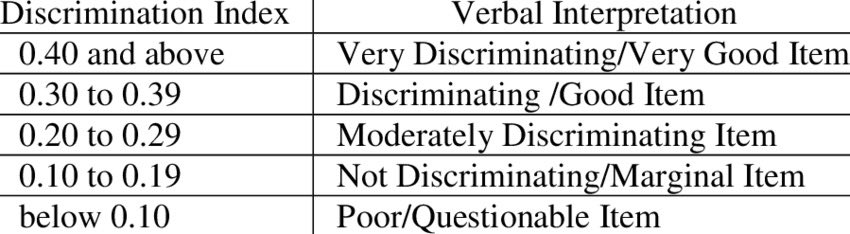
Difficulty Index