Anatomy & Physiology
•Anatomy (form)
•Study of the structure of body parts and their relationship to one another
•Physiology (function)
•Study of the function of body parts; how they work to carry out life-sustaining activities
•Form is always related to function!
•Anatomy vs Physiology = Form vs Function (Principle of complementarity)
The Principle of Complementarity:
→The principle of complementarity in anatomy states that the structure of an organism is closely related to its function.
Zsaw2.1121
→Anatomy is the study of biological structure, whereas physiology is the study of biological function. These two concepts are highly interconnected because structures have evolved to complement their function.
→Anatomy = Physiology
→Anatomy = Structure
→Physiology = Function
→Structure = Function….
Subdivisions of Anatomy
→Gross or macroscopic anatomy is the study of large, visible structures
↳Systemic anatomy: looks at just one system (cardiovascular, nervous, muscular, etc.)
↳Surface anatomy: looks at internal structures as they relate to overlying skin (visible muscle masses or veins seen on surface)
→Microscopic anatomy deals with structures too small to be seen by naked eye
↳Cytology: microscopic study of cells
↳Histology: microscopic study of tissues
Subdivisions of Physiology:
→Based on organ systems (e.g., renal or cardiovascular physiology)
→Often focuses on cellular and molecular levels of the body
↳Looks at how the body’s abilities are dependent on chemical reactions in individual cells
→To study physiology, one must understand basic physical principles (e.g., electrical currents, pressure, and movement) as well as basic chemical principles
1.1.3 Levels of biological organization
Chemical level: atoms, molecules, and organelles
Cellular level: single cell
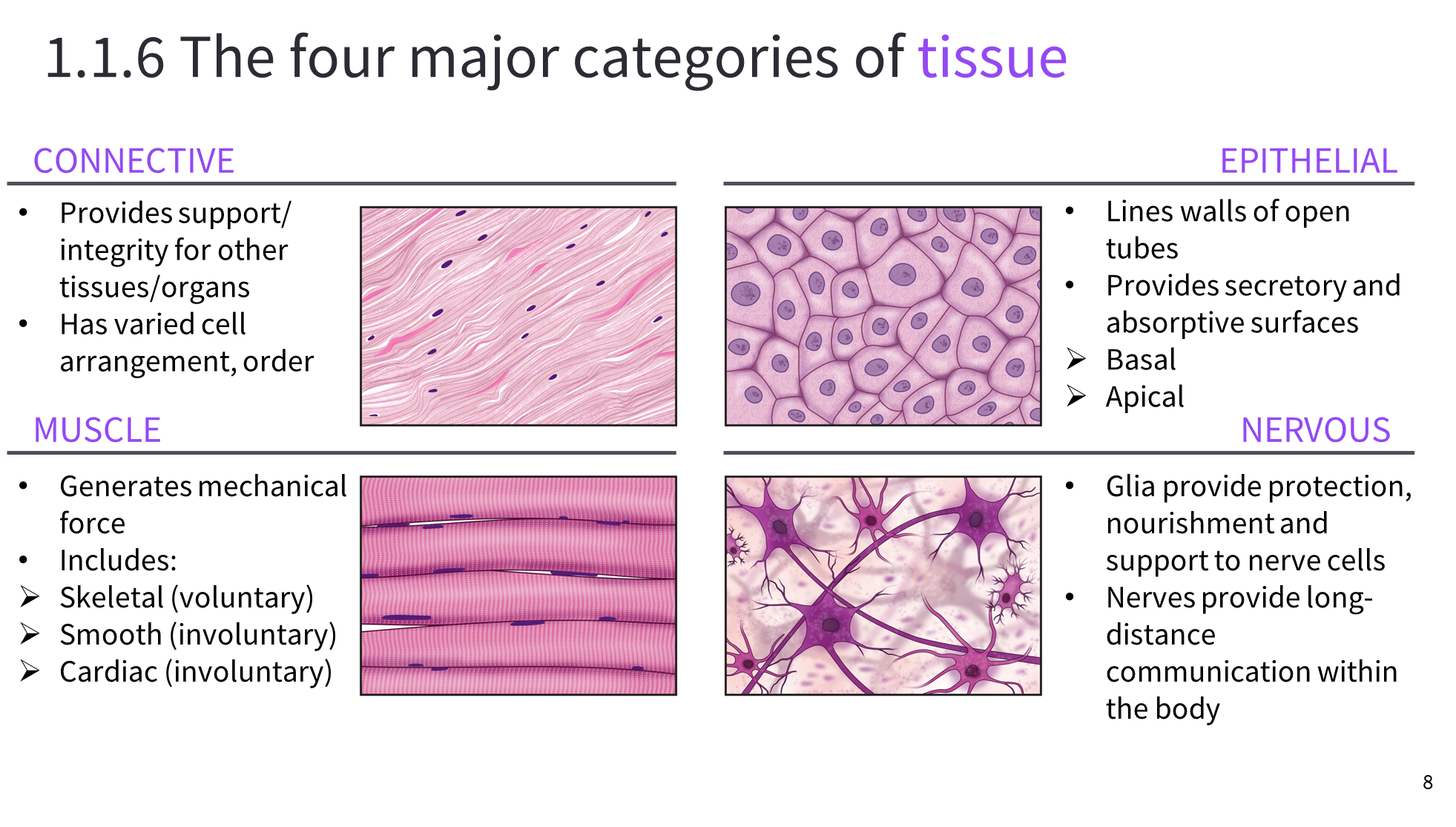
Tissue level: groups of similar cells
Organ level: contains two or more types of tissues
Organ system level: organs that work closely together
Organismal level: all organ systems combined to make the whole organism
Biomolecule | Building Block | Function |
Protein | Amino acid | Fundamental component of structure and dynamic metabolic function in the cell |
Lipid | No single building block for all lipids | Long-term energy molecule, structural component of the membrane bilayer (phospholipid), and integral extracellular membrane facilitator of cell–cell interactions (glycolipid) |
Carbohydrate | Monosaccharide | Structural molecule, attachment on protein for cell recognition and short- and long-term energy storage (glycogen) |
Nucleic acids | Nucleotide | Unit for hereditary information (DNA) or protein biosynthesis (RNA) |
BIOMOLECULES: Building blocks for functional cells, tissues and organs
Organic compounds – that contain carbon and are made by living things, all of which are covalently bonded molecules, and most are large molecules.
1.1.5 Cells are the living unit of life
ALL CELLS COMPRISE AT LEAST:
1.Membrane: Lipid bilayer surrounding cell or organelle
2.Genetic material: E.g. DNA
3.Cytosolic fluid: Fluid component of the cell interior