Lesson 14: Religious Area Analysis and Religious Impact Assessment
Introduction
Lesson Introduction
Welcome to the Religious Area Analysis and Religious Impact Assessment lesson. This lesson will examine how to prepare a Religious Area Analysis, also known as the RAA, and how to prepare a Religious Impact Assessment, or RIA. As a Religious Affairs Specialist, one of your duties is to prepare both the RAA and the RIA.
Lesson Objectives
In this lesson you will learn to construct a Religious Area Analysis, RAA, and a Religious Impact Assessment, RIA. At the end of this lesson you will complete the Lesson 14 posttest with a score of 70% or higher.
- Construct a Religious Area Analysis (RAA)
- Construct a Religious Impact Assessment (RIA
Topic 1: Religious Area Analysis (RAA)
- Introduction
The Army today is deploying to more areas of the world than ever before, including many that are not familiar to Americans. It has therefore become increasingly important for Commanders and Soldiers to be aware of the different religious and spiritual aspects of the people they can expect to encounter. At the completion of this lesson, you will have gained an understanding of the impact of religion and beliefs and how this will change the way you analyze and assess religious situations.
- Chaplain Corps Mission
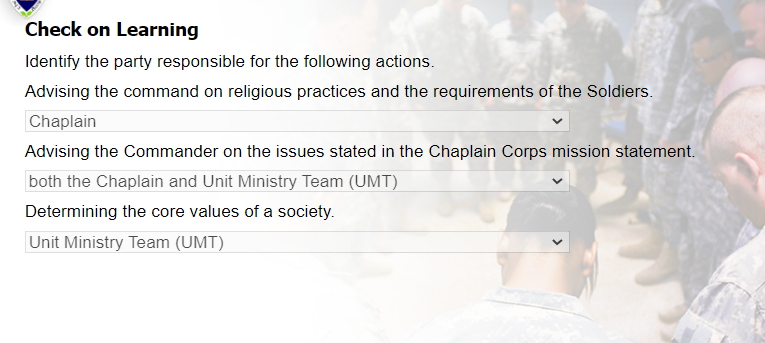
The mission of the Chaplain Corps is to provide religious support across unified land operations, assist Commanders in free exercise of religion, and provide religious, moral, and ethical leadership.
- {{The Unit Ministry Team, or UMT, is responsible for advising the Commander on the issues stated in the Chaplain Corps mission statement. Sensitivity and consideration go a long way to positively impact the overall mission.{{
- Provide religious support across unified land operations
- Assist Commanders in free exercise of religion
- Provide religious, moral, ethical leadership
- Required Capabilities
Every Chaplain Corps must be capable of providing certain types of support. Units can expect the provision of their religious leaders and religious staff advisors to come from the Chaplain Corps.
- {{The Chaplain is responsible for advising the command on religious practices and the requirements of the Soldiers in the command.{{
- {{The UMT is also responsible for advising the command on specifics in an area of concentration, or AOC, that may impact the success of the mission.{{
- Religious leaders and staff advisors
- Internally advising command on soldier requirements
- Externally advises command on specifics in operating environment
- External Advisement for the Operational Environment
The Chaplain Corps must consistently demonstrate understanding of the culture of any relevant society. It is particularly important to be familiar with any core values a society may have. Core values are deeply held beliefs that are of critical importance to the society's way of life. UMTs will help identify the most cherished values of a given culture. Because religion is such an integral part of the values of a culture, mission preparation and analysis must take care to examine the religious groups in an area of operations for any given mission. Religion has the ability to shape the operational environment and therefore impacts the operations process. Commanders should consider how culture impacts the operations.
- Demonstrate understanding of societal culture
- UMTs help identify core values
- Mission preparation and analysis should take into account religion
- Commanders consider the impact of culture on operations
- Worldview
Another concept that UMTs must be able to understand is "worldview." Worldview is the lens by which people receive, interpret, and process information and events in their lives. An individual's worldview is shaped by the origins, upbringings, education, experiences, ideology, religion, and belief system. This perspective contributes to how an individual will behave in certain circumstances, the core values they will fight for, and their perception of truth and morals. It is important that UMTs understand a group's worldview because it impacts each individual's ability to look and think objectively. Objectivity and the ability to see other perspectives and understand one another is crucial for effective decision-making and mission success.
- Worldview:
- How an individual sees the world
- Shaped by origins, experiences, religion, and beliefs
- Impacts the ability to look objectively
- Differing worldviews impact missions
- Advisement with Products
When conducting operations, the Commander will need to know the impact of a religion on the mission at hand. He or she will rely on the UMT for this information. The UMT provides the Commander with religious advisement throughout the operations process, which consists of planning, preparation, execution, and assessment. The UMT will give the Commander relevant data on the impact of religion. The Commander's situational understanding will be impacted through three specific products: a Running Estimate; Religious Area Analysis, or RAA; and Religious Impact Assessment, or RIA.
- Advise Commander throughout operations process
- Provide relevant data on religious impact
- Produce three products:
- Running Estimate
- Religious Area Analysis (RAA)
- Religious Impact Assessment (RIA)
- Running Estimate
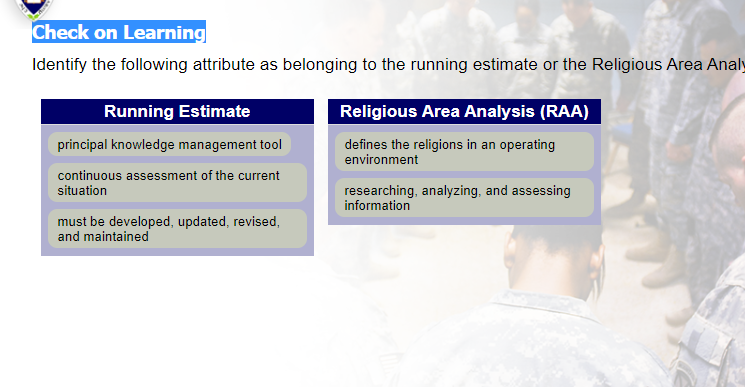
In this topic, we will discuss two of the three products of religious advisement. The first of these products is the running estimate. Running estimates are principal knowledge management tools used by the Commander and staff throughout the operations process. The running estimate is defined as a continuous assessment of the current situation, used to determine if the current operation is proceeding according to the Commander's intent and whether planned future operations are supportable. Each staff will maintain a running estimate, which must be developed, updated, revised, and maintained. Effective plans are dependent upon accurate and current running estimates.
- Principal knowledge management tools
- Used by Commander and staff
- Determines if operation is consistent with the Commander’s intent
- Must be developed, updated, revised, maintained
- Religious Area Analysis
Religious Area Analysis, or RAA, is the process of researching, analyzing, and assessing information concerning religious practices and traditions within an operational environment. This process enables Chaplains and Religious Affairs Specialists to disseminate the analyzed information in a usable format for Commanders. RAA defines the religions in an operating environment, and identifies the religious categories or factors of the situation. In this way, they can analyze the impact religion will have on the operating environment.
- Researching, analyzing, assessing information concerning religious practices
- Allows for the dissemination of religious information to Commanders
- Analysis of the religious impact on operating environment
- Compiling the RAA
Compilation of an RAA is not meant to be difficult process, but it must be done thoroughly. The following points will aid in keeping you on track. First, you must analyze and assess the situation. This means you must familiarize yourself with the environment and what you and your Chaplain are working with. Be knowledgeable about your area and its customs. Consider your limitations. How far can your support be expected to extend? Identify the reasons why you may not be able to help. This knowledge will help you understand your own worldview and the ways in which you may be biased. Do away with bias. What aspects of the situation might be easy for you or your team to focus too much on or overlook? Remember that you are an advisor, and others will look to you for opinions that are as objective as possible.
- Analyze and assess the situation
- Be knowledgeable about area customs
- Consider your own limitations
- Remove biases
- Additional Considerations
Two additional terms that will be helpful to the RAA process are PMESII-PT and METT-TC. PMESII-PT is an acronym that military officials often use as an analytical starting point to assess an operational environment. PMESII-PT lists considerations to keep in mind: Political, Military, Economic, Social, Information, Infrastructure, Physical Environment, and Time. METT-TC stands for Mission, Enemy, Terrain and weather, Troops and support, Time available, and Civil considerations. The factors listed in METT-TC help Commanders remember and prioritize what to analyze during the planning phase of any operation.
- PMESII-PT
- Political, Military, Economic, Social, Information, Infrastructure, Physical Environment, Time
- Analytical starting point to assess operational environment
- METT-TC
- Mission, Enemy, Terrain and weather, Troops and support, Time Available, Civil Considerations
- Provides guidance during planning phase
- Summary
In this topic, you constructed a Religious Area Analysis, or RAA, in a computer-based training environment, which will aid you in completing the Lesson 14 Religious Area Analysis and Religious Impact Assessment posttest with a score of 70%. You learned about the RAA, the running estimate, and the role played by the Unit Ministry Team, or UMT. All of this will assist you and your Chaplain in playing your own roles as effectively as possible.
Construct a Religious Area Analysis (RAA) \n
Topic 2: Religious Impact Assessment (RIA)
- Introduction
Today, Commanders and Soldiers are expected to be more aware of the different religious and spiritual customs found around the world. When conducting operations in unfamiliar environments, the importance of knowledge about customs becomes indisputable. At the completion of this lesson, you will have an understanding of what is expected of you as a Religious Affairs Specialist for assessing situations in contexts which may be foreign. Effective conduct in these environments will foster diplomatic relations as well as enrich the mindset of your unit.
- Product Refresher
Recall from the previous topic that it was the responsibility of the Unit Ministry Team, or UMT, to provide the Commander with religious advisement. The Commander could expect to receive three products in particular: the Running Estimate; the Religious Area Analysis, or RAA; and the Religious Impact Assessment, or RIA. All of these products give the Commander a better idea of situational religious impact and what to expect from the mission at hand. In this topic, we will discuss the final product: the RIA.
- Running Estimate
- Religious Area Analysis (RAA)
- Religious Impact Assessment (RIA)
- RIA Basis
The Religious Impact Assessment determines how religion builds stability and security. It is extracted from a number of resources. Those resources will include the running estimate, a continuous assessment of the current situation, and the RAA, the researched information concerning religion in the operational environment. The RIA may also draw from any coordinating information or other sections. The RIA report is used to help develop future courses of action. It identifies trends that impact the mission, interprets the significance of actions, and appraises future possibilities with probable forecasts. Through the information gathered from the running estimate and the RAA, the RIA works to clarify problems and devise integrated solutions to complex issues.
- Reports how religion builds stability
- Extracted from Running Estimate, RAA, and other documentation
- Helps develop future courses of action
- Identifies trends, interprets actions, and appraises possibilities
- Drives integrated solutions to complex issues
- RIA Goals
The RIA seeks to further the abilities of the Chaplain Corps by proactively supporting its troops, as opposed to offering reactive support. For the religion of the populace and coalition forces in the operation environment, assessments address the question of how they help or hinder the Commander's mission. Assessments will also list how much religion impacts military operations. These analyses that go into the RIA will play a pivotal role in aiding the Army to build a better future for all those around it.
- Proactive support of troops
- Assess manner in which religion affects mission
- Assess how much religion impacts operations
- Religious Factors
Religious factors, typically identified in the RAA, are integral in the religious advisement process. They can be broken down into three categories, with much to be considered when looking at their different components. Click the links to learn more about each type of religious factor.
- Physical Factors
- Physical Factors
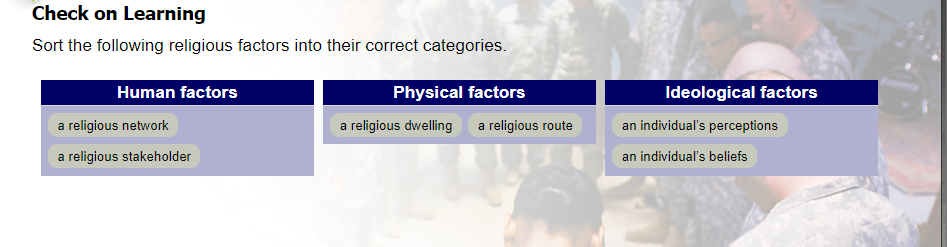
One of the religious factors is the physical factors that affect the mission. Physical factors refer to those factors of a mission that may be material or corporeal. Such factors are especially important to consider in planning for navigation or travel. Some examples of physical religious factors are * {{sites, places, routes, and symbolic structures.{{ * Significant sites * Routes * Symbolic structures
- Human Factors
- Human Factors
Humans are also considered a type of religious factor. Human factors refer to those figures who are relevant to the mission at hand and may play a role in the operational process. Human factors include but are not limited to: * {{leaders, stakeholders, advisors, teachers, financiers, and religious networks.{{ * Figures relevant to mission * Role in operational process
- Ideological Factors
- Ideological Factors
A group's ideology has intangible roots that set it apart from physical and human factors yet features effects that are very visible. Ideological factors can influence the behavior of the individual or worldview, their belief and perception, and all of that which dictates thought processes, reactions, and morality. For a Religious Affairs Specialist, cognizance of ideological factors will make a great difference when interacting with others. * Behavioral influence * Beliefs * Perceptions * Morals
- Definition
From time to time, the UMT may have the privilege to engage religious leaders. This is an interactive process that can benefit all parties involved. Soldier and leader engagement is defined as personal interaction by Soldiers and leaders with foreign audiences in an area of operations. Click to see examples of religious leaders. The engagement may occur as a scheduled meeting, or it may be opportune. It is therefore important to be prepared for such an interaction at all times.
- Personal interaction by Soldiers and leaders
- Examples of religious leaders
- Tribal leaders
- Militants
- Leaders from other religious groups
- Religious opinion-makers
- Government officials
- Authoritative narrative interpreters
- Preachers
- Curates of souls
- Shamans
- Mullahs
- Rabbis
- Imams
- Ayatollahs
- Religious social critics
- May be scheduled or opportune
- Conduct during Soldier-Leader Engagements
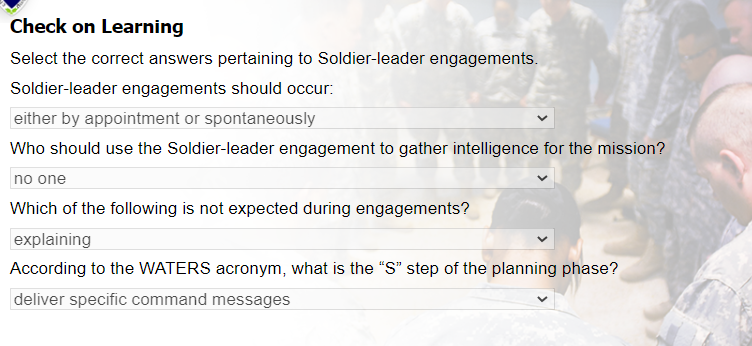
The benefits of Soldier-leader engagement are as much for the individual as they are for diplomacy. It is important not to be lost in the hectic, everyday activities performed in an area of operations and remember to listen, inquire, and examine during these interactions. Soldier-leader engagements force participants to listen more deeply and for longer periods of time. Participants must take a more active approach to demonstrate that they are listening and possess the ability to maintain intense mental focus and concentration on the topic. Individuals must also inquire of others. This means paraphrasing their ideas when the instinct might otherwise be to attack, defend, or explain. Finally, it forces participants to examine their own thoughts and separate assumptions from facts. Doing so will cultivate the ability to penetrate into another's assumptions and worldview, to uncovering the framework that governs behavior.
- Listen
- Actively listen and demonstrate concentration
- Maintain focus on topic
- Inquire
- Paraphrase ideas of others
- Do not attack, defend, or explain
- Examine
- Separate assumptions from facts
- Allows the uncovering of an individual’s behavior
- Prominence in Levels of War
Soldier-leader engagement is a rare and valuable opportunity to build mutual trust and respect in often unlikely places. As such, the UMT is not to use the interaction to gather any intelligence, no matter the context. Engagement may be conducted across the range of military operations. Because it can occur spontaneously in addition to being planned, it may be found at the strategic, operational, and tactical levels. Religious leaders, too, can be met at all levels.
- Meant to build mutual trust and respect
- Not for gathering intelligence
- May be spontaneous or planned
- Found at strategic, operational, tactical levelsOperations Process
The engagement operations process requires the same level of careful planning as any other operation and is a command-directed task. It follows the same operational process of planning, preparations, execution, and assessment. The planning stage may be completed by minding the acronym WATERS, which presents a series of questions: W: Who am I conducting the engagement with? What are his or her issues? A: Action Leader. Who is conducting the engagement? T: Time and Place of the engagement. Are there any conflicts? E: Effects to achieve. What is the intended outcome? R: Response, especially to impasses. What are we willing to do if we don't get what we want? S: Specific command messages to be delivered during the engagement. Is there anything that needs to be communicated? The procurement of the answers of the listed questions will ensure the rest of the process goes much more smoothly. * Who the engagement is conducted with * Action leader of engagement * Time and place of engagement * Effects to achieve * Response to impasses * Specific command messages to be delivered
- Summary
In this topic, you constructed a Religious Impact Assessment, or RIA. You learned about Religious Impact Assessments, factors in religious affairs, and Soldier-leader engagements. Armed with this knowledge, you will be ready to serve your role as Religious Affairs Specialist with diplomacy and objectivity that falls nothing short of admirable.
Construct a Religious Impact Assessment (RIA) \n
\n