sociology class 9
institutions - power and religion
1. power and social movements
a. definitions
power (Weber): the ability to achieve desired ends despite resistance from others
informal power and
formal power: backed up by a position
authority: legitimate powerpeople wnat to follow that person, leads to stability
types:
traditional: give people authority because it has always been that way
charismatic: give people authority because of the individual, we like them
rational-legal: give people authority because they have a position
b. explaining formal power
the pluralist model
structural-functionalist roots: explains stability
power is diffused between interest, poltiical and lobby groups
sources of power also diffused
extremes pulling it out of balance, resulting in policy covering middle ground
no segment of society rules everything, might be (dis)advantage
the power elite (Mills)
one elite, 3 sectors:
politics
corporate
military
interlinkage (they know each other) and circulation (they stay at the top, even when moving sectors)
quasi-hereditary caste (from father to son)
the elite is actually unaware of this happening
they have a common belief system
rational-legal authority: they get the position
they think they’re working for the common good
the ruling class
no political equality (Marx)
state favours ruling class
legitimation: parliaments, government, pressure groups…
hegemony (Gramsci)
state = political society (police, politics,…) + civil society (public sphere)
rule = force + consent
this means ruling through force, but also through people’s minds
concessions and seduction to gain economic control
the independent state (Poulantzas)
state not controlled by capitalists
capitalists not interested in power of the class, only interested in competing with each other
state’s only interest is stability, they favour the status quo
the status quo is capitalism
state has to keep divided classes together
repressive apparatus
ideological apparatus: rule through people’s minds
→ nationalism: state binds together culturally similar people; people believe they belong together, they’ll stay together
fragmentation of class: alliances and new petty bourgeoisie (middle class)
c. social movements
non-institutionalized practices (what they can do) and discourses (what they can say) that aim to invoke social change in subparts of society
formal politics (= top-down) and subpolitics (= bottom-up, politics of everyday life) (Beck)
new social movements
part of identity, good and virtuous, feel better than non-activists
materialistic qualities evolution to human rights as goal; post-materialism
stages of social movements
emergence: goal identification; something is wrong in society
coalescence: strategy how to go public and draw attention, thinking stage
bureaucratisation: they go public and to sustain, they need to bureaucratise, organize themselves so tehy can keep existing without the original starters of the movement
decline: different reasons
goals achieved (maybe choose new ones)
internal events (insufficient funding or conflict)
external reaction (cross boundaries, go to far society reacts negatively)
cooptation (people from movement are taken into formal politics)
2. religion
a. definitions
Durkheim: 2 types of objects
profane objects: mundane, instrumentally understood, everyday items; like a water bottle
sacred objects: transcendental, non-instrumental, objects with deeper meaning, they’re a symbol; like a wedding ring
object of religion: religion is a social institution involving beliefs and practices based upon a conception of the sacred
→ rituals: tell us what we should do, moral rules
→ morality
b. explaining religion
the functions of religion (Durkheim)
totemism: the group becomes the totem
people celebrate the clan animal, the clan animal = the clan, the clan = the social, religion celebrates the social
functions:
social cohesion → religion as collective cosciousness
social control
gives meaning, purpose → stability
the power of the symbol (Berger)
we use religion to converse with others with it, it keeps it alive
social construction of religion
human product
used to give meaning, guiding actions
cosmic frame of reference
to catch immortality → gives deeper meaning
in terms of crisis
Thomas Theorem: wether it’s real or not doesn’t matter
the conflicts of the spirit (Marx)
religion is a light in the darkness of oppression
religion legitimates capitalist rules, but also makes it tolerable
religion is the sigh of the oppressed creature, the heart of the heartless world, the soul of soulles conditions. It’s the opium of the masses (oppressed turn to religion like people would turn to drugs)
illusory happiness (real happiness can only happen without oppression)
must be abolished
c. types of religious organisation
the nature of religious organisations (Troeltsch)
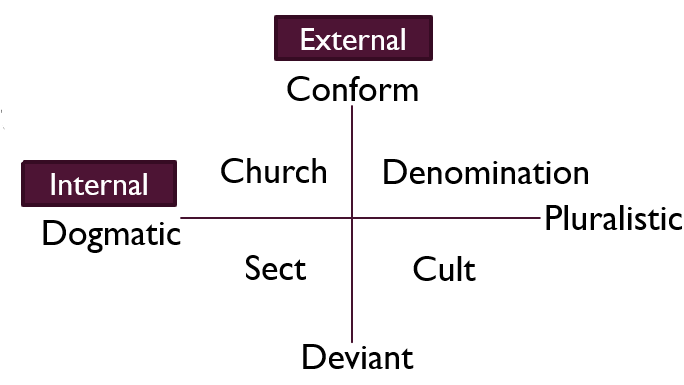
2 axes: more of a continuum
is religion accepted by the wider society? deviant vs conform
do they put themselves as having the only truth or as having 1 truth of many? dogmatic vs pluralistic
4 organizations:
church: conform, but deviant
well-established, bureaucratically organised
membership by birth
avoids controversy, don’t want to be deviant and get wider society against them
→ abstract rules so chances of opposition small
denomination: conform but pluralistic
pluralistic churches like protestant countries: you can shop kind of between diferent groups, they won’t force you to believe their truth, there are multiple truths out there
sect: dogmatic, but deviant
often revolve around people
you often get converted into one, because quite young organizations
bureaucratically organised, but less formal
basically young churches and can evolve into churches in the long run
cult: pluralistic, but deviant
often individual leader
revolve often around 1 idea/dimension
not yet a structure
looser organised
d. religion in the 21st c
secularisation (sociologists in 20thc thought this, but they were quite wrong)
forms of secularisation
decline of need for sacral and supernatural explanations
religious organisations redirect to profane issues (world issues)
religion to the private sphere OR only in public sphere
why?
social differentiation (Durkheim)
many different positions in society - collective consciousness erodes, religion part of collective consiousness so erodes too
rationalisation (Weber-Berger)
less need for religion, people think more rationally, uprising of science
desecularisation
constant need for the sacral
religious ‘market place’
sect-churc-sect (church back to side of society)
succesful sects can convert into churches to replace the declining churches
fundamentalism
a conservative religious doctrine that opposes intellectualism and worldly accomodation in favour of restoring traditional, other-worldly spirituality
features
extreme reaction against secularisation
conservative, study sacred texts literally
good vs evil
reject pluralism
emerging out of social marginalisation, people turn back to what they know when they feel threatened