APGOV Unit 5 Review
The Constitution doesn’t say who has the right to vote and who doesn’t, it is left up to the states, but Congress can admit more people into the franchise when it seems fitting
At first only white men with property were allowed to vote (they were a minority), then all white men even those without property (going into the Civil War), constitutional amendments gave more and more people the right to vote
Franchise has the right to vote
15th amendment: recognized the right of black men to vote
17th amendment: grants people the right to vote in senators
19th Amendment: recognized women’s right to vote
24th Amendment abolished poll taxes (used to suppress minorities)
26th Amendment: lowered the voting age from 21 to 18
some states have enacted laws making it harder for minority groups to vote, or just some people (like convicted felons)
VOTING MODELS
Rational Choice voting: person votes based on their self-interest
Retrospective Voting: a person votes based on the recent record of the candidate
Prospective voting: a person votes based on what everyone says the candidate will do in the future
Party-Line voting: A person votes for all the party’s candidates
VOTER TURNOUT
Not everyone that can vote does vote
structural barriers: a policy or law can prevent or encourage people to vote (voter ID laws)
political efficacy: a citizen’s belief of whether their vote matters (a Californian probably won’t vote if they support a Republican)
National tide: When voters across the country support one party in many elections because of national issues or how they feel about the president.
demographics: senior citizens vote in higher numbers; younger people are the least likely to vote (ages 18-21)
type of election: national elections have more participation than state or local elections
What factors affect the decisions of the people who vote?
-party identification/ideological orientation
-candidate characteristics
-political issues
-religious beliefs, gender, race, or ethnicity
LINKAGE INSTITUTIONS
linkage institution: a societal structure that connects people to their government or the political process - stuff in between the regular people and the government
4 main linkage institutions
-political parties
-interest groups
-elections
-media
political party: an organization at least partly defined by a certain ideological belief that puts forward candidates for elections
mobilization and education of voters
canvassing campaigns: party volunteers show up at people’s homes to try to convince them to vote for their candidate
write and publish the party platform
find quality candidates
candidate characteristics: likable, significant following, they can unite different segments of the party, money
provide campaign management
Parties change
the way parties interact with candidates
PAST: the party mattered, and the candidate was secondary
NOW: the candidate matters the most and the party is secondary (candidate-centered campaign process)
Parties change their platforms to please the larger audience better; they change their messaging to appeal to more voters (different coalitions)
coalition: demographic group
altering the entire party structure (in 3 ways)
party realignment (when the opposing party keeps winning big)
changes to campaign finance laws: how much money can be lawfully given to candidates
changes in communication and data-management technology: using data to win elections (Romney project ORCA) (Obama project Narwal to target demo and psychographics)
psychographics: classify people according to their inner life: personality, attitudes, aspirations, desires
THIRD-PARTY POLITICS
America has a 2-party system
They can’t win because of winner-takes-all voting districts, and the incorporation of third-party agendas into the two major parties’ platforms (they get absorbed)
Duverger's Law: The principle that in a winner-take-all (single-member district) electoral system, like in the U.S., only two major political parties are likely to thrive, because third parties struggle to win.
whichever candidate wins more votes wins all the electoral votes in the state, which causes the two parties to grow bigger and for less people to vote for them because they think that their vote doesn’t count
proportional voting: the number of votes you get is the number of votes you get in total
they also have very narrow agendas which makes it easier for one of the two parties to absorb
INTEREST GROUPS
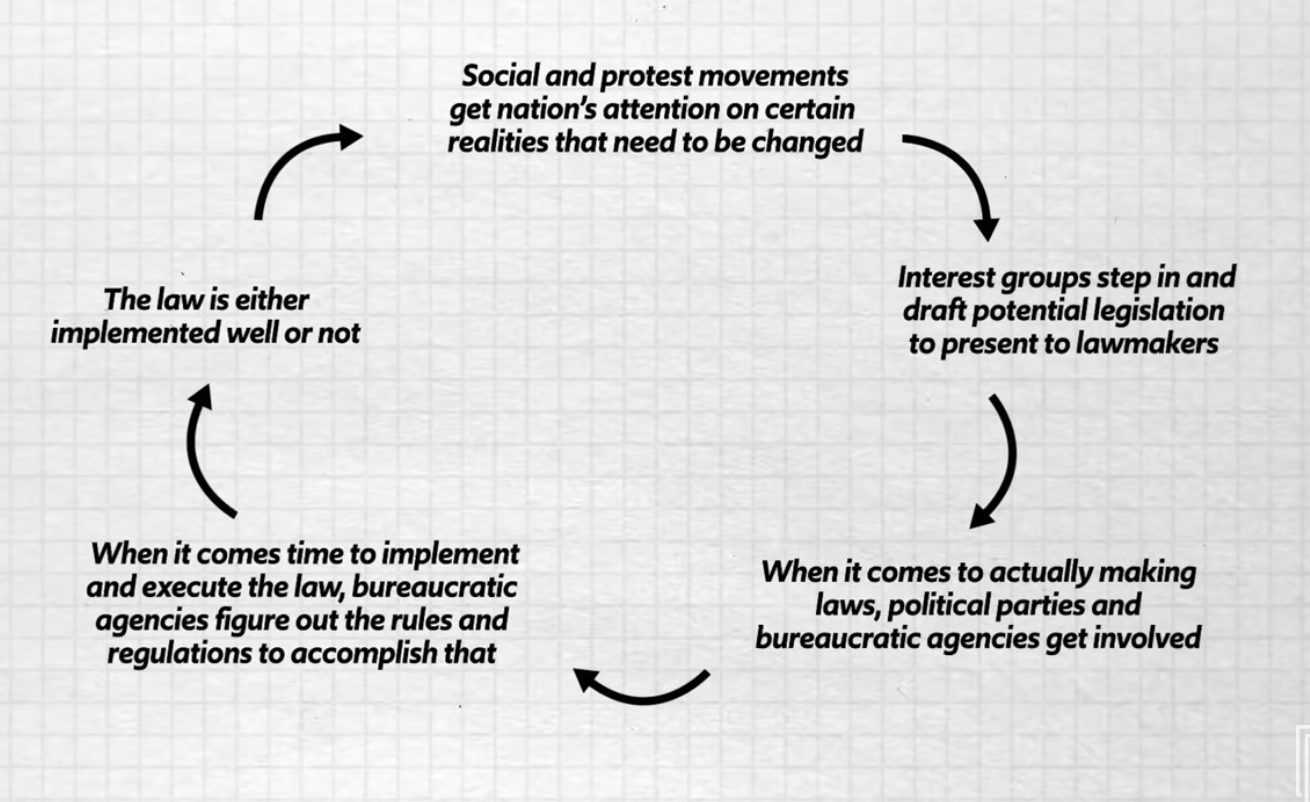
interest groups - a group of people who gather around a policy issue in order to persuade policymakers to pass legislation that they want
usually narrow interests
Stuff interest groups do:
they educate voters and office-holders on their chosen issue
engage in lobbying
draft legislation
mobilize its members to apply pressure on as well as work with legislators and government agencies
Grassroots lobbying: When ordinary citizens try to influence government officials by contacting them directly, often through letters, calls, protests, or social media, to express their opinions on an issue.
iron triangle: relationship between interest groups, congressional committees, and government agencies
Influences that hinder or help interest groups
their activity can be influenced by the inequality of political and economic resources
unequal access to decision-makers
free rider problem: when a larger group benefits from a smaller group within the group (when 2 people out of the 5 people in a group project do all the work but everyone still gets an A)
single-issue interest groups: devote all their time and money to one single problem (NRA)
opposite of that are social movement interest groups and protest movement interest groups
examples prohibition movement: women grouped together to get legislation to pass a law prohibiting the manufacturing of alcohol; civil rights movement
ELECTING A PRESIDENT
first, candidates need to earn their party’s nomination through primary elections; primary elections are held differently in each state (and some hold caucuses instead)
open primaries: any registered voter can vote in either party’s primary, but not both
closed primaries: only people registered with the party can vote in in that primary
In a caucus, voters discuss and debate before publicly voting
the winner of the primary and the chosen vice president is presented at the national convention
If a president has already served, the party usually keeps that candidate as their nominee
incumbent advantages
since they already have won an election, they know how it’s done
the incumbent is known
they already have an army of volunteers and fundraisers
election day is always the first Tuesday in November
The people don’t really get to elect the president due to the electoral college; winner-takes-all system
faithless electors: when the candidate who gets the electoral vote has less popular votes
in order to win they must receive 270/538 electoral votes
there is a debate over the electoral college
why we should keep the electoral college: forces candidates to campaign in all states rather than just those that are heavily populated
why we shouldn’t keep the electoral college: candidates actually spend most of their time in the swing states
Coattail effect: When a popular candidate at the top of the ticket (like a president) helps other candidates from the same party win in lower-level elections.
CONGRESSIONAL ELECTIONS
happen every 2 years
members of the House have two year terms
senators have 6 year terms (1/3 of them are up for elections every 2 years)
we vote for congressional representatives on the same day we vote for congressional
mid-term elections are in the year they don’t happen at the same time
there is still an incumbency advantage, and it is even more pronounced (95% of incumbents get reelected into office)
advantages: name recognition, track record, established funding, safe districts (they can gerrymander districts to lock in their elections)
candidates are also chosen my primary elections (open or closed)
CAMPAIGNING
political fundraising: has increased by massive billions in the past 30 years
the campaign season has gotten longer
increasing complexity: they higher consultants to help them
canvassing: volunteers who call and go door to door to help the candidate
reliance on social media
advertising (biggest chunk of their funding)
Federal Elections Campaign Act (FECA) 1974
Federal election commission: created to oversee/regulate the money being spent in political campaigns
established limits for: 1. how much money a person could give to a candidate, and 2. how much money candidates could spend on their campaign
people with the loudest voice have the most money
money = speech
Buckley v Valeyo: upholded 2, but decided to strike down 1
hard money - contributions given directly to a candidate (was being restricted in FEC)
soft money - donated to a party or interest group who then buys advertising on the candidates behalf (technically wasn’t restricted under FEC)
people just started using soft money donations
BCRA: increased the amount of hard money that could be given to the candidate, but passed regulations to make soft money transparent; “stand by your ad” provision (I’m ___ and I approve this message)
Citizens United v FEC
court ruled that the limits on contributions from individuals and corporations was a violation of free speech; corporate funding of ads and broadcasts can not be limited; political spending is a form of protected speech under the first amendment
PAC: organizations that raise money to influence the population to vote for their candidate
connected PACs: formed by corporations or other entities like labor unions; only collects funds from the members of their organizations which gets donated to candidates in limited quantities
non-connected PACs: formed independently (without an organization) usually with a specific public interest; donations are limited by law but can accept donations from the public which are then donated to the candidate
super PACs: can be formed by anyone, accepts unlimited donations, but can not directly coordinate with the candidate (most controversial)
MEDIA
newspaper, telegraph, radio, television, internet, social media
news is more news that we like, not what we need to know or what will challenge us
3 types of news: news events (covid, Vietnam war), investigative journalism (expose corruption), election coverage/political commentary
horse-race journalism: when it turns into a popularity contest instead of an accuracy contest
media bias: its become harder to detect due to algorithms
fairness doctrine (not in practice anymore): news outlets were required to broadcast both sides of issues (can be bad, like when cigarettes were popular)
two ways to detect media bias
determine the ideologcial preference of the reporters (most lean democrat
examine the character of the reporting itself
most newspapers main goal is to keep you watching and gain money, not to get you well-informed
social media can increase political participation
strong ties - bind a person to a cause through close relationships
weak tie - doesn’t require a close connection