Micro 8,10,11
Chapter 8 - Perfect Competiton
Order of curves on graph: MC, ATC, AVC, and then demand curves, which illustrate the relationship between price and quantity in the market.
Profitable Price: price greater then average cost. Sales - cost + Profit
As long as a company makes profit, competition will continue to join the market, causing the supply curve to shift right and decrease prices
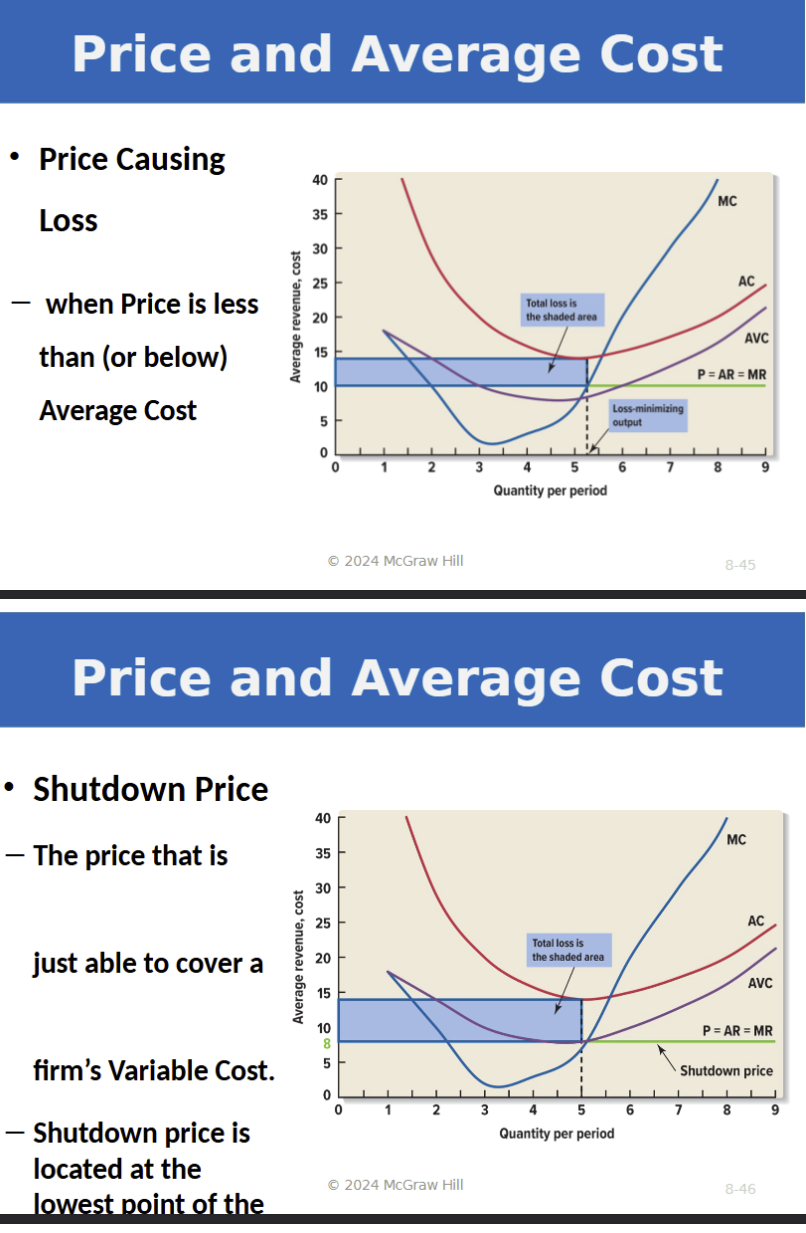
Break-Even point of graph: MC=ATC, which indicates the level of production at which total revenue equals total costs, resulting in neither profit nor loss.
Shut down price: the minimum price at which a firm can continue to operate in the short run, covering variable costs. If the market price falls below this point, the firm should cease production until conditions improve. MC=AVC
Perfect Completion: Price taker, product is homogenous, price is the min of ATC, consumer pays the least, resources used efficiently, long run producing is most effective
Market Equilibrium: Occurs where the quantity supplied equals the quantity demanded, ensuring that resources are allocated efficiently without surplus or shortage.
Long-Run Adjustments: In the long run, firms can enter or exit the market, leading to adjustments in supply until economic profits are zero, reinforcing the principle of perfect competition.
Industry: A group of producers, all producing a similar product
Market: Interaction of producer and consumers
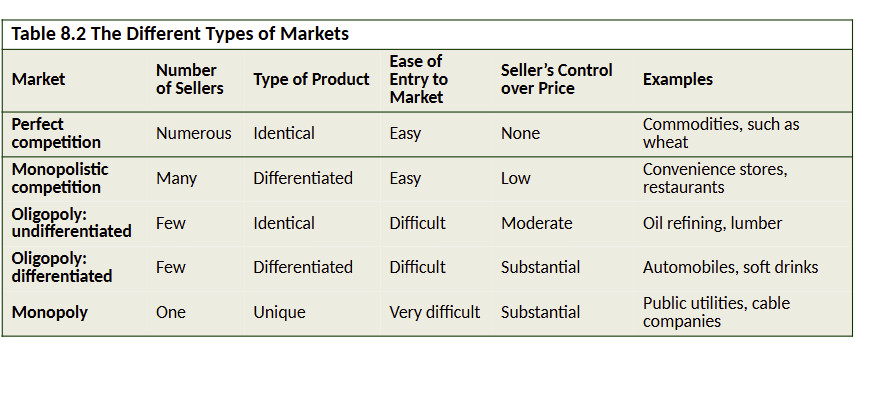
Hair Salon: Monopolistic comp
Industrial chemicals in Canada - undifferentiated
oligopolyCommercial breweries in Canada - differentiated oligopoly
World market for coffee - perfect competition
Rogers Cable in Ontario - monopoly
Perfect Competition: A market in which all
buyers and sellers are price takers
– Conditions:
– Many small buyers and sellers
– No preferences shown (undifferentiated product)
– Easy entry and exit by both buyers and sellers
– The same market information available to allFor competitive firm, Price=AR=MR
Total Profit: TR-TC
Profit Maximization
MR>MC produce more
MR<MC produce less
MR=MC is maximizing total profit
Different cost curves can be used to illustrate how different decisions are made by the firm.
the AVC curve is used to decide whether to produce at all or shut down
the MC curve is used to decide the best output,
the AC curve is used to determine the level of profit or loss.
Would a firm willingly produce at a loss?
YES, if the losses from production are less than total fixed costs, the firm should continue to product
NO, if the losses from production are more than total fixed costs, the firm should not continue to produce
Firm primary goal: profit maximization
Shut down price is any amount less then…? average variable cost
jdjdjd
Chapter 10 - Monopoly
The one firm is the industry, price maker
Barriers to Enter: technical, legal. economic
Computer operating systems: technical barrier
Commercial aircraft manufacturing: economic barrier
West coast salon fishing: legal barrier
Demand is a downward-sloping curve, must decrease the price in order to sell more
Total revenue increases as more units are sold, then starts to decline
Average revenue is identical to the demand curve
When marginal revenue is positive (or negative), total revenue is rising (or falling)
Total revenue is a maximum when marginal revenue is zero
The top half of any demand curve is elastic, the bottom half
is inelastic. This monopolist would never produce an output greater than 11, i.e., where the demand is inelasticTotal Profits
Max is TR-TC at the greatest amount
Break-even: TR=TC
Total Profit Curve shows the relationship between total profit and output level, indicating how profit varies as production increases. Max was TR slope=slope of TC (MR=MC)
Marginal Cost (MC): The cost of producing one additional unit, which affects total profit as output changes
Total Revenue (TR): The income generated from sales, which is essential for calculating profit.
Profit Maximization: Occurs where MR (Marginal Revenue) equals MC, ensuring that any increase in production will not decrease total profit.
Marginal Revenue less then price in monopoly: Because the lower price of the extra unit of output also applies to all prior units of output, resulting in a decrease in total revenue for each additional unit sold compared to a perfectly competitive market.
To increase its sales, a monopolist must reduce the price on ______: the whole unit of its output
Why are monopolist price maker: control total quantity supplied and control the price
When marginal revenue is ___, total revenue is increasing: positive
What is maximized when MR is equal to zero? Total revenue
Profit maximized for monopolist: MC=MR
an example of price discrimination among units purchased? A coffee shop which offers a free coffee for every six purchased.
Price Discrimination: when producers charge different customers different prices for the same good or service?
Compared to a perfectly competitive firm, a monopolist finds it profitable to charge a ______ price and supply a ______ quantity. higher, lower
Diminishing marginal utility leads to what kind of price discrimination? Discrimination among units purchased.
Chapter 11 - Imperfect Competition
Product Differentiation allows firms to create a distinct market presence, enabling them to charge higher prices for their unique offerings compared to homogeneous products in a competitive market.
Some control over prices in imperfect comp
Imperfect is split into two kinds
Oligopoly: Many firms offer similar but differentiated products, leading to some degree of pricing power. 4 big brands with over 40% control of the market. Use large advertisement, non-price competition.
When new firms enter a oligopoly, demand shifts left and it become flatter. Leading to normal profits in the long run
Concentration ratio is higher then 40% its a oligopoly
Monopolistic: Many small firms (car repair shops, restaurants), small advertisement, niche markets
Concentration ratio less then 40% its monopolistic, characterized by a higher number of firms competing in the market with limited pricing power.
Concerns with Monopolistic Competition
Produces at a lower output compared to perfect competition, does not achieve productive efficiency, charges higher prices then perfect competition and does not achieve allocative efficiency
Productive efficiency: Long-run equilibrium price does not equal minimum average total cost
Allocative efficiency: Price exceeds marginal cost
Blocking market entry to increase profits: if entry is blocked positive economic profits can be maintained in the long run.
this can be done though licensing, franchising and professional associations
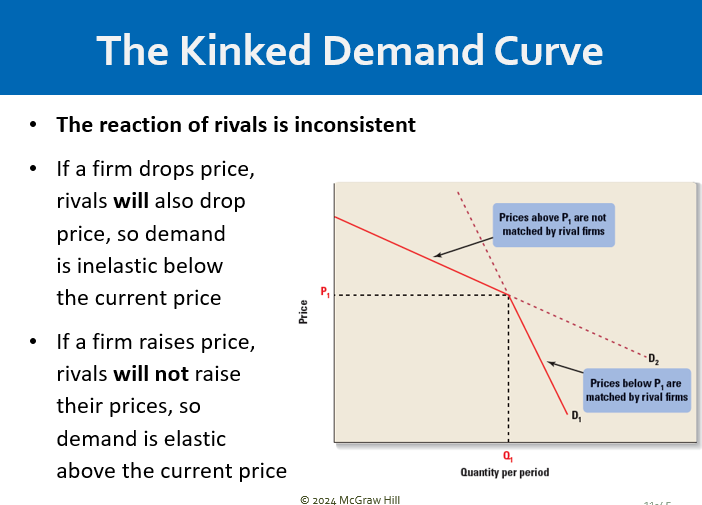
In a oligopoly mutual interdependence exists among firms, meaning that the actions of one firm directly affect the decisions of others, leading to strategic behavior in pricing and output.
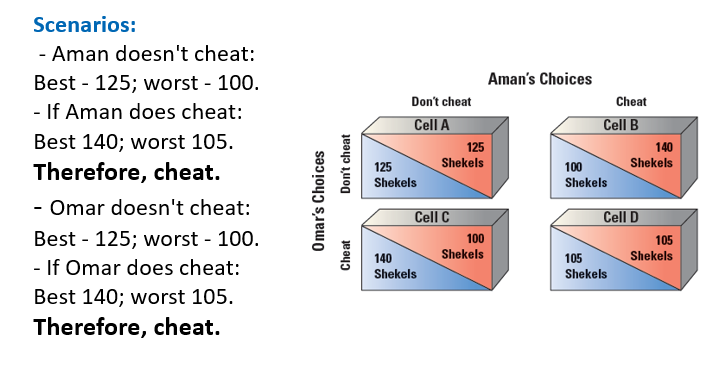
Game Theory, Nash Equilibrium: a situation where each rival chooses the best actions given the anticipated actions of the others
Collusive Oligopoly: Cartel
A cartel is a group of sellers that collude by restricting output to drive up prices benefiting members as long as they do not cheat.
A classic example of a cartel is the Organization of the Petroleum Exporting Countries (OPEC). OPEC is a group of countries that collaborate to control the production and pricing of oil on the global market. By coordinating their outputs, they aim to influence oil prices and stabilize the market, benefiting the member countries as long as they adhere to the agreed production levels.
Non-Collusive Oligopoly: Price Leadership
Price leadership occurs when one leading firm sets the price for the industry, and other firms in the market follow suit. This strategy allows the price leader to maintain market stability while also maximizing profits for all firms involved. Unlike a cartel, price leadership does not require formal agreements or collusion, making it a more flexible approach to managing competition within an oligopoly.
Monopolist would never produce in when the marginal revenue in the negative
Rising Moon must be operating in a monopolistically competitive market and is in long-run equilibrium. (This is because at the profit maximizing output, the firm is just breaking even and unlike perfect competition the firm is facing a downward-sloping demand curve.)