respiratory
Step 12: Respiratory System
Definition and Importance
A pulmonologist is a physician specializing in the respiratory system.
The respiratory system is crucial for bringing oxygen into contact with the bloodstream in the lungs.
The human body cannot survive without oxygen for more than three to five minutes.
Respiratory arrest (failure of lungs) and cardiac arrest (failure of the heart) can both lead to death.
Components of the Respiratory System
Anatomy
The respiratory system consists of air passages, pulmonary vessels, lungs, and breathing muscles.
Upper Airways:
Nose, mouth, pharynx (muscular tube).
Air Passage Flow:
Air enters through the upper airway, moves through the pharynx, and into the larynx (voice box).
The epiglottis prevents food and water from entering the respiratory tract.
Air continues into the trachea, which splits into bronchi—leading to the right and left lungs.
Lung Structure:
Each lung has branching tubes that terminate in alveoli (tiny air sacs) where gas exchange occurs.
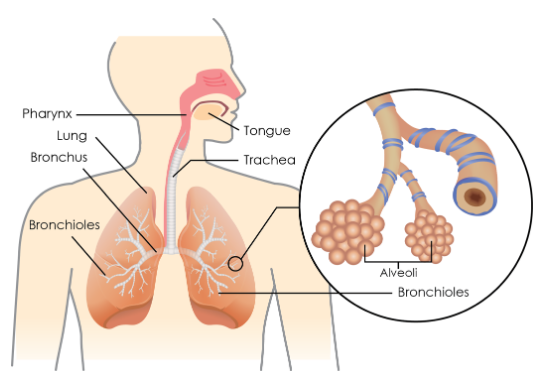
Functions of the Respiratory System
Gas Exchange
Oxygen enters and carbon dioxide exits the bloodstream in the alveoli via tiny vessels.
Ventilation (Breathing):
Inhaling (Inspiration):
Diaphragm contracts downward, causing the lungs to fill with air.
Exhaling (Expiration):
Diaphragm relaxes upward, forcing air out of the lungs.
Normal breathing occurs spontaneously 12-20 times per minute, moving about a pint of air each time.
Respiratory System Terminology
Combining Forms and Abbreviations:
alveoli/alveolus: air sac
pharyng/o: pharynx, throat
ARDS: acute respiratory distress syndrome
phon/o: voice, sound
bronch/o: bronchus
phren/o: diaphragm, mind
bronchiol/o: bronchiole
pleur/o: pleura, rib
capn/: carbon dioxide
pneum/o: air, gas, lung
COPD: chronic obstructive pulmonary disease
pulm/o, pulmon/o: lung
CPR: cardiopulmonary resuscitation
RDS: respiratory distress syndrome
CXR: chest x-ray
rhin/o: nose
DTaP: diphtheria, tetanus and pertussis
RLL: right lower lobe (of lung)
FEV: forced expiratory volume
RT: respiratory therapist
ICU: intensive care unit
RUL: right upper lobe (of lung)
IN: inhalation
SCLC: small cell lung cancer
laryng/larynx: voice box
SOB: shortness of breath
LLL: left lower lobe (of lung)
spir/o: breathe
LUL: left upper lobe (of lung)
T&A: tonsils and adenoids
MDI: metered-dose inhaler
TB: tuberculosis
Page 2: Respiratory Disorders and Impacts
Pathogen Exposure
Each breath can carry microorganisms (viruses and bacteria) that can impact respiratory health.
Most microorganisms are harmless, but some can cause serious respiratory illnesses.
Common Respiratory Illnesses:
Upper Airway Conditions:
Common cold: affects only upper airways.
Lower Respiratory Diseases:
Bronchitis: inflammation of the bronchi.
Pneumonia: infection inflaming air sacs in lungs.
Chronic Conditions:
Emphysema:
Alveoli enlarge, destroying walls and capillaries, leading to breathing difficulties and low blood oxygen.
Asthma:
Airways narrow and swell, producing excess mucus—causing wheezing and shortness of breath.
Lung Cancer:
Growth of abnormal cells in lungs, caused by irritants (cigarette smoke, asbestos, radiation).
Begins as a tumor in bronchi, leading to pain, coughing, and difficulty breathing.
Survival rates are improving with new therapies.