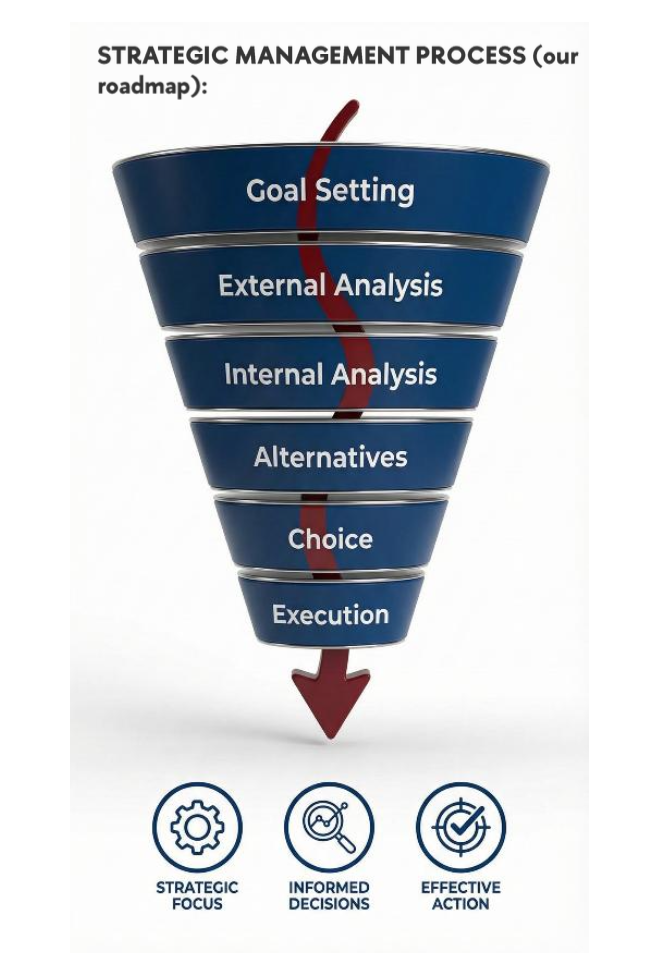
Stratman 1
Historical Evolution of Strategic Management
Military Foundations:
Century BC ("Strategos"): Derived from the ancient Greek term for "military leader," defined as managing limited resources to achieve victory.
Century BC (Sun Tzu - "The Art of War"): Championed the principle of "Win without fighting." Emphasized knowing oneself and the enemy, serving as the historical prototype for SWOT analysis.
(Carl von Clausewitz - "On War"): Coined the term "Fog of war," representing pervasive uncertainty and incomplete information in strategic environments.
Transition to Business ():
Military principles translated directly into corporate environments due to shared fundamental dynamics: allocation of limited resources, competition for market position, operating under uncertainty, and the necessity of making explicit trade-offs.
Evolution of Management Systems:
(Budgeting System):
Predictability: History-driven assumption that the past repeats itself.
Speed of Change: Slower than the organization's pace.
Core Focus: Maintaining stability.
(Strategic Planning System):
Predictability: Assumption that new events can be accurately forecasted.
Speed of Change: Faster than the organization's pace.
Core Focus: Forecasting and prediction.
(Strategic Management System):
Predictability: Only weak signals are available, if any.
Speed of Change: Much faster than the organization's pace.
Core Focus: Innovativeness and adaptive capabilities.
Environmental Frameworks: VUCA vs. BANI
VUCA Framework ():
Volatility: High turbulence and frequency of change.
Uncertainty: Unpredictability of future events.
Complexity: Interconnectedness of numerous variables.
Ambiguity: Lack of clarity regarding cause-and-effect relationships.
Traditional Response: Operating under a plan-and-control paradigm.
BANI Framework ( by Jamais Cascio):
Brittle: Fragility of structural systems (e.g., global systemic disruptions like pandemics).
Anxious: High anxiety driven by information overload and ongoing crises (e.g., infodemics).
Nonlinear: Small initial causes produce disproportionately huge consequences.
Incomprehensible: Events and outcomes that defy standard logic or rationale.
Modern Imperative: Adaptation as a fundamental survival mechanism ("adapt or die").
Core Conceptual Foundations: Strategy vs Ambition vs Tactics
The Conceptual Hierarchy:
Ambition: Represents a goal without a plan to achieve it. Statements like "Become #1 in the market" or "Double revenue" are ambitions, not strategies.
Strategy: The vital connecting link that answers "How will we get there?" from "Where do we want to go?". Defined as a unique market positioning supported by trade-offs and a coherent activity system.
Tactics: Specific operational actions not the logic of competition. Actions like "Cut prices by " or "Launch advertising on Instagram" are tactics, not strategies.
Operational Efficiency vs. Strategy:
Operational Efficiency (OE): Performing the same operational activities as competitors, but doing them better, faster, or cheaper (e.g., Six Sigma, Lean Manufacturing, Total Quality Management / TQM). All players compete on the same track, with the fastest runner winning.
Strategy: Performing fundamentally different activities from competitors, OR performing similar activities in a radically different manner (e.g., Cirque du Soleil, Netflix, Nespresso, Costco). Choosing a separate track to create a distinct game.
Porter's Principle (): "Operational efficiency is necessary but insufficient for sustainable advantage."
The Productivity Frontier:
Definition: The maximum economic value created at a given cost level using existing best practices.
Operational Efficiency Impact: Drives movement toward the productivity frontier.
Strategic Impact: Dictates choosing a unique, defensible position ON the productivity frontier.
The Competitive Pitfall: When all industry players converge on the productivity frontier, competition turns into destructive hyper-competition and mutual exhaustion.

Strategic Trade-offs and Activity Systems
Case Study: Southwest Airlines:
Refusals (What They Do NOT Do):
No on-board meals.
No assigned seats.
No flight connections at major congested hubs.
No mixed aircraft types.
No premium business class.
Impact: Every refusal directly reduces costs and minimizes turnaround time. (speed it up)
Choices (What They DO):
Ultra-low ticket prices (fare leader).
Rapid gate turnarounds (<25\,m\imaginaryI n ).
Point-to-point regional flight network.
Single standardized fleet (Boeing 737).
High flight frequency across secondary airports.
Impact: Every positive choice reinforces the core advantage of speed combined with low price.
Porter's Fit Principle and Activity Maps:
Fit Concept: "Fit locks out imitators — you need to copy the entire web, not individual threads."
Systemic Interlocking Elements: A single fleet enables simplified maintenance and rapid boarding, enabling point-to-point flying from secondary airports, yielding maximum aircraft utilization, driving down prices, and achieving high speed.

Strategy Formulation and Realization: Mintzberg's 5 Ps
Mintzberg's 5 "Ps" of Strategy ():
Plan: Consciously intended course of action.
Ploy: Specific tactical maneuver intended to outwit a competitor.
Pattern: Realized stream of actions over time ( ; strategy must be judged by deeds, not words).
Position: Specific location of products/services within the market environment.
Perspective: Overarching worldview, strategy-in-mind, or organizational culture.
Pattern: Represents the actual behavior and actions that unfold over time within an organization. It highlights the distinction between the intended strategy (the Plan) and what truly occurs in practice. The pattern is often unpredictable and can emerge from the cumulative effects of numerous small decisions and actions rather than a coherent, top-down directive. This aspect is vital because organizations must recognize that their actions may diverge from their plans in response to market dynamics, competitive pressures, and internal changes. Successful strategies frequently arise from this emergent pattern, demonstrating that flexibility and adaptability can lead to unexpected opportunities and innovative outcomes.
Plan: Refers to the intended course of action that an organization aims to follow to achieve its strategic objectives. It is a formalized process that outlines specific steps, resource allocations, timelines, and responsibilities designed to guide the organization toward its goals. While essential for providing direction, a rigid adherence to a Plan can limit a company's capacity to respond to changing environments and emerging trends, leading to strategic inertia. A Plan may not take into account the complexities and realities of the operational landscape, hence understanding that strategy is more than just well-crafted documents is critical for effective management. Recognizing the interplay between Plan and Pattern helps leaders align their intended strategies with the adaptive behaviors of their teams and the demands of their environment.
The Strategy Realization Framework:
Intended (Planned) Strategy: Original deliberate design formulated by leadership.
Unrealized Strategy: Components of the intended plan abandoned due to unfeasibility or changing market conditions.
Deliberate Strategy: Realized portions of the original intended strategy.
Emergent Strategy: Spontaneous patterns of action that arise in response to unanticipated opportunities or threats.
Realized Strategy: The actual final strategy executed ().

Case Study: Honda Super Cub ():
Deliberate Plan: Export and market large-displacement motorcycles () to established American bikers.
Failure: Large bikes experienced frequent mechanical failures during long-distance U.S. driving, and core U.S. bikers rejected the brand.
Emergent Reality (): U.S. Honda employees used lightweight Super Cub scooters for personal urban errands. Local citizens expressed interest in buying them. Management made a spontaneous strategic pivot to distribute Super Cubs through sporting goods retailers.
Result: Captured of the total U.S. motorcycle market, created an entirely new customer category, and established the iconic campaign "You meet the nicest people on a Honda."
Strategic Lesson: Success was achieved through adaptive emergence rather than rigid adherence to strategic planning; success requires market responsiveness and willingness to abandon invalid deliberate plans.
Martin Reeves' Strategy Palette
Framework Overview (Reeves, BCG, ):
Evaluates strategic management styles along two primary environmental dimensions: Unpredictability (low vs. high) and Malleability / Ability to Shape (low vs. high).
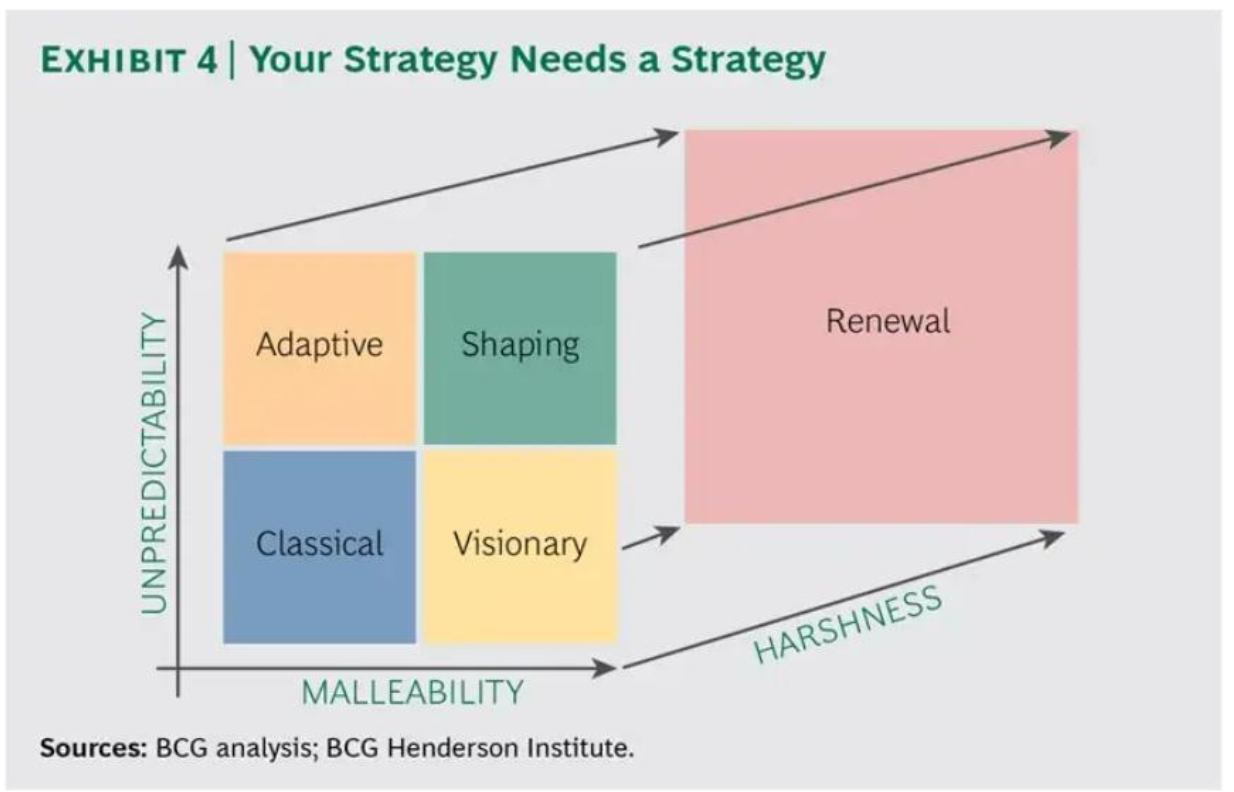
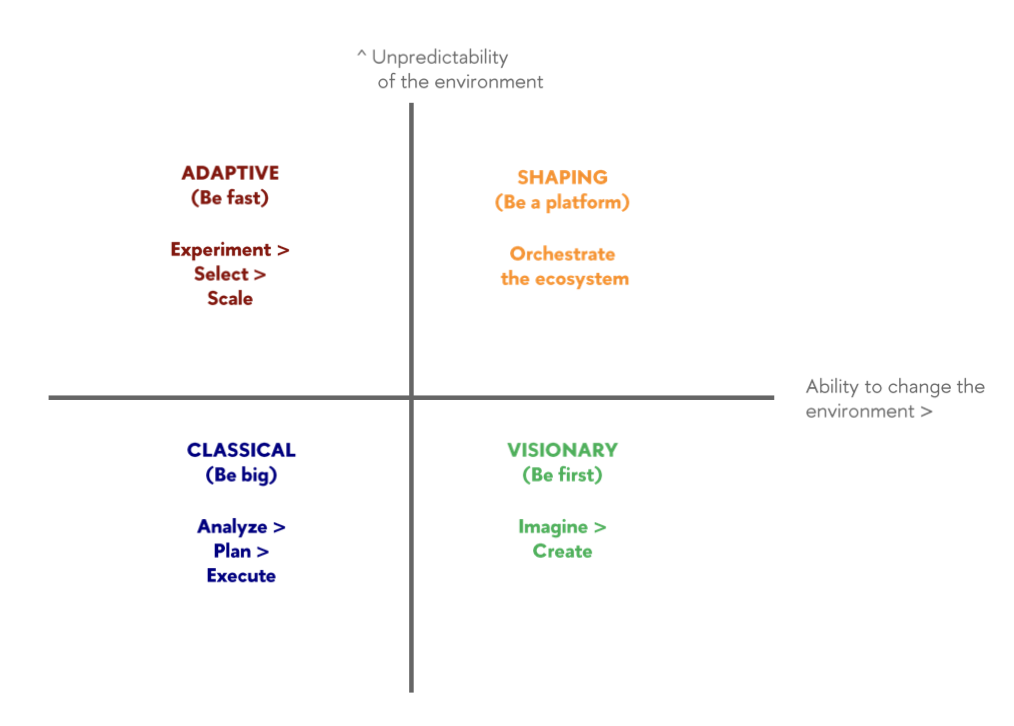
The Four Strategic Styles:
Classical Style ("Be Big"):
Environment: Low unpredictability, low malleability (stable environment).
Strategic Process: Analyze Plan Execute.
Key Drivers: Economies of scale and operational efficiency.
Examples: Traditional Oil & Gas sector, Toyota Production System.
Adaptive Style ("Be Fast"):
Environment: High unpredictability, low malleability (chaotic environment where rules cannot be changed).
Strategic Process: Experiment Select Scale.
Key Drivers: Rapid reaction speed and iterative learning.
Example: Fast-fashion retailer Zara ( collections per year with a design-to-rack turnaround).
Visionary Style ("Be First"):
Environment: Low unpredictability, high malleability (predictable dynamic capability to create markets).
Strategic Process: Imagine Create.
Key Drivers: First-mover foresight and disruptive innovation.
Examples: SpaceX (reusable rocketry), Apple iPhone.
Shaping Style ("Be a Platform"):
Environment: High unpredictability, high malleability (turbulent environment where the firm can set ecosystem rules).
Strategic Process: Orchestrate the broader ecosystem.
Key Drivers: Multi-sided platform dynamics and network effects.
Examples: Alibaba, Uber, Apple iOS, Google Android.
Organizational Failure Modes
Cause 1: Blindness to Environmental Change:
Case Study: Nokia ().
Context: Held a dominant global mobile market share but missed the smartphone transition, dismissing the touch-screen iPhone as an unviable item.
Strategic Misstep: Mismatched execution by persisting with a Classical strategic style in a Visionary environment.
Cause 2: Internal Inertia and Fear of Cannibalization:
Case Study: Kodak ().
Context: Engineered the world's first digital camera in but suppressed the innovation internally to protect high-margin film revenue.
Strategic Misstep: Succumbed to internal inertia and fear of self-cannibalization ("Yesterday's success becomes today's vulnerability").
Key Strategic Takeaways
Strategy vs. Operational Efficiency: Avoid competing purely by running faster on the same track; design a fundamentally unique operational track.
Strategic Discipline via Refusals: Sustainable barriers to competitive imitation rely on explicit trade-offs combined with a tightly aligned Activity Map.
Context Alignment: Realized strategy is defined by actual behavioral patterns over time, requiring alignment of managerial approach with environmental conditions via the Strategy Palette.