Psychology- How do people learn and remember
Classical Conditioning
What is learning?= Learning is described as a relatively permanent change in behaviour that occurs as a result of experience.
-It can be active or passive.
-Sometimes the results of learning might be immediate, or delayed after the learning has taken place.
-Learning is seen as a psychological construct.
What is classical conditioning?= Refers to a type of learning that occurs through the repeated association of two (or more) different stimuli, producing a specific response that did not occur originally.
-Behaviourist approach to learning.
What is a stimulus?= Any object/event that elicits a response from an organism.
What is a response?= A reaction by an organism to a stimulus.
What is neutral stimulus (NS)= A stimulus that does not initially elicit a response.
What is an unconditioned stimulus (UCS)?= A stimulus that elicits a reflexive response.
What is an unconditioned response (UCR)= A natural (unlearned) behaviour given to a stimulus.
What is a conditioned stimulus (CS)= A stimulus that elicits a response due to it being paired with an unconditioned stimulus.
What is a conditioned response (CR)= A response caused by the conditioned stimulus.
The three phases of conditioning= Before conditioning, during conditioning and after conditioning.
Before conditioning=
NS (Neutral Stimulus) - No relevant response.
UCS (Unconditioned Stimulus) - UCR (Unconditioned response).
-The NS is a stimulus that does not initially elicit a response.
-The UCS is a stimulus that elicits an involuntary response.
-The response it produces is known as an UCR.
During conditioning=
NS + UCS = UCR.
- NS is paired repeatedly with the UCS to produce a CR.
-This ensures the organism comes to associate the NS with the UCR originally produced by the UCS.
After Conditioning=
CS (Conditioned Stimulus)- CR (Conditioned Response).
-After multiple pairings of the NS and the UCS, the NS now becomes the CS.
-This new learned response is called the CR, which occurs in response to the CS.
Using the language of classical conditioning- Template
Before conditioning: NS — produces no response. UCS —- leads to UCR —-.
During conditioning: NS — is repeatedly paired and presented immediately before the UCS — to produce the UCR —.
After conditioning: NS becomes CS. CS — leads to CR —.
Operant Conditioning
What is operant conditioning?=
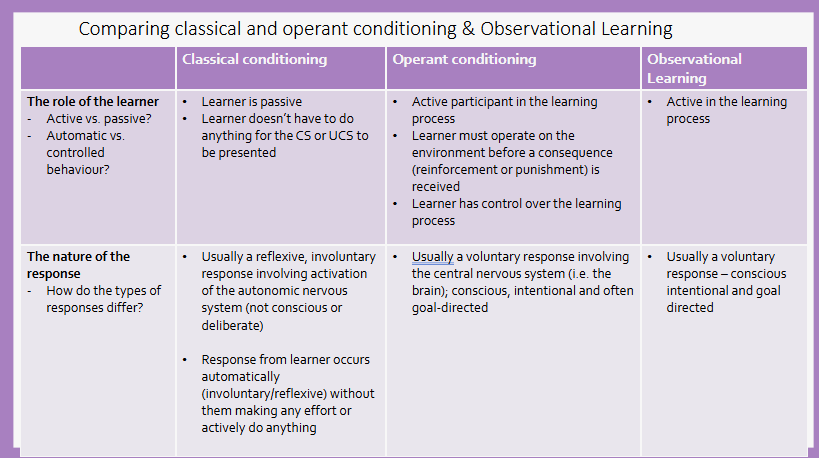
-Theory of learning that suggests that consequences of an action (positive or negative) determine like likelihood that it will be performed again in the future.
-Behaviourist approach to learning.
-An organism will repeat a behaviour that has desireable consequences.
-Repeat a behaviour that will allow it to avoid undersirable consequences.
-Won’t repeat a behaviour that has undesireable consequences.
-Positive consequences strengthen the behaviour.
-Negative consequences weaken the behaviour.
-Operant conditioning involves voluntary actions/behaviours (operants) as opposed to classical which is involuntary and reflexive.
Three phase model of operant conditioning=
-The three phase model of operant conditioning.
-The antecedent (A) that triggers/occurs before a particular response/behaviour/action.
-The behaviour (B) the learner’s voluntary response to antecedent.
-The consequence (C) the event that follows the response- making behaviour more or, less likely to be repeated.
-Antecedent (A) - behaviour (B) - Consequence (B).
Negative vs Positive: Operant Conditioning=
Positive: + (adding) something to increase or decrease behaviour.
Negative: - (taking away) something to increase or decrease behaviour.
Reinforcement=
-Said to occur when a stimulus ( a reinforcer; such as an object or event) strengthens or increases the frequency or likelihood of a response that it follows.
-Reinforcer: a stimulus.
-Reinforcement: act of giving the stimulus.
-Any form of reinforcement strengthens the behaviour.
Positive reinforcement: Occurs from giving/adding a positive reinforcer- something pleasant/desirable after the desires response has been made.
Negative reinforcement: The taking away or the avoidance of an unpleasant stimulus.
Punishment=
-Any form of punishment weakens or decreases the behaviour from occuring again.
Positive punishment: the giving/presentation of an unpleasant stimulus which decreases the strength/likelihood of the response occuring again.
Negative punishment: the removal or loss of a pleasant/desirable stimulus, thereby decreasing or weakening the likelihood of the response occuring again.
Something is added: Positive reinforcement (Increases the behaviour), Positive punishment (Decreases the behaviour)
Something is taken away: Negative reinforcement (Increases the behaviour), Negative punishment (Decreases the behaviour)
Positive reinforcement=
Giving something wanted/desirable e.g. a reward to encourage positive behaviour.
Positive Punishment=
Giving something unwanted/desirable to discourage negative behaviour.
Negative reinforcement=
Taking away something unwanted/undesirable to encourage positive behaviour.
Negative punishment=
Taking away something wanted/desirable to discourage negative behaviour.
Observational Learning
What is observational learning?=
Can be described as learning through watching and/or listening to others.
-Occurs when someone uses observation of a model’s actions and the consequences of those actions to guide their own future actions.
Model: Who or what is being observed.
-Observational learning is often referred to as ‘modelling’ or ‘social learning’.
What is the Observational Learning Process?
Attention: the first stage of observational learning in which individuals actively focus on the model’s behaviour and the consequences of the behaviour.
Retention: the second stage of observational learning in which individuals create a mental representation to remember the model’s demonstrated behaviour.
Reproduction: the third stage of observational learning in which the individual must have the physical and mental capabilities to replicate the behaviour.
Motivation: the fourth stage of observational learning in which the individual must want to reproduce the behaviour.
Reinforcement: the fifth stage of observational learning in which the individual receives a positive consequence for the behaviour which makes them more likely to reproduce the behaviour again in the future.
Aboriginal and Torres Strait Islander Approaches to Learning
Systems of knowledge=
The knowledge and skills that are based on interconnected social, physical, and spiritual understandings, and in turn, inform survival and contribute to a strong sense of identity.
-AICs approaches to learning are multimodal by nature, meaning that they use a variety of methods and are all interconnected with one another.
8 Ways Framework
Story Sharing= Approaching learning through narrative.
Learning Maps= Explicitly mapping/visualising processes.
Non-verbal= Applying intra-personal and kinaesthetic skills to thinking and learning.
Symbols and images= Using images and metaphors to understand concepts and content.
Land Links= Place-based learning, linking content to local land and place.
Non-linear= Producing innovations and understanding by thinking laterally or combining systems.
Deconstruct/reconstruct=. Modelling and scaffolding, working from wholes to parts (watch then do).
Community Links= Centring local viewpoints, applying learning for community benefit.
Atkinson-Shiffrin Model
Memory= Can be defined as the processing, storage and retrieval of information acquired through learning.
-It is an active information processing system that ‘encodes’, ‘stores’, and ‘retrieves’ information.
Encoding= The process of converting raw information to useable form.
Storage= Information which is retained overtime so it can be accessed and used in the future.
Retrieval= Recovery of stored information.
Atkinson-Shiffrin multi-store model of memory= A model of memory which outlines the three separate stores of memory (sensory, short-term, and long-term) each of which interact through the process of encoding, storage and retrieval.
All incoming information enters sensory memory; a store of memory which very briefly stores raw information detected by the senses.
Short-term memory (STM) is a store of memory that temporarily stores a limited amount of information that is consciously being attended to and actively manipulated.
Encoding is the process of converting information into a useable form which can be manipulated and stored in the brain.
-Information from STM is encoded into long-term memory (LTM), which is a store of memory in which a potentially unlimited amount of information is stored for a relatively permanent amount of time.
Information stored in LTM can also be retrieved.
-Retrieval is the process of accessing information.
Sensory Memory
Sensory memory= A store of memory which very briefly stores raw info detected by the senses.
-The capacity of sensory memory is potentially unlimited.
-Duration approximately 0.2-4 seconds.
Types of sensory memory
Iconic memory-
-Visual sensory memory.
-Duration- 0.2-0.5 seconds.
-Capacity- unlimited.
Echoic memory-
-Auditory sensory memory.
-Duration- 3-4 seconds.
-Capacity- unlimited.
Haptic memory-
-Tactile sensory memory.
-Duration- under 2 seconds.
-Capacity- unlimited.
Short term memory= A store of memory that temporarily stores a limited amount of information that is consciously being attended to and actively manipulated,
-Memory system with limited capacity.
-Duration- 18-30 seconds.
Capacity- limited to 7+2 bits of information/ 5-9 items
Long term memory= A store of memory in which potentially unlimited amount of information is stored for a relatively permanent amount of time.
Explicit memory
Explicit- information can be consciously or intentionally be retrieved and stated (declared).
Episodic- personal experiences.
Semantic- facts and knowledge about the world.
Implicit Memory
Implicit- memory that does not require conscious retrieval (memory without awareness, difficult to declare in words).
Procedural- motor skills and actions, how to do things.
Classical conditioned= conditioned responses to stimuli, particularly fearful/anxiety inducing.
What are the strengths of the Atkinson- Shiffrin Multi-store Model of memory
-Distinguishes between the different stores involved in memory.
-The model outlines that each memory store has a different capacity and duration.
-Findings from memory studies support the distinction between STM and LTM.
Limitations
-Oversimplified model.
-STM is more complex than the model suggests.
-Model ignores factors, such as motivations and strategy which can facilitate learning and assist in encoding information.
-This model does not account for individual differences.
Brain Structures Involved in Memory
What is the hippocampus?= A brain structure that is primarily involved in encoding explicit memories.
What is the amygdala?= A brain structure that is primarily involved in encoding the emotional components of memory.
-Plays a role in processing and regulating emoional reactions, particularly fear and anger.
-It has a role in the formation of a wide range of emotional memories and research on this has tended to focus on its role in classically conditioned fear responses.
What is the neocortex?= A brain structure that stores explicit memories.
What is the cerebellum?= A brain structure involved in encoding and storing implicit memories.
-Specifically those related to unconscious habits, simple reflexes, or procedural sequences of precise movements.
What is the basal ganglia?= A brain structure involved in encoding and storing implicit memories, specifically related to habit formation, procedural sequences of movements reward pathways.
The role of episodic and semantic memory in retrieving autobiographical events
-Episodic memory is often associated with autobiographical events, which refer to personally lived experiences.
-Retrieval is the process of accessing information that has been stored in long-term memory and bringing it into our conscious awareness in short-term memory.
-The hippocampus is involved in the retrieval of episodic memories.
Constructing possible imagined futures
-Episodic and semantic memory are also involved in constructing possible imagined futures.
Imagined futures= hypothetical experiences and situations that an individual has the ability to create and conceptualise in their mind.
-Brain regions involved in the retrieval of autobiographical memories are also activated when people construct possible imagined futures.
Alzheimer’s disease
-Neurodegenerative disease= diseases characterised by the progressive loss of neurons in the brain.
-Alzheimer’s disease is an example of a neurodegenerative disease.
-One of the symptoms is a decrease in cognitive functions.
-Diagnosis of Alzheimer’s disease can only be made through post-mortem examination.
-Lesions are predominantly identified in the hippocampus.
The two primary lesions associated with Alzheimer’s disease are:
-Amyloid plaques, which are fragments of the protein beta-amyloid that accumulate into insoluble plaques that inhibit communication between neurons.
-Neurofibrillary tangles, which are an accumulation of the protein tau.
-As damage can be associated with the hippocampus, patients with Alzheimer’s disease may struggle to remember semantic and episodic components of personally experienced events.
Aphantasia
Aphantasia= a phenomenon in which individuals lack the capacity to generate mental imagery.
Mental imagery= the visual representations and experiences of sensory information without the presence of sensory stimuli.
-Research shows that people with aphantasia struggle to retrieve autobiographical events and construct possible imagined futures.
Mnemonics
Written traditions= practices in which knowledge, stories and customs are shared primarily through writing and reading.
Mnemonics= devices or techniques used to aid the encoding, storage, and retrieval of information.
Purpose: aid the encoding, storage and retrieval of memory.
-They do this by organising and linking new information to fit in with existing information in LTM, improving initial encoding of information.
Acronym= mnemonic device in which the first letters of items from a pronounceable word to aid memory.
Acrostic= mnemonic device in which the first letters of an item create a phrase, rhyme, or poem to aid memory.
The method of loci= mnemonic device that converts items into mental images and associates them with specific locations to aid memory.
Oral traditions= practices in which knowledge, stories, and customs are preserved and shared through spoken word and movement.
Sung narratives= stories that share important cultural, ecological, and survival information through the use of singing, harmony and rhythm.
Songlines= multimodal performances conducted as a family or community travels through country and spaces in the landscape that record journeys, link important sites, and describe ways to live, care for and nurture country.