Organizing the Police Department
Police Organization and Leadership
Buracratic Organization Structure
Characteristics of Bureaucracy
A defined hierarchy of authority
Impersonal rules
Written rules of conduct
Protect cops from liabilities
Must be trained on the rules and signed off
If you need to diverge from the rules, then you need to be prepared to justify your reasoning
Promotion based solely on achievement
We should be promoting people who are good officers, show up, are leaders, take care of the community,
Promote based on merrit, not sinority
Specialized division of labor
Policing is very divided, the job is not just being a detective (you must be a police officer first)
Different units (child abuse, murder, traffic)
Criticisms of Bureaucratic Organizational Structure
Bureaucratic organizational structure too rigid.
1970s: adoption of democratic management.
The professionalization of police era in LA started the bureacratic system
1980s: Community Oriented Policing
Getting rid of most of the middle managers
Shrink higherarcy, people in the community want things done immediatly
Empower police officers to make decision on their own, without having to go to their middle managers
Police accredidation is a 3 year process
Sikler doesn’t like police unions
Unions are how you keep a bad cop around
Police are street level burecrats
Cops are lazy, they are good at shifting responsibility to another agency
Stand around doing nothing
Organizational Theories (super important!)
System Theories
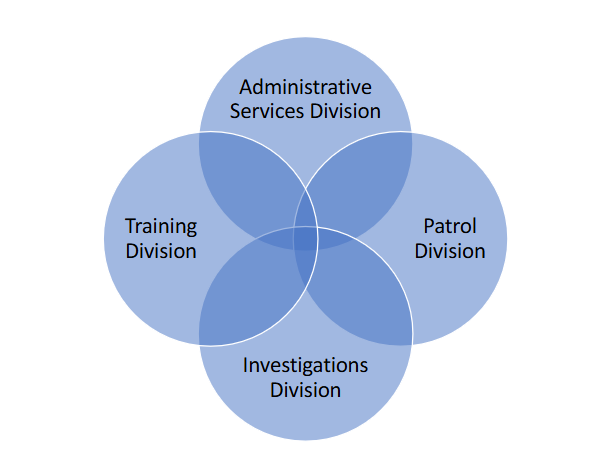
Must have all of these
defunding the police → defunding the training
Police is interconnected, all working together!
Training is important!
Contingency Theory - Look at this (ON THE TEST)

Institutional Theory - (ON THE TEST)
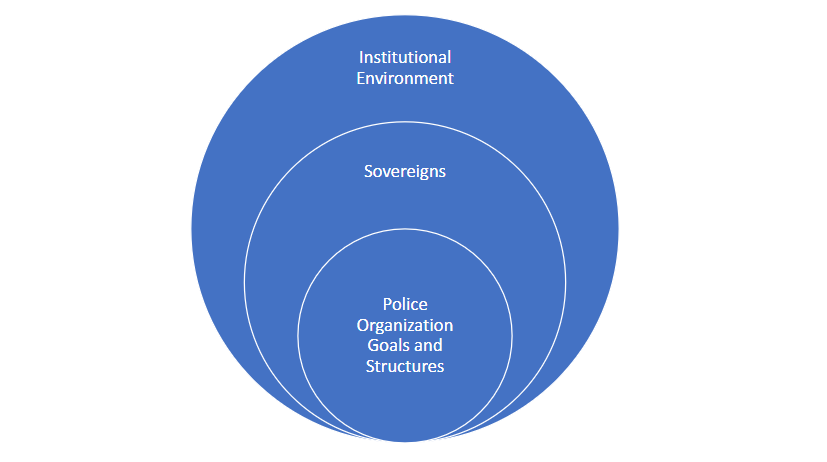
Police must be legitimized in their jurisdiction
If public views police in a positive light, they are more likely to obey the law, support the police
If they don’t respect the police, the public will not obey the law
They will stop at a stopsign
Resource Dependency Theory - (ON THE TEST)

Altering Police Organizations
Community Policing
Decentralization: bottom-up approach.
Creates precints, store-front police departments, so that citizens can stop in
Small amount of middle managers
Creation of a more diverse police force.
Women are wanted in policing → they will be taken by other agencies
Women don’t get as agressive, deal with threats better
Better at communicating, descalation
Not all agencies fully adopting community policing.
COMPSTAT
Four principles.
Goal: overcome weaknesses of traditional model.
Criticisms: reinforces hierarchy.
Study findings: little impact.
Civil Service System
Creation: cut out political corruption.
Goal: provide level playing field.
Benefits: led to diversification.
Criticisms: system inflexible
Police Unions/Associations
Personnel standards.
Seniority - Assignment of police officers.
Discipline of police officers and accountability.
Collective Bargaining – Municipal finances/budgets.
Political Influence impacts politics.
Accreditation
Commission on Accreditation for Law Enforcement Agencies (CALEA).
Criticisms of accreditation: lack of oversight, cost.
Positive outcomes: training, diversity.
Police Leadership:
Police Chiefs and Leadership Style
Police Chiefs
Main representatives of police organizations.
Size of organization influences duties.
Tenure quite short.
Leadership Styles
Transformational-style leader.
Transactional-style leader.
Bureaucratic-style leader.
Machiavellian-style leader.
Social contract–style leader.
Police Field Supervisors
Police Field Supervisors
Traditional supervisors.
Innovative supervisors.
Supportive supervisors.
Active supervisors.
Managing Personnel Issues
Stress
Bureaucratic structure.
Workload.
Police subculture.
“Second shift.”
Suicide.
Physical illness
Burnout
Prolonged response to stress.
Influenced by rewards of police work within the organization.
Increased with use of body-worn cameras.
Job Satisfaction
Officer perception of their organization is most important.
Supervisors affect officers’ attitudes.
Foot patrol and community policing increase satisfaction.
Cynicism
Niederhoffer: decreased idealism.
David Klinger: acts of police brutality.
2007 study: race and cynicism.
Organizational cynicism.
Morale
Influenced by relationship with public.
Changes based on high-profile shootings: Laquan McDonald.
Ferguson Effect.