PY 131 Chapter 7: Energy
Work and Energy
Newton described the Universe in terms of position, velocity, acceleration, force, momentum…
- There exists an alternative, complimentary, description based on the concepts of work and energy.
- ==Work and Energy are scalars==: they have no direction
Work
- Work has a very precise definition in physics. The work done by a force on an object is the product of the distance moved by the object and the component of the force in the direction of the object's displacement.
- W=F×d
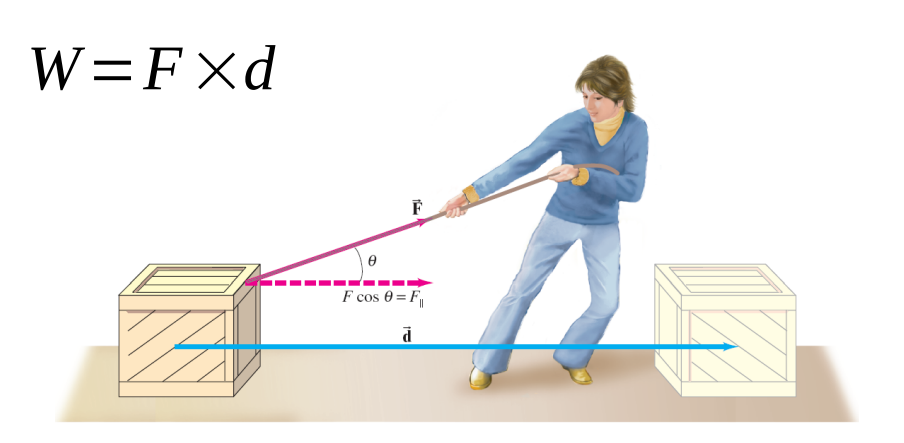
- The SI unit of work is the joule – symbol J.
- One joule is the work done by a force of 1 N upon an object which moves 1 m in the direction of the force.
- It is possible to apply a force and yet do no work.
- A force can do negative work if it is directed opposite the displacement. The net work done on an object is the sum of the work done by each separate force acting on the object.
Power
- Power also has a very precise meaning in physics.
- Power is the rate at which a force does work.
- If a force does an amount of work in a certain time interval then the power of that force is
- Power= work done/ time interval
- The SI unit of power is the watt, W, or J/s.
QUESTION 1:
Is it possible to do work on an object that remains at rest?
- ==Yes, it’s possible.==
Work-Energy Principle
- The work done by the net force is
- W_net = ΣW= F_net×d
- We define the (translational) kinetic energy as
- K= (mv^2)/2
- The SI units of kinetic energy are also joules.
- Then it is possible to show that the work done by the net force is equal to the change in the kinetic energy.
- W_net =K_final−K_initial= ΔK
- The work-energy principle is:
The net work done on an object is equal to the change in the object's kinetic energy.
- Objects whose velocity only changes direction do not change their kinetic energy.
QUESTION 1:
Two stones, one twice the mass of the other, are dropped from a cliff. Just before hitting the ground, the kinetic energy of the heavy stone compared to the light one is?
- Since K=(mv^2)/2… K_1 = (mv^2)/2 and K_2= (2mv^2)/2, ==the KE of the larger stone is 2x greater than the other.==
QUESTION 2:
A car accelerates from 0 to 30 mph. Later it accelerates from 30 mph to 60 mph Which increase in speed requires the greater amount of work?
- ==Going from 30 to 60mph takes more work== because (mv^2); (so the change from 0 to 30 would be 0^2 + 30^2, while the change from 30 to 60mph would be 30^2 + 60^2)
QUESTION 3:
Car A has a speed twice as fast as Car B. Both cars brake suddenly and skid to a stop. How does the braking distances of the cars compare?
- Car A skids four times as far.
Conservative Forces
Forces can be divided into two types: conservative and neoconservative.
The distinction is whether the work done by the force between two points depends upon the path taken between them.
- for a conservative force the work is independent of the path
- for a nonconservative force the work is dependent upon the path taken.
Examples of conservative forces:
- gravity
- electric (Coulomb) force
- spring (elastic) force
Examples of nonconservative forces
- tension
- friction
- air resistance
- normal force
Potential Energy
- Conservative forces can only be functions of position: they cannot depend upon time, velocity etc.
- Every conservative force has an associated potential energy U.
- The change in potential energy change of an object when it is moved from an initial location to a new location is the negative of the work done by the force moving between those positions.
- The negative sign is a convention that will make sense later.
Gravitational Potential Energy
- Gravity is a conservative force and the potential energy is U_G.
- Consider an object with mass m sitting on the floor which you raise to a height h above the floor.
- The work done by gravity as the object moves is
- W_G=−mgh
- The change in the gravitational potential energy of the object is
- ΔU_G=+mgh
- If we set the gravitational potential energy at floor level to be zero, the gravitational potential energy of the object is
- U_G=mgh
Conservation of Mechanical Energy
- Consider a case where only conservative forces do work upon an object that moves from one place to another.
- For each conservative force we have a potential energy U.
- The sum of all the potential energies at the initial location is U_initial, the sum of all the potential energies at the new location is U_final.
- Since only conservative forces act upon the object, net work done by all these forces is
- W_net =−ΔU=−U_final+U_initial
- But from the work-energy principle we also know
- W_net =K_final−K_initial
- So it must be the case that
- K_final−K_initial=U_initial−U_final
- Rearranging we get
- K_final+U_final=K_initial+U_initial
- E_final=E_initial
- The total mechanical energy, E = K + U, of an object is a constant when only conservative forces do work upon it.
- There may be other forces acting upon the object but if they do no work, the total mechanical energy is conserved.
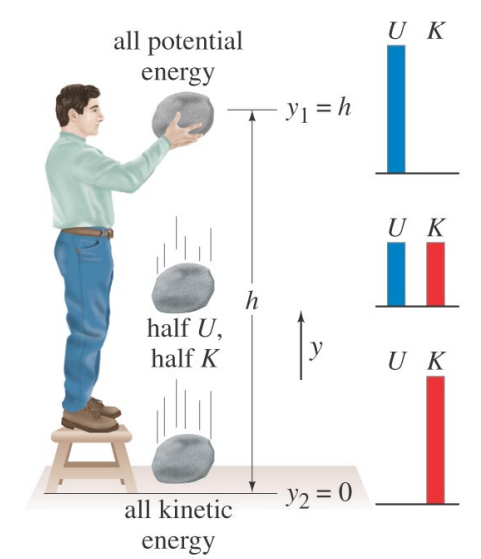
EXAMPLE 1:
Anton and Beth are standing on top of a tall building both holding rocks with the same mass. At the same moment they both throw their rocks with the same speed: Anton throws his at an angle below the horizontal, Beth throws her at an angle above the horizontal. Whose rock hits the ground first and which rock hits with the greater speed? (Ignore air resistance)
- Anton’s rock hits first, but they hit with the same speed.
- Explanation: The mechanical energy of the two rocks immediately after their launch are the same – same height about ground, same speed. Since gravity is a conservative force, the mechanical energy of each rock is conserved. Both rocks have the same gravitational potential energy just before they hit the ground – zero – so they must also have the same kinetic energy. Same kinetic energy and same mass means same speed.
Conservation of Energy
- When we allow for nonconservative forces we find mechanical energy is not conserved.
- ~1800 it was shown mechanical energy could be converted into thermal energy - heat.
- James Joule found the increase in thermal energy of a system matched the decrease in mechanical energy.
- Other forms of energy were found: light, electrical, chemical…
- Finally, Einstein realized that mass was also a form of energy.
- The conservation of mechanical energy was extended to include these other forms of energy.
The total energy is neither increased nor decreased in any process. Energy can be transformed from one form to another, and transferred from one object to another, but the total amount remains constant.
Machines
An ideal machine is a device that changes the work done by one force into the same amount of work done by a different force.
- A lever or pulley is almost an ideal machine
- For a non-ideal (real) machine some of the input work is lost
Consider a machine such as a lever. We apply a force F1 over a distance d1 at one end of the lever. At the other end, a force F2 is exerted on an object over a distance d2.
- If the lever is ideal, then F_1(d_1)=F_2(d_2)
- F1 can be small and d1 large, F2 can be large and d2 small
For a fixed pulley you have to pull on the rope a distance d to move the weight up a distance d. Since the work done is fixed, the force you need to apply is the same as that applied to the weight.
For a movable pulley you have to pull on the rope a distance 2d to move the weight up a distance d. Since the work done is fixed, the force you need to apply is half that applied to the weight.
Efficiency
- No actual machine is ideal, the work we do does not turn into an equal amount of work elsewhere.
- We still gain the mechanical advantage of increasing the applied force, it just isn’t as large as for an ideal machine.
- The efficiency of a machine is the ratio of the amount of useful work done by the machine compared to the amount of work we had to put in.
- Efficiency= useful work done by machine / work put into machine
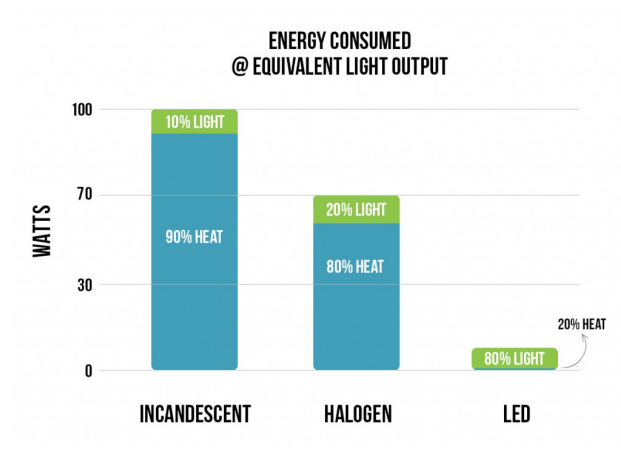
- Lightbulbs are a form of machine – electrical energy is put in, light comes out.
- The efficiency of lightbulbs with the same light output varies with the technology.