AP English Language and Composition
Credits to Fiveable
Unit 1
Claims, Reasoning, Evidence
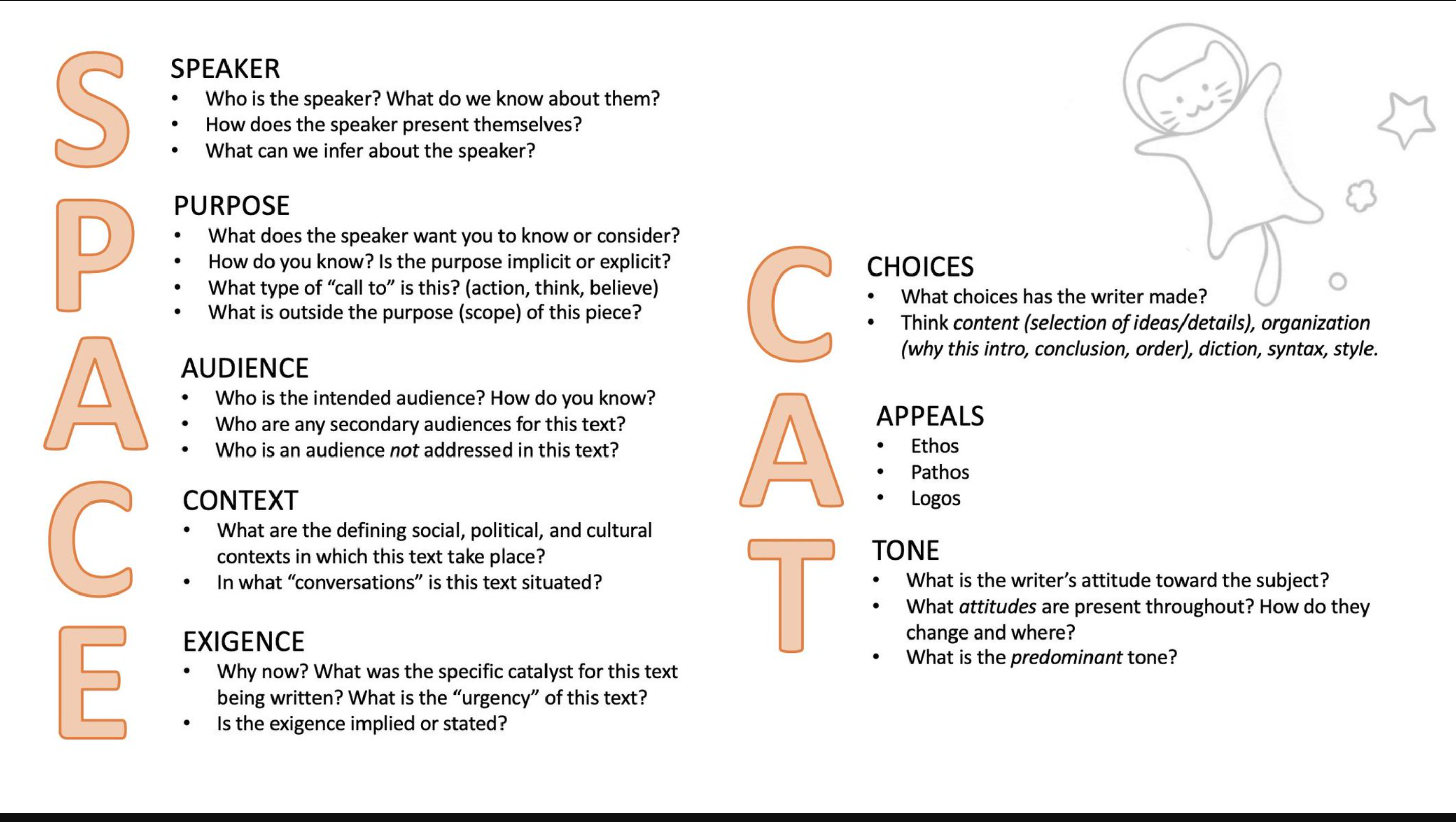
Rhetorical situation: refers to exigence, purpose, audience, writer, context, and message
Exigence: what prompts/inspires the writing
Purpose: refers to the reason or intention behind an action, decision, or creation. It is the driving force that gives meaning and direction to our endeavors.
~ Think of purpose as the compass that guides a ship through stormy seas. Without a clear purpose, we may drift aimlessly and struggle to find our way.
~ Remember to ask yourself "Why did the author write this text?" 🤔
How do we identify the Purpose?
Examine the author's rhetorical choices: Analyze how an author's use of rhetorical strategies, such as appeals to ethos, pathos, and logos, contribute to the overall purpose of the text.
Identify literary devices: Look for the use of literary devices, such as imagery, symbolism, and characterization.
Examine the tone: The tone of a piece of writing can indicate the author's attitude or feelings towards the subject, which can give you a clue as to the purpose.
Identify patterns and themes: Find repetitive patterns and themes in the text.
Intended Audience: refers to the specific group of people for whom a message, speech, or piece of writing is created or targeted. It considers factors such as age, interests, knowledge level, and beliefs in order to effectively communicate with them.
~ Imagine you're planning a surprise party for your best friend. The intended audience would be your friend and all those who will attend the party - people who will appreciate and enjoy what you have planned specifically for them.
Claim: a statement that asserts a position or belief about a particular topic. It serves as the main point or thesis of an argument and requires support from evidence.
~ Imagine you're at a party, and someone makes a bold statement about their favorite movie being the best ever. That statement represents their claim, which they will need to back up with reasons (evidence) if they want others to believe them.
Make sure that the Writer’s position is conveyed through defensible claim(s)- this means it’s not solely fact
Evidence: refers to the information or data that supports a claim or argument. It is used to persuade the audience and make the argument more convincing.
Evidence may include: facts, anecdotes analogies, stats, examples, observations, experiments, etc.
~ Think of evidence as the ingredients in a recipe. Just like how specific ingredients are needed to make a dish delicious, evidence is necessary to make an argument strong and persuasive.
NOTE: Evidence is strategically embedded into writer’s ideas; not just pasted in. Writers need to be able to explain why their evidence is significant/proves their point
How do these two relate?? Evidence can support a claim by providing specific, relevant, and credible information that helps demonstrate the claim's truth or validity and advance an argument.
PARAGRAPH TIME!!!
Each paragraph should follow the AEC structure…
A: An assertion is a statement or claim that is made without providing evidence or proof. It is a declaration of something to be true or real, based on the speaker or writer's belief or understanding. n argumentative writing, assertions are used to present the writer's position on a topic.
E: Evidence refers to any information that is used to support or refute a claim or assertion. It can take many forms such as facts, data, statistics, testimonials, examples, observations, expert opinions, and research studies.
C: The commentary provides a deeper understanding of the subject or text being analyzed. It usually includes the writer's or speaker's own thoughts, insights, and opinions on the topic.
Effective Argument: one that persuades its audience by presenting well-supported claims with logical reasoning, strong evidence, and clear organization. It aims to change minds or influence opinions through compelling communication.
~ Picture an effective argument as a well-built structure. Just like how a sturdy building stands tall due to its solid foundation, walls, and roof, an effective argument convinces others because it has solid reasoning supported by strong evidence.
So now how do I develop a paragraph???
Begin each paragraph with a clear topic sentence that relates to the thesis and previews the main point of the paragraph.
Provide evidence, examples, or anecdotes to support the topic sentence. This evidence should be relevant, credible, and appropriate for the audience and purpose.
Use logical reasoning to connect the evidence to the topic sentence and thesis. This will help strengthen the argument and clarify the connection between the evidence and the overall argument.
Include transition words and phrases to link the paragraphs together and to guide the reader through the argument.
Avoid introducing new information in the conclusion paragraph. Instead, summarize the main points of the argument and restate the thesis.
Finally, proofread and edit your work for grammar, punctuation, and spelling errors. A polished and well-written argument will be more effective in persuading your audience.
Unit 2 and 3
Organizing Information for a Specific Audience and Using sufficient evidence for an argument
Audience: refers to the intended recipients or listeners of a message. It is crucial to consider their characteristics, interests, beliefs, and values when crafting effective communication.
The audience influences the choices writers make in terms of persuasion methods.
Writers attempt to relate to the audience’s emotions/beliefs
~ Think of the audience as a group of friends with different tastes in music. To create a playlist that everyone enjoys, you need to consider their preferences and choose songs that resonate with them collectively.
How do I analyze the audience?
Identify the intended audience: Determine who the writer is trying to reach and what their background, values, and expectations may be.
Evaluate the writer's tone and style: Consider how the writer's tone and style are tailored to their intended audience.
Analyze the language and vocabulary used: Look at the words and phrases used in the text and consider how they might be understood by the intended audience.
Consider the context of the piece: Think about the historical and cultural context in which the piece was written and how that might have influenced the intended audience.
Evaluate the effectiveness of the writer's appeal: Consider how well the writer has addressed the intended audience and whether their message is likely to be received and understood by them.
NOTE: Analyzing the audience is a crucial part of any writing process. When you write, consider who your audience is and how you can revise your work to address them effectively.
What’s the deal with audience and purpose? They seem to be REALLY similar… The audience is the group of people that the writer is trying to reach and persuade, while the purpose is to present a persuasive argument that will be received and understood by that audience.
The audience is the target of the writer's argument and the purpose is to communicate and persuade that audience.
The writer must understand the audience and tailor their argument to be most effective for that audience, in order to achieve the purpose.
Relevant/Strategic Evidence: refers to carefully selected and presented information used strategically in an argument. It involves choosing specific evidence that will have the greatest impact on persuading the audience.
~ Imagine you're playing chess and each piece represents a different type of evidence. Strategic evidence is like using your most powerful pieces strategically at key moments to outmaneuver your opponent and win the game.
Thesis Statement: a clear and concise sentence that presents the main argument or claim of an essay. It serves as a roadmap for the reader, outlining the main points that will be discussed in the essay.
Thesis may be sprinkled throughout the text; if it’s directly expressed, it’s called a thesis statement
~ Think of a thesis statement as the GPS navigation system for your essay. Just like how a GPS guides you to your destination by providing clear directions, a thesis statement guides your reader through your essay by clearly stating what you will be discussing.
Line of Reasoning: refers to the logical progression of ideas or arguments in a piece of writing or speech. It is the way in which evidence and claims are connected to form a coherent and persuasive argument.
~ Think of a line of reasoning as building blocks stacked on top of each other. Each block represents a piece of evidence or claim, and they are carefully arranged to create a strong and stable structure.
How do I identify a line of reasoning?
Look for the main argument or claim: A line of reasoning will typically begin with a statement or claim that the author is trying to prove or disprove.
Identify supporting evidence: A line of reasoning will use evidence to support the main argument or claim. This can include facts, statistics, examples, or expert testimony.
Look for logical connections: The author will often connect the evidence to the main argument or claim using logical reasoning. Look for words such as "therefore," "hence," "as a result," and "thus" which indicate a logical connection between the evidence and the main argument.
Identify counterarguments: A line of reasoning will often address counterarguments or opposing viewpoints. Look for phrases such as "on the other hand," "however," and "nevertheless" which indicate the author is addressing an opposing viewpoint.
Pay attention to the conclusion: The line of reasoning will typically end with a conclusion that summarizes the main argument or claim and the evidence that supports it.
Applying identifying line of reasoning
NOTE: MAKE SURE YOU DON’T HAVE A FLAWED LINE OF REASONING, it can’t have ANY of the following…
Hasty generalization: drawing a broad conclusion based on a small and unrepresentative sample.
False Cause: Assuming that because one thing happens after another, the first must be the cause of the second.
Ad Hominem: attacking the person instead of the argument
Straw man: misrepresenting an opponent's argument in order to make it easier to attack
False Dilemma: presenting only two options when there are more alternatives available.
Basically, NO FALLACIES!!!
How do I combine my Line of Reasoning and thesis?
Refine your thesis statement: Make sure that your thesis statement is clear and concise. It should state the main argument of your essay.
Review your lines of reasoning: Review the lines of reasoning you have developed. Make sure that each line of reasoning supports your thesis statement.
Connect the lines of reasoning to the thesis: Make sure that each line of reasoning is connected to the thesis statement. Use transition words and phrases to connect the lines of reasoning and the thesis statement.
Reiterate the thesis: Reiterate the thesis statement in the conclusion of your essay. This helps to reinforce the connection between the thesis statement and the lines of reasoning.
Evaluate the connection: Evaluate the connection between the thesis statement and the lines of reasoning. Make sure that the connection is clear and that the thesis statement is supported by the lines of reasoning.
EXAMPLE: "The use of plastic bags should be banned because they harm the environment and pose a threat to wildlife."
Here are the lines of reasoning that connect to the thesis statement:
Plastic bags can take hundreds of years to decompose in the environment, causing harm to wildlife and ecosystems.
Plastic bags are a significant source of pollution, affecting air and water quality.
Plastic bags pose a threat to wildlife, as they can be mistaken for food and cause harm or death to animals.
Each of these lines of reasoning supports the thesis statement by providing evidence that plastic bags harm the environment and wildlife. The lines of reasoning are connected to the thesis statement through the use of transition words and phrases, such as "causing harm to wildlife and ecosystems" and "affecting air and water quality." The thesis statement is also reinforced in the conclusion of the essay, where the writer reiterates the argument and emphasizes the importance of banning plastic bags.
Text Sample:
The use of plastic bags has been a controversial issue in recent years, with many people advocating for their ban due to the harm they cause to the environment and wildlife. The thesis statement of this argument is "The use of plastic bags should be banned because they harm the environment and pose a threat to wildlife." This statement is supported by three lines of reasoning. Firstly, plastic bags can take hundreds of years to decompose in the environment, which causes harm to wildlife and ecosystems. Secondly, plastic bags are a significant source of pollution and affect air and water quality. Finally, plastic bags pose a threat to wildlife, as they can be mistaken for food and cause harm or death to animals.
Each of these lines of reasoning provides evidence that plastic bags are harmful to the environment and wildlife, and they are connected to the thesis statement through the use of transition words and phrases. The argument is reinforced in the conclusion, where the writer reiterates the importance of banning plastic bags and emphasizes the harm they cause to the environment and wildlife. The strong connection between the thesis statement and the lines of reasoning makes this argument well-organized and convincing, and it provides a compelling case for banning the use of plastic bags.
Counterargument: opposing viewpoints or arguments that challenge the main claim or thesis statement. They provide alternative perspectives and force writers to address potential weaknesses in their own arguments.
~ Imagine you're playing a video game where you have to defend your castle from enemy attacks. Counterarguments are like those enemy attacks - they come at you with different strategies and try to weaken your defenses. By acknowledging counterarguments and addressing them effectively, you can strengthen your own position.
ALWAYS add evidence that supports your claim, but HOW do you do that???? Use credible sources, analyze the evidence, and consider the relevance to the argument, then we can effectively choose and use sufficient evidence to support our claims and strengthen our essays.
How do I cite?
In the exam for specific essays you will be provided with sources and they will have letters (ex: Source A, Source B, Source C). All you would have to do is put the source letter in parentheses after using the quote.
Sample Text:
Computers in the classroom seems like an innovative, groundbreaking idea, however for the same reasons it would succeed, may also be its blunder. Through technology, teachers have the ability to interact and communicate “like never before.” but in a society where almost every home in America has a household computer and even those pinned as “poor” according to the federal standard have access to the quick convenience of a cell phone, technology integrated into education is not as impressive or exotic to students (Source B).
Citing gives credit to the original author, avoids plagiarism, provides evidence, allows readers to follow up, establishes credibility, and meets academic standards. Overall, it's vital to show the test scorer that you used the sources provided.
Cause and Effect: refers to the relationship between events or actions where one event (the cause) leads to another event (the effect). It explains how and why things happen in a sequence.
~ It’s like a domino chain reaction. When you push the first domino, it causes a chain of falling dominos. Each falling domino is the effect of the previous one being pushed.
Identify the cause: Start by identifying the event or situation that caused something to happen. This could be a historical event, a decision, or a series of events.
Explain the effects: After identifying the cause, explain the effects that followed. These could be short-term or long-term effects, direct or indirect effects, and positive or negative effects.
Provide evidence: To support your argument, provide evidence that supports the cause-effect relationship. This could be data, statistics, expert opinions, or real-life examples.
Use transitional words: To connect the cause and effect, use transitional words such as "as a result," "therefore," "hence," "consequently," and "so."
Show the relationship: Make sure to show the relationship between the cause and effect and explain how the cause led to the effect.
Unit 4 and 5
How writers develop arguments, intros, & conclusions and Bringing it all together
Argument Essay: An argument essay is an essay in which the writer takes a position on a specific issue or topic and supports it with evidence, reasoning, and persuasive techniques.
~ Imagine you're in court presenting your case. In an argument essay, you are like the lawyer defending your client's innocence. You present strong evidence, logical reasoning, and persuasive arguments to convince the jury (readers) of your viewpoint.
STRUCTURE:
Introduction
State your thesis: Your thesis statement should clearly state your position on the issue and provide a roadmap for the rest of your essay. Make sure it is clear, concise, and debatable.
Provide background information: Provide some context for your argument by introducing the topic and explaining its significance. This could involve discussing the history of the issue or outlining the current debate.
Preview your arguments: Preview the main arguments you will make in support of your thesis. This helps to guide the reader through the essay and prepares them for the evidence you will present.
Conclusion
Restate your thesis: Begin your conclusion by restating your thesis statement. This reminds the reader of the main argument and helps to tie the essay together.
Summarize your main points: Provide a brief summary of the main points you made in the body of the essay. This helps to reinforce your argument and remind the reader of the evidence you presented.
Provide a final thought: End the essay with a final thought that leaves the reader with something to consider. This could be a call to action, a suggestion for further research, or a prediction for the future.
Rhetorical Analysis Essay: A rhetorical analysis essay is an essay that examines how an author uses language and rhetoric to persuade or inform their audience. It analyzes the strategies, techniques, and appeals employed by the author to convey their message effectively.
~ Think of a rhetorical analysis essay as dissecting a magic trick. Just like you break down each step of a trick to understand how it's done, in a rhetorical analysis essay, you break down the author's words and techniques to uncover how they create their persuasive or informative effect.
STRUCTURE
Conclusion
Consider the impact of the author's message: In the conclusion, reflect on the impact of the author's message and how effectively it was conveyed to the audience through the use of rhetorical devices.
Evaluate the effectiveness of the rhetoric: Evaluate the effectiveness of the rhetorical devices used by the author to persuade the audience. Discuss the ways in which the author's use of language, tone, and structure enhanced the message.
End with a thought-provoking statement: End the essay with a thought-provoking statement that ties together the main points of the essay and leaves the reader with something to consider. This could be a question, a call to action, or a prediction.
Discuss the relevance of the message: Explain why the author's message is still relevant today and how it can inform our understanding of current issues.
Synthesis Essay: A synthesis essay is a type of essay where the writer combines information from multiple sources to develop a unique perspective on a given topic.
~ Think of a synthesis essay as creating a delicious smoothie. You gather different fruits (sources) and blend them together to create a new and flavorful drink (your unique perspective).
STRUCTURE
Introduction
Begin with an attention-grabbing statement: The introduction should capture the reader's attention and create interest in the topic. An attention-grabbing statement could be a surprising fact or statistic, a provocative question, or a relevant quote.
Provide background information: After grabbing the reader's attention, the student should provide some context and background information on the topic. This information should help the reader understand the topic and its significance.
Introduce the prompt and claim: The student should introduce the prompt and the claim provided in the prompt. This will help the reader understand the focus of the essay and what the student is expected to do.
State the thesis: The student should state their thesis, which is their position on the topic and the main argument of the essay. The thesis should be clear, concise, and specific.
Provide an overview of the essay: Finally, the student should provide an overview of the essay, outlining the main points that will be covered in the body paragraphs
Conclusion
Restate the thesis: The conclusion should begin by restating the thesis statement in a new way. This reminds the reader of the main argument of the essay.
Summarize the main points: The student should summarize the main points of the essay. This should be done in a concise and clear manner, highlighting the key ideas that support the thesis.
Provide a final thought: The conclusion should end with a final thought on the topic. This could be a call to action, a prediction, a recommendation, or a reflection. It should leave the reader with something to think about.
End with a closing statement: The conclusion should end with a strong closing statement that brings the essay to a satisfying end. This could be a memorable quote or a statement that emphasizes the main point of the essay.
Comparison-contrast method: analyze categories of comparison
Definition/description method: relates details of something using examples/illustrations
NOTE:
Introduction may include evidence to draw the audience in
Conclusion may summarize evidence and argument in order to leave the reader thinking and potentially acting
Descriptive words (adj. and adv.) can be strategically chosen in order to convey writer’s perspective; keeping in mind what’s most convincing
Transitional elements: words/phrases/clauses that show relationships between ideas
Unit 6, 7, 8, and 9
Perspective, Arguments, Style, Complexity
Tone: refers to the author's attitude or feelings towards the subject matter of a text. It sets the overall mood and atmosphere of a piece of writing.
~ Think of tone as the musical soundtrack that accompanies a movie. Just like how different soundtracks can evoke different emotions in viewers, the tone in writing can create various emotional responses in readers.
Position ≠ perspective: writers may share the same position but approach the topic from different background and specific opinions
Writers need to consider the credibility of their sources, as doubtful sources may detract from their argument
Only the most relevant information should be incorporated into a writer’s argument
Understanding Arguments
Components of an argument: claim, evidence, reasoning, and counterargument
Different types of arguments: deductive, inductive, and causal
Rhetorical appeals: ethos, logos, and pathos
Know the role of ethos, logos, and pathos in persuasive writing
Simile: figure of speech that compares two different ideas or things that are similar in some way using the words “like” or “as.”
Example: Her happiness shone like sunshine to her friend.
Metaphor: figure of speech that makes a comparison between two unrelated things or ideas without using the words “like” or “as.” The goal is to make the reader look at one thing in a new way.
Example: King Lear was a storm, raging and tumultuous one moment, and then strangely serene the next.
Analogy: a type of reasoning that compares one concept to another based on similarities. It can make an unfamiliar idea easier to understand by providing a comparison that people can relate to.
Example: Handwriting is like a bridge that connects thoughts and ideas to the physical world. By teaching handwriting in school, we are giving students the tools they need to turn their ideas into tangible creations.
Anecdote: short story or humorous account of an incident, typically one that is personal or biographical in nature. Anecdotes often involve a witty remark or amusing observation of human behavior and are usually based on real events.
Example: Once, when King Lear had been ruling for many years, he decided to divide his kingdom among his three daughters. His youngest daughter, Cordelia, refused to flatter her father as her sisters did and instead spoke honestly about the love she had for him. In a fit of rage, King Lear disowned her and banished her from his kingdom.
Syntax: refers to the arrangement of words and phrases in a sentence or language. It focuses on the rules governing word order, sentence structure, punctuation, and grammar.
~ Imagine syntax as following a recipe for baking cookies. Just like how you need to follow specific steps in order (mixing ingredients before baking), syntax requires arranging words according to grammatical rules (subject before verb) so that your sentences make sense.
Diction: refers to the choice of words and phrases in writing or speech. It is the deliberate selection and arrangement of words to convey a specific meaning or tone.
~ Think of diction as choosing ingredients for a recipe. Just like different ingredients can create different flavors, the choice of words in writing can create different tones and meanings
How to get that complexity point?
Concession:
FRQ 1 (the synthesis essay) of the AP exam would be a great place to concede, given that you are given multiple sources that offer varying perspectives. After using the sources that are in favor of your argument, take inventory of the remaining sources. Are there any that you acknowledge the strength of? Maybe you thought to yourself “Darn, that source entirely goes against my argument.” Do any of them offer points that are difficult/impossible to refute? If so, a concession could be fitting.
Begin by restating the opposing argument and bring up the source that relates to it. You can then choose to express agreement or acceptance of their argument. You can even refer to your own argument and acknowledge that the opposing source refutes it.
Rebuttal:
Contrary to a concession, you could use a rebuttal when you do know how to attack the opposing argument. If you saw an opposing source and immediately thought “I can actually use this for my own argument,” a rebuttal is the move.
Again, bring up the opposing argument and source. Then, offer your own view of the source. Maybe there’s a particular detail about it that weakens it, or there’s a phrase within it that is actually supportive of your argument. Look carefully! You may be able to find a valuable quote.
Refutation:
Refutation is probably the most extreme writing technique of the three to employ in your essay. It requires you to be able to solidly state and justify why an opposing claim is false. This may require background knowledge of a topic or an amazing ability to nitpick and expose flaws.
You should first restate the opposing argument in your own words, then identify the flaw in their argument. After this, provide evidence that refutes their argument and explain why the evidence disproves their point (an explanation is crucial!). This will weaken the opposing argument and show the reader your critical analysis skills.