CELLS
Cells — one-sentence overview
Cells are the fundamental units of life: they maintain internal order, carry genetic information, harvest and use energy, communicate with other cells, and—through different structures and specializations—make up all living organisms.
3.1 Cells Are the Units of Life
Core idea: Cell theory — (1) all living things are made of cells, (2) the cell is the smallest unit of life, and (3) all cells arise from preexisting cells. Historical contributors: Schleiden, Schwann, Virchow.
Levels of biological organization: cells → tissues → organs → organ systems → organisms.
Methods that established cell theory: microscopy, cell staining, and modern molecular methods (DNA sequencing, live-cell imaging).
3.2 Different Cell Types Characterize Life’s Three Domains
Three domains: Bacteria, Archaea (both prokaryotes), and Eukarya (eukaryotes).
Prokaryote vs. eukaryote — main differences:
Prokaryotes: no membrane-bound nucleus, usually unicellular, circular chromosome, 70S ribosomes, often cell wall (peptidoglycan in bacteria).
Eukaryotes: membrane-bound nucleus, linear chromosomes, membrane-bound organelles (mitochondria, ER, Golgi), 80S ribosomes, can be unicellular or multicellular.
🔵 Type | 🟢 Key features |
|---|---|
Prokaryote | No nucleus; small; single circular chromosome; simple internal structure |
Eukaryote | Nucleus; organelles compartmentalize tasks; larger; complex cytoskeleton |
Functional implication: compartmentalization in eukaryotes allows greater specialization and regulation of metabolic pathways.
3.3 A Membrane Separates Each Cell from Its Surroundings
Transport proteins, Enzymes, Recognition proteins, Adhesion & Receptor proteins.
Plasma membrane structure: phospholipid bilayer with embedded proteins (fluid mosaic model), cholesterol (in animal cells) modulates fluidity.
Membrane functions: selective barrier, site of signaling (receptors), transport control, and cell identity (glycoproteins/lipids).
Transport mechanisms:
Passive: diffusion, osmosis, facilitated diffusion (no energy).
Active: primary (pumps like Na+/K+ ATPase) and secondary active transport (use of ion gradients).
Bulk transport: endocytosis (phagocytosis, pinocytosis, receptor-mediated) and exocytosis.
Osmotic scenarios: isotonic, hypotonic (cell swelling), hypertonic (cell shrinkage) — important in physiology and lab work.
3.4 Eukaryotic Organelles Divide Labor
Ribosomes: Sites of protein synthesis, either free in the cytoplasm or attached to the endoplasmic reticulum.
Endoplasmic Reticulum (ER): Rough ER is involved in protein synthesis and modification, while Smooth ER is responsible for lipid synthesis and detoxification processes.
Golgi Apparatus: Functions in the modification, sorting, and packaging of proteins and lipids for secretion or delivery to other organelles. This is where the proteins complete their intricate folding and become functional.
Cytosol - A watery mixture of ions, enzymes, RNA, and other dissolved substances found in the cytoplasm.
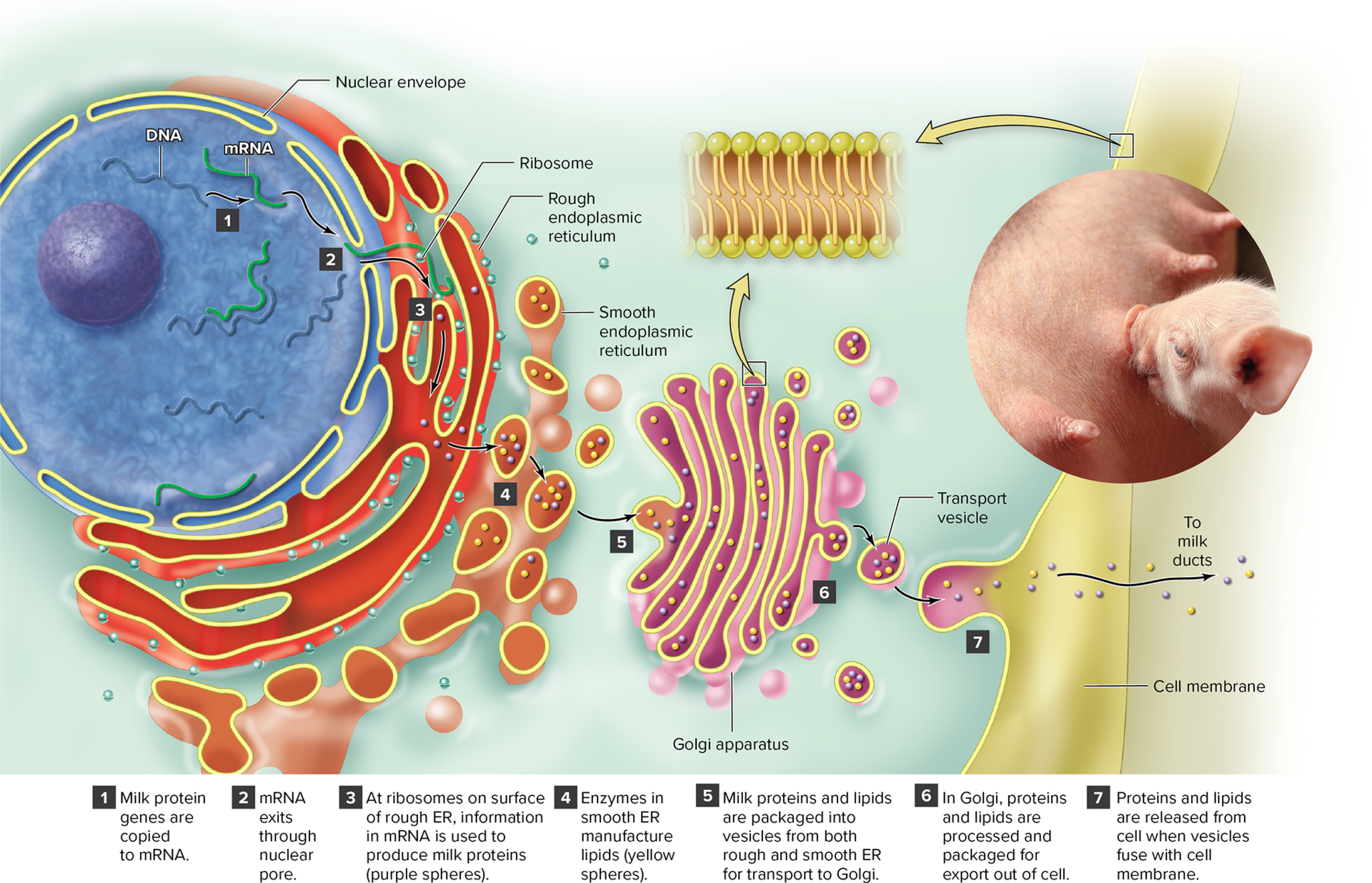
Nucleus: genome storage, transcription, and nuclear pores regulate traffic.
Lysosomes - Organelles that contain digestive enzymes to break down waste materials, captured bacteria, debris, and macromolecules, playing a crucial role in cellular maintenance.
1) white blood cells contain the greatest number of lysosomes.
2) It contains hydrolytic enzymes

Energy organelles: mitochondria (cellular respiration → ATP; have own DNA) and chloroplasts (photosynthesis in plants/algae; own DNA) — evidence for endosymbiosis.
Vacuoles are membrane-bound cellular organelles that perform diverse functions including storage of water, nutrients, and waste, as well as turgor pressure maintenance, which supports plant structure storage of water, nutrients, and waste, as well as turgor pressure maintenance, which supports plant structure.
Other organelles:
Peroxisomes (oxidative metabolism) originat at the ER, they help dismantle toxins from the blood in the liver and kidneys.
Vacuoles (storage in plants) - Stores salts, sugar, pigments, and contains enzymes that recycle and degrade molecules, and expands to exert turgor pressure.
Practical note: secretory cells (e.g., pancreas) have extensive RER and Golgi.
3.5 The Cytoskeleton Supports Eukaryotic Cells
Main components and functions:
Microfilaments (actin): cell shape, movement (muscle contraction, amoeboid motion), cytokinesis.
Intermediate filaments: mechanical strength, structural integrity.
Microtubules (tubulin): intracellular transport (motor proteins like kinesin/dynein), form mitotic spindle, cilia/flagella structure.
Dynamic assembly and disassembly enable shape change and intracellular trafficking.
3.6 Cells Stick Together and Communicate with One Another

Cell junctions (animal cells): tight junctions (seal), Anchoring (adhesion), gap junctions (allow exchange of substances).
Plant cell connections: plasmodesmata (cytoplasmic channels through cell walls).
Cell signaling overview: signal —> receptor (surface or intracellular) —> signal transduction (second messengers like cAMP, Ca2+) —> cellular response (gene expression, metabolic changes).
Types of signaling: autocrine, paracrine, endocrine (hormones), and synaptic (neurons).
Investigating Life: 3.7 “The Tiniest Compass” (likely example)
Likely refers to magnetotactic bacteria or magnetosome organelles that orient along magnetic fields.
Key takeaways: specialized intracellular structures can give microbes remarkable behaviors; used as an example of structure→function and experimental investigation.
Chapter summary — essential takeaways
Understand cell theory and the difference between prokaryotic and eukaryotic organization.
Know major organelles, their functions, and how compartmentalization enables cellular complexity.
Master membrane structure and transport types, and the physiological consequences of osmosis.
Remember cytoskeleton roles in structure and movement, and how cells adhere and signal to coordinate multicellular life.
Quick study flashcards (8)
1) Q: 3 parts of cell theory? A: Made of cells; smallest unit; arise from preexisting cells.
2) Q: Organelle that makes ATP? A: Mitochondrion.
3) Q: Fluid mosaic refers to? A: Membrane of lipids and proteins that move laterally.
4) Q: Active vs passive transport? A: Active uses ATP/energy; passive does not.
5) Q: Microtubule motor proteins? A: Kinesin (toward plus end) and dynein (toward minus end).
6) Q: Golgi function? A: Modify/package proteins and lipids.
7) Q: Plasmodesmata vs gap junctions? A: Plant vs animal direct cell-to-cell channels.
8) Q: Evidence for endosymbiosis? A: Mitochondria/chloroplasts have double membranes and their own DNA.
Pros, cons, and caveats
Pro: This structure-focused approach links form to function — great for remembering what organelles do.
Con: High-level summaries gloss over molecular detail (e.g., specific transporter mechanisms, signaling cascades).
Caveat: Some organisms blur categories (e.g., large bacteria, organelle reduction in parasites). Always tie vocabulary to examples.
Where do you want to go from here? I can (pick one): create a 1-page study sheet, produce labeled diagrams for plant/animal cells, generate 20 practice multiple-choice questions, or condense this to 2–3 paragraph notes for quick review.