Bio Test 3
Cellular respiration pt1- 2
Cellular Respiration
All the metabolic reactions that a cell uses to get energy from organic molecules, while releasing waste; cellular energy
it is an aerobic reaction which means it uses O2
it releases CO2 waste via the oxidation of orgnic molecules
Glucose + Oxygen → Carbon Dioxide + water
C6H12O6 + 6O2 → 6CO2 + 6H2O
Redox reaction
exergonic reaction
Some is lost as heat, but most of that energy will be utilized
ATP
NADH
FADH2
Steps in Cellular Respiration
Glycolysis → Pyruvate
releasing free energy as NADH and ATP
Breakdown of pyruvate → Acetyl-CoA (cytosol)
Citric acid cycle (this is in the mitochondria)
this releases CO2, ATP, NADH, FADH2
Electron transfer
oxidative Phosphorylation
produces the most ATP
Glycolysis
Glucose (6-C) becomes metabolized to form 2 pyruvate (3-C) molecules in the cytosol, utilizing ATP
this process releases a net energy of 2 ATP and 2 NADH molecules
ATP at this stage is formed by substrate-level phosphorylation, directly transferring a phosphate from a phosphorylated organic molecule to ADP

Breakdown of Pyruvate Overview
Two pyruvate molecules formed from glycolysis enter the mitochondrial matrix
once inside, pyruvate is broken down to an acetyle group (2-C) and one CO2
Each o=pyruvate brokken down produces 1 NADH molecule by the reduction of the NAD
Citric Acid Cycle Overview
Each acetyl group produced from the breakdown of pyruvate is incorporated into an organic molecule, which is larer oxidized to from 2 CO2 molecules
during the cycle 1 ATP, 3 NAdh and 1 FADH2 molecule is made per acetyl group
since there is 2 acetyl groups one cycle produces 2 atp, 6 nadh, and 2 fadh2 molecules
Oxidative Phosphorylation overview (electron transfer)
NADH and FADH2 made in the first 3 steps contain high energy electrons and can be readily transferred into a redox reaction to other molecules
once high energy electrons are removed energy is released and through a =n electron tranport chain energy is used to produce H+ electrchemical gradient
like photsynthesis, chemiosmosis utilizes stored energy in the H+ electrochemical gradient to synthesize ATP
this produces 30-34 atp molecules
Glycolysis part 2 (deeper dive)
involves the metabolism of glucose into two pyruvate molecules which can occur in the presence or absence of O2
glycolysis is characterized as a 10-step pathway with different enzymes at each step, a common pathway across bacteria, archaea and eukaryotes
the 10-steps of this pathway can be lumped into 3 phases:
Energy investment phase (1-3)
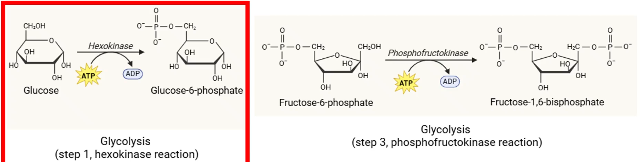
phosphates from 2 atp molecules attach to glucose, then convert to fructose-1, 6-biphosphate. the phase raises the free energy of glucose allowing future reactions to be exergonic
1,glucose becomes phosphorylated utilizing ATP, (ATP-ADP)
2-3, structure rearrangements lead to production of fructose-6-phosphate and further to fructose-1,6-biphosphate
Cleavage phase (4-5)
fructose -1,6-biphosphate is cleaved into 2 glyceraldehyde-3-phospate (G3P) molecules
4, fructose-1,6-biphosphate cleaves into G3P and dihydroxyacetone phosphate
5, Dihydroxyacetone is rearranged to form another G3P
energy liberation phase (6-10)
produce 4 ATP, 2 NADPH and 2 pyruvate molecules. since the energy investment phase used 2 ATP, the net yield is 2 ATP molecules
6-10:

Glucose to a G3P and then G3P through a variety of redox reactions and unstable phosphorylation to becoming 2 pyruvate via 1glucose
Regulation of Glycolysis
availability of substrates
the enzyme phsphofruktinase which catalyzes step 3, which is believed to be the rate limiting step
ATP itself can lead to feeback inhibition at high concentrations, binding to phosphofruktinase and inactivating the enzyme
Breakdown of Pyruvate
pyruvate is tranported from the cytosol into the mitochondria matrix by a transport protein
once pyruvate is trandported through an outer membrane channel and inner membrane channel (H+ active tranport) into the mitochondria matrix is oxidized or broken down by pyruvate dehydrogenase
CO2 is removed from pyruvate
2 high energy electrons are removed from pyruvate and transferred to NAD+ with H+ produces NADH
5. Remaining acetyl is attached to coenzyme coa and organic molecule which produces acetly coa, via covalent bond to sulfur


Cellular Respiration pt 3
ATP Synthase


ATP production
H+ enters one at a time through a cahnnel in the a subunit and binds to c subunit
An adhacent H+ bound to a c subunit is released and travels through a channel in the a subunit
The binding and releasing of a H+ in the c subunit leads to a clockwise
rotation. The y and δ subunits rotate with the c subunit as well.
rotation of y changes its contact with the 3 b subunits, causing the b subunit to change their structure
Structural Changes of B Subunits
Conformation 1. ADP and P bind with good affinity
Conformation 2: ADP and P bind tightly, strainging bonds to form ATP
conformation 3. ATP binds weakly and is released, cycle is continued
Diet and Cellular Respiration
2 main sources of cellular respiration are proteins and fats
variations in diets can lead to dramatic changes in metabolism